Jologs, On Purpose
A word, a sock, and the newest cargo to pass through the oldest trading port in the Philippines
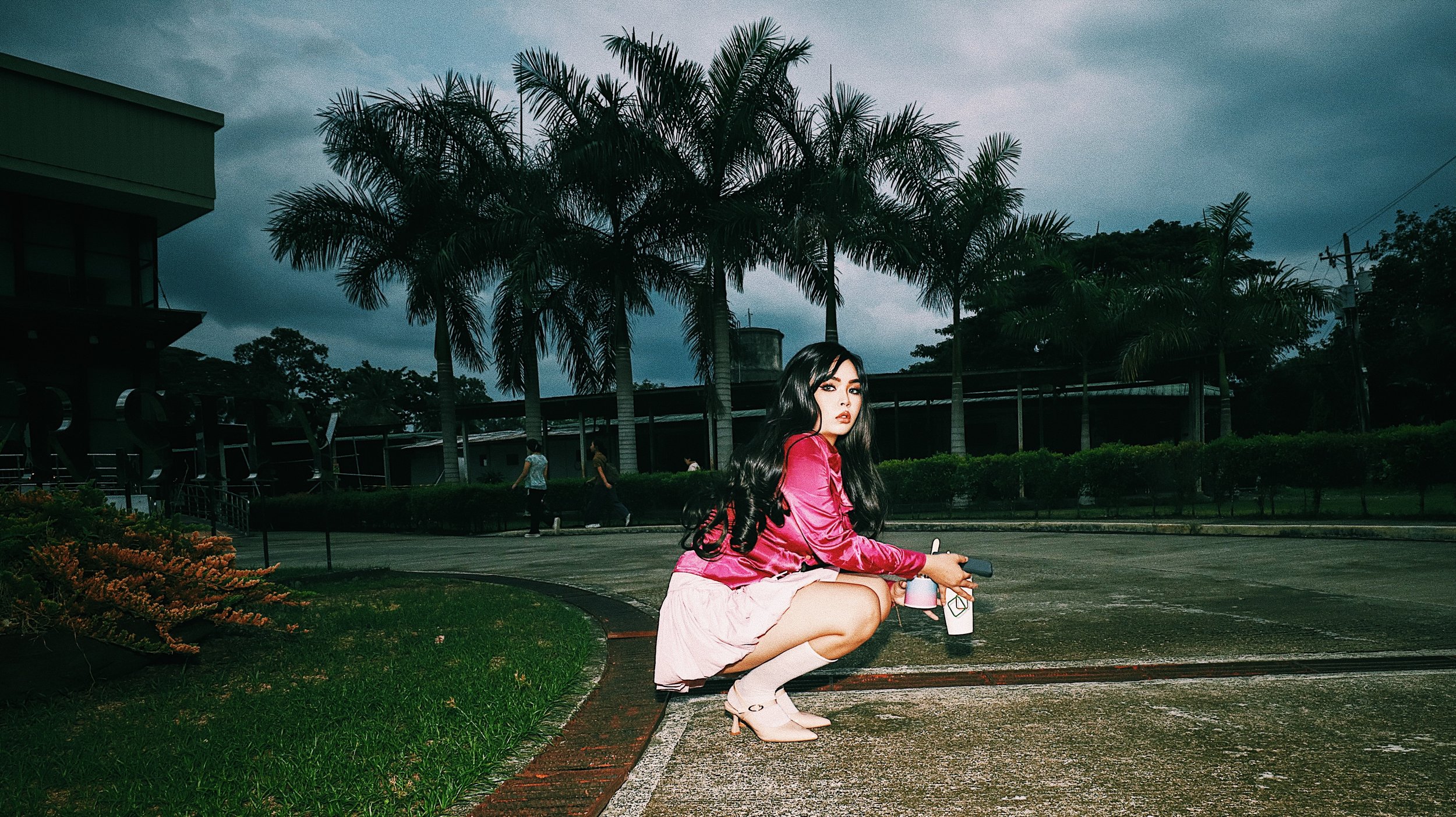
Junen (@sleepy_miming), Butuan City, Philippines.
A Long Way from Manila
Butuan City sits on the Agusan River in Mindanao, in the southern Philippines — a regional capital of roughly 370,000 people, and the historic seat of the Rajahnate of Butuan, a pre-colonial kingdom that traded gold and boats with Song Dynasty China, Champa, and the Bengal coast a thousand years before Spanish contact. It's also, more prosaically, a university town: home to Caraga State University, and to BAKSU.
Mindanao itself is worth placing plainly: it's the Philippines' second-largest island, home to roughly 27 million people across six regions of its own — not a remote outpost, but a major landmass that simply doesn't function as the country's center of gravity. That center sits a thousand kilometers north, on the island of Luzon, where Manila is.
Not being in Manila matters here. Manila is where Philippine media, retail, and cultural trends actually get made and distributed — it's roughly 800 kilometers from Butuan, a 90-minute flight or the better part of two days by boat. Whatever reaches Mindanao has already been filtered once, through Manila's own version of what's current, before it gets filtered again through Seoul, K-dramas, and a girl group's Instagram. Butuan isn't provincial in the sense of being cut off. It's provincial in the more specific sense of receiving everything secondhand — and building something new out of it anyway.
If you want a rough American shorthand for where that places it socially: call it the Kentucky of the Philippines — agricultural, working-class, a long way from the capital in more than kilometers, the kind of place a country's own cultural gatekeepers are prone to writing off. Which is worth holding onto, because it's the same condescension baked into the word this piece is named after. Jologs didn't start out meaning "wore the wrong socks." It started out, more or less, meaning "poor" — a term for someone from a squatter area before it ever became a term for someone's outfit. The insult a body risks here and the insult a whole region risks nationally are, structurally, the same insult.
Say Nothing, Watch Everybody
On the first day, the instruction was deliberately thin: dress in a way you understand as Korean style. That's the whole prompt — the same minimal one used across the earlier Vietnam and Indonesia fieldwork. No moodboard, no reference images, no conversation beforehand about what "Korean" might mean here.
Ten members of BAKSU — Caraga State University's self-organized, self-taught Korean pop-culture club — showed up to meet us on campus that morning having never seen us, spoken to us, or been briefed by us in any way.
BAKSU's full name is the Benevolent Adherents of KPOP Student Union. Not "fans." Not "club." Adherents — the word you'd use for a religious order, not a hobby group. Nobody workshopped that name to sound cool. It sounds exactly like what it is: a group of college students who decided, completely straight-faced, to organize their own devotion formally. That's worth sitting with before anything else in this piece, because it's a small preview of the whole argument — commitment worn without irony, in a place that has a very specific word for what happens when that goes wrong.
We'd never met a single one of them either. That's not an incidental detail. It's the entire method. Photo-sartorial elicitation works by keeping the prompt as close to nothing as possible and letting the body answer instead — because what someone reaches for under a minimal prompt, with no time to think it through or check their answer against anyone else's, is about as close as you get to unmediated evidence of what "Korean style" has actually become in someone's head, built entirely from screens rather than any direct contact with Korea itself.
We shot them not where we found them, but where they let us. This was their space — campus buildings, administrative offices, the ordinary outdoor walkways between classes. That was their territory, not a backdrop we happened to wander into. No studio, no controlled setup. Just an ordinary day on their own ground, with ten students who'd each decided, alone, what "dressed like Korean style" meant.
Junen was one of them.
The Word for Getting It Wrong
jologs (n., adj.)
/ˈdʒoʊ-lɒgz/ — Filipino slang
tacky; unrefined; low-class; out of fashion; trying too hard.
The word Filipinos reach for the moment someone gets it wrong.
Here's a photo that could get you called that — the one at the top of this piece.
Except it isn't “wrong.” It's Korean.
It also isn't as candid as it looks. We were walking the campus together, shooting as we went, and what reads like a stolen, off-guard moment is closer to the opposite: she has enough command of the genre to build "caught off guard" on request, without breaking stride. The photo isn't documenting an accident. It's documenting a skill — the same kind of tacit, embodied competence this whole piece keeps finding, just aimed at a camera instead of a closet.
Here's a second photo — same day, taken maybe thirty minutes apart — genuinely her first day, before either of us had said a word about interviews, or socks, or anything else.s
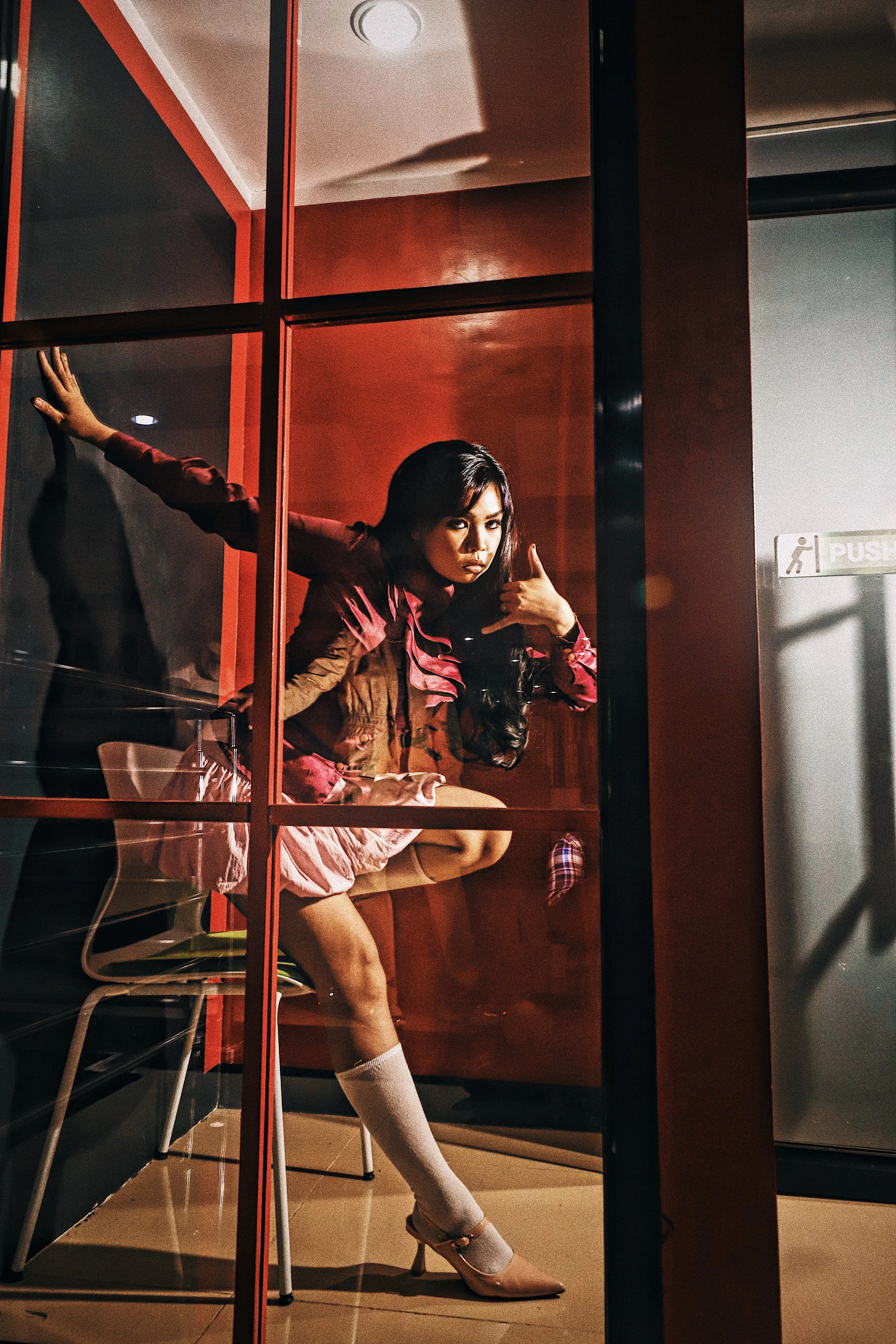
Junen's first PSE response — the day she met the rest of BAKSU, before this was a study.
Same silhouette. Same instinct. Nobody had to teach her this one.
The Machine Guessed First
Here's where it gets strange. Weeks before any of this happened, before a single flight was booked, we built a recruitment flyer for the trip — the kind of thing you post to pull students in. It needed an image. We asked an AI image generator to imagine, cold, no fieldwork, no data, just guess: what does "Korean style" look like?
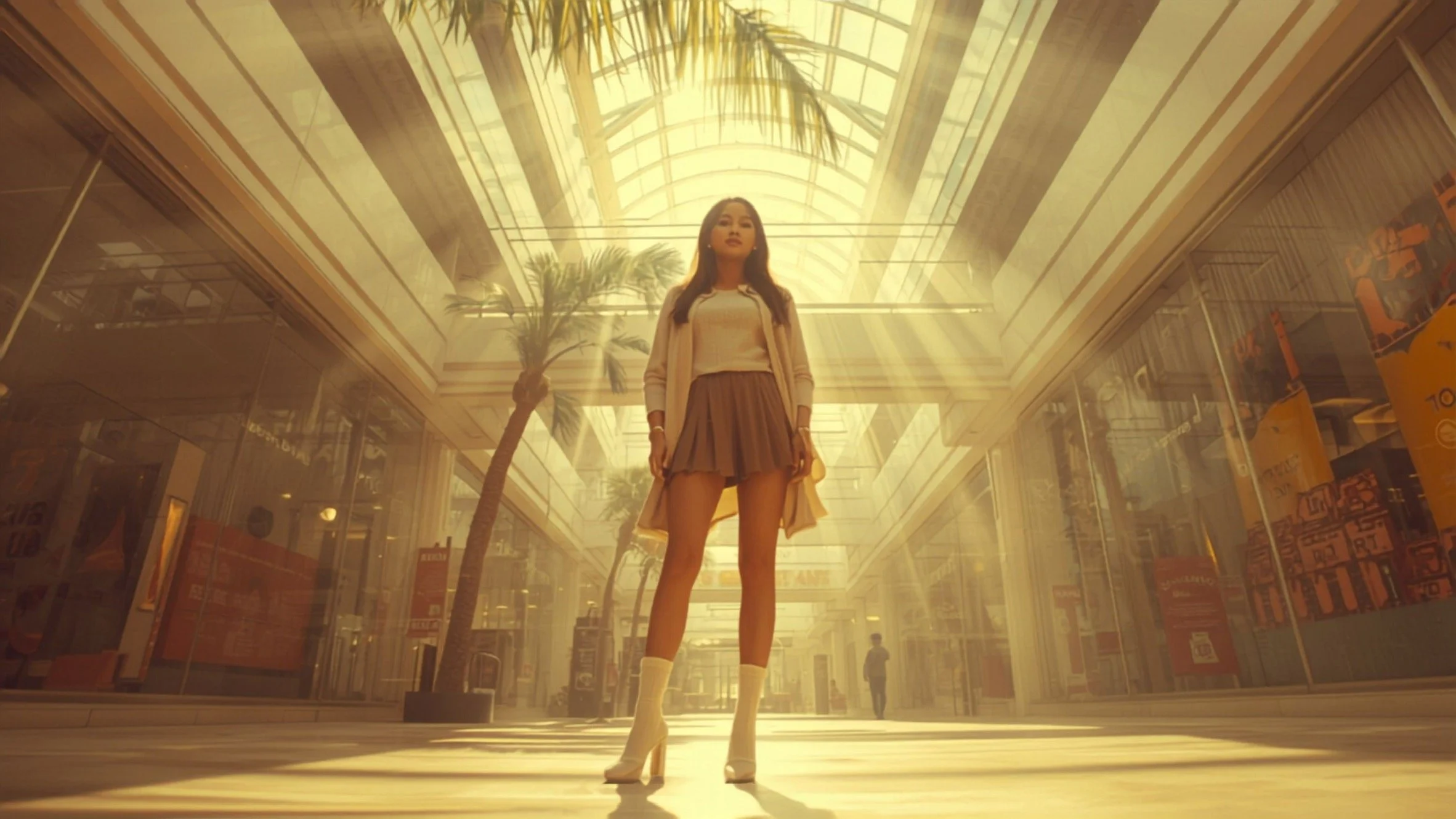
A Canva-generated flyer illustration, "What's Your Idea of Korean Style?", resulting in a generated model in thin, white socks and heels.
White socks. Heels. The exact silhouette.
Maybe that's uncanny. Maybe it's less romantic than that — maybe an image model trained on a decade of K-pop photo dumps has simply absorbed the same stereotype we were about to go test in person, and got there the boring way. Both readings are worth sitting with. Either way, the machine guessed it blind, and then a real 21-year-old walked through a door wearing it, unprompted, before she'd said a single word to us about why.
Something else about that flyer image is worth flagging, because it turns out to be a decent monument to a supposition the whole project had been quietly carrying. The larger design runs Seoul into Hanoi on one leg and, on this one, Kyoto into Butuan — and somewhere in planning both, an assumption got baked in without anyone quite deciding it on purpose: that the likeliest place to actually find "Korean style" on the ground would be a shopping mall. It's an easy assumption to reach for. Malls are where teenagers gather, where commerce clusters, where anything imported eventually shows up on a rack.
It didn't hold up here. SM Mall — no relation to SM Entertainment, despite the shared initials — turned out to have very little of the Korean dressing scene we'd gone looking for. If it shows up there at all, it's probably tied to the mall's own scheduled K-pop events, and a check beforehand turned up none happening during the window we were actually on the ground.
That's close to a repeat of something that already happened once, in Indonesia. The working theory going into Yogyakarta was that the stylistically transgressive kids would cluster at Malioboro, the city's main commercial street, on the specious logic that "cool" or "deviant" youth congregate in visible public commercial space, and anything Korean-influenced would fall inside that same set. That supposition turned out wrong there too.
Both miss the point at the same thing: how little actual cultural knowledge the general public — even the people standing closest to the phenomenon — has about what specifically counts as a Korean space or practice. The two commercial spots flagged going in as possibly or actually Korean-coded, Samjang and Sam's 2D, weren't known to the college administrators and faculty we were working alongside. And when we went to check them ourselves, they'd either stopped being Korean-themed in any real sense, or had simply lost whatever popularity they once had.
The AI-generated flyer image is a decent stand-in for that whole cluster of assumptions. It isn't just a stereotype about socks and heels. It's a guess built on the same aggregate folk theory the project itself was carrying — that this kind of thing lives in a mall — a theory that turned out to be at least partly wrong twice, in two different countries, before the fieldwork ever corrected it.
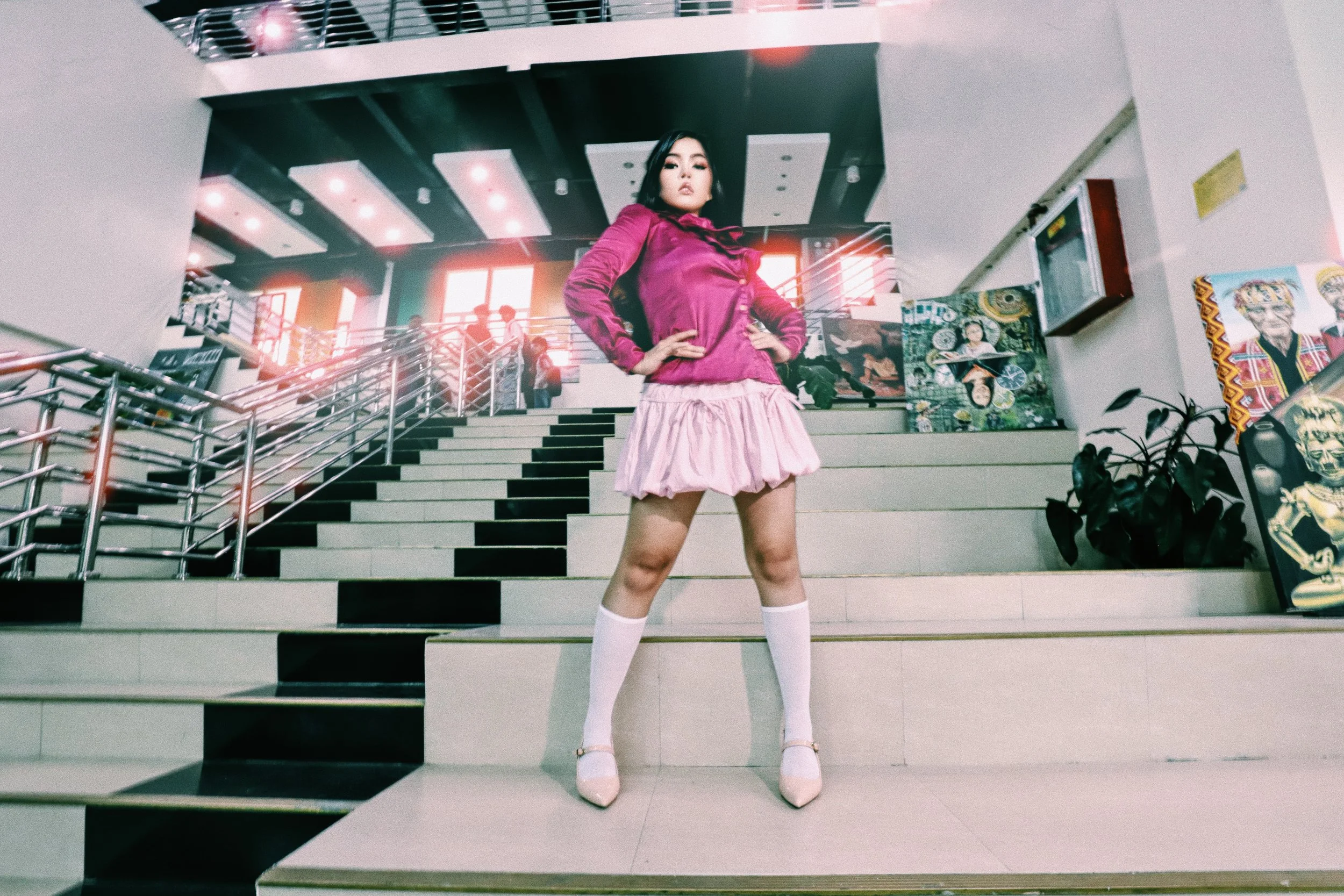
Junen, a real human and Korean culture aficionado, arrived at the same conclusion as the AI image did, perhaps by channeling, interpreting, and interpolating, the same mimetic codes and coming to a similar sartorial conclusion.
She got to the words the next day.
The Benevolent Adherents
BAKSU is the best thing that could have happened to this project, and not because they were easy. Nobody handed them a curriculum. A group of students decided on their own to organize around a shared obsession and teach themselves how to do it well. Then they showed up to be photographed by strangers, dressed in their own idea of a country they know only through screens, and took a one-line prompt (“Dress in your idea of Korean style.”) seriously enough to produce ten different answers. That's generosity and nerve in roughly equal parts.
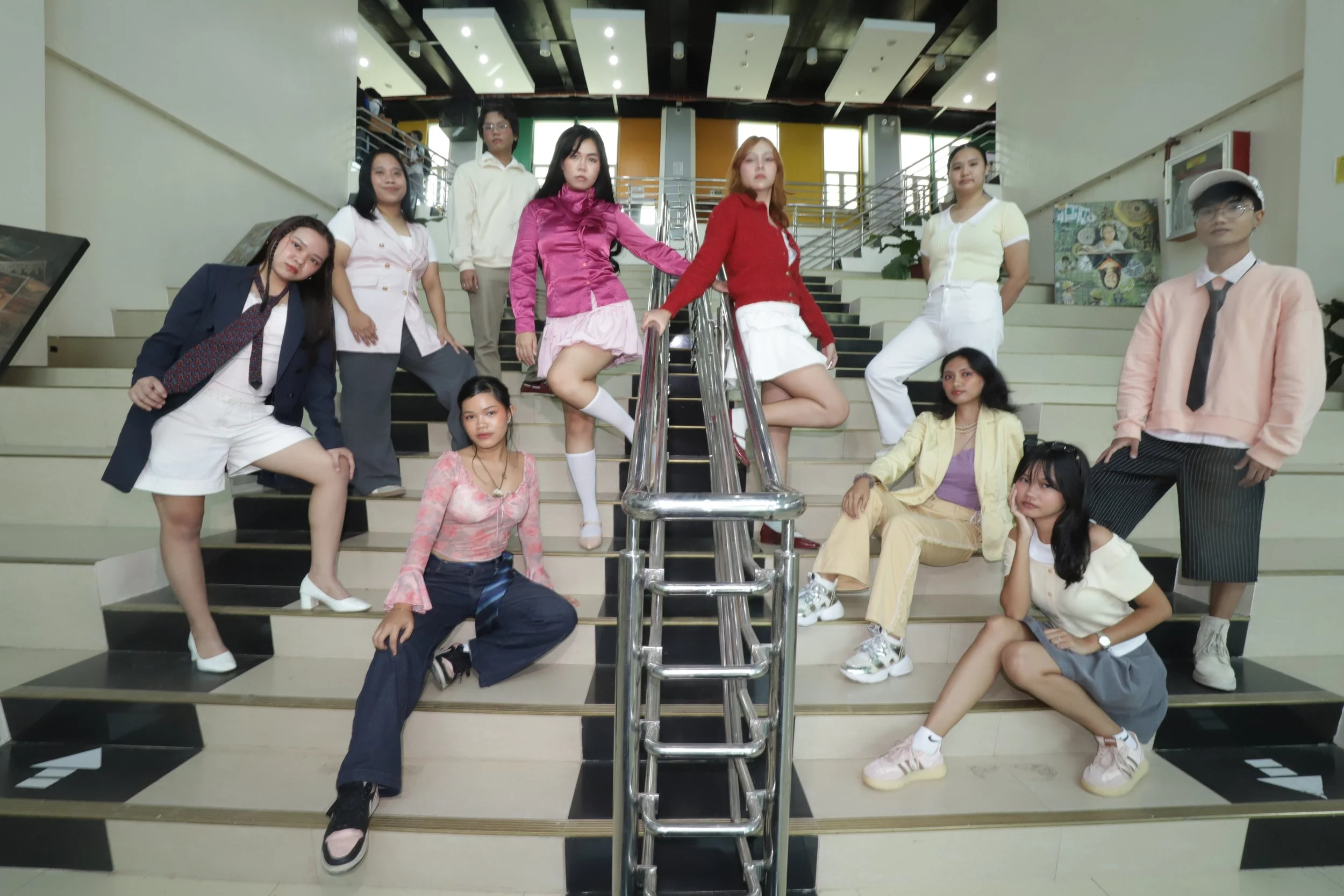
Korea style in Butuan City, Caraga State University student style.
Junen, in the white socks and pink, shiny top, didn't have the English word for jologs in that quote above. Somebody else in the study did. Clare — another BAKSU style lead, interviewed that same week, amd seated in the bottom ro wearing Nike socks and Adidas sneakers with the grey tennis skirt — didn't hesitate when asked what to call it: jologs. Her own gloss landed just as sharp: "an insult term for gangster style."
That's the whole theory of how Korean fashion actually spreads, sitting in a pair of socks. Ask any of the nine students we talked to what "Korean style" means, and almost none of them describe a garment. They describe a permission slip — combine what shouldn't be combined, wear the wrong thing on purpose, risk exactly the insult that word carries, and don't flinch. One put it plainly: Korean fashion "doesn't give a care about what they say." That's not a description of clothes. That's a description of nerve.
The reference point for that permission slip, it turns out, isn't a single look at all. Ask what "Korean style" is modeled on and you rarely get a photo back. Junen own answer ran through TWICE — nine members cycling through a different concept every comeback — because, in her words, a group like that hands you "many expos for your passion." Not a style to copy. A whole range to draw from. What's traveling here isn't one silhouette; it's license to pick from a rotating cast wide enough that almost anything can plausibly count as citing it
The Professional
Shayne put the underlying logic more plainly than anyone else in the sample. Ask her what "Korean style" actually means and she doesn't reach for a designer or a color palette — she reaches for a verb.
"Mix and match... a lot of styles into one."
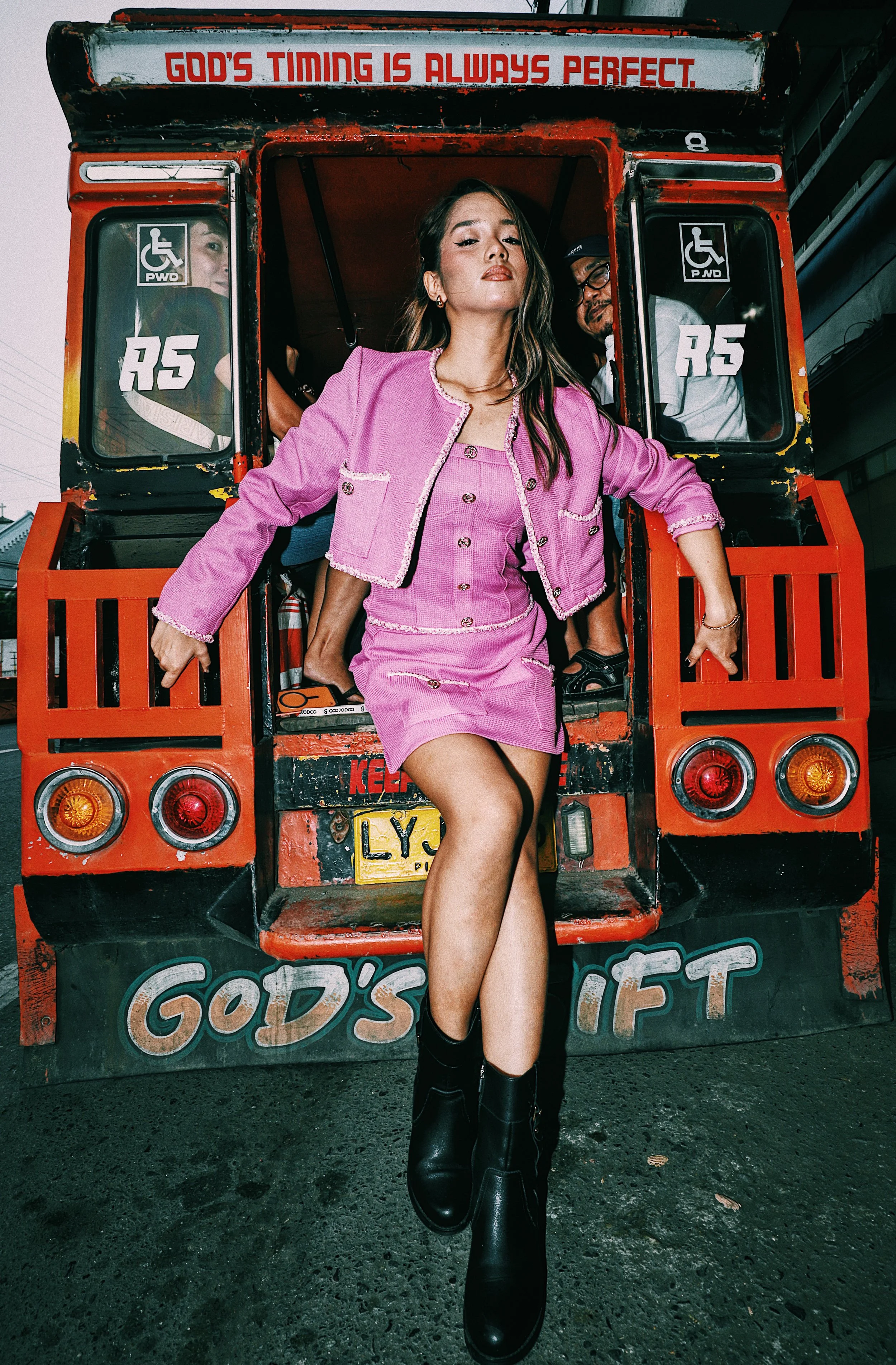
Butuan City based Shayne Mellijor in a styled editorial shot, suspended off the back of a jeepney painted with "God's Timing Is Always Perfect," in a pink tweed set that Shayne reads as quintessentially Korean — shot the same way as everyone else in this piece — prompted in the field to wear a Korean style.
In her own interview, she named the reference outright: Chanel, for the set's clean, cut, classy polish — deliberately set against a pair of black combat boots. Soft-meets-tough, worn as a rule rather than an accident.
The truck behind her is doing its own version of the same thing. Jeepneys are Filipino vernacular art at its most combinatorial already — surplus American military vehicles turned into rolling shrines, hand-lettered gospel stacked over chrome and whatever paint job the owner could afford that year. "God's Timing Is Always Perfect" runs across the top. "God's Gift" runs along the back, half-hidden behind her boots. Nobody asked permission to combine any of that either. Shayne isn't citing Korea in front of a neutral backdrop. She's citing it in front of a vehicle that's been practicing the identical move — combine what doesn't obviously belong together, mean it anyway — for longer than K-pop has existed in the Philippines at all.
Every portrait here came out of the same shoots, run by the same hand, under the same thin prompt — dress in a way you understand as Korean style. What varies is how much candid flavor survives the process. Junen's read as caught mid-motion. Shayne's reads as fully composed. Both are the same method meeting different subjects — Shayne is a working influencer who's spent more hours in front of a lens than anyone else in this sample, so what she gives back under an open-ended prompt is already produced, already graded, already has a title card in her head before you've raised the camera. That's not a different category of evidence. It's the same instrument reading a subject who happens to already know how to compose for it.
Same Signal, Three Receivers
What's worth noticing is what survives that difference in polish. Ask three people who've never met, who sit at entirely different points in this — a professional influencer, a campus style leader, a design major whose own answers ran thinner than almost anyone's — what "Korean style" actually is, and they converge on the same shape without ever comparing notes. Shayne calls it mixing everything into one. Junen, thinking of TWICE, calls it "many expos for your passion" — a group built to hand you a whole range instead of one look. Van, the design major, independently named the identical soft-and-edgy duality Shayne just described, in a separate interview, on a separate day. None of them coordinated that. More likely they're all tuned to the same signal from somewhere upstream — the same broadcast landing on three different receivers, each set differently, each catching the same station anyway.
Not one aesthetic. A collision of several, worn at once, on purpose. Three other students converged on the identical move independently, without ever comparing notes — soft pulled hard against edgy, on the same body, at the same time. Nobody organized that consensus; nobody could have. If there's a working definition of "Korean style" operating on this campus, it's closer to that than anything a moodboard could pin down: not a fixed look, but a habit of combination.
On this trip to Caraga State, we also visited a group of FDeisgn% Textile students and ran into a fashionista in one of the classsrooms, who was already wearing her own notion of Korean style. Van's own garment made the same point more vividly than anyone's sentences could.
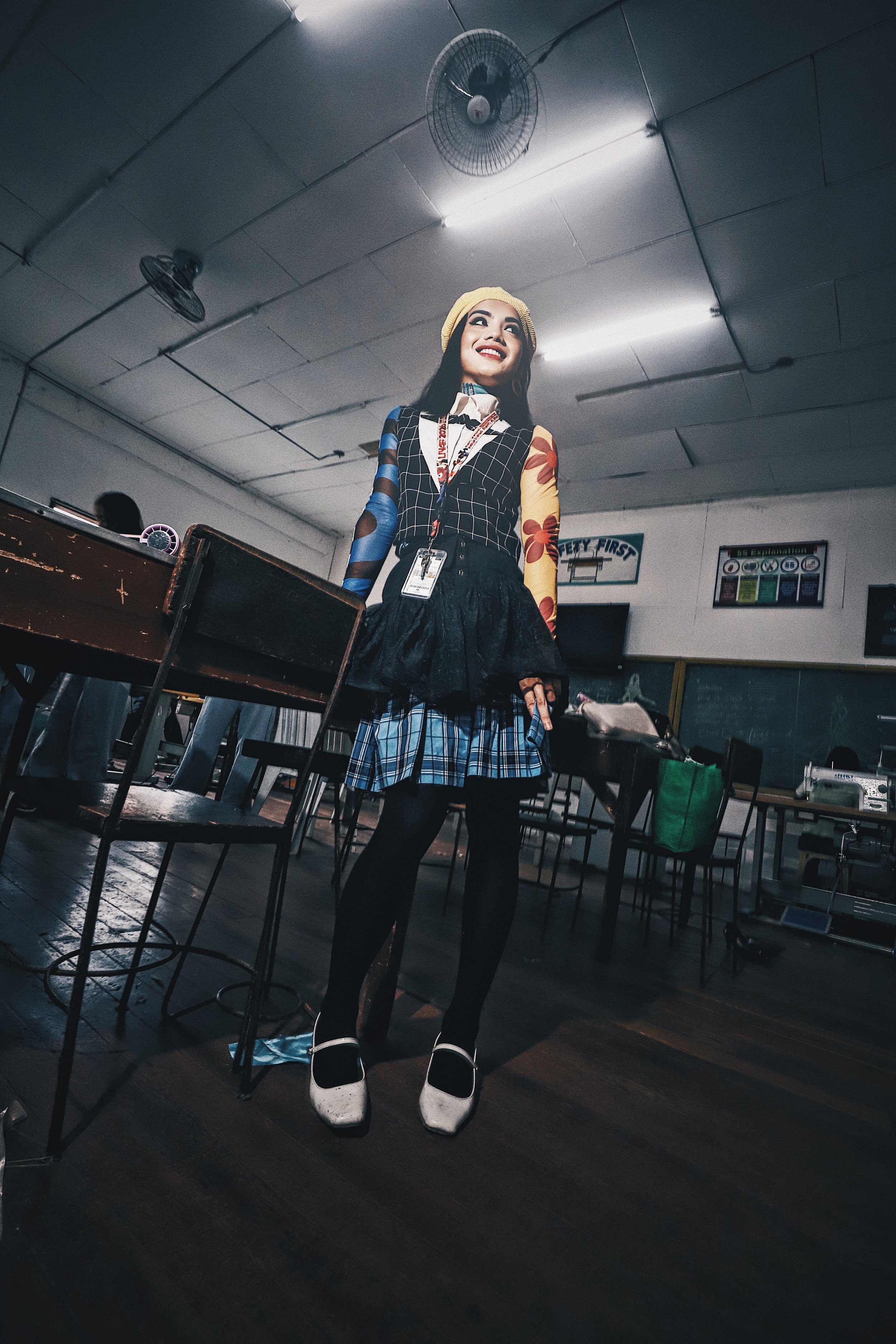
Van (@vandydai), mismatched floral sleeves, houndstooth vest, black tulle skirt over a plaid pleated skirt, beret, student lanyard, in a CSU classroom.
Mismatched floral sleeves in two different colorways, one of them sheer, layered under a houndstooth vest over a sheer collar. A black tulle skirt stacked on top of a plaid pleated one. Mary Janes, a beret, and — left on rather than tucked away — her actual student lanyard. It reads less like an outfit than a small essay in clashing genres: schoolgirl plaid, goth tulle, a colorful K-pop print, all stacked on one body, all somehow landing as one coherent statement instead of a costume accident. Asked what any of it meant, she had almost nothing to offer back. Whatever she was doing, she was doing it bodily, not in her head.
A Wall That Isn't Korean
And here's the part that should complicate your certainty about where any of this is actually coming from.
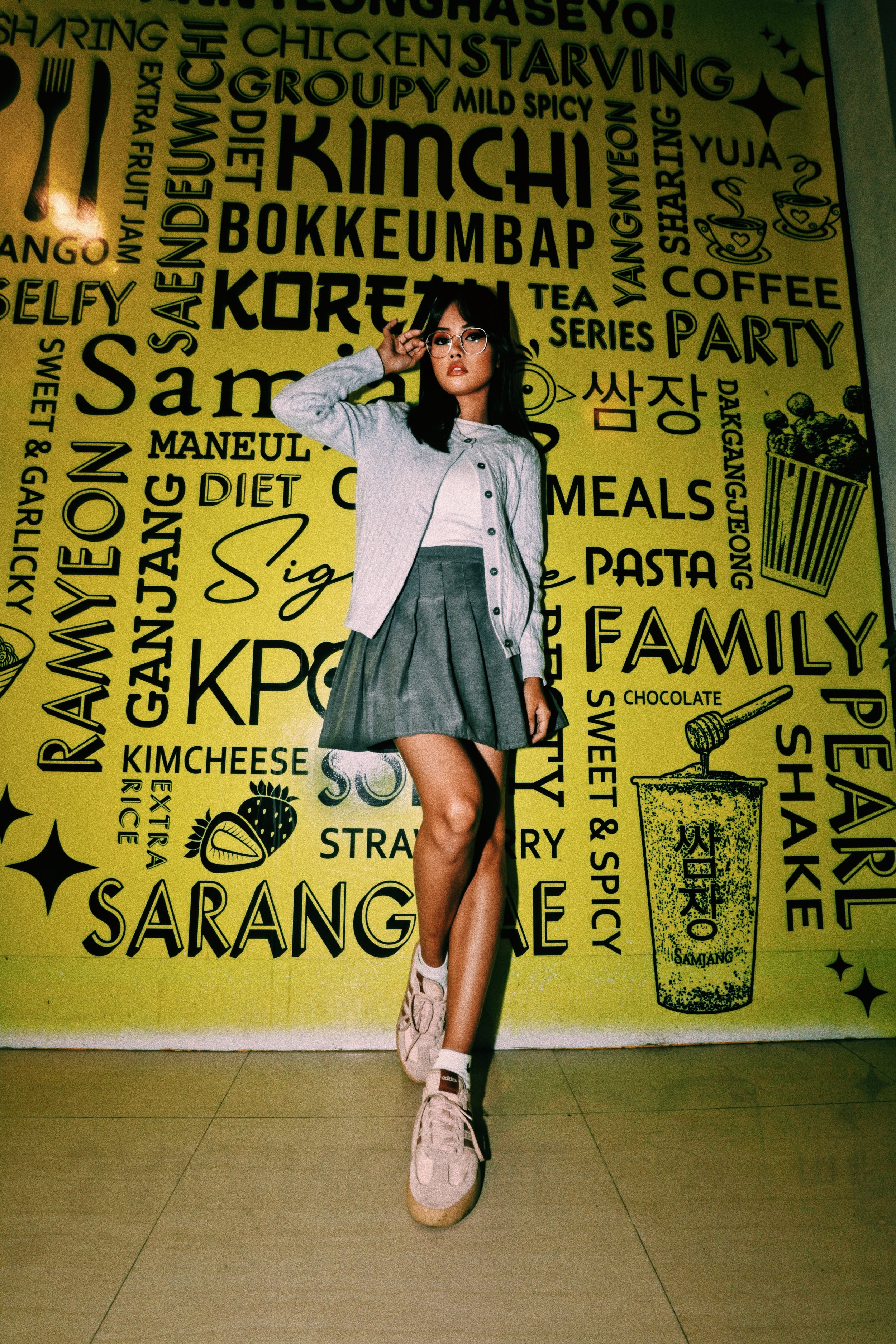
[Photo: Clare (@withlauve.clai), staged and standing against the wall of the Samjang restaurant in Butuan City.
That wall isn't Korean. Nobody Korean designed it, stocked it, or has ever stood behind that counter. It's a Filipino cafe's best guess at what "Korean" is supposed to look like, built entirely from screens, for customers who will never check it against the real thing. It sat there for days generating nothing on its own — just paint. It needed a body in front of it to mean anything at all.
It's the same move, in the end, as an American retail chain calling itself Anthropologie because the founder liked how his old college major sounded with a French accent on it — borrowing a discipline's weight without doing any of its actual work. The wall did that with an entire country's culture. The store did it with an entire field of study.
Which is true of almost everything in this study. Nobody cited Korea. They cited a girl group's Instagram, a drama's costume department, a wall painted by someone who's also never been. What's spreading here isn't an import from Korea. It's a copy of a copy, assembled locally, activated by whoever's brave enough to stand in front of it and mean it.
The Hole in the Theory
Worth pausing on the hole in that theory before it gets too pleased with itself. Almost everyone we talked to had already opted in — BAKSU members, self-declared fans, people who'd shown up on day one already dressed in the exact thing we'd come to study. Of course they had a theory ready. People who've spent years building an identity around something can usually explain it; that's not a discovery, that's a tautology — a statement that's true by definition and tells you nothing new, like saying dedicated fans are dedicated.
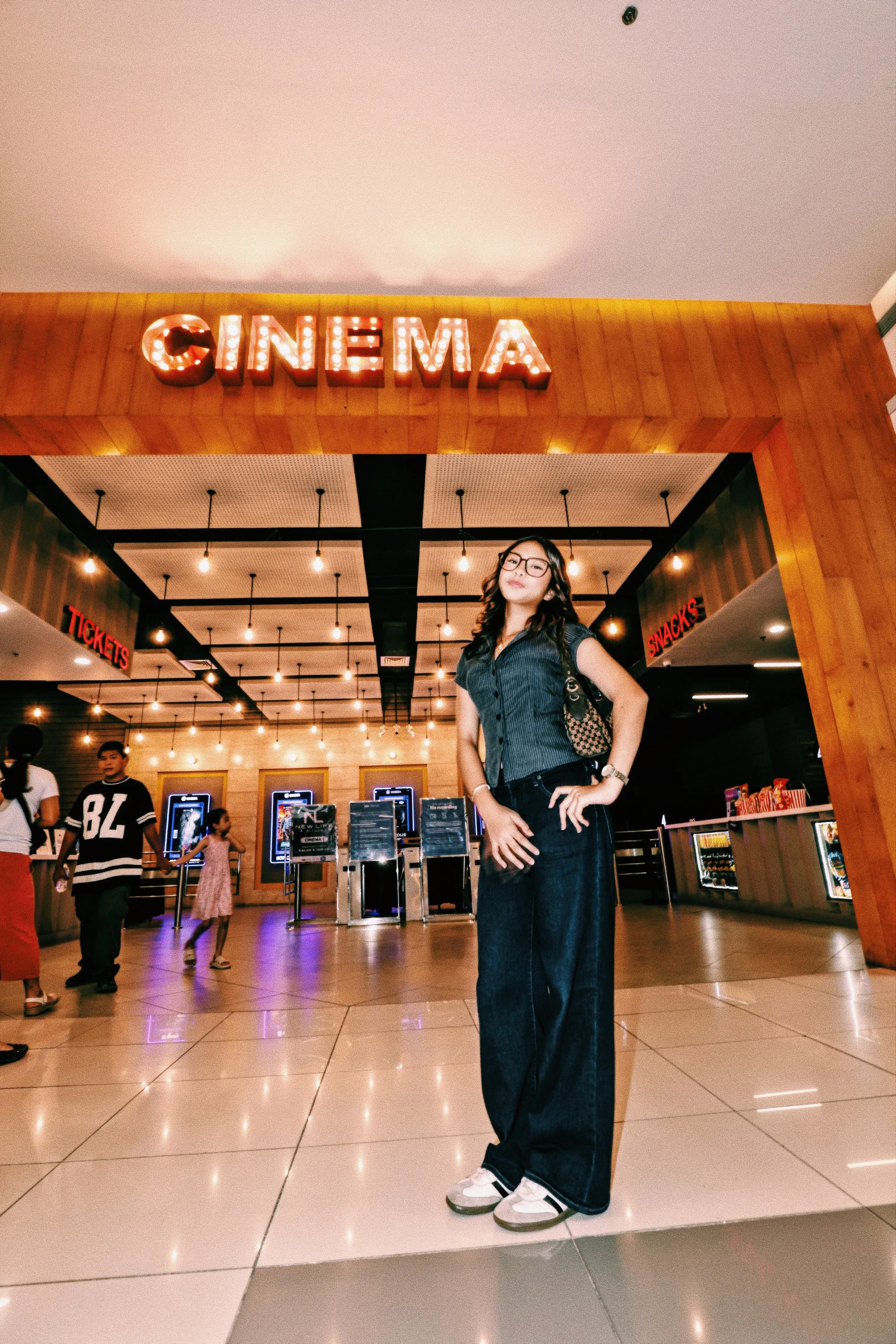
Model @xanxan.zz poses inside the SM Mall in Butuan City and channels the Korean vibe that made her stick out from the crowd.
Which is what made the sixteen-year-old in the mall worth chasing down. Sandra wasn't BAKSU, wasn't a design student, hadn't been recruited or briefed or asked to show up anywhere — we spotted her walking through SM Mall in Butuan and asked to talk, cold. Her theory, when we asked for it, barely existed. "Maybe some, similar" was as far as she'd commit, and she couldn't say for sure that any specific piece of what she was wearing was Korean at all. But the silhouette was legible enough to stop us from across the food court. Whatever she was doing with her body, she'd absorbed it without ever once building the sentence that explains it.
That gap — real competence, no accompanying theory — is either the most interesting finding in this whole study or a sample of one. It's probably both. It suggests the look itself might be traveling further than anyone's actual fandom, riding in on nothing but ambient exposure, while the theorizing stays locked up in the identity-invested minority who happen to be the ones willing to talk to researchers. One girl in a mall can't prove that. She can only make you a little suspicious of how neatly everyone else's answers lined up.
The Price of Admission
Zoom out further and the stakes stop being funny. In Indonesia, the same license to transgress can mean a young Muslim woman removing her hijab inside one specific coffee shop, at one specific hour — weighed against family and religious risk, requiring actual infrastructure to manage safely. Next to that, a sock that might get you called jologs is almost gentle. Same rebellion. Wildly different price of admission.
Look closer at that Yogyakarta coffee shop and "Korean" isn't just handing one person an excuse to break a personal rule. It's doing zoning work — marking off a specific room, for a specific hour, as exempt from the normal social contract, because everyone involved has tacitly agreed the space counts as foreign enough to suspend the rule without being foreign enough to threaten it. Butuan never needed that architecture. Nobody has to zone off an hour or a room to wear a pink sock; the permission is carried on a body, in the open, on an ordinary afternoon. In Yogyakarta, Indonesia, "Korea" has to be built into the floor plan and the clock. In Butuan, it just has to get dressed.
That difference might explain something odd from earlier: why the two supposedly Korean-coded spots flagged going in, Samjang and Sam's 2D, turned out to be obscure, or already faded, or news to the very faculty working mere blocks away from them. If the permission here doesn't need a room — if it rides on a body instead of getting built into a floor plan — then a dedicated Korean-themed space was never structurally necessary in Butuan the way it apparently is in Yogyakarta. Nothing was propping those cafes up from below. They could open, draw a season of foot traffic, and quietly fade, and the actual phenomenon wouldn't even notice, because it was never depending on them in the first place.
So what does a week in Butuan actually teach you? Not that Korean style traveled here intact — nothing about what we saw was intact. It arrived already broken into parts and reassembled by hand: a rotating cast of idols and dramas standing in for one fixed reference, the same habit of combination surfacing independently in a professional influencer, a campus style leader, and a design major who could barely explain what she'd built. Whatever this is, it lives more reliably in construction than in speech, and it clusters on individual bodies rather than in any one place — including the place we ourselves assumed it would, twice, in two different countries, before the fieldwork corrected us.
Korea didn't export a look. It exported an excuse — and an AI guessed the shape of it before anyone went looking, a 21-year-old wore it before anyone asked her to, and named the risk out loud before anyone told her what to call it.
Now Boarding
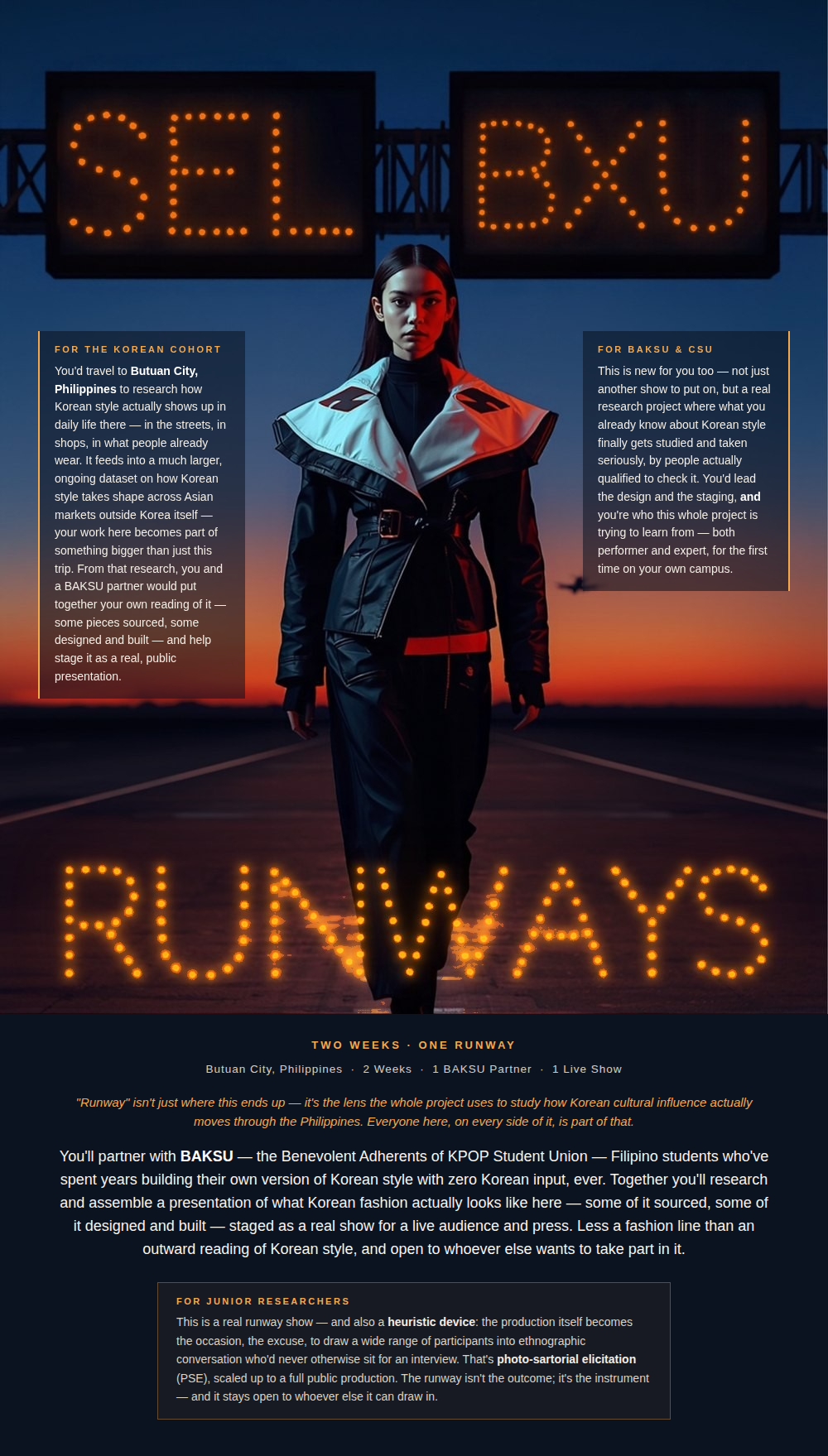
Boarding begins soon…
Everything in this piece was found. The permission slip, the zoned coffee shop, the jologs risk, the wall that isn't Korean: none of it was built for anyone. It was already there, waiting for someone to stand next to it with a camera.
The obvious next question is what happens if you build one on purpose. That is Runway SEL/BXU, the project this fieldwork is heading toward. SEL is Seoul, BXU is Butuan's own airport, and the program is a flight route turned into a curriculum. The idea is simple to say and harder to do. A small group of Korean students would come to Butuan and be paired one-to-one with BAKSU members. They would spend a first stretch doing what we did, reading the city through the same thin prompt, and then move into the studio with Caraga State University's fashion and textile students, the people who know how garments hold together. The finish line is a runway the whole group designs and then walks. A runway is a corridor built for being read: a path, a light, an audience, a threshold where ordinary dress becomes a claim. It is the permission slip with architecture around it. None of this is settled, and the university has the final say, but this is the direction.
What interests us most is the reversal. For years we have asked young people in Hanoi, Yogyakarta and Butuan what Korean style means to them. Now the Koreans would be the ones at the end of the catwalk, watching their country get cited back to them by people who learned it from screens. Would they recognize it? Would they object? Would they borrow something? If the same combinations and the same nerve show up when the supposed source and the supposed receivers share one room, that tells us something. If they don't, that tells us something too.
Korea exported an excuse. Runway SEL/BXU will be our attempt to find out what happens when the excuse is handed back, with a runway under it and the lights on.