A new, Seoulacious way to see the city, and to understand it with a camera
Some bad news first: you're probably a bit basic.
That's not an insult, it's a location. You're standing exactly where the itinerary sent you, pointing the camera at exactly what the algorithm told you to point it at. The neon. The hanbok. The street-food stall with the line. Seoul has been shot a million times this way, and every one of those pictures was taken before the plane landed.
John Berger had the diagnosis in 1972. He was a British art critic and novelist, and his BBC series Ways of Seeing, along with the book that followed, taught a generation to ask who a picture is really for. His opening move still stings: "The way we see things is affected by what we know or what we believe." You arrive believing in a certain kind of Korea, the camera goes shopping for proof, and that's all you ever find. It isn't a lie. It just isn't real, either.
Here's that Korea.
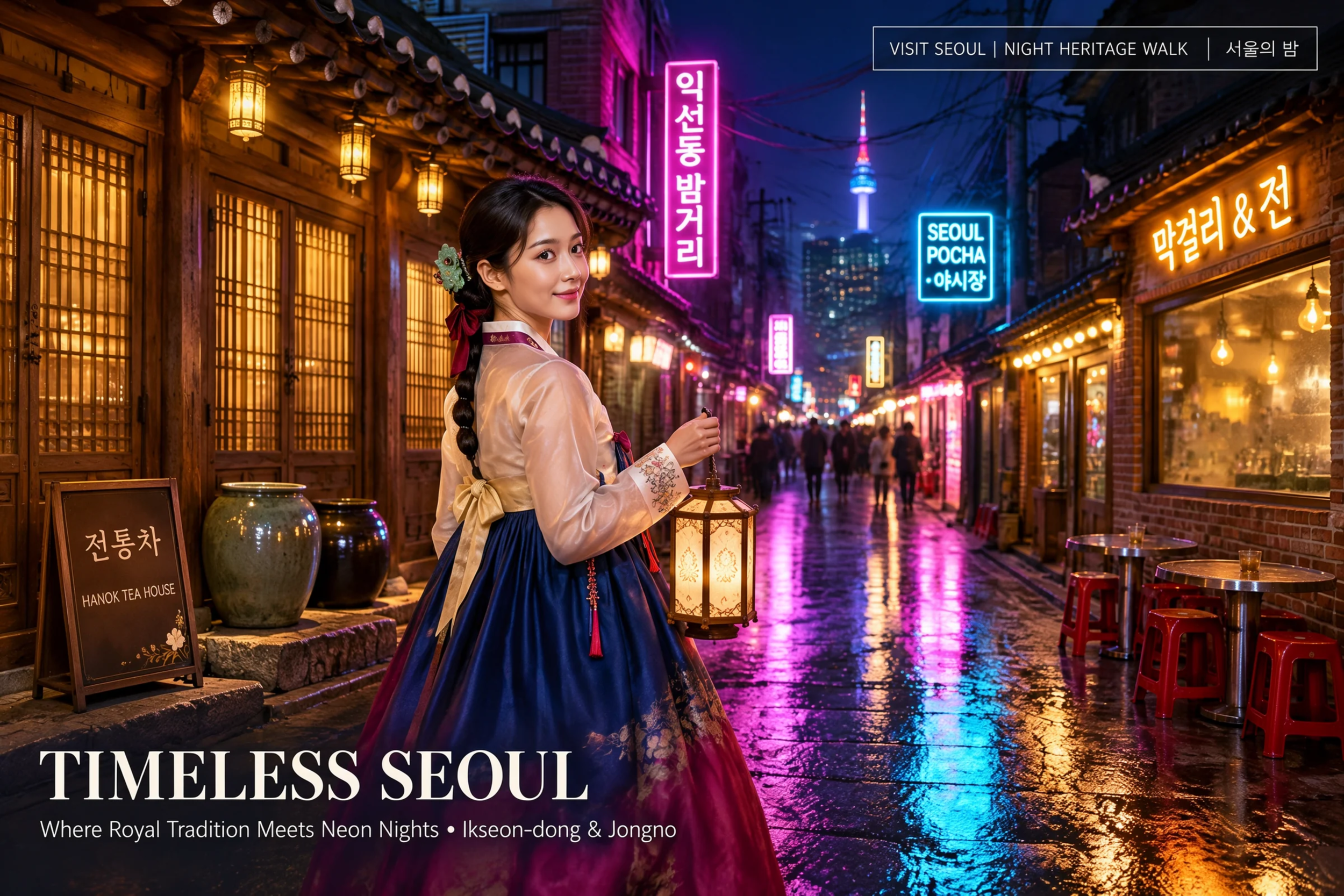
Ya BASIC. This is “The Picture You Came With.” (AI-generated).
This is the Seoul most people carry in their heads: neon, hanbok, a smile with nothing behind it. Notice that it isn't even a photograph. It's a cartoon, a composite of brochures, drama stills, and filters, and it's finished before anyone has looked at anything. Even the caption is already written for you.
Now look at this one.

Model @melina_.sd poses in a back alley near Samgakji Station. The Jangsu Sikdang's (Long Life Restaurant) sign: lamb ribs, goat soup, boiled whole duck. “Duck must be reserved a day in advance.”
[IMAGE 1 — CENTERPIECE, full-bleed: IMG_1723_VSCO.jpeg] Caption (draft):
A woman crouches in an alley at night, cigarette lit, pack in hand, looking straight back at you. She isn't hiding from the lens and she isn't lost in it. She's using it.
Beside her, a lit sign glows in the dark. You probably can't read it. I can: it sells lamb ribs, goat soup, and whole boiled duck, and at the bottom, one line says the duck must be reserved a day ahead.
That line is not for you.
Not because it's hidden. It's lit up, at street level, in plain sight. It's not for you because you don't speak or read Korean, and that's the code you never get past. The line is for a regular, someone who was here yesterday, who knows the place, who planned ahead. The sign is talking to somebody else, and the photograph has the nerve to include it. That's the whole gap between a tourist picture and the real thing. A tourist's photograph is addressed to the tourist. A better one admits there are people it isn't addressed to.
The second thing in this frame is nunchi (눈치): the Korean habit of reading the room before you act. She's crouched in a posture every Korean knows from the curb outside a restaurant. She's smoking where a woman smoking still carries a charge. She knows exactly who's watching. She is reading the room, and so is the photographer. Berger wrote that "we never look at just one thing; we are always looking at the relation between things and ourselves." Here, the relation is the picture.
The sign you walked past
Read the sign again. Yang-galbi, yeomso-tang, ori-baeksuk (양갈비, 염소탕, 오리백숙). Lamb ribs, goat soup, boiled duck.
To a tourist, that's a menu. To a lot of older Koreans, it's a category: boyangsik (보양식), stamina food. These are the things you eat to restore what summer, age, and hard work take out of you. And for most of modern Korean history, that category had a centerpiece you won't find on any menu you were handed.
Dog.
To be clear: I'm not claiming this particular restaurant ever served it. I'm saying the sign speaks the language of the places that did.
A warning: the next few sections leave the camera behind and walk through some food history. That's deliberate. It's the argument. Berger said what we see depends on what we know. Here's what it looks like to know a little more.
Heat with heat
Korea's three hottest days of summer are called boknal (복날). For generations, the way to survive them was to eat something scalding and heavy, fighting heat with heat. The old answer was a dog soup. Its history is a history of renaming: gaejangguk (개장국), then bosintang (보신탕, "body-protecting stew"), then boyangtang ("invigorating soup"), yeongyangtang ("nutrition soup"), sacheoltang ("four-seasons soup"). Each new name was a way to say it without saying it. Shops called themselves "health centers" (geongangwon, 건강원). More recently, signs stopped saying anything at all: "jeongol," "suyuk," or just "black goat," with the ghost of the old lettering still visible under the new paint.
Here's the twist most visitors never hear. The dish they think of as Korea's ancient answer to summer, samgyetang (삼계탕), the whole young chicken stuffed with rice and ginseng, is the newcomer. In the Joseon era the boknal table was split by class: commoners ate dog soup, the aristocracy ate beef soup, and chicken was a luxury. Ginseng chicken soup started out as gyesamtang (계삼탕, "chicken-ginseng soup") for well-off Seoulites in the colonial period, got its first restaurants in the 1950s, and took its modern form in the 1960s, when refrigeration and looser ginseng rules made whole fresh ginseng practical. It didn't reach everyone until the 1970s. Then, from the 1980s, as attitudes shifted and regulations tightened, dog soup declined and samgyetang moved into the empty seat. The "traditional" tourist dish is, in part, a stand-in. It became the national summer food while the older one became harder to say out loud. The sign in this photograph sells the other half of that family: boiled duck, goat, the heavy stamina dishes that never got a national marketing campaign.
Where these places live
They never lived on the tourist map. The "bosintang alleys" were in working-class markets: Jongno's Sinjin Market, Gyeongdong Market in Dongdaemun, and Moran Market in Seongnam, once counted among the three biggest dog-meat markets in the country. Moran's alley once held dozens of restaurants, and dogs were kept in cages at some of them. You'd have to be sent there. No one was going to stumble into it on the way to a café.
The customers were mostly older, many in their seventies, eating in places run by owners whose families had cooked the same soup for fifty years. For them it wasn't a scandal. It was, in one customer's words, part of their generation's tradition.
Learn to read the cluster
Step back from the centerpiece and the sign turns out to be one voice in a crowded alley.
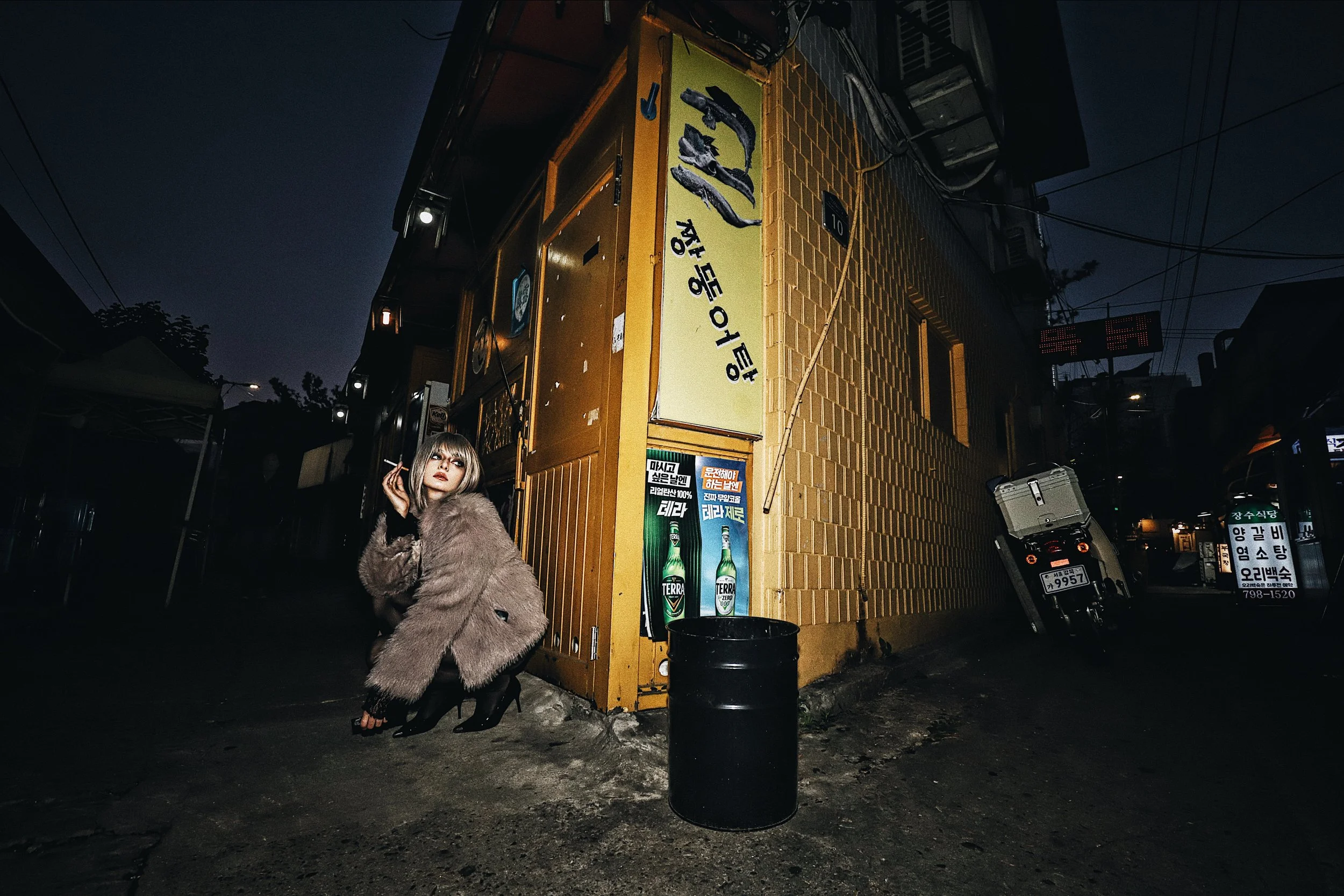
Model @its.byliaa takes a smoke break in the entrance to the same Samgakji alley as @melina_.sd in the centeriece image above. The sign from the centerpiece is the small white board at the far right.
Same alley, same night, a different model, and this time she isn't looking at you. She's looking up and away at something out of frame, and the corner building does the talking. Its tall yellow board advertises jjangttungeo-tang (짱뚱어탕), mudskipper soup, another stamina dish, with pictures of the fish stacked above the lettering. Below it, two beer posters pitch in two halves: one for the days you want a drink (Terra), one for the days you have to drive (Terra Zero). A delivery scooter leans on its stand at the right, box on the back. And down at the far end, small, is the duck-reservation sign from the centerpiece, speaking to its regulars. The sign you were told wasn't for you is one of several pitches in this alley, all aimed at the same night crowd.
That's the first lesson of the cluster: signs don't stand alone. Once you can read one, you start to notice they travel in packs. Four more photographs, four more neighborhoods, the same grammar.
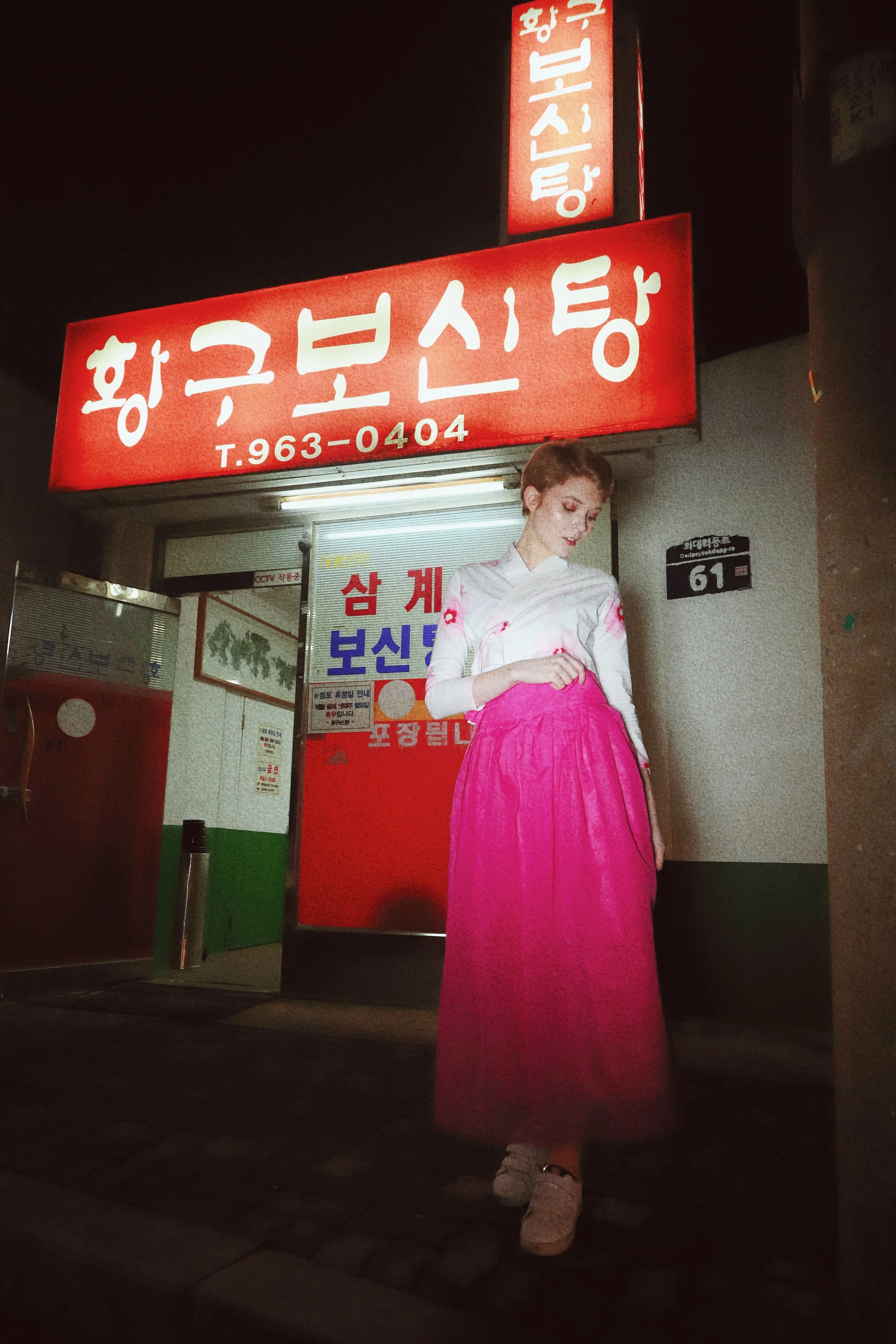
In February, 2018, a Finnish model wears a modernized hanbok in front of a bosintang sign. Two ideas of "tradition" in one frame. The door lists samgyetang and bosintang together, with takeout possible..
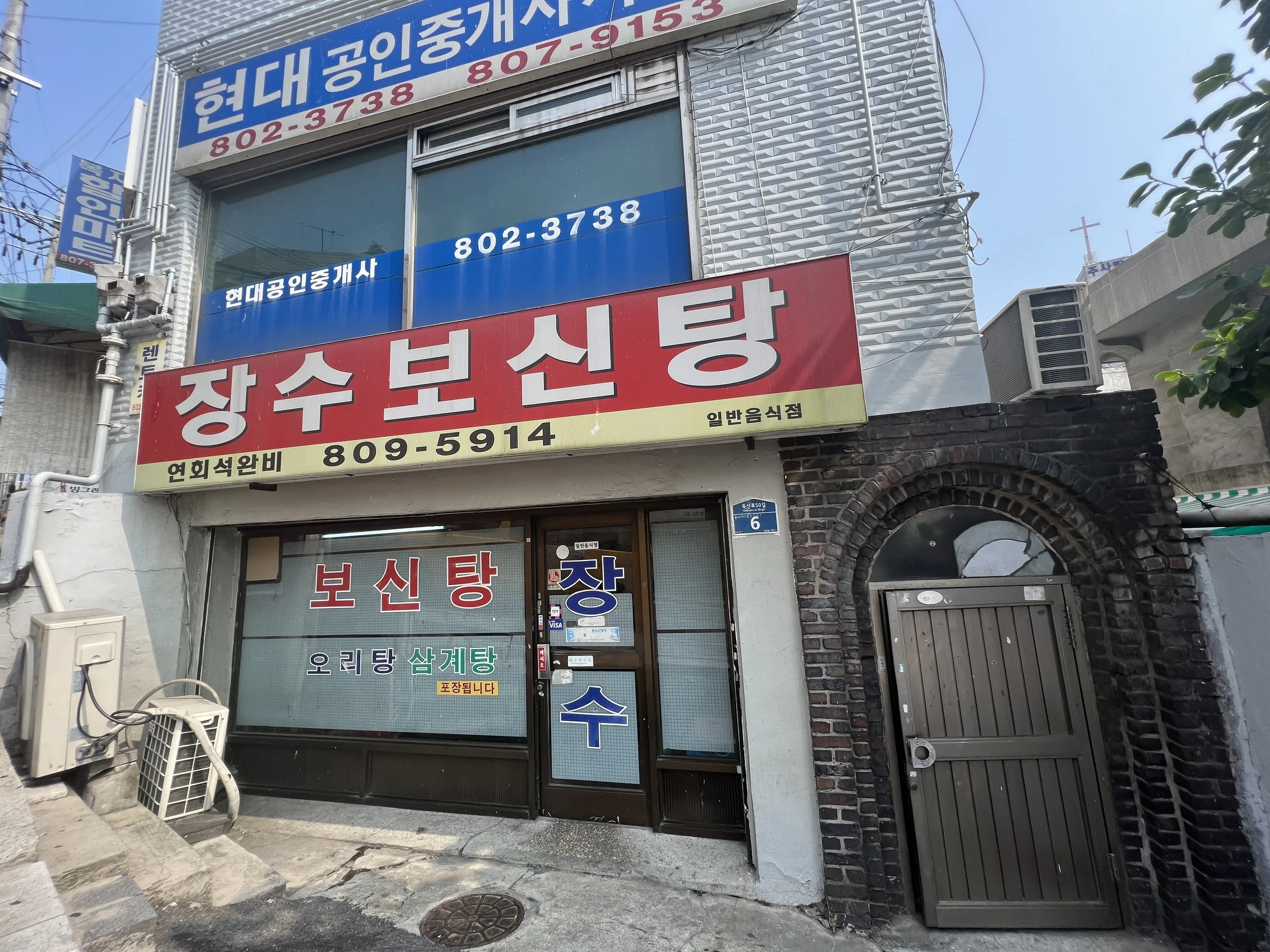
The Jangsu Bosintang Restaurant in June, 2022, serving bosintang, duck soup, and samgyetang. “Banquet seating available.”
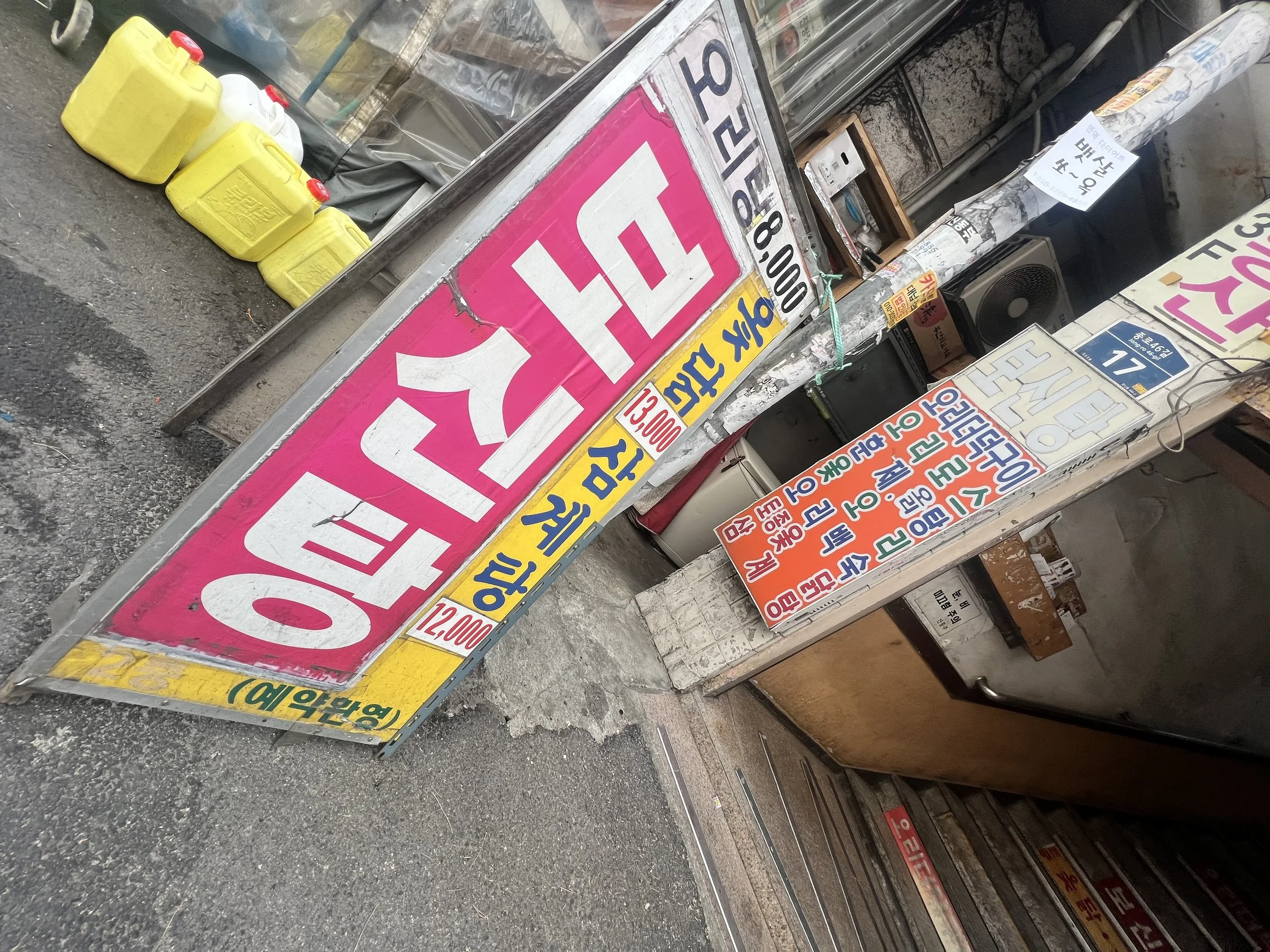
Duck soup, samgyetang, lacquer-tree chicken (otdak, 옻닭), all on one board. "Reservations welcome." Taken in March, 2023 in Dongdaemun.
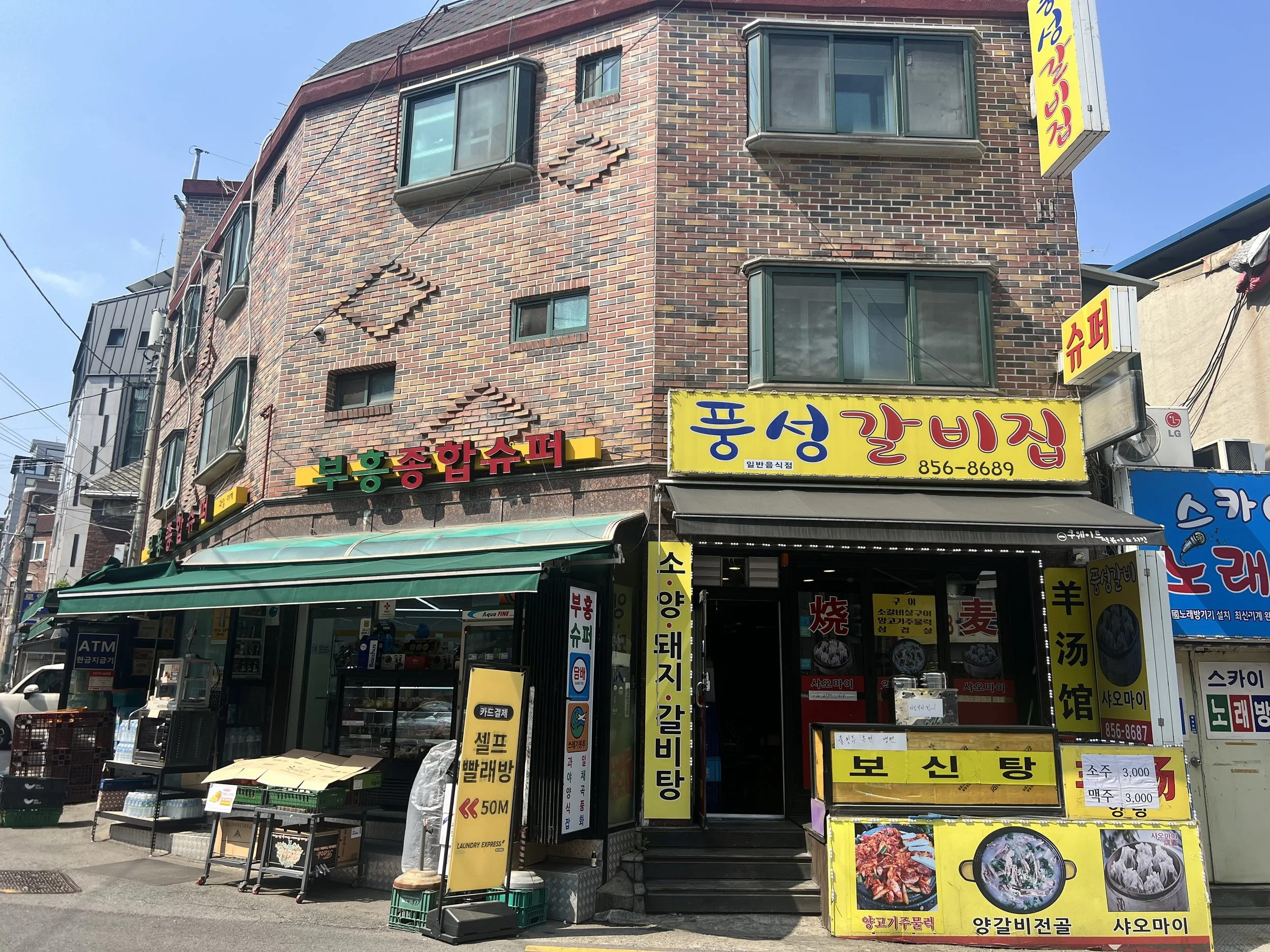
Caption (draft): A bosintang placard on a façade selling lamb, galbi-tang, and shaomai, with Chinese-language signs beside Korean ones. Taken in April, 2024 in the Guro Digital Complex area of Seoul.
The dishes cluster. The same handful of dishes keep showing up together: bosintang (보신탕) beside samgyetang (삼계탕) and ori-tang (오리탕, duck soup) on a door near Hankuk University of Foreign Studies; duck soup, samgyetang, and otdak (옻닭, lacquer-tree chicken) on one board; and yang-galbi jeongol (양갈비전골, lamb-rib hot pot) beside a bosintang label in Guro. That's the boyangsik menu: one category, many animals.
The names cluster. Hwanggu (황구, "yellow dog"), Jangsu (장수, "longevity"), Pungseong (풍성, "abundance"). The names promise vigor, a long life, plenty, or in one case simply name the animal. Jangsu appears on the sign in the centerpiece photograph and again on a bosintang storefront in another neighborhood.
The small print clusters. Pojang doemnida (포장됩니다): takeout available. Yeyak hwanyeong (예약환영): reservations welcome. Yeonhoeseok wanbi (연회석완비): banquet seating available. These are places for groups, for orders planned ahead, for taking a pot home. That's why a duck reservation notice fits so naturally.
And the cultures cluster. On the Guro façade, Chinese-language signs (羊汤馆, yáng tāng guǎn, "lamb soup house") sit next to the bosintang placard. The same family of dishes branches across communities.
This is the skill: don't read one sign, read the pack.
Then the ground moved
Pet ownership rose. Dogs became family. Polls showed most Koreans no longer ate dog meat, and nearly everyone said they'd skipped it the previous year. In January 2024 the National Assembly passed a law banning the breeding, slaughter, and sale of dogs for meat. It takes full effect on February 7, 2027, with prison terms of up to three years. The government counted nearly 6,000 affected businesses, including thousands of restaurants and traders. Farms have been closing fast, and restaurants have been quietly switching to black goat and other stamina dishes, which is why a sign like this one now offers goat and duck where it used to hint at something else.
Not a tidy story
I won't pretend this is simple. This is a tradition and a cruelty at the same time, depending on who's telling it. Defenders say it's heritage and livelihood, and that the government has no business controlling what people eat. Critics say dogs aren't livestock, that the industry had been breaking the law for years, and that public feeling has moved on. Both of those arguments are printed on that sign. The photograph doesn't settle them. It just refuses to hide them.
Never a matjip
And here's the part tourists miss entirely. These places were never matjip (맛집), the "must-eat restaurant" tag that every blog and map app hands out. No blog queue, no Naver stars, no waiting list, no "hidden gem" listicle. They were wildly popular with one slice of the population and completely invisible to another. That's the point. Korean food culture has a basement, and the tourist route runs through the lobby.
Most visitors can't read the sign. Even those who can would never end up on this street. By the time they learn enough to find places like it, the thing the sign was a code for will be illegal. You missed a dish, sure. But more than that, you missed a whole social history, printed at street level in a script you couldn't read, in a neighborhood you were never going to visit.
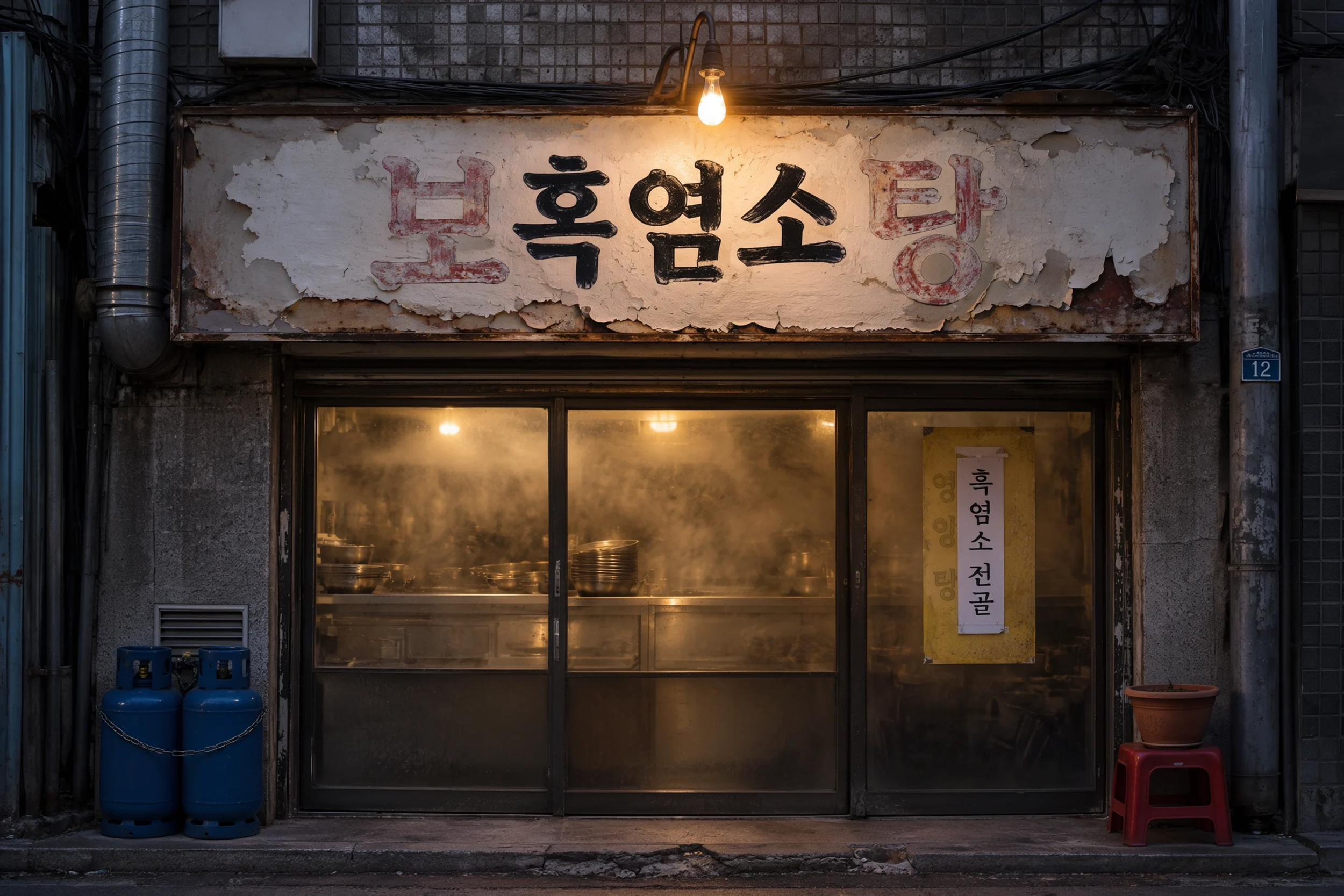
A GHOST FROM THE MACHINE: a shopfront where the old "bosintang" (보신탕) lettering is still visible under new "black goat" (heugyeomso, 흑염소) painted on]. AI-GENERATED
[IMAGE 3 — STAND-IN (Canva media MAHa9lqaAC4, https://www.canva.com/M/MAHa9lqaAC4). Replace with a real photograph when you shoot one (see anchor A5). Caption: What the sign used to say. AI-generated concept image.
A confession about that picture: it doesn't exist. I had a machine make it. Look at how clean it is. The old name still legible beneath the new one, two eras sharing one board, as if the city had written its own footnote. Reality almost never does this. Real signs are repainted overnight, taken down, covered with a tarp, or left up in plain sight until the day the law arrives. The ghost is rarely this readable, and the places that hold it rarely stay put long enough to be photographed.
That's why I'm showing it. It's the idealized form of what we're looking for: the one frame where the history announces itself. You will never see it like that. What you'll see is a fragment: a faded edge of paint, a letter that doesn't match, a price too high for goat, a door that used to be a different door. The real work is excavation, and the image is only the picture in your head that the digging is aimed at. A machine can draw the idea of a clue. Only a person standing there, who can read, can find a real one.
Which means we have a cartoon of our own. The tourist has the neon Seoul at the top of this piece. We have the ghost sign. Both are constructed, both are easy to make, and neither is waiting for you on a real street. The difference is what happens next: they stop at the picture. We start digging.
Back to the camera: why this sign matters
I didn't take you down that alley just to shock you.
Same photograph, two viewers. A visitor sees a striking woman, a glowing sign, and some unreadable text. Someone who knows what you now know sees a kind of restaurant that served one generation's idea of vitality, was never listed as a place to eat, is being legally erased within months, and is selling duck and goat where it used to hint at something else. Nothing in the frame changed. The seeing did. That's Berger's claim made concrete: what you know changes what you see. Set it beside the picture you came with, the cartoon Seoul at the top, and the difference isn't that one is real and the other fake. One was made to be seen without knowing anything. The other can't be seen without knowing something.
Three things follow for anyone holding a camera in Korea.
First, the lens doesn't do the seeing. Knowledge does. A better camera, a better angle, or a better filter won't get you out of the tourist's picture. Knowing what the signs say, who they're addressed to, and what's behind them will.
Second, the most important things in a frame often look like background. Signs, prices, small print, the name above the door. That's where a place speaks to its own people and where history leaves its traces. A tourist crops them out. A photographer who can read them keeps them in.
Third, some of what you're photographing is leaving. This category of restaurant is being legally erased, and a photograph made now is also a record of something the city is quietly repainting. Seeing differently isn't only a matter of taste. It's a way of keeping a record before the record is gone.
So this was never a lecture on dog soup. The history is the example. The point is the habit it trains: read the sign, then the cluster, then ask who it's for, what it's hiding, and what's about to disappear.
Which brings us back to her, in the alley, looking at you.
Let's be honest about the gaze
That picture of the model at the top of the article smoking in front of the goat soup sign is a woman and model performing for a camera in a back alley. It's Seoulacious and salacious, and this piece won't pretend otherwise.
Berger's Chapter 3 is the trap: men act, women appear, and a woman's choices are made while watching herself being watched. So "she's an agent in her choices" doesn't escape his argument. It restates it.
But here's what actually happened with this frame. Midway through the shoot, she said out loud that this might be a good moment for a cigarette. I asked whether she actually smoked. She did, but she just had none on her, as her bag was back at the coffee shop. So I handed her my credit card, and she walked to the convenience store around the corner and bought her own pack, her brand, her choice. The cigarette in the photograph is hers. So is the idea.
That doesn't erase the structure. Her suggestion may itself have been a response to what she sensed the frame wanted. Models learn what a camera is looking for, and so do photographers. Neither of us can say where her idea ended and the structure began. What I can say is that we arrived at the same aesthetic conclusion by being in the same place, reading the same light, and each knowing what the image needed. The usual assumption is that the photographer holds the power. Not always. Not in this shot.
The way through is not to resolve the contradiction but to name it. Her agency is real, but it's staged inside the gaze: what she wears and how she holds the cigarette are choices, and also responses to an audience she anticipates, which is exactly what makes them informative. Mine is real too, and usually carries more power, since the frame, the selection, and the publication are mine. But not always. In this shot the idea was hers, and so was the pack in her hand. Call it co-authorship with a moving asymmetry: we both act inside a structure neither of us chose, and the photograph records the negotiation. Sometimes she leads and sometimes I do.
I'm not outside this structure. I'm imbricated in the male gaze, and I use that as an instrument to track how it works against the way she positions herself in relation to it.
And the boots
One more honest thing, since we're being honest. This entire shoot was always about the boots.
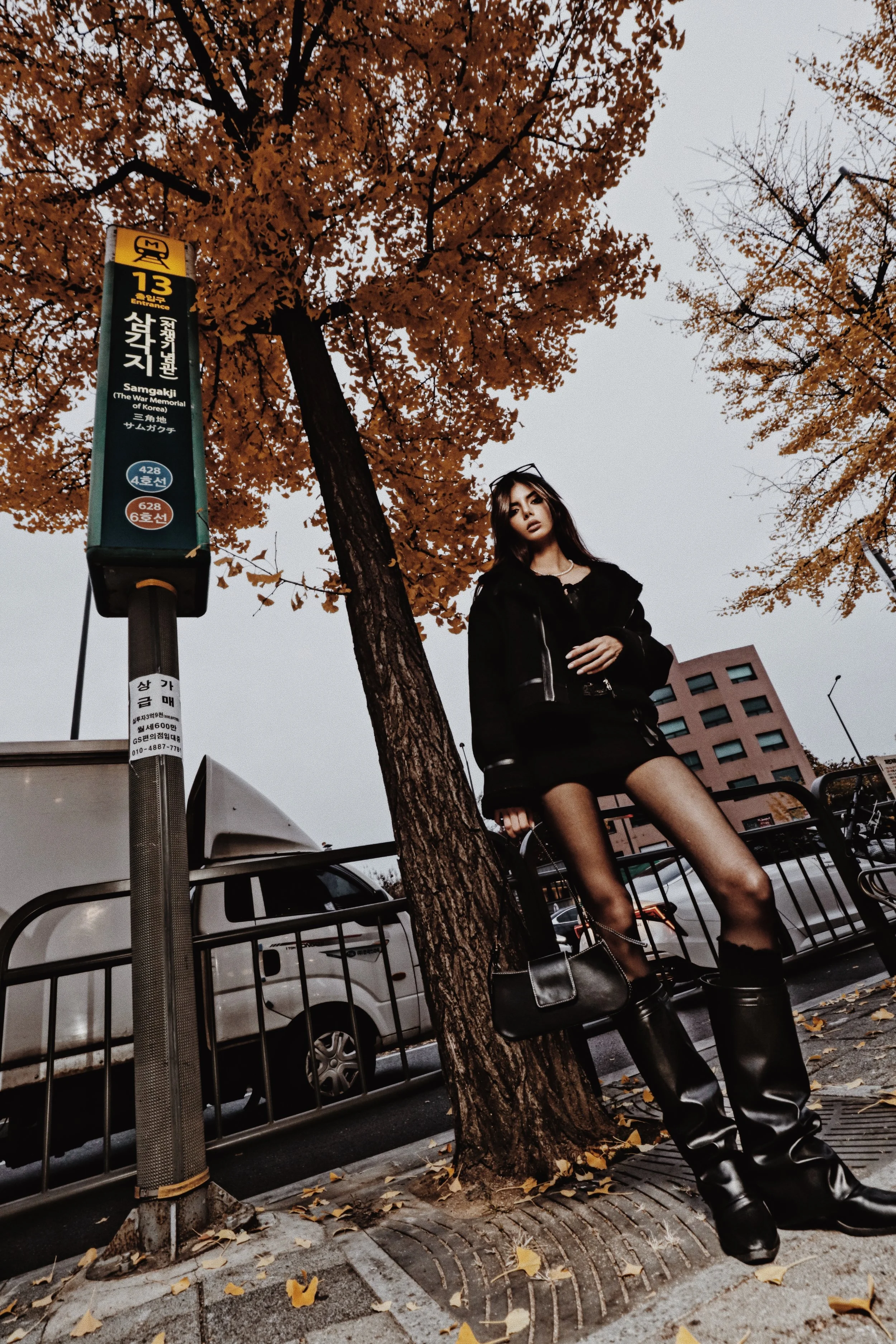
Model @melina_.sd stands witness before the seemingly sedate Samgakji Station subway sign after having switched on ite internal light only 3 minutes before we clicked the shutter, the clean countenance of which hides an entire neighborhood of things all the tourist maps miss. But in the end, this editorial was always about the boots.
Look at what she's wearing: tall black leather boots with ruffled socks peeking out at the top. You can't escape the pairing in Seoul right now. Walk any station exit at rush hour and count. The silhouette repeats so closely it starts to look like a uniform, only a couture one. The school uniform is the literal version, issued by an institution and enforced by a rule. This one has no rule, no bell and no one checking, and it still lands within a few centimeters of identical.
Why now? Part of the answer is a slow build. Slouchy, wrinkled socks have been spreading through Korean street style since around 2020, carried by idol styling, Y2K nostalgia and a price of a dollar or two a pair. The rest is persuasion. In November 2025, W Korea told its readers that knee socks peeking out above long boots would be a precondition of the winter, and noted that influencers were doing it almost without exception. This September, Harper's Bazaar Korea was telling them not to hide their socks, and to let them sit slightly crumpled over the boot top rather than pulled up neatly. A look that is cheap, warm and endorsed by every feed you open is how you get a tsunami.
I asked people on the street about it. One respondent in Seongsu didn't talk about boots at all. She talked about layers. The boots and the socks, she told me, are really about layering, and everybody in Korean fashion wants to layer everything right now. Her answer shifts the question from copying to construction. Nobody here is wearing a boot. They're building a stack: tights, sock, boot, each layer chosen against the others. Elle Korea has been saying the same thing since last December, advising readers to layer sheer knee socks over thick ones so that the texture of each layer plays off the next. Layering is the grammar, and the boots are just the loudest word in it.
This is also nunchi, scaled up. Everyone reads the same room, the same feed and the same crowd on the platform, and the readings converge. Uniformity is what a society of very good readers produces.
Even here the frame can't stop talking to other people. Taped to the pole beside her is a flyer reading sangga geummae (상가 급매), a shop for quick sale, with rent and investment figures written for someone who knows how to read them. The subway sign is for commuters, the flyer is for property people, and the boots are for everyone who follows fashion.
Berger's last chapter was about advertising, the kind of picture that exists to sell you a version of yourself. A fashion editorial is exactly that, and we make them. It doesn't cancel anything above. It completes the point: every picture has an addressee, and part of seeing differently is admitting who yours is.