
There is a blouse in the Daegu Textile Museum that the Korean government has registered as a National Cultural Heritage. It is made from nylon. It has a fluted collar and delicate gathered sleeves. It is not particularly dramatic to look at. What makes it historic is what it was before it was a blouse: an American military parachute, discarded after a single jump, picked up somewhere in wartime Daegu, cut apart, and remade into women's fashion by a refugee designer who was legally prohibited from using the material she was working with.
The blouse was sewn by Choi Kyung-ja (최경자) sometime in the early 1950s, during and just after the Korean War. It is the founding artifact of K-fashion. Not a founding symbol — a founding artifact. A concrete object. Parachute nylon, refugee hands, a sumptuary law it openly defied, and a market of women who wanted it badly enough to pay for something technically illegal.
The K-fashion story usually starts somewhere around 2009, when CNN discovered Seoul Fashion Week, or 1988, when the Seoul Olympics gave Korea its first sustained global close-up, or vaguely in the K-pop era, when idol aesthetics began influencing street fashion worldwide. All of those starting points are wrong. The actual story begins here: in rubble, in scarcity, under a prohibition, in a city in southeastern Korea that most people couldn't find on a map.
The fabric fell from the sky, then the law came down
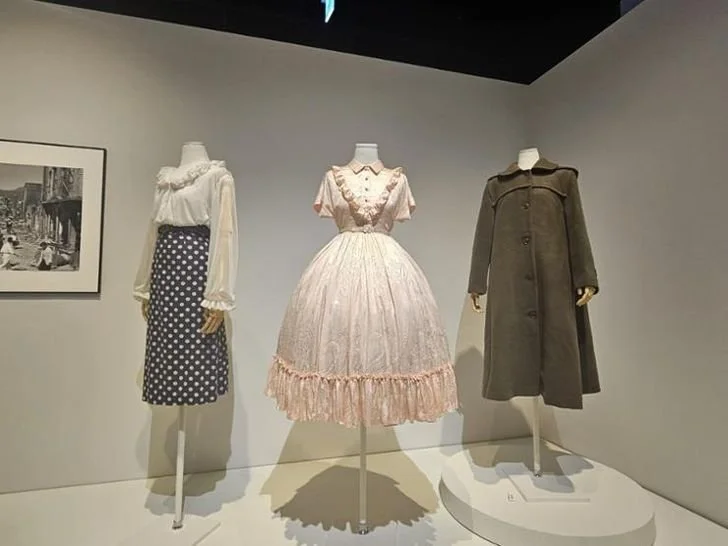
“"Military Blanket Coat," right, and "Parachute Silk Blouse," left, designed by Choi Kyung-ja, are on display at the Daegu Textile Museum. Korea Times photo by Park Jin-hai” Source: The Korea Times
When the Korean War broke out in June 1950, textile mills across the peninsula lost roughly seventy percent of their spinning and weaving capacity. Cloth became one of the hardest commodities to find. Daegu, positioned inside the Pusan Perimeter, survived the war relatively intact — its Japanese-built factories, the Nakdong River line, and the enormous Seomun Market (서문시장) made it the de facto textile capital of wartime Korea. Refugees poured in from across the peninsula, including a designer who had fled Hamhŭng with her skills, her knowledge, and not much else.
American parachutes were the one abundant fabric in town. The U.S. military discarded its canopies after a single jump, and the thin, tough, lustrous silk-and-nylon fabric was structurally superior to almost anything available on the Korean civilian market. Refugee seamstresses began recutting the canopies into women's blouses — delicately gathered tops with fluted collars, sleeve trim, the kind of details that said fashion, not survival wear. The Daegu Textile Museum now describes this practice as "upcycling before upcycling existed." That framing is accurate and almost comically understated.
The state disagreed with all of it. On November 18, 1951, the Busan-based wartime government enacted the Wartime Life Improvement Act (전시생활개선법), whose accompanying decree listed the prohibited fabrics in forensic detail: yangdan (양단, silk brocade), velvet, habutae (하부다에, habutae silk), lace, and nylon. Wearing, selling, or importing these fabrics was a punishable offense. Items already owned were grudgingly exempted.
Read that list again. Nylon — a synthetic fabric, a wartime military material, a fabric that the American military was literally discarding in piles around Daegu — was banned as a luxury. The prohibition wasn't irrational given the state's logic: nylon was imported, expensive in civilian terms, associated with the American PX economy that was running parallel to the official wartime market, and therefore precisely the kind of decadent Western consumption the government wanted to suppress during a national emergency. But the prohibition mapped onto reality in a way that was immediately absurd. The state was telling Korean women they couldn't wear the material that American paratroopers were throwing in the trash.
Choi ignored all that noise. .
Choi Kyung-ja versus the sumptuary state

WHO’S WHO: CHOI KYUNG-JA (최경자)
1911–2010 · Hamhŭng / Daegu / Seoul · The Founder
Trained at Ochanomizu University in Tokyo (graduating 1936), Choi was Korea's first professionally trained Western-dress designer. She opened her first atelier in Hamhŭng in 1937 — now North Korea — and fled south when the war started. In Daegu she made the parachute blouse. In 1952 she founded the Gukje Yangjangsa (국제양장사), relocating it to Myeong-dong, Seoul, in 1954. In 1957 she held Korea's first formal fashion presentation at the Bando Hotel — explicitly framing it not as a runway show but as a research presentation, designing for Korean bodies and Korean conditions rather than European templates.
Her 1962 Celadon Dress (청자 드레스) — an evening gown painted with cranes and pine trees in reference to Goryeo ceramics — was Korea's first credible argument that Western-trained Korean designers had something aesthetically distinct to offer the world, not just technical competence at copying.
In 1961 she founded the Kookje Fashion Design Institute (국제패션디자인학교), Korea's first formal fashion school. She trained over 50,000 students. The names of three of them tell you what that school built: André Kim, Lie Sang-bong, Lee Shin-woo. She also founded Korea's first fashion magazine, Costume (1964). She died in 2010 at 99, still working.
The structural point: Choi didn't just make a blouse. She built the system — educational, institutional, aesthetic — that allowed Korean fashion to exist as an industry. Every Korean designer working today is downstream of a school she founded when Korea's per capita GDP was under one hundred dollars.
As demand outran the supply of surplus canopies, Choi began importing raw nylon yarn and having it woven into fabric that mimicked the parachute hand. The piece preserved in the Daegu Textile Museum — the one registered as national heritage in 2022 — is this second-generation version: fully manufactured nylon, not literal canopy. Her clients were the wives of American officers, the returning diaspora, and the emerging urban middle class. Her defiance of the prohibition was not ideological. It was commercial. She had found a material people wanted and she was selling it.
The law's enforcement collapsed almost immediately in any case, because no implementing regulations defined what counted as a prohibited item, making street-level enforcement arbitrary and widely resisted. The 1951 armistice expectations had already "shaken the wartime life system," as the Encyclopedia of Korean Culture notes. Choi moved faster than the regulators and faster than the armistice negotiations. She was already in Myeong-dong by the time the government caught up to the reality that the prohibition was unenforceable.
Her parallel contemporary solved the same scarcity problem from a different angle.
WHO’S WHO: NORA NOH (노라노)
b. 1928 · Seoul · The Professional
Born Noh Myŏng-ja (노명자), she married at sixteen specifically to avoid Japanese colonial conscription as a comfort woman — married women were exempt from sexual slavery. When she realized her in-laws treated her as domestic labor, she divorced, renamed herself after the protagonist of Ibsen's A Doll's House, and at nineteen sailed to Los Angeles to study fashion. She returned in 1949 and founded the House of Nora Noh in 1950 — a year before the wartime fabric prohibition law existed.
She hosted Korea's first haute couture fashion show at the Bando Hotel in 1956, drawing on Balenciaga, Dior, and Nina Ricci and reinterpreting them for Korean bodies. In 1963 she launched Korea's first ready-to-wear line — the move that made fashion democratic rather than aristocratic. She dressed the actresses and singers who defined Korean femininity across three decades: Um Aing-ran in Audrey Hepburn silhouettes, Yoon Bok-hee in the miniskirt that inaugurated the 1970s. Her designs made the cover of Vogue in the 1960s and 70s. In 1979 she became the first Korean fashion designer to formally enter the American market; in the 1980s she had a ground-floor window at Macy's.
The structural point: While Choi built the education system, Noh built the business model. She proved Korean designer-led fashion could sustain itself commercially across multiple decades without state support. Her 1963 ready-to-wear decision is the philosophical origin of K-fashion's democratic accessibility — the idea that fashion is for women who work, not just women who are rich.
Together, Choi and Noh established the two pillars Korean fashion needed before it could go anywhere: institutional infrastructure (Choi's school, her magazine, her pedagogical network) and commercial proof-of-concept (Noh's sustained business across three decades). Without both pillars, what came next would have had nothing to stand on.
Nylon becomes Korea's first chemical industry
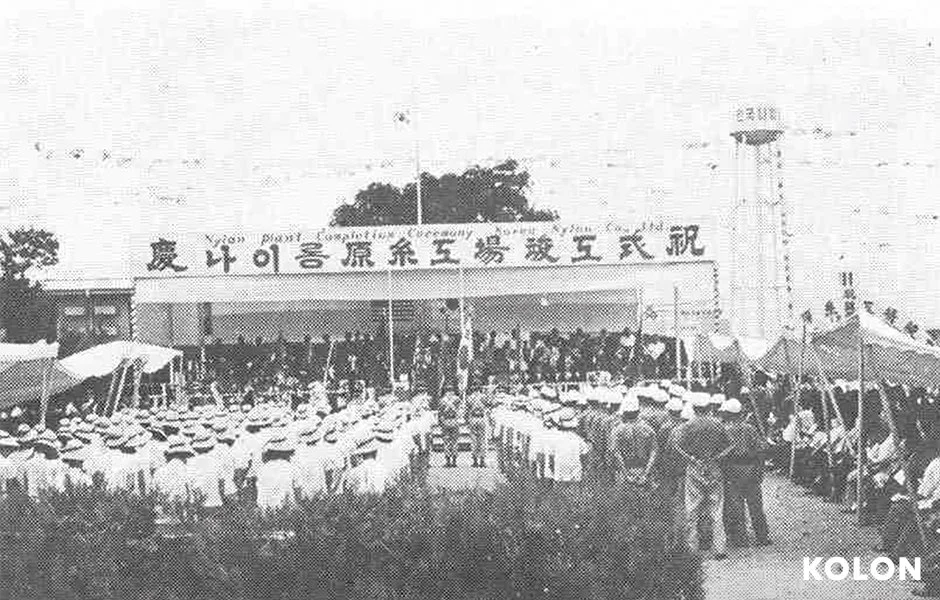
Lee Won-man had been trafficking Japanese nylon into Korea since 1953. He saw what Choi's customers were paying for imported yarn and concluded domestic production was urgent. On April 12, 1957, he incorporated Hankook Nylon (한국나이롱주식회사) in Daegu — the first synthetic-fibre manufacturer in Korean history. The name of its successor company is a portmanteau that makes the origin explicit: KOrea plus nyLON equals Kolon.
The parachute-blouse consumer demand of 1951 through 1956 was the proof-of-market that justified the factory. The stretch-nylon plant came online in October 1958; a 2.5-ton-per-day filament plant followed in 1963; and that same year Hankook Nylon became the first Korean company to export nylon abroad. What had been banned in 1951 as a luxury had become, by 1963, a Korean industrial export. The arc is twelve years. The mechanism is Choi Kyung-ja's customer base.
Daegu's broader textile boom followed the same wartime-survival logic. Samho Bangjik (삼호방직) — untouched because it lay inside the Pusan Perimeter — multiplied its cotton-yarn output twenty-six-fold between 1950 and 1954. Cheil Mojik (제일모직) was founded by Lee Byung-chul in Daegu in September 1954, producing Korea's first domestic suiting fabric the following year. By 1957, Seomun Market alone generated forty percent of Daegu's total market turnover, handling textiles that moved through wholesalers to Dongdaemun in Seoul. The "Milan of Korea" identity Daegu markets today was not planned. It was an accident of war geography: Daegu's factories survived because the front line happened to run north of the city.
The shadow economy that dressed the nation
Alongside Choi's couture ateliers and Kolon's factories ran a third channel: the Yankee Markets (양키시장). Goods pilfered or resold from U.S. military PX stores — nylons, gabardine, Lucky Strikes, canned food — filtered into civilian markets across Korea, including Daegu's Gyodong Market (officially tolerated from 1956), Seoul's Namdaemun, and Incheon's Baedari. These markets supplied the aspirational imagery that Choi and Noh were translating into wearable Korean design: Hollywood hemlines, Hepburn silhouettes, the whole visual language of American postwar femininity arriving in Korea through the back door of military surplus.
The state's sumptuary project was fighting a two-front war — against legitimate ateliers that were technically using prohibited materials, and against cash-and-carry stalls a few blocks away that were selling the same materials off the back of military supply chains. It lost both. The Wartime Life Improvement Act was repealed on November 5, 1963 — six months before Hankook Nylon began exporting. The government that had banned nylon as a decadent luxury watched that same material become the engine of Korea's first synthetic-fibre export industry, then quietly removed the prohibition from the books.
The lineage it built
The generation Choi trained at the Kookje Fashion Design Institute solved problems she had not yet reached. Each inherited the infrastructure she built and used it to go somewhere she hadn't gone.
WHO’S WHO: ANDRÉ KIM (앙드레 김)
Kim Bong-nam (김봉남) · 1935–2010 · Goyang, Gyeonggi · The Diplomat
The son of rural farmers in Gyeonggi Province, Kim Bong-nam trained at Choi Kyung-ja's Kookje Institute — the direct lineage connection. At twenty-seven he opened Salon André in Sogong-dong, Seoul, in 1962, becoming Korea's first male fashion designer at a moment when that designation carried real social risk. A French diplomat gave him the name "André" on the grounds that he would need an easy foreign name to become a world-class designer. He kept it.
In 1966 he became the first Korean designer to hold a fashion show in Paris. Le Figaro described him as a "magician from fairyland." He went on to show in New York, Washington DC, Barcelona, Cairo, Sydney, and Beijing — roughly 200 domestic and 50 international shows over his career. He was named chief designer for the 1981 Miss Universe pageant and designed the Korean athletes' uniforms for the 1988 Seoul Olympics. He received Italy's Cultural Merit Award (1982), South Korea's Presidential Culture and Art Medal — the first fashion designer to receive it (1997) — and a French government Art and Literature medal (2000).
The structural point: Choi and Noh built Korean fashion for a Korean audience. Kim was the first to build a Korean fashion identity legible to a global audience as specifically, proudly Korean — not a variation on Western couture. His 1966 Paris show, three years after Hankook Nylon began exporting, completes the industrial-to-cultural arc: the same nylon the state had banned in 1951 was now funding the factory whose output clothed the industry whose designers were showing in Paris.
WHO’S WHO: LIE SANG-BONG (이상봉)
b. 1955 · Seoul · The Architect
Lie Sang-bong came to fashion obliquely — he studied broadcasting and entertainment and worked as an actor before pivoting to design in the mid-1970s. He won the Central Design Contest in 1983, launched the LIE SANGBONG brand, and debuted on the runway at Seoul Fashion Week in 1993 with a collection called "The Reincarnation." By 1999 he was Designer of the Year by the Mayor of Seoul. In 2002 he made his Paris debut at prêt-à-porter with "The Lost Memoir" — and then kept showing, season after season, for twelve consecutive years before adding New York Fashion Week in 2014. His designs have been worn by Beyoncé, Rihanna, and Lady Gaga.
The defining move was the Hangul (한글) collection at Paris prêt-à-porter in 2006 — garments on which Korean script functioned as visual design element, printed across fabric as both text and pattern. It answered the hardest question in Korean fashion: how do you signal Korean-ness to an international audience without being explanatory or decorative? Hangul gave him something abstract enough to function as pure design and specific enough to be unmistakably Korean. He served as the inaugural president of the Council of Fashion Designers of Korea and held a chair professorship at Hongik University's Graduate School of Fashion — the same institutional mentorship function Choi Kyung-ja had performed forty years earlier.
The structural point: Lie is the bridge between the founding generation and the current one. Twelve consecutive Paris seasons proved Korean fashion could compete in the world's most demanding market without compromise. Through the CFDK and Hongik, he transmitted what he learned to the designers who came after. The lineage from Choi's Kookje Institute to Lie's CFDK is the institutional spine of the entire story.
WHO’S WHO: LEE YOUNG-HEE (이영희)
1936–2018 · Seoul · The Translator
Lee Young-hee solved a problem the other designers on this list didn't face: how do you present a five-hundred-year dress tradition to audiences with no framework for it, without compromising what it is? She graduated with a degree in dyeing design from Sungshin Women's University, opened her shop Lee Young Hee Korean Clothes in 1976, and spent the next two decades working on that problem. The answer she developed was not to Westernize hanbok (한복, traditional Korean dress) but to contextualize it — to present it in the formats the global fashion industry recognized as authoritative.
In 1993 she became one of the first Korean designers to participate in Paris prêt-à-porter, opening a hanbok boutique in Paris the following year. Her Paris debut was historic not because hanbok appeared there — it had appeared in diplomatic contexts before — but because it appeared as fashion, evaluated by the fashion press on fashion's terms. Her work influenced Karl Lagerfeld, Dior, and Carolina Herrera. She dressed multiple South Korean First Ladies. Her 2009 autobiography was titled Hanbok Designer Leaving for Paris (파리로 간 한복쟁이). She died in 2018.
The structural point: Lee Young-hee argued with her body of work that Korean fashion history did not begin with the postwar adoption of Western dress — that there was a five-century tradition predating the colonial period that deserved a global audience. She is the reason hanbok is now a reference point for international designers rather than an anthropological artifact.
Why the blouse still echoes in 2026
In May 2026, the Daegu Textile Museum will host a seminar titled "K-Fashion's Beginning: From War to Fashion" (K-패션의 시작: 전쟁에서 패션으로). The three sessions cover first-generation designers and material sourcing, the cultural heritage value of modern and contemporary dress, and the sustainable expansion of K-fashion. The exhibition centerpiece is the parachute blouse.
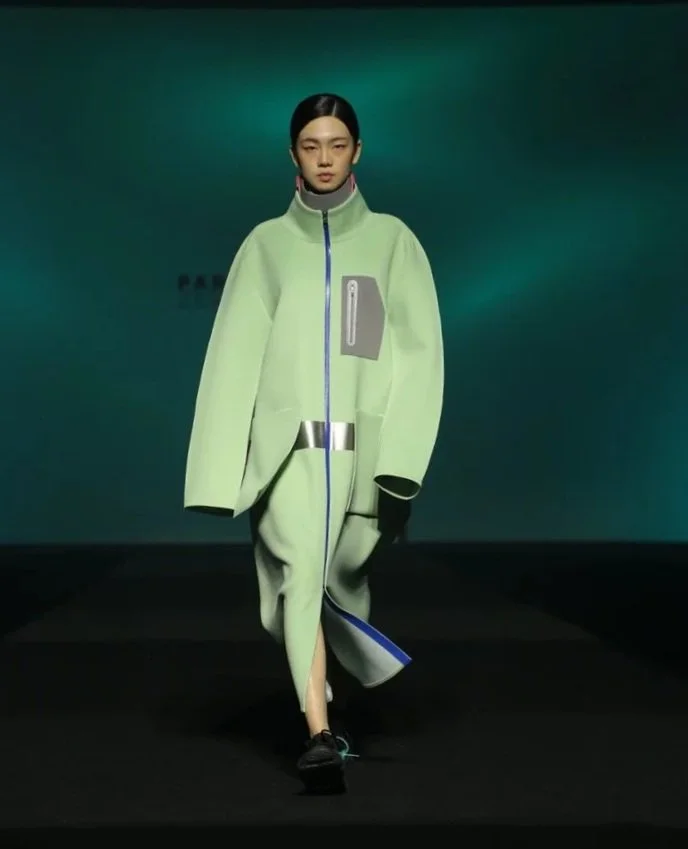
IMSEONOC neoprene look at Seoul Fashion Week in March 2023.
The sustainability framing is not incidental. The Korean textile industry is actively constructing a narrative that connects postwar resourcefulness to contemporary zero-waste values — the argument that Korean fashion has always done more with less, that the parachute blouse and the PFAS-free nano-membrane are points on the same line. Designer Lim Seon-oc (임선옥) of PARTsPARTs — whose entire brand since 2011 has run on a single self-developed neoprene with welded seams, no cutting waste, and 100% recyclable mono-material construction — runs public zero-waste workshops that explicitly narrate Choi's canopy recycling as their direct ancestor. The Seoul Museum's 2022 registration of the parachute blouse as National Cultural Heritage, alongside Choi's military blanket coat from the same period, was the state formalizing that narrative.
There is a certain irony in all of this that is worth naming. The government that in 1951 banned nylon as a decadent luxury now preserves a nylon blouse as patrimony. The Wartime Life Improvement Act's prohibition of the very material used to make the country's most historically important fashion object is not a footnote. It is the whole story. Korean fashion creativity did not emerge despite the state's attempts to control material culture. It emerged against them — through a refugee designer who looked at a military surplus canopy, saw a blouse, and sold it to women who wanted to feel beautiful in a city surrounded by rubble.

A war artifact that refused to be one
The standard modernization narrative frames the Korean 1950s as a lost decade — poverty, dependency, reconstruction — and locates Korean fashion's emergence in the export-industrial 1970s, the Olympic 1980s, or the hallyu 2000s. The parachute blouse breaks that chronology completely. It shows a working, profitable, style-literate women's fashion economy operating under a bombing campaign and against an active prohibition, supplied by an American military waste stream, staffed by refugee designers, and already building the industrial muscle that would make Kolon, Cheil Mojik, and the entire Daegu textile complex viable.
Choi Kyung-ja did not wait for peace, prosperity, or permission. She cut up what fell from the sky, sold it to women who wanted to feel human again, and in doing so wrote the first paragraph of the K-fashion story that the world is now reading backward. Every designer in this piece followed from that act. André Kim's 1966 Paris show. Nora Noh's 1963 ready-to-wear line. Lee Young-hee's hanbok at prêt-à-porter. Lie Sang-bong's Hangul across twelve Paris seasons. All of it downstream from a woman in wartime Daegu who decided that a parachute canopy was actually a blouse.
The war didn't interrupt Korean fashion history. It started it.