The Label Is the Lie: How Seoul Turned "Vintage" Into the Perfect Hypermodern Con
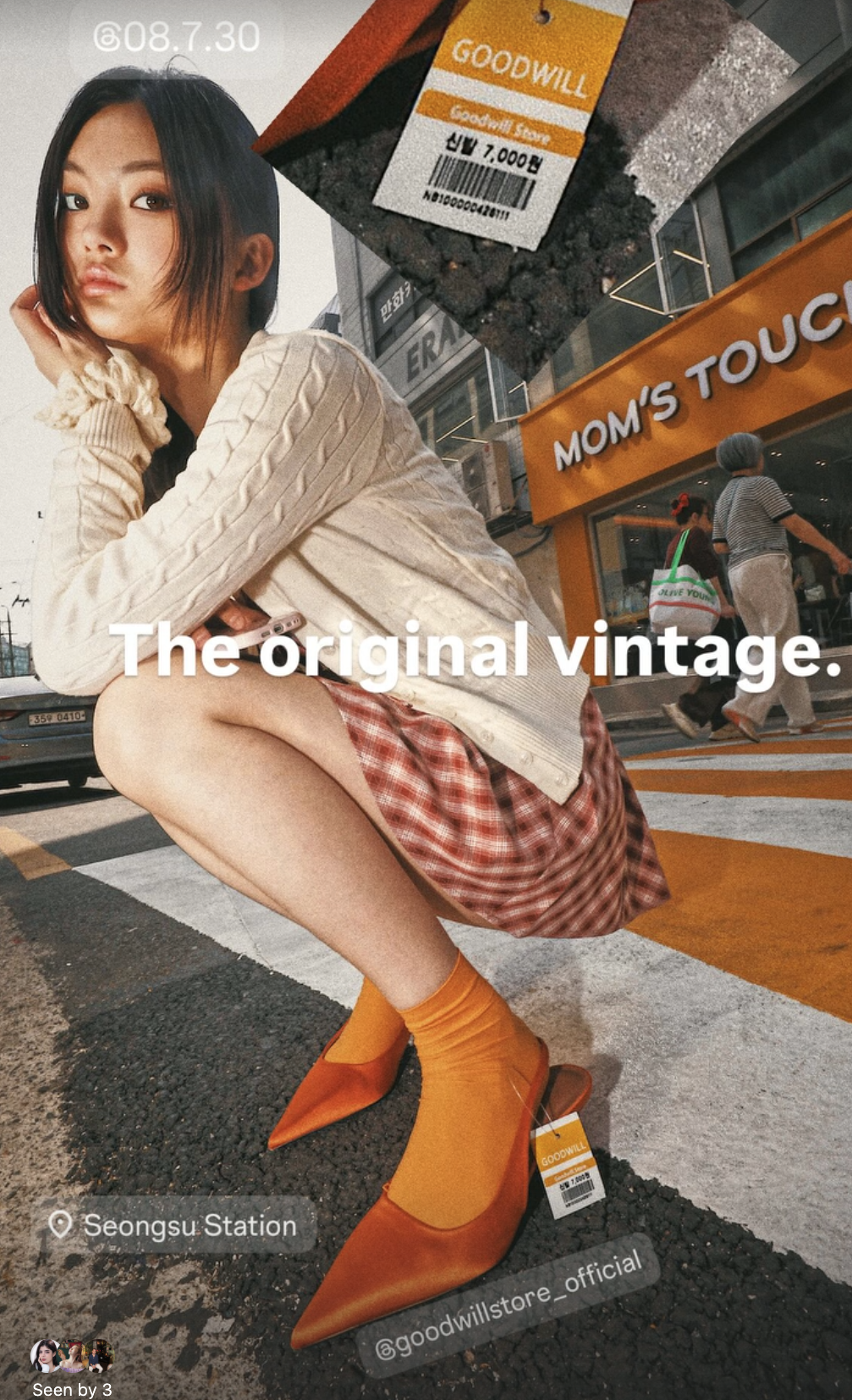
Goodwill Korea low-key SLAPS for the good shit. Those orange slingback kitten heels? 5 bucks.
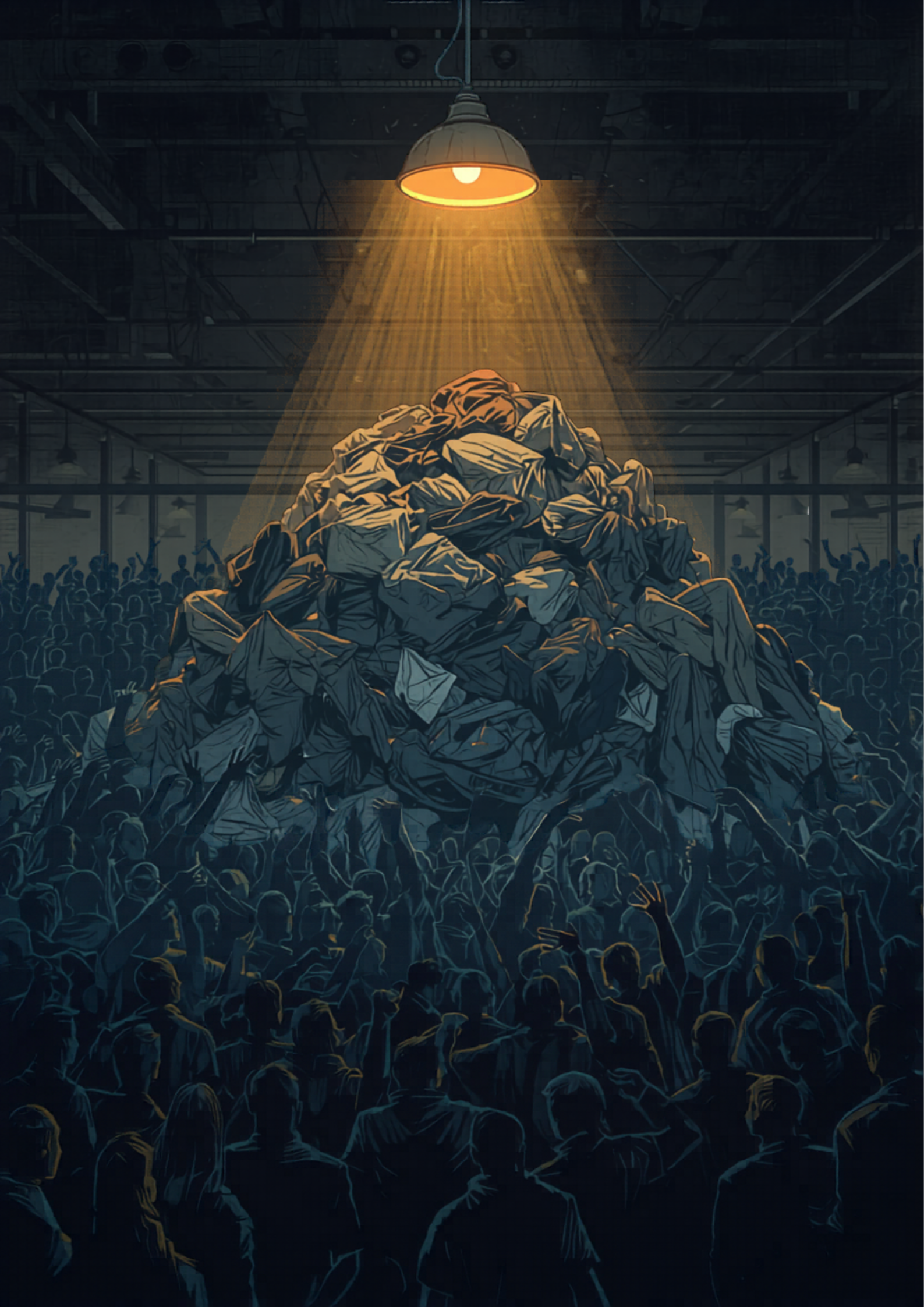
It's 5:30 a.m. at a used clothing collection center in Ansan, about an hour southwest of Seoul, and a war has broken out.
Not metaphorically. Merchants are physically fighting — scrambling, elbowing, diving — through a 30-ton mound of clothing that arrived in the pre-dawn hours. A Hankyung reporter who witnessed this scene called it an 옷무덤 — a clothing mountain: compressed bales from apartment-complex donation bins, from domestic recycling centers, from the discarded wardrobes of Gangnam apartment residents who sometimes, astonishingly, throw out Burberry coats with the original tags still attached. The buyers who surface from this pile with something good — something nameable, something Instagrammable — will have it cleaned, racked, and priced in a Seongsu-dong (성수동) boutique before the week is out.
By the time you find that coat on the rack, it costs ₩150,000. The merchant paid less than ₩5,000 for it at dawn. In the dark. In a fight.
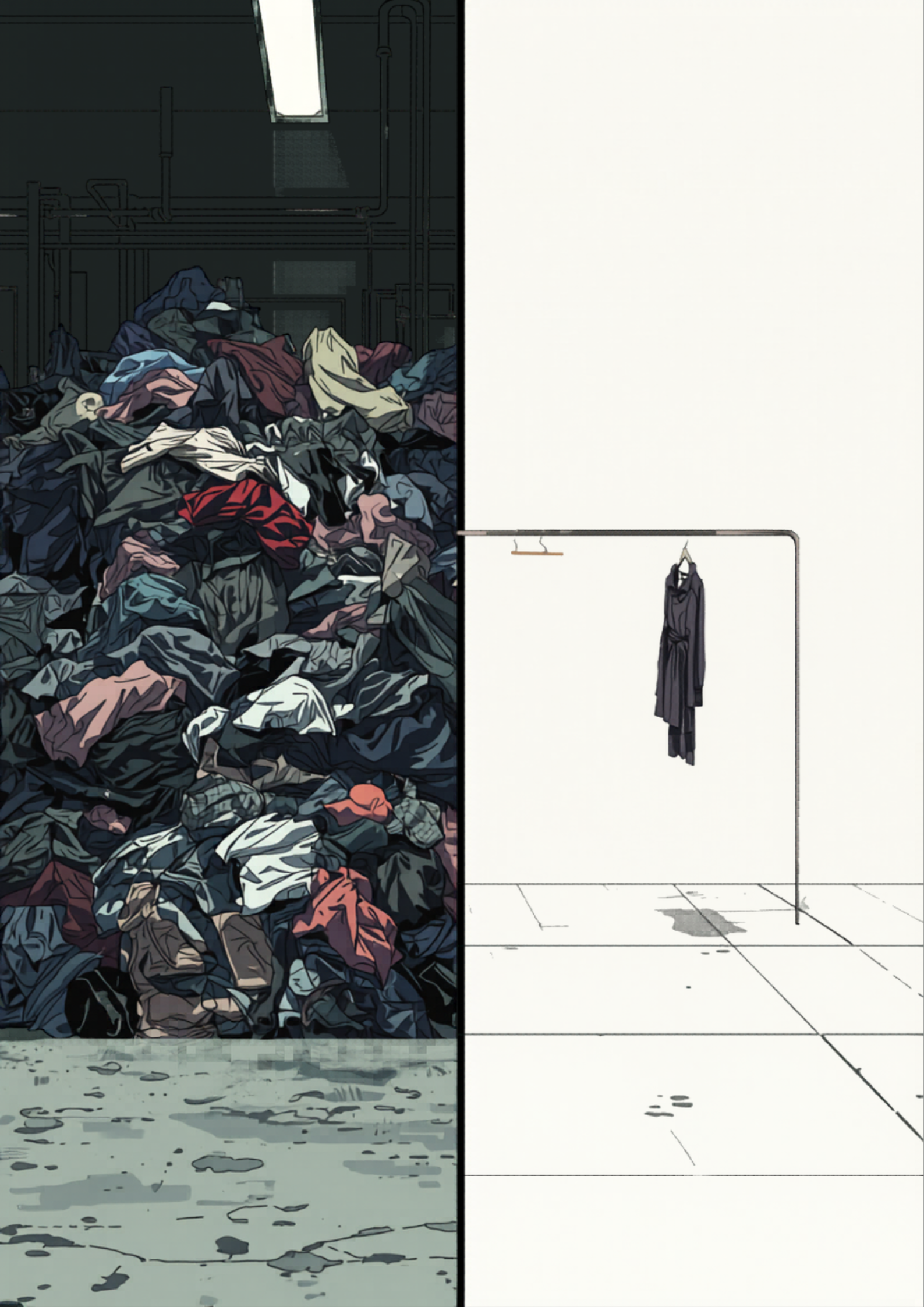
That gap — between the clothing mountain at 5:30 a.m. and the softly-lit boutique at 2 p.m. — is not a scandal. It's a system. A highly efficient, algorithmically amplified, sociologically sophisticated system that tells you something important not just about Seoul's vintage market, but about the specific kind of civilization that produced it: a hypermodern one, where the sign has completely eaten its referent, and everyone is perfectly fine with that.
The Terminology Problem (Which Is Actually the Whole Problem)
Korea has three distinct words for what English speakers lazily compress into "secondhand."
보세 (bose) is wholesale fashion-market clothing — Dongdaemun (동대문) goods, mass-produced, new, cheap. 구제 (guje) means literally "rescue" — clothes someone else wore, now resold. And 빈티지 (bintiji) — "vintage" — is defined in a widely-cited thread on the Korean women's cultural forum 82cook.com with devastating precision: "낡아보이게 만든 옷." Clothes made to look old.
Not old clothes. Not used clothes. Clothes manufactured to perform age.
This is not a misunderstanding circulating among uninformed consumers. Korea's comprehensive cultural encyclopedia Namu Wiki documents the same definition, adding that "it's common for secondhand shops that only carry cheap, unremarkable clothes to call themselves 'vintage shops'" — 큰 특색 없는 저렴한 옷만 취급하는 구제샵도 상호엔 빈티지샵을 자칭하는 경우도 흔하다. There is no regulatory standard in Korea distinguishing "vintage" from contemporary production. No official age threshold. No provenance requirement. The label is purely aesthetic. It means: worn-looking. It means: the vibe of age, without the inconvenience of actual age.
In Korea, "vintage" is a style category, not a provenance claim. And once you understand that, a ₩43 trillion (~$30 billion USD) market projected to exceed ₩50 trillion in 2026 makes complete, perfect, internally consistent sense — in a way it couldn't before.
The Four-Tier System Nobody Names
Seoul's vintage market is not a simple fraud. It's more interesting than that. It operates across four distinct tiers — all of which share retail space, Instagram hashtags, neighborhood aesthetic, and frequently the same storefront signage — with no mechanism, legal or linguistic, for distinguishing one from another.
Tier One: authentically secondhand. Dongmyo (동묘) Flea Market — the sprawling, low-lit, genuinely chaotic market near a Joseon-dynasty military shrine in Jongno — runs floor piles where shirts go for ₩8,000 and pants for ₩20,000. Kilo stores like Road Vintage sell imported bales at ₩15,000 per kilogram, completely transparent about sourcing. A 30-year Dongmyo vendor told investigative outlet The Scoop that even at those prices, he "can barely sell one item a day." This is real 구제. The provenance is not a mystery. It smells like someone's closet because it is someone's closet. This tier, ironically, is the one with the lowest margins and the least Instagram engagement.
Tier Two: genuine vintage with a curation premium. Hongdae (홍대) and Seongsu-dong boutiques source from the same import pipelines — VintageTalk (빈티지톡), one of Korea's major vintage wholesalers, imports 100-pound bales from American secondhand warehouses and updates 2,000+ items weekly, noting explicitly that "non-branded items come mainly from the US, while branded items are imported from Japan." The garment is real secondhand. But the same shirt available at Dongmyo for ₩10,000 sells for ₩50,000–200,000 in a boutique context. The markup is for selection, staging, and the aesthetic labor of making you feel like you found something. Whether that labor is worth it is between you and your credit card. What's worth noting is that this tier is under genuine supply pressure: Bronzewick's owner told Hankyung that wholesale costs have risen 2–3× as real vintage inventory grows scarcer — proof, paradoxically, that these stores are dealing in genuine secondhand, since fake vintage would face no supply constraint at all.
Tier Three: the gray zone, and it is vast. This is where 복각 (bokkak) military reproductions — new items manufactured to look vintage — share racks with genuine secondhand, where dead stock with original tags gets folded into "vintage" inventory, where the linguistic collapse between 구제 and 빈티지 does its real cultural work. A Segye Ilbo investigation confirmed that reproduction military pieces are openly mixed with authentic old items in Hongdae stores. Nobody flags the difference. There is no flag to raise.
Tier Four: new production sold as vintage — and the infrastructure for it is hiding in plain sight. DnCorea, a China-to-Korea clothing sourcing agency operating openly in the market, lists 라벨작업 — literally "label work," i.e., swapping labels on Chinese-manufactured goods for Korean online mall operators — as a standard service. The agency sources from 1688.com, VVIC, Taobao, and wholesale bases in Guangzhou and Dongguan, noting matter-of-factly that Korean operators routinely "mix Dongdaemun domestic goods with Chinese imports." Business of Fashion has documented that Dongdaemun (동대문) can move from trend concept to retail product in under 24 hours — a production velocity that makes the "vintage discovery" narrative essentially a fiction at this tier. A guide for visitors on KoreaExperience.com states flatly: "Never buy 'vintage' from a street stall — it is just a distressed fake."
The pricing across these tiers is the tell. A collection-center bale costs roughly $0.50–$2.00 per kilogram. A boutique shirt retails at ₩50,000–200,000. The margin between those two points — somewhere between 1,000% and 10,000% — is not the margin of rare-item curation. It is the margin of fashion retail. The "vintage" boutique is not a curation service. It's a production system where the product being manufactured is an experience of discovery.
Musinsa Built the Bridge — and Then Burned the Distinction
If you want to understand how "vintage" in Korea became permanently detached from the concept of actual old clothing, you need to understand Musinsa (무신사).
Korea's dominant online fashion platform — $3.3 billion GMV, 10+ million active users, the closest thing Korea has to a fashion operating system — maintains a dedicated 빈티지 and 빈티지룩 ("vintage look") search category. Type in that term. Every result is new production. Not secondhand garments. Not curated vintage. New clothes from brands using vintage-inspired design, manufactured at scale, sold at standard fashion markup under the semantic umbrella of "vintage." Musinsa's own private-label SPA brand, Musinsa Standard, produces retro and vintage-styled pieces that move through trend cycles at exactly the speed of fast fashion.
By the time a Korean Gen-Z consumer has been algorithmically exposed to "vintage" on Musinsa a few hundred times — which happens fast on a platform they open daily — the cognitive framework has been established with industrial efficiency: vintage means a look, not a history.
Then in August 2025, Musinsa launched Musinsa Used — a genuine secondhand resale service that attracted 10,000+ sellers and shipped 34,000+ garment bags within two weeks of launch. So now the same platform sells new "vintage-look" items and facilitates genuine secondhand, under the same brand umbrella, with no particular distinction made between them. The confusion is not a glitch. It's the product.
The broader platform ecosystem completes the picture. Bungaejangter (번개장터) — Korea's most fashion-focused secondhand platform, where 54% of members are teens or in their twenties and fashion accounts for roughly half of all transactions — ran an explicit campaign built around the tagline: "패션의 미래는 빈티지에 있다고 믿으니까" — "Because we believe the future of fashion is in vintage." Their Vintage Festival featured 15 curated vintage boutiques alongside vintage YouTuber 박영감 (Park Youngam). KREAM (크림), the Naver-backed platform that started as a sneaker resale authenticator, rebranded its boutique category as "vintage" and reported 203% year-over-year transaction growth in that category. These platforms are not passively reflecting consumer demand. They are actively constructing "vintage" as a market category — because transaction volume requires it.
Who's Buying, and Why — The Sociology of the MZ Generation
The demographic driving this market is what Korean researchers and marketers call the MZ세대 (MZ Generation) — Millennials and Gen Z combined, born roughly 1980–2010, representing approximately 32.5% of Korea's population and a wildly outsized share of its fashion spending.
The sociological conditions this generation carries into the vintage market are specific and documentable.
They practice 미닝아웃 (Meaning-Out) — expressing personal values and identity through consumption choices. They oscillate between 플렉스 (flex) culture — conspicuous display of premium purchases — and YONO (You Only Need One) selectivity, a response to economic anxiety dressed up as minimalist sophistication. They have been described in Korean cultural commentary as the "우아한 가난의 세대" — the "generation of elegant poverty" — the first Korean cohort to be economically worse off than their parents, yet structurally unwilling to sacrifice aesthetic self-presentation. And in 2026, KB Financial Group's consumer research unit documented three dominant MZ consumption trends: 제철코어 (seasonal hyper-specificity), 필코노미 (necessity-economy selectivity), and 나노커뮤니티 (nano-community belonging). Vintage consumption sits precisely at the intersection of all three: it signals seasonally relevant taste, it performs financial selectivity, and it secures membership in a community of people who know what real vintage looks like — whether or not they're actually buying it.
The 뉴트로 (Newtro, "new + retro") phenomenon built the cultural architecture for this market. Demand for vintage and retro-styled fashion grew roughly 40% among Korean Gen Z consumers during the Newtro wave, fueled initially by brands like MLB Korea and New Balance, and then turbocharged by K-pop aesthetics. The idol dimension cannot be underestimated. G-Dragon (GD, of BIGBANG) famously filmed footage at Dongmyo, creating what vendors now call "GD Alley" and triggering immediate surges in foot traffic and prices. NewJeans built an entire visual identity around Y2K aesthetic — which is to say: around vintage look, manufactured for mass consumption by HYBE, one of the world's largest entertainment conglomerates. The idol association with vintage authenticity is pure simulacrum: the most mass-produced cultural objects in Korea signal the most "individual" consumption behavior in Korea.

What the Academic Research Actually Found
Here's where it gets theoretically precise — because Korean academics have been studying this market, and their findings are more damning than the consumer forum posts.
A 2019 study by Lee Hae-dong (이해동) and Lee Min-sun (이민선), published in the Korea Design Forum (한국디자인포럼) and indexed in the Korea Citation Index (KCI), directly examined vintage fashion values among Korean Millennials. The study identified a critical bifurcation: traditional vintage fashion values — as established in Western scholarship — center on 저항 (resistance), 향수 (nostalgia), 진품성 (authenticity), and 희소성 (scarcity). Korean Millennial vintage values, however, have pivoted to something the researchers called "일상의 과시를 통한 확대재생산" — literally, "expanded reproduction through everyday display."
That phrase is worth sitting with. "Expanded reproduction through everyday display" is not a description of anti-consumption. It is a description of the classic Bourdieusian distinction mechanism operating through consumption: the use of visible goods to reproduce social hierarchies through the performance of taste. The researchers found that Korean Millennial vintage consumption is primarily about signal, not substance — and that the signal is produced through quotidian self-presentation on social media, not through the actual acquisition of rare or historically significant garments.
A related KCI paper on "vintage fashion values among Korean fashion influencers" (한국 패션 인플루언서에 나타난 빈티지 패션 가치) found that influencer-driven vintage aesthetics in Korea function primarily as identity performance rather than cultural preservation — a finding that maps directly onto Pierre Bourdieu's distinction framework in La Distinction (1984). For Bourdieu, cultural capital — the accumulation of taste, knowledge, and aesthetic sensibility — functions as a form of symbolic currency that reproduces class hierarchies under the guise of "natural" good taste. Vintage consumption in Korea is a textbook case: the claim to have "found" a unique piece, to know a market that others don't, to have an eye for quality — these are exactly the forms of embodied cultural capital that Bourdieu described as disguised modes of social distinction.
Sarah Thornton's 1995 extension of Bourdieu into subcultural contexts introduced the concept of "subcultural capital" — the insider knowledge and practices that signal membership in a taste community. Her framework applies with precision to Seoul's vintage 파인더스 (finders) culture: the embodied knowledge of what constitutes "real" vintage versus mere 구제 (guje), the ability to 발품 팔다 (literally, "sell your feet" — put in physical labor searching), the skill of assembling a coherent vintage look from disparate pieces. These practices constitute subcultural capital that signals distinction within Korean youth culture. But Thornton herself warned that subcultural capital loses value precisely when it goes mainstream — and Korean vintage crossed that threshold years ago. When Marie Claire Korea publishes best-vintage-shop guides and the Visit Korea government tourism site recommends vintage shopping to foreign tourists as a cultural experience, the subcultural has been absorbed entirely into the commodity mainstream.
The most theoretically interesting dimension comes from a Sustainability journal study comparing fast fashion avoidance behavior between Korean and Spanish consumers. The researchers found that 탈개성화 (tal-gaeseonghwa) — deindividuation, the fear that mass fashion consumption erases individual identity — was a significant driver of anti-consumption and vintage-seeking behavior in Korea, but was not a meaningful driver in Spain. The authors attributed this to Korea's structurally collectivist social organization: in a culture where conformity is embedded through school uniform systems, hierarchical workplace culture, and the relentless 빨리빨리 (ppal-li ppal-li, "hurry-hurry") trend cycle, the performance of individuality becomes itself a conformist act. The vintage consumer in Seoul is not a rebel. They are a conformist performing rebellion, at scale, in coordination with millions of other conformists performing the same rebellion, in the same neighborhoods, buying the same "unique" items.
Douglas Holt's influential 1998 paper in the Journal of Consumer Research, "Does Cultural Capital Structure American Consumption?", provides the precise mechanism: contemporary distinction operates through consumption practices — how things are consumed, the rituals surrounding acquisition — rather than through consumption objects themselves. What you buy matters less than the performance of how you found it, how you know it's good, how you wear it. The Dongmyo pilgrimage, the Seongsu-dong boutique circuit, the Instagram documentation of finds — these constitute a standardized, reproducible performance of authentic discovery. The discovery itself is the mass-produced product.
Baudrillard Was Right, and Seoul Is the Proof
Jean Baudrillard's concept of the simulacrum — developed across Simulacra and Simulation (1981) and Symbolic Exchange and Death (1976) — describes a process in which signs become detached from their referents and begin producing their own reality. He identified four stages: a faithful image of a deep reality; a perversion or masking of that reality; an absence of any profound reality; and finally the pure simulacrum — a sign that has no relationship to any reality whatsoever, only to other signs.
Korean vintage fashion operates predominantly at stage three, trending toward stage four.
A Korean academic study on "Modern Fake Fashion Based on Simulacre Concept of Baudrillard," published in the Korean fashion studies literature, identified the terminal stage of this process as "forming new value and independent aura beyond reproducing the original." This is exactly what Korean vintage consumption has achieved. The concept of "vintage" in Seoul no longer refers to old garments. It refers to itself — to the accumulated cultural meaning of the word, the aesthetic, the shopping ritual, and the Instagram grammar that surrounds them. A new item manufactured in Guangzhou and tagged as "vintage-look" on Musinsa is not pretending to be old. It is invoking the sign system of vintage — and in a Baudrillardian sense, that invocation is the product. The garment's actual history is irrelevant because the history was never the point.
The garment is a delivery mechanism for the sign. The sign is what's being consumed.
This is hypermodernity's core operation: the acceleration and intensification of sign production to the point where signs circulate independently of any referent, and consumers purchase sign-value rather than use-value or even exchange-value. Korea's 빨리빨리 culture applies its characteristic velocity to this process. In Japan, it took 70 years to build a genuine vintage infrastructure. In Korea, it took roughly a decade to build a vintage aesthetic infrastructure — no authenticity required, no history necessary, no slowdown tolerated.
Japan Proves What Actual Vintage Culture Looks Like — and the Comparison Is Brutal
South Korea's relationship to Japan's vintage market is not that of a peer culture. It is that of a consumer.
Japan has more vintage clothing shops per capita than any country on earth. Shimokitazawa (下北沢) alone contains approximately 200 vintage boutiques. Japan's furugiya (古着屋 — literally "old clothes shop") culture spans more than 70 years, with roots in post-WWII American military surplus markets. The differences between this culture and Seoul's are not aesthetic. They are structural, epistemological, and philosophical.
Authentication is institutional. Japan's secondhand retail operates under strict legal regulations with multi-tier authentication by certified specialists. KOMEHYO employs master appraisers with 20+ years of experience. Items are graded using a seven-category surgical vocabulary running from 新品 (shinpin, brand new with tags) down to 全体的に使用感・汚れのある商品 (well-used throughout with significant soiling). Staff physically steam each piece before placing it on the sales floor. The smallest defect affects price. This is a knowledge system, not a vibe system.
The collector-scholar tradition is genuine and obsessive. The Amekaji (アメカジ — American Casual) movement demonstrates what authentic vintage engagement actually requires. Beginning in the 1960s, Japanese collectors traveled to the United States with empty suitcases, hunting vintage American workwear. In the 1980s and 90s, the "Osaka Five" — Studio D'Artisan, Evisu, Fullcount, Denime, and Warehouse — were founded by collectors who had spent years building archives of original 1940s–70s American denim, and who then devoted years more to reproducing those originals with fanatical fidelity: chain-stitch hems, shuttle-loom construction, period-correct thread weights, authentic selvedge lines, denim weights ranging 14–21 oz. The details are legible only to other enthusiasts. There is no visible branding. This is the exact opposite of performative vintage: it is vintage as scholarship, as material culture research, as craft archaeology.
Boro textile culture illustrates the philosophical gulf most clearly. Japanese boro (ぼろ) garments — the layered, patched, stitched textiles from Edo-period rural communities — were not made as fashion objects. They were functional garments repaired and re-repaired over multiple generations using sashiko (刺し子) stitching technique, each patch added from necessity, each layer documenting the material conditions of a family's economic life. After WWII, boro garments carried shame — visible reminders of poverty in a modernizing nation. The rehabilitation of boro as aesthetic object happened slowly, through the work of textile historians and collectors like Chuzaburo Tanaka, whose 20,000-piece collection eventually became the basis for the AMUSE Museum in Asakusa. The cultural philosophies undergirding this relationship to objects — 勿体無い (mottainai, profound regret over waste), 侘び寂び (wabi-sabi, appreciation of imperfection and transience), ものを大切に (mono wo taisetsu ni, cherish your things) — are not marketing slogans. They are embedded epistemologies about the relationship between human beings and material objects.
When a Seoul boutique sells a "distressed" patchwork jacket, it is producing an aesthetic representation of these visual qualities. When a Japanese boro textile exists, it is a historical document of human labor across time.
The trade data makes the relationship explicit. Japan exported $88.2 million worth of used clothing in 2020 alone, with South Korea among the top importing countries. VintageTalk, one of Korea's largest vintage import operations, explicitly notes that "branded items are imported from Japan." Seoul's curated vintage market is a downstream consumer of the genuine vintage infrastructure Japan spent seven decades building. Korea took the output of Japan's material culture and put it on Instagram.
A member of the Vintage Fashion Guild who visited Korea summarized the situation with the economy of someone who has spent decades thinking about this: "Nothing by way of vintage there. People are well-dressed in general and mostly dressing by the same styles/trends."
Seven words that collapse the entire distinction.
The Global Context: Korea Is an Extreme Case of a Universal Problem
The fast-fashion-as-vintage pipeline is not uniquely Korean. But Korea is its most advanced expression.
In Western markets, the mechanisms are increasingly documented. On Depop, sellers dropship AliExpress "Y2K-inspired" items listed with vintage-coded language. Urban Outfitters' "Urban Renewal Vintage" line — marketed as "lovingly hand-picked" — has been confirmed by former designers to be sourced from bulk wholesale operations. In 2025, PreLoved Pod documented how Banana Republic directly replicated a hand-repaired pair of vintage Levi's 501s from a San Francisco vintage shop, mass-producing faux-sashiko-repaired denim that mimicked the original owner's handmade documentation video down to the repair pattern. A former URBN Corporation designer confirmed the mechanism: "Design teams scout everywhere — vintage stores, competitors, fast fashion, small indie labels." The vintage aesthetic is treated as found material, strip-mined for production signals.
The global resale market reached $227 billion in 2024 and is projected at $367 billion by 2029, according to ThredUp's 2025 Resale Report — a CAGR of roughly 10%, growing 3× faster than the overall apparel market. A record 58% of American consumers shopped secondhand in 2024. These numbers look like an environmental and economic revolution. But a critical 2025 study published in Nature Scientific Reports — based on consumer behavior data, not self-reported attitudes — found that secondhand fashion consumption is positively correlated with new clothing purchases (r = 0.58, p < 0.01). Buying secondhand does not replace new purchases. It supplements them, through moral licensing ("I bought vintage, so I can also buy this new piece") and rebound effects (engagement with fashion as a category increases overall fashion spending). The sustainability promise of vintage consumption is, at minimum, unproven. At maximum, it's greenwashed fast fashion consumption with extra steps.
What makes Korea structurally distinct from Western vintage markets is not the presence of these dynamics — they're everywhere — but their compression, acceleration, and systematization. Korea's vintage market went from marginal to ₩43 trillion in under a decade, without the American thrift infrastructure built by generations of Goodwill and Salvation Army donations, without the UK's charity shop network embedded in every high street, without Japan's seven-decade collector-scholar tradition. Korea applied 빨리빨리 to vintage adoption: the trend was imported as aesthetic, platform-ified by Musinsa and KREAM, scaled through KG import operations, and monetized before any underlying culture of authenticity had time to form.
The market reached critical mass before the foundation was poured. That is not an accident. That is hypermodernity operating as designed.
The Infrastructure of Inauthenticity
The final piece of the picture is the one hiding most openly: the sourcing infrastructure that makes the whole system run.
Korean vintage sourcing operates through at least three documented channels. The first is KG (킬로그램) — kilogram-weight import operations that bring sorted bales from American and Japanese collection centers through warehouses in Incheon and Ansan, where merchants sort into categories (by brand recognition, garment type, condition) before distributing to retail. Road Vintage, one of the most prominent KG operations in Korea, identifies itself as "Korea's first KG import vintage operator" and sells directly to the public at ₩15,000/kg — transparent, efficient, and operating at industrial scale.
The second channel is curated import from Japan and the US — the premium tier, where specific branded items (Levi's, Carhartt, Ralph Lauren, Champion) are sourced individually or in targeted lots, priced per piece rather than per weight, and sold through boutiques at margins consistent with luxury retail.
The third channel is the one that completes the loop back to Tier Four: Chinese manufacturing sourced through B2B wholesale platforms. DnCorea's service menu — openly published — includes domestic brand consultation, Chinese production sourcing from 1688.com and VVIC, import logistics, and 라벨작업 (label replacement). The agency serves Korean online mall operators who need to move product that reads as anything other than Chinese fast fashion. The gap between "vintage-look jacket from a Guangzhou factory with label-swapped" and "imported vintage jacket from an American warehouse" is, from a retail presentation standpoint, not visible to the consumer. Both arrive on the rack looking like they came from somewhere interesting. Neither has a verifiable history. One just cost considerably less to acquire.
And this is where the system reveals its final elegance: it doesn't need to be uniform fraud to function as a coherent market. The genuine Dongmyo floor pile, the curated VintageTalk import, the reproduction military jacket, and the label-swapped Guangzhou garment all operate under the same 빈티지 sign. The sign does not discriminate between them. The consumer — who, per the 82cook.com definition, understands that vintage means "clothes made to look old" — is not deceived. They are participating. The sign is what they paid for. The sign is what they received.
The Steam Ritual and What It Means
In Shimokitazawa's vintage shops, staff steam each garment before placing it on the sales floor. This takes time. It communicates something specific about the shop's relationship to the object: that it has been examined, that its condition has been assessed, that it has been prepared for presentation with care. The steam is a ritual of custodianship.
In Seoul's vintage boutiques, the ritual is different. It is the Instagram flat-lay, the minimalist white-shelf display, the muted-toned fitting room, the Notion-formatted price tag with the garment's putative origin ("USA 1990s"). These rituals communicate something too — but what they communicate is not custody of the object's history. They communicate fluency in the visual grammar of authenticity. The store is not demonstrating that the garment has a history. It is demonstrating that the store knows what a garment with a history should look like.
This is the purest expression of Baudrillard's third-order simulacrum: a sign that masks the absence of a profound reality. The shop has mastered the semiotics of vintage curation. Whether any particular garment is actually vintage is epistemologically irrelevant — not because anyone is hiding it, but because the question itself no longer applies. In a market where vintage means clothes made to look old, authenticity is not a property of the garment. It is a property of the sign system surrounding it.
The steam is a ritual of care for objects with history. Its absence in Seoul signals that the history itself is absent. And nobody in this market — not the sellers, not the platforms, not the academics, not the consumers — is pretending otherwise.
📷 [PLACEMENT 8 — AI IMAGE: The Label]Canva illustration: close-up of a clean pristine clothing label against heavily distressed denim collar, new vs. worn contrast as the entire visual focus, clinical lighting, no brand names. See Canva Image Sub-List #4 — regenerated version combining fabric texture of candidate 4 with label legibility of candidate 3. Insert portrait/square, centered.
What This Is, Precisely
Korean vintage consumption is not a scandal. Calling it fraud would require that someone was being deceived — and the evidence strongly suggests everyone involved understands the transaction they are making.
What it is, precisely, is the most advanced contemporary example of what Pierre Bourdieu predicted in 1984 and Jean Baudrillard predicted in 1981: a consumer economy in which cultural capital is purchased rather than accumulated, in which signs circulate independently of referents, and in which the performance of distinction is itself mass-produced and mass-consumed, at fashion-industry speed, on fashion-industry margins.
Korean academic researchers Lee Hae-dong and Lee Min-sun named it "expanded reproduction through everyday display." Bourdieu called it distinction. Baudrillard called it the simulacrum. The 82cook.com user called it "clothes made to look old."
All four descriptions are accurate. They describe the same object from different distances.
The ₩43 trillion market is not built on lies. It is built on a collective agreement — enforced by platforms, aspirational models, academic trend cycles, and 빨리빨리 velocity — to value the performance of vintage over the fact of it. In a hypermodern economy, where every material object has been absorbed into sign-production, this is not even particularly remarkable. It is just fashion doing what hypermodernity does to everything: accelerating the circulation of signs, detaching them from their referents, and selling the detachment as a feature.
Seoul didn't invent this. But it executed it faster, at higher scale, and with greater elegance than anywhere else on earth.
The label is the lie, and the lie is the product, and the product is moving.
Dr. Michael Hurt is a visual sociologist, photographer, and Editor of SEOULACIOUS magazine. He has documented Seoul street fashion for 30 seasons and is Founder & Director of KARSI (Korean Advanced Research & Studies Institute). He teaches cultural theory and art at Korea National University of Arts (K-Arts).
Sources: Lee Hae-dong & Lee Min-sun, "빈티지 패션 가치" (Korea Design Forum / KCI, 2019); Sustainability 12(17), "Fast Fashion Avoidance Beliefs and Anti-Consumption Behaviors: The Cases of Korea and Spain" (2020); Nature Scientific Reports, "Secondhand fashion consumers exhibit fast fashion behaviors despite sustainability narratives" (2025); Bourdieu, La Distinction (1979/1984); Baudrillard, Simulacra and Simulation (1981); Thornton, Club Cultures: Music, Media and Subcultural Capital (1995); Holt, "Does Cultural Capital Structure American Consumption?" Journal of Consumer Research 25(1) (1998); Hankyung, "A급 빈티지 옷, 부르는 게 값… 구제시장 헌 옷 입수 경쟁" (2023); Segye Ilbo, "어느 별에서 왔니? 구제옷에 숨겨진 비밀" (2017); Namu Wiki, 구제 entry; 82cook.com community thread on 보세/구제/빈티지 (2022); ThredUp 2025 Resale Report.