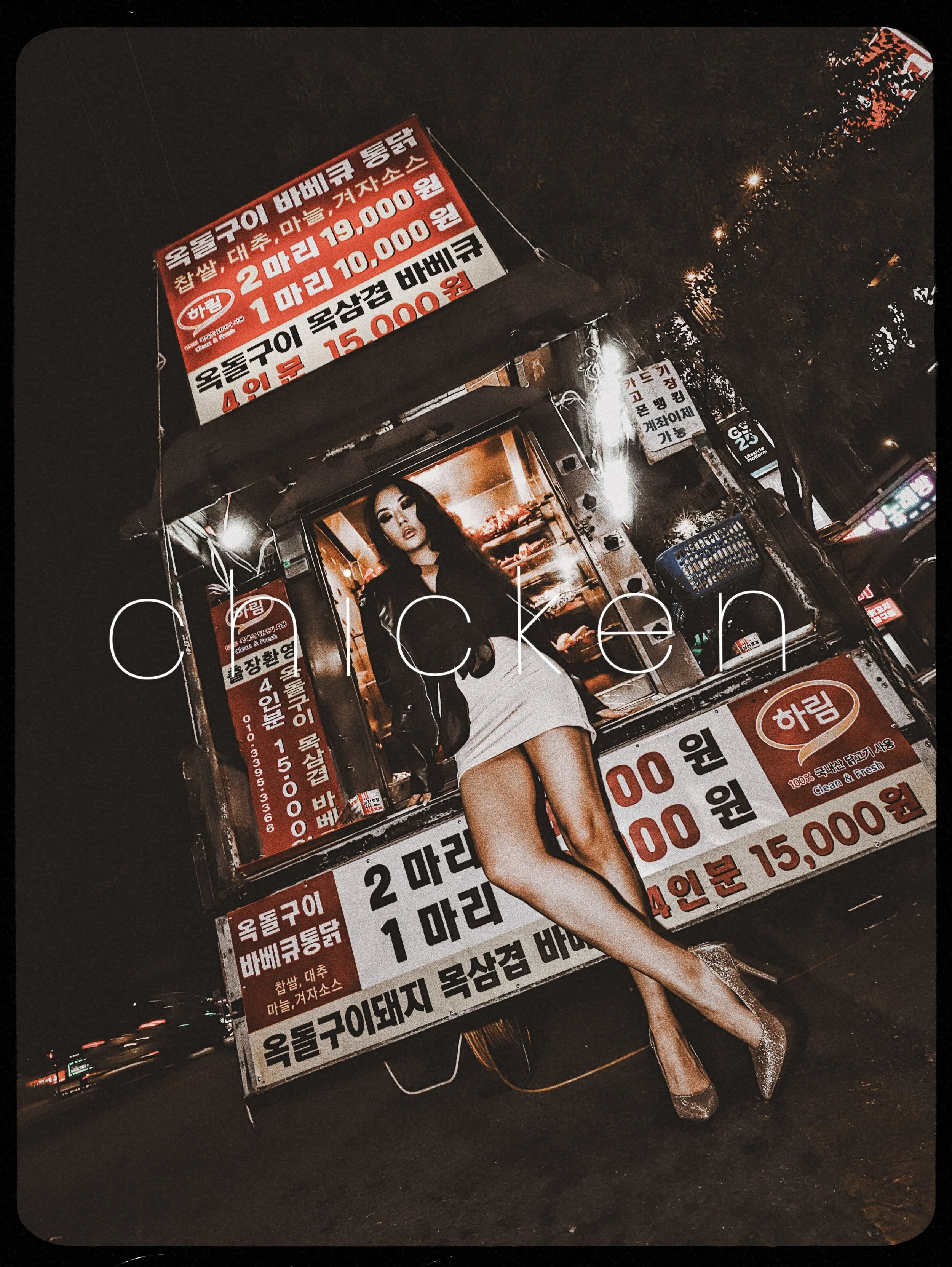
It's 11pm on a Tuesday in Mapo-gu. A delivery rider cuts between the orange glow of convenience store signs and disappears down an alley. Inside a third-floor apartment somewhere above a 편의점 (pyeonuijeom — convenience store) and a nail salon, a box arrives. Fried chicken, golden and lacquered in a red-brown sauce that coats the fingers on contact. A can of Hite sweating on the table.
This is not a special occasion. This is just Tuesday in Seoul.
Korea has approximately 40,000 dedicated fried chicken restaurants — roughly as many as McDonald's has locations on the entire planet. In a country the size of Indiana. That number is insane. And the story of how it happened is nothing like the one most people tell.
The Story Everyone Tells (And What's Wrong With It)
You've heard the narrative. African American GIs, stationed in Korea after the war, teaching locals to fry chicken. Black culinary tradition crossing the Pacific, military bases as vectors of cultural transmission. It's a satisfying story. It connects real, important histories. Food personality Alton Brown stated it as flat fact on Netflix in 2022. Dozens of websites ran with it. Nobody asked for a source.
There isn't one.
No military records, no contemporaneous newspaper articles, no named oral histories, no photographs, no letters. Nothing tying any specific African American soldier to any specific Korean cook in any documented moment of culinary transmission. The frequently cited anecdote about a "Korean tank driver" who described fried chicken as "a taste of heaven" during Thanksgiving? It appears in identical marketing copy across multiple Korean fried chicken restaurant websites. It is never attributed to anyone.
Compare that to budae-jjigae — army stew, that glorious, transgressive mixture of Spam and ramen and hot dogs that Seoul's pojangmacha still sling at 2am in Noryangjin and Mapo. Budae-jjigae has a documented creator, a specific restaurant, a paper trail. If fried chicken had entered Korean cuisine through equally direct contact, you'd expect something similar. You don't get it.
This doesn't mean Black culinary history doesn't matter. It means attaching it to Korea requires actual evidence — not vibes and a good narrative arc.
The African American GI story also has a physics problem.
The Oil Problem Nobody Talks About
Mass commercial cooking oil did not exist in Korea until approximately 1971, when Haepyo and other manufacturers began large-scale vegetable oil production. Before that, oil was scarce and expensive. Deep-frying at scale was not a cultural choice Koreans were declining to make. It was materially impossible.
The Korean War ended in 1953. Affordable cooking oil arrived eighteen years later.
So whatever influence American soldiers had during or after the war, the mass adoption of deep-fried chicken could not have happened until the 1970s at the earliest. The story's entire timeline collapses the moment you ask: how were they frying anything?
There's also a Japanese dimension that the popular narrative quietly erases. Japan had been colonizing Korea since 1910 and didn't leave until 1945. Donkatsu — deep-fried breaded pork cutlet — arrived in Korea through Japanese colonial food culture in the 1930s, training Korean palates to associate the deep-fried crust with modernity and aspiration. The Korean word for "fried chicken" — huraideu chikin (후라이드 치킨, a Japanese-inflected transliteration rather than the standard Korean phonological rendering peuraideu chikin) That's a linguistic fossil in the language itself, suggesting Japanese mediation of the concept before American GIs were in the picture.
None of this is in the Alton Brown version.
What Actually Happened
The documented history of commercial chicken in Korea begins not in a military mess hall but in Myeong-dong.
In 1960, Myeongdong Yeongyang Center (명동영양센타, Myeongdong Yeongyang Senta) opened in the heart of what was then Seoul's most glamorous commercial district — the Myeong-dong of department store windows and first dates and women in heels navigating the same narrow streets that still fill up on weekend nights. They sold whole rotisserie chickens cooked in electric ovens. The name, yeongyang, means "nutrition." Chicken was health food. A payday luxury. The cultural icon of the era was "yellow bag chicken" (노란 봉투 통닭, noran bongtu tongdak): a father coming home to a Mapo or Dongdaemun apartment with a whole roasted bird in a yellow paper bag, once a month, as a treat for the family.
By 1968, chicken delivery had been documented in Seoul. Not fried chicken. Roasted chicken, brought to your door. The infrastructure was already there.
The pivot to deep-frying came through one specific, well-documented person.
In 1975, a businessman named Yu Seok-ho (유석호) traveled to the United States and watched Kentucky Fried Chicken operate. The revelation wasn't the frying — it was the pieces. Selling chicken in individual portions rather than whole birds. He returned to Seoul and, in 1977, opened Lim's Chicken (림스치킨) in the basement of Shinsegae Department Store in Chungmu-ro. Korea's first dedicated fried chicken franchise. A six-piece set for ₩280–330. Cutting chicken into portions was genuinely novel to Korean consumers. The concept expanded to roughly 400 locations.
The building itself deserves a paragraph. Shinsegae — 신세계 (Shinsegae), which means, literally, New World — was founded in 1930 as the first modern department store in Korea, originally a branch of Mitsukoshi, the Japanese department store giant, during colonial occupation. For decades it functioned as the primary portal through which modernity, foreign goods, and new food culture entered Korean consumer imagination. This was where donkatsu — the deep-fried breaded pork cutlet that first trained Korean palates to love a fried crust — arrived in the 1930s, mediated through Japanese colonial food culture before any American soldier set foot on the peninsula. The name wasn't subtle about its ambitions: this was the New World, delivered to downtown Seoul. By 1977, when Yu Seok-ho put Korea's first fried chicken franchise in its basement, he was placing it exactly where Koreans had always gone to encounter the foreign and the modern. The department store didn't just sell things. It sold the idea that the outside world had things worth wanting.
The location is worth pausing on further. Chungmu-ro was — and still is — Seoul's printing and publishing district. Think of it as Myeong-dong's less glamorous older brother: same general geography south of Cheonggyecheon, same dense commercial energy, but built around type shops, printing presses, film production houses, and the small businesses that serviced them. Yu Seok-ho, a businessman, knew that neighborhood. His customers were the men who ran those shops, ate lunch nearby, and were already comfortable spending in a commercial district. The fact that a more affordable, street-level version of fried chicken would eventually take root in the blocks around Chungmu-ro — rather than inside the department store itself — follows its own logic: the New World enters through Shinsegae's front door, then migrates into the neighborhood outside it. He wasn't placing a franchise randomly. He was opening in his own world, right next to the portal.
Then came the person who actually built what you eat today.
The Man from Hyomok-dong
Yoon Jong-gye (윤종계) was born in Daegu in 1952. His printing business collapsed. He opened a modest fried chicken shop — Gyeseong Tongdak — in Daegu's Hyomok-dong neighborhood, the kind of area that's always a neighborhood rather than a destination, the kind of place where the real work of Korean life gets done.
Around 1980, he noticed two things: customers were cutting their palates on hard chicken skin, and chicken stopped being appetizing once it cooled. He spent six months developing a sauce. Korean red pepper powder (not gochujang), starch syrup, and — on the advice of an elderly neighbor — cornstarch as a binding agent. The cornstarch was the breakthrough. It produced a gloss. The sauce clung. It held up to cooling. It made fried chicken work at room temperature in a way it never had before.
He called it yangnyeom (양념, "seasoned") chicken. He also invented chicken-mu (치킨무, chikin-mu) — the pickled radish cubes now served alongside every order in every neighborhood in Korea — after customers complained about digestive discomfort.
In 1985, Yoon launched the Mexican Chicken brand (맥시칸, Maeksikal — nothing to do with Mexico) and aired South Korea's first television commercial for fried chicken. The chain grew to roughly 1,700 outlets. Then an employee secretly patented his sauce recipe. The courts ruled in Yoon's favor. Rather than pursue criminal charges, he chose to have both parties surrender the patent.
He made yangnyeom chicken open-source for an entire industry.
That decision — one man in Daegu choosing not to own something he invented — may be the single most consequential act in Korean fried chicken history. It had nothing to do with any origin story. It was an ethical choice, made in private, with massive public consequences.
Yoon Jong-gye died in January 2026. The Korea Herald ran an obituary.
The Double-Fry and the Economics of Crunch
Meanwhile, Korean fried chicken was quietly developing a technical vocabulary that separated it from everything else.
Double-frying: cook at around 170°C, let it rest, fry again at 190°C. Ultra-crispy exterior, moist interior, skin that shatters rather than bends. Potato starch or cornstarch instead of heavy wheat-flour breading. Younger, smaller chickens. Sauce applied by hand rather than dunked.
Julia Moskin wrote the landmark New York Times piece around 2006–2007 that introduced Korean fried chicken to mainstream American food consciousness. She described the crust as "thin, crackly and almost transparent" — the product of a technique that had been refined through competitive franchise pressure, not imported from anywhere.
No single inventor of double-frying has been documented. It emerged organically in a market where 647 franchise brands were competing for the same customers. Evolution through competition rather than a single moment of genius. Which is, incidentally, how most actual innovation works.
The Chimaek Nation Gets Built in Two Acts
By the late 1990s, Korean fried chicken had everything except the social ritual that would make it iconic.
Act One: The IMF Crisis.
The Asian Financial Crisis hit Korea like a structural failure — not a downturn but a collapse. The IMF bailout came with conditions. Layoffs were mandated. South Korea's average career exit age settled at 52.1 years, well before any pension eligibility. Hundreds of thousands of middle-aged workers found themselves holding lump-sum severance payments and no job prospects. The cheapest franchise available? Chicken.
The industry roughly doubled. Not because chicken got better. Because Korea ran out of other options for its displaced workforce.
Those Gangnam apartments, those Mapo side streets, those Nowon alleys — suddenly they all had chicken shops. The density that looks insane from the outside was built from desperation, not demand.
Act Two: The 2002 World Cup.
Korea's football team reached the semifinal. Nobody expected it. Fifty million people watched in outdoor plazas, and what they ate while watching was fried chicken and cold beer — chimaek (치맥, chimaek: "chi" from chicken, "maek" from maekju, beer). Mapo Hangang Park. Gwanghwamun Plaza before there was a Gwanghwamun Plaza. The streets of Hongdae. The ritual fused itself to a specific, collective joy at a specific, collective moment.
After the tournament, the number of chicken restaurants roughly doubled again.
Then K-drama finished the job. In 2014, My Love from the Star (별에서 온 그대, Byeoreseo On Geudae) aired the line: "A snowy day is just perfect for our chimaek time." Jun Ji-hyun said it. Chinese consumers heard it. Korean beer exports to China surged 200% in a single month. In 2021, "chimaek" was added to the Oxford Dictionary alongside hallyu, K-drama, and mukbang.
Daegu — where Yoon Jong-gye developed yangnyeom sauce in Hyomok-dong — now hosts an annual Chimac Festival that draws over a million visitors. The city became the spiritual capital of something that changed Chinese consumer behavior from a single line of dialogue.
The Franchise Math Nobody Wants to Do
Here's what 40,000 chicken restaurants actually means.
There are currently 647 registered chicken franchise brands operating in South Korea. The top three: BBQ (2,316 domestic stores), bhc Chicken (2,228 stores, ₩512.7 billion in revenue), KyoChon (1,361 stores, the highest per-store revenue in the industry). KyoChon's closure rate is 1–2%, the lowest in the business, because they're the quality-over-quantity play and everyone else is fighting for whatever's left.
Most are not KyoChon. Most are former office workers in their fifties who took their severance, paid a franchise fee, and are now working 70-hour weeks in a Seongbuk-gu or Dobong-gu storefront trying to break even. The industry isn't a success story — it's a structural response to a broken labor market that has been replicated every time another generation of Korean workers gets pushed out of formal employment in their early fifties.
In Korea, this is not analysis. It's common knowledge, carried as dark humor. "He opened a chicken shop" is a sentence every Korean adult understands without elaboration — it means a business failed, a career ended, a man needed something to do with his severance before pension age. It sits in the same register as jokes about samgyeopsal restaurants and pojangmacha carts as the fallback options for men who ran out of road. The fact that Yoon Jong-gye, the inventor of yangnyeom sauce, opened his chicken shop after his printing business collapsed isn't incidental background. It's the whole story in miniature. The man who built the foundation of a ₩10 trillion industry did it because he needed another option. Korea's chicken republic was built by people who needed another option.
The fried chicken boom is, at least partially, a monument to an economy that runs on disposable middle-aged workers.
That is not the story Alton Brown told.
What the Record Actually Shows
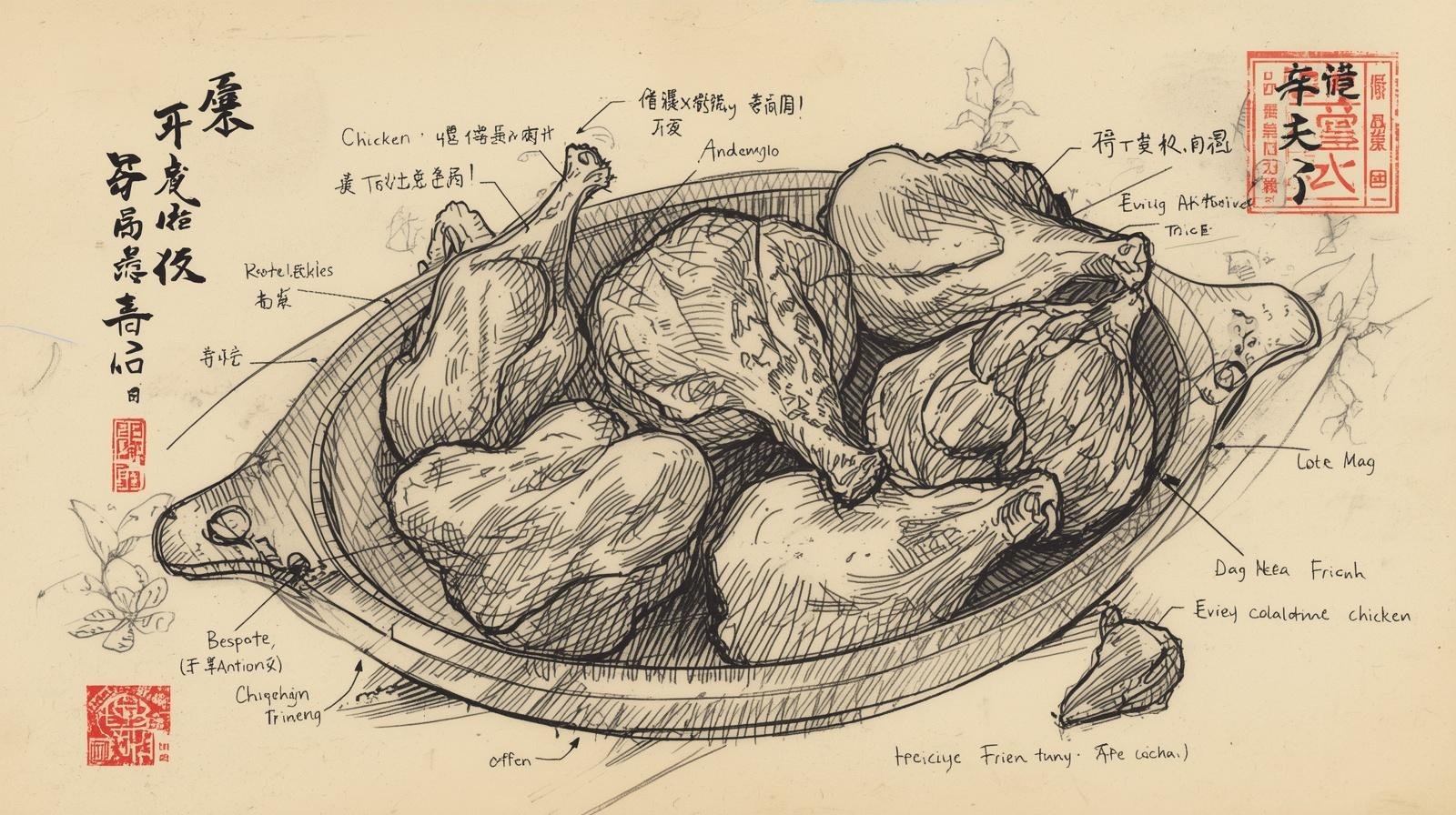
An imagining of a Joseon Chicken recipe.
Korean fried chicken is a story about material conditions — oil availability, agricultural industrialization, economic crisis, franchise infrastructure — at least as much as it's about any cultural transmission. The 15th-century Joseon cookbook Sangayorok documented a dish called pogye (포계, literally "oil-cooked chicken"), chicken cooked in oil with soy sauce, sesame oil, and flour-water. Oil-based chicken preparation existed in Korean culinary tradition before Western contact. Not deep-frying, but not nothing either.
The specific documented path to what you order from your Mapo apartment on a Tuesday night runs through: affordable vegetable oil (1971), Yu Seok-ho watching KFC in America (1975), Lim's Chicken in the Shinsegae basement in Chungmu-ro (1977), Yoon Jong-gye's sauce in Hyomok-dong (around 1980), his decision to surrender the patent, the IMF crisis (1997), the 2002 World Cup, and Jun Ji-hyun.
Not a soldier.
The broader point about American military influence on Korean cuisine is real and documented — budae-jjigae is the actual proof of concept. But the specific claim about African American GIs is two legitimate histories (Black culinary innovation; U.S. military food culture in Korea) joined by an undocumented mechanism, circulated without sources, and amplified by a celebrity on streaming television because it felt true.
The actual story is less cinematic. A man in Daegu whose printing business failed. Six months experimenting with cornstarch ratios. A patent dispute he chose to resolve by giving the recipe away. That's not a story about cultural transmission. That's a story about one person's generosity creating an entire industry.
Forty thousand restaurants. One sauce. One decision.
The delivery rider is already on his way.