Pimpin' Ain't Easy — But K-Pop Makes It Look Effortless
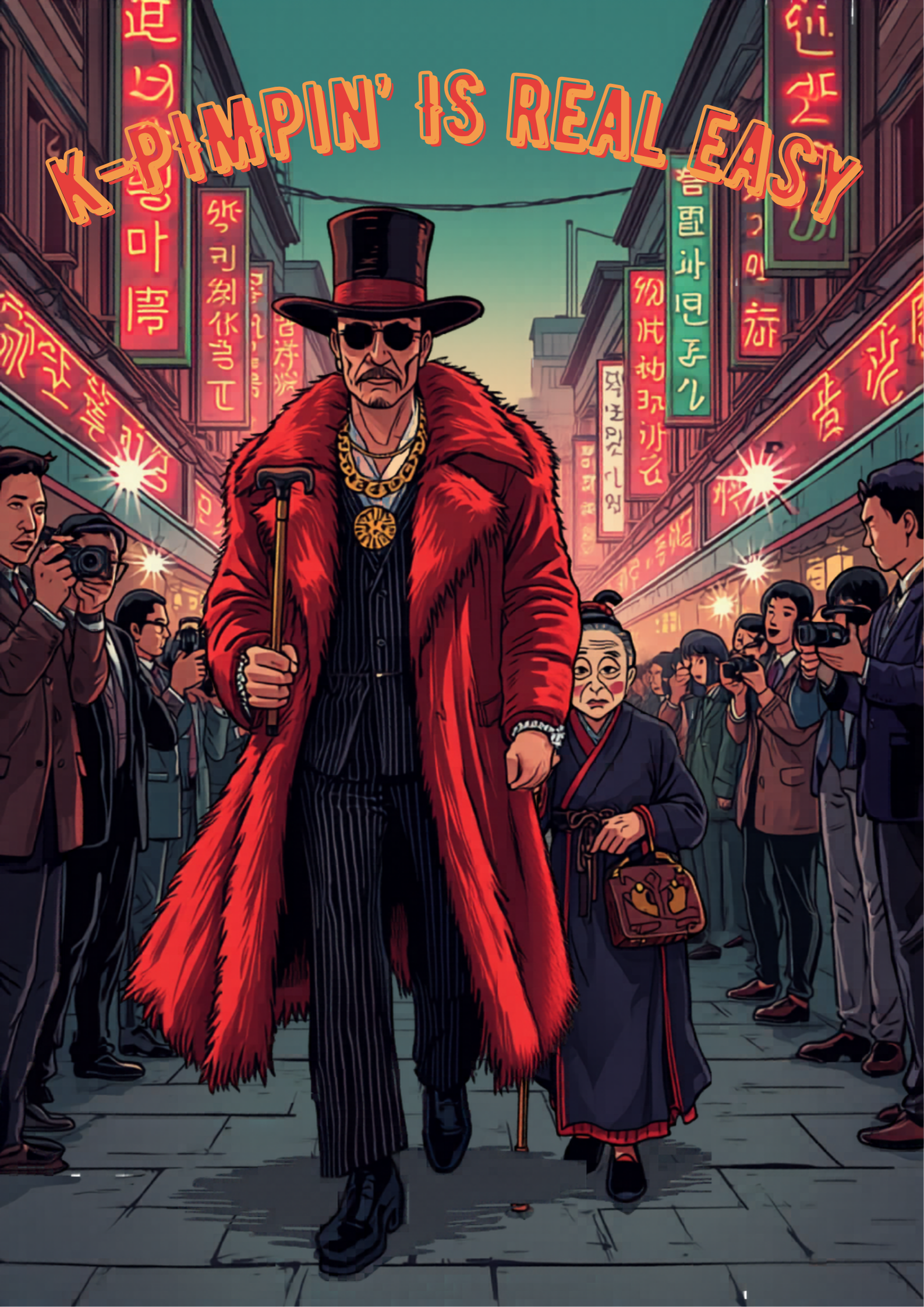
K-pop taught the world to love Korean culture. Then it figured out how to pimp it.
“My lifestyle's crazy, I'm luxury lazy
So much gold that jewelry don't faze me
Cordless phone, eight or nine homes
Girlies on my Jammie with an Ice-T jones
Bank account boomin', fast-lane zoomin'
Known around the world for my high post groomin'
Mack like a preacher, love like a teacher
Got a girl who lives in Paris
When I want her I beep her
Too many clothes, got a ragtop Rolls
1,000 Watt system and my speakers are Bose
I kick it like a champ, I thought you knew it
Pimpin' ain't easy but somebody gotta do it”
— Ice-T, 1987
Ice-T's debut album opens with a deadpan inventory of the exhausting burdens of carceral, capitalistic extraction — the gold, the mansions, the endless counting of cash. The whole song is a mock-complaint: somebody has to do the hard work of taking value from others and making it pay. It's grueling. It's thankless. But somebody's gotta do it.
Apparently HYBE didn't find it that hard.
By now, you've probably seen the controversy about BTS and Howard University. The animated teaser for the Arirang album — inspired by the real story of seven Korean students who found refuge at Howard in 1896 and recorded the first known Korean voices on American soil — depicted Howard's campus with a mostly white crowd. Black figures pushed to the background. The Mecca, whitewashed.
The response was immediate and correct. Howard students and alumni were right to be angry.
But if cultural appropriation is all you see here, you're missing the forest for the trees.
Because at the exact same moment HYBE was releasing that animation in America, BTS was opening their comeback concert in Seoul with minyo — Korean folk song, Arirang swelling under Joseon-era visuals, traditional singers deployed for maximum ancestral weight — before pivoting immediately to the internationally produced banger and never touching tradition again for the rest of the show.
Two controversies. One week. Two communities with legitimate grievances pointed at the same company.
The American discourse is locked on cultural appropriation — the question of who has the right to use whose culture. It's a real framework. But it's also a specifically American framework, and when you apply it to HYBE you miss something important: HYBE does the same thing to Korean culture. The same extractive move. The same deployment-and-abandonment. The same treatment of cultural weight as a marketing asset to be used and discarded.
HYBE isn't even good at cultural appropriation. To do it thoughtfully you have to understand what you're taking well enough to handle it with care. What's tripping HYBE up on the American side with Howard is the exact same thing tripping them up on the Korean side with tradition: they don't actually know what they're holding. They know it has value. They know it generates emotion. They know it moves units. That's the full extent of their relationship to it.
The Howard students who are angry and the Korean critics who are suspicious are looking at the same company from different angles and seeing the same thing. They just don't have a shared language for it yet.
We're going to call it what it is: the heritage hustle.
The Arirang Alibi
You watch the comeback. It opens with minyo — Korean folk song, the tradition of Arirang and its hundred regional variations, the music that carried ordinary Korean life through occupation and war and displacement. Five female sorikkun in hanbok belt it out to the rhythm of drums and bamboo flutes at Gwanghwamun.
Sorikkun — the word itself means something. Sori (소리) is sound, voice, the thing that carries. Kkun (꾼) is a person defined by what they do, someone who has become their practice. A sorikkun is not a singer in the pop sense — not someone who performs songs. A sorikkun is someone whose entire being has been shaped by the act of making that specific sound, who has trained their voice and body for years under a master until the form lives in them rather than being performed by them. These five women brought that to Gwanghwamun. Their training. Their craft. The entire accumulated weight of what they carry in their bodies.
And then BTS walks in and the drop comes. The sorikkun are done. Tradition has left the building.
What you just witnessed wasn't a cultural statement. It was a press release written in folk song form.
Worth noting: they didn't even bring out pansori — the rigorous, physically devastating, decades-to-master art form that actually carries the full ceremonial weight the staging was implying. They brought out minyo — the most accessible, most crowd-legible, most emotionally deployable thing in the repertoire. The folk song everyone already knows. And they got credited for the depth they didn't touch.
Now here's the smoking gun. According to a Hankook Ilbo report from the day after the concert, there was internal pushback within BTS against the traditional concept. HYBE Chairman Bang Si-hyuk drove the decision through over the group's own resistance. His reported pitch to the members: "Imagine foreigners singing along to 'Arirang' at a stadium performance."
Not Koreans. Foreigners. The entire strategic logic of deploying Korea's most resonant folk song was oriented toward the foreign gaze — toward the image of international audiences performing Korean identity back at themselves.
This is 사대주의 (sadaejuui) — Korea's historical tendency to define value by the approval of a perceived greater power — operating at the executive suite level in 2026. Bang Si-hyuk looked at Arirang and saw not a living tradition but a foreign sing-along concept. The tradition's depth was irrelevant to the calculation. Its legibility to outsiders was everything.
Hyunjung Lee saw this pattern coming. In her 2008 doctoral dissertation Global Fetishism: Dynamics of Transnational Performances in Contemporary South Korea (University of Texas at Austin), she argued that Korean cultural productions deploy tradition not out of genuine engagement but as the price of admission to global recognition — what she called "global fetishism." Her central formulation: if for South Korea "global" is synonymous with glamorous cultural success, it is precisely the return to the local which permits that fetishism. The tradition is the toll. You pay it, you pass through, you proceed to the product.
Her case study was Nanta — for the uninitiated, a nonverbal Korean percussion performance that launched in 1997 and became the longest-running and most internationally toured Korean show in history, playing in over 60 countries and running a permanent venue in New York's off-Broadway circuit in the early 2000s. Before K-pop went global, before Parasite, before any of it, Nanta was the thing Korean cultural producers pointed to when they wanted to prove Korea could compete on the world stage. Lee showed how it deployed samulnori folk percussion and traditional elements with surgical precision: stripped of cultural specificity, rendered nonverbal so no language barrier could impede access, packaged as what amounts to food without language — exotic, energetic, emotionally satisfying, requiring zero cultural knowledge from international audiences. You felt Korean depth without encountering any. The tradition flavored the product. The product moved.
Japanese media scholar Koichi Iwabuchi had a name for this operation. In Recentering Globalization (Duke University Press, 2002), he described how Japanese cultural exports like anime and video games were deliberately stripped of their cultural specificity to make them globally digestible — what he called removing the cultural nioi, the smell, the odor of national origin. Mukokuseki — stateless, odorless, frictionless. No cultural smell means no cultural barrier. The product travels without resistance because it has been engineered to offend no one's nose.
Call it what it is: cultural deodorant. Apply before global release. Neutralize anything that might require actual engagement. Ship.
Nanta was Korean culture de-odorized. Samulnori with the ritual stripped out. Traditional percussion with the community stripped out. Korean-ness as aesthetic seasoning rather than living practice.
And BTS? Their two biggest global crossover hits — "Dynamite" (2020) and "Butter" (2021) — were recorded entirely in English. Not Korean with some English phrases. Entirely in English, by a Korean group, targeting the American market. Cultural deodorant applied at the source.
Here is the contradiction that is the entire argument in miniature: HYBE engineers the cultural smell out of the actual music so it travels without friction — then sprays Korean cultural cologne all over the comeback concert opening to claim the authenticity they specifically removed. The sorikkun are the cologne. The minyo is the cologne. The Joseon staging at Gwanghwamun is the cologne. The music itself has already been de-odorized.
This, Lee argued, was 사대주의 operating as cultural production logic — not crude imitation of the West, but the strategic use of Korean-ness as a credential for Western and global approval. Deploy the odor when it earns credibility. Remove it when it might create friction. Control the smell.
HYBE has been running the same play ever since. Just at stadium scale.
This is also ggondae thinking at its most consequential. Bang reached for the things older establishment Koreans most want the world to recognize — the dignified, officially approved, UNESCO-stamped version of Korean identity — rather than the things that are actually, organically, irresistibly compelling about Korea. The music that hits like greasy jambalaya. The street fashion that spread without anyone designing a strategy around it. The weirdness and edge that teenagers in Vietnam and Indonesia absorbed kinesthetically without being told to. None of that was in the concept. The concept was: here is the Korea we want you to take seriously. Korea by PR. And the BTS members who pushed back understood something their chairman didn't: what makes them genuinely compelling has never been the official version of Korean cultural depth. It has been everything else.
A Field Guide to the Heritage Hustle
The Seoul concert is one data point. The pattern runs much deeper.
Exhibit A: Daechwita
Agust D's 2020 "Daechwita" opens with a voice issuing a royal command: "Myeonggeumilha daechwita." That voice belongs to Chung Jae-kuk — the only designated practitioner of Intangible Cultural Property No. 46. Not one of several masters. The last one. The sole living keeper of a military musical tradition that nearly died under Japanese colonial rule, revived for Armed Forces Day in 1961, with exactly three assistants being trained to carry it forward today. Suga chose Chung's 1984 National Gugak Center recording for its "solemnness."
Good ears.
That voice served as a dramatic intro. Fifteen seconds before the trap beat dropped and the song proceeded as the global hip-hop banger it was always going to be. Won Il — four-time Grand Bell Award winner, former artistic director of the National Orchestra of Korea — said it plainly in the Korea Times: Daechwita "mixes samples of the namesake Korean traditional music, but it did not dig into the musical structure of the original genre. It gives a glimpse into the sound of Korean traditional instruments, but cannot provide a thorough understanding of our traditional music."
The last living keeper of a centuries-old intangible cultural heritage. A sound effect for fifteen seconds.
Exhibit B: IDOL, Pink Venom, and the Arirang Album
BTS's 2018 "IDOL" deploys kkwaenggwari, janggu, Bongsan Talchum choreography, pungmul rhythms, hanbok-inspired costuming. Soompi covered it breathlessly: "Hopefully the success of 'IDOL' is paving the way for future K-pop acts to embrace more Korean sounds!" That was 2019. Still hopefully waiting.
BLACKPINK's 2022 "Pink Venom" opens with Jisoo playing the geomungo — a six-string zither going back to the Goguryeo Kingdom. Eight seconds. Then the production pivots to the trap-influenced pop sound it was always going to be, and the geomungo is never heard from again.
Displayed. Dismissed. On to the drop.
The Arirang album itself — named after Korea's most resonant folk song, released as a statement of Korean cultural identity — was written and produced with Diplo, Kevin Parker, Mike Will Made-It, Artemas, and JPEGMafia. The interlude "No. 29" consists solely of the tolling of South Korea's 29th National Treasure, the Divine Bell of King Seongdeok. A national treasure reduced to a palette cleanser between bangers. The Tradition Tax paid in bell tones.
인간문화재: What Korea Actually Built
You need to understand what Korea built to protect its traditional culture — because once you understand it, what K-pop does to that tradition stops being a matter of taste.
In 1962 — following a colonial occupation that tried to eradicate Korean culture and a war that killed millions — the government made a decision: these living practices and the people who carry them will be protected by the state. Not the recordings. Not the archives. Not the museum exhibits behind glass. The living people. The living practices. The bodies that hold the knowledge.
You cannot preserve intangible culture in an object. A gayageum in a display case is just wood and silk strings. A recording of pansori is a photograph of a fire. The tradition lives only in bodies — in years of training, in the physical relationship between master and student, encoded into muscle and breath and bone. When the last body that holds that knowledge dies without transmitting it, the tradition dies too. Permanently. Gone.
So Korea built the 인간문화재 system — Living National Treasures (보유자) — individuals designated as the living repositories of an Important Intangible Cultural Property. Monthly stipends. Health insurance. Special government protection even in times of war and armed conflict. In return: a legal obligation to transmit the tradition to the next generation.
Twelve Important Intangible Cultural Properties currently have no living holder. The knowledge already gone. Many surviving holders are in their seventies or older, with few successors.
Now remember Master Chung Jae-kuk. Three assistants. Six decades of work. The last keeper of his lineage. Suga sampled his 1984 recording for a dramatic intro. Fifteen seconds. Then the trap beat dropped.
That is not returning to your roots. That is strip-mining them for content.
The Deepest Irony
Here's where this gets historically obscene.
The entire Korean national treasures system — the framework K-pop artists invoke when they signal cultural roots — was built by Japan.
Not inspired by Japan. Built by the colonial government of imperial Japan, administered by Japanese archaeologists and anthropologists, for Japanese imperial purposes. In 1916, Japan's occupying administration promulgated the first comprehensive preservation laws on the Korean peninsula. Scholar Hyung Il Pai documented in Korean Studies (Vol. 25, No. 1, 2001) that Korea's 1962 preservation laws "retained these colonial classifications and sequential numbering of monuments and relics." Her most damning finding: "the politics of selection in how authenticity is manufactured and displayed for public consumption has not fundamentally changed since the beginning of the Japanese colonial era."
Japan built this system not out of respect but to catalog Korea as a cultural specimen — evidence of backwardness that justified Japanese rule. They preserved Korean artifacts the way a collector preserves specimens. Pinned. Classified. Behind glass. Arranged for the colonial gaze.
Korea's answer was the 인간문화재 system — the explicit rejection of that logic. Instead of objects behind glass, living people. Instead of artifacts, practices. The insistence that culture is alive, transmitted body to body. This was the point.
And now K-pop does exactly what the Japanese colonial gaze did. The colonizer made Korean culture into a museum exhibit. Korea spent sixty years building a system to fight that logic. K-pop turned it back into a museum exhibit. And the fans called it a return to roots.
Heritage Hustling. History Hustling. Same Move, Different Target.
In 1896, seven Korean students stranded in Vancouver found refuge at Howard University — founded in 1867 to educate Black Americans in a nation built on their exclusion. That summer, they produced the first known recordings of Korean voices and music in the United States. The song they sang was Arirang.
Korean students finding refuge at the flagship institution of Black American education. The first recording of Arirang on American soil happening because a Black university said yes when stranded Koreans had nowhere else to go. A moment of solidarity between two marginalized peoples inside a nation that wanted neither of them. That story belongs to both communities simultaneously.
HYBE animated it with a mostly white crowd. Black figures pushed to the background. Howard's own fact-check noted the animation depicted Founders Library — a building that hadn't been constructed yet in 1896. They couldn't get the buildings right, let alone the people.
HYBE's defense: a disclaimer calling it "a modern reimagining" that "deviates from actual historical events."
One Howard alum put it to theGrio with quiet precision: "I think the discourse reveals what I basically kind of felt with a lot of K-pop." That "basically kind of felt" is doing enormous work. It's the sensation of watching history become marketing. Of watching your institution's meaning get extracted while the community that built that meaning gets moved to the background — literally, pixel by pixel.
Heritage hustling. History hustling. The traditions are different. The communities are different. The hustle is identical. Whether the resource is a Living National Treasure whose six decades of practice gets used as a sound effect, or the founding mission of the institution that educated Thurgood Marshall — the extraction logic is the same. The only difference is who gets left holding an emptied-out history while HYBE banks the credibility and drops the album.
The Discourse Has It Backwards
What we're describing has an academic name: self-orientalism — a dominant cultural industry applying the same objectifying tourist gaze to its own traditional culture that outsiders apply to "exotic Asia." The tradition becomes the thing you pose in front of for the photo. Mood. Branding real estate. Nobody actually lives there.
Prof. CedarBough Saeji — ethnomusicologist at Pusan National University, UCLA PhD — has documented this pattern more rigorously than anyone in the field. In her foundational study of traditional iconography in Korean hip-hop videos (Global Hip Hop Studies, Vol. 1, No. 2, 2020), she finds these videos deploy tradition "as a symbol of national pride and as a tourist destination wherein the palace is a backdrop and you wear a hanbok to create a visually striking Instagram post." Her sharpest formulation: "The artists themselves become the equivalent of the tourist in rented hanbok wandering the palace with a selfie stick, incongruous tennis shoes peeking from beneath her skirts. Tradition is a playground and a backdrop, not where we live."
In follow-up work (Acta Koreana, Vol. 25, No. 2, 2022), Prof. Saeji documents what this produces: "the appearance of tradition continues to be more important than tradition itself." A major K-pop agency official confirmed it without intending to — artists "borrow traditional components as musical or performance concepts." Borrow. Not inhabit. Not study. Not sit with a master for years until the form changes how you move and breathe. Borrow. Like a jacket. Return before closing time.
Sunhong Kim — ethnomusicologist at the University of Michigan and former professional piri and taepyeongso performer with nine years of institutional gugak experience — named the commercial logic: K-pop idols incorporating gugak "can be understood as engaging in career development by doing something 'unique' in a neoliberal society." (Korea Herald, November 2025.) Career development. The tradition is a resume line.
What does it look like when someone has actually done the work? Ask Jocelyn Clark. Harvard PhD, professor at Pai Chai University, holder of the 이수자 (certified disciple) designation in gayageum under Korea's National Intangible Cultural Heritage system — and one of the foremost living authorities on Korean traditional cultural heritage on the planet. The 이수자 designation is the state's official recognition that a practitioner has received and internalized a tradition through direct transmission from a designated Living National Treasure — the same standard applied to every Korean practitioner in the system, conferred by the same evaluators, meaning the same thing. Clark has not studied Korean traditional music from the outside. She has lived inside the transmission system itself, submitted her body to it for over two decades, and earned the designation that Korean masters earn. When she speaks about what Korean traditional culture requires and what is being lost, she speaks as one of the highest authorities on these questions alive — an authority that applies regardless of where you were born, and that most people now invoking Korean tradition for branding purposes could not come close to claiming.
Clark has watched traditional instruments become "exotic in their own land — a stay-at-home diaspora." Familiar enough to deploy as branding. Unknown enough that no one demands accountability to the form.
Gayageum player Kim Do-yeon puts the practitioner's diagnosis plainly: "Traditional instruments have wide overtones that give them depth. But if you record them without knowing how to balance that sound, they end up losing their soul. To merge with pop, you need more than layering. You need a conversation." (Korea Herald, November 2025.)
HYBE isn't having a conversation. HYBE is issuing a press release.
The Question Nobody Is Asking
We have an enormous critical apparatus built to ask: What are Western artists taking from Korean culture?
We have almost nothing built to ask: What is the Korean entertainment industry doing to the people who actually keep Korean culture alive?
Right now, Master Chung Jae-kuk is training three assistants to carry a tradition that survived Japanese colonial erasure and a devastating war. Twelve traditions have already lost that race — twelve items on the Intangible Cultural Heritage list have no living holder. That knowledge is gone. Not archived. Gone. No sample resurrects it.
K-pop plays with the ones that survived. Flashes them for the press cycle. Banks the identity credit. Returns to the international songwriting camp with Diplo and Mike Will Made-It.
HYBE reaches into Black American history, lifts the moment where Korean and Black American lives intersected in solidarity in 1896, and erases the Blackness from the campus — whitewashing a historically Black institution while using that institution's history to sell an album.
Both communities are being hustled. Both histories are being mined. Such is the logic of culture under neoliberal economics — everything with weight becomes a resource, everything with meaning becomes a market, everything with depth becomes a brand.
Somebody's gotta do it.