The Outfit That Doesn't Want You to See It — Until It Does
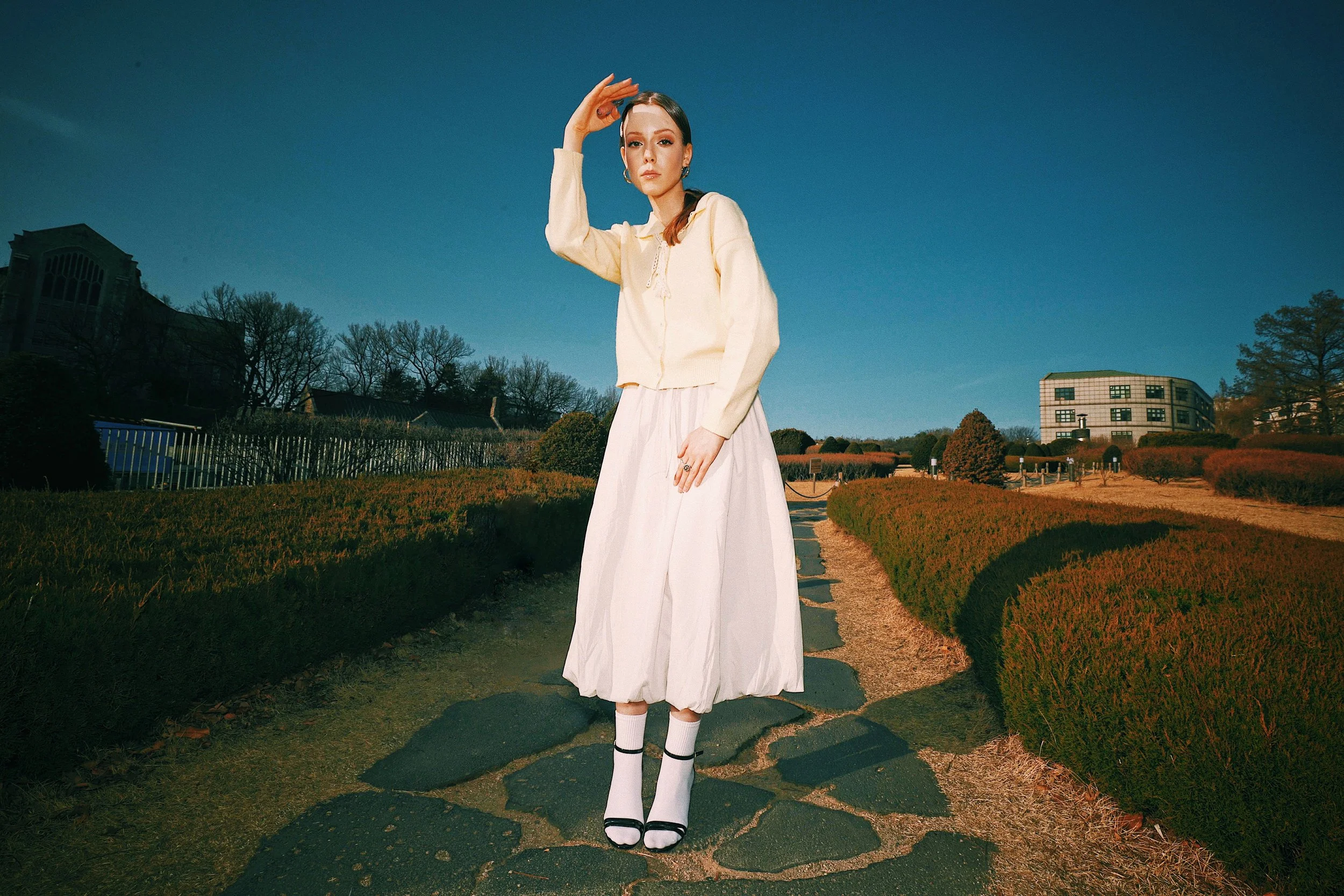
@model.tonia on the campus of Ewha Womans University — one of the oldest women's universities in Asia, founded by American Methodist missionaries in 1886 to educate Korean women at a time when their feet were barely supposed to leave the house and were objects/markers of domesticity. The whole outfit reads soft, pale, demure — until you reach the feet. Bare feet in strappy sandals were considered mildly improper in public well into the 1980s — the correct thing was socks. She knows that. In 2026, the white ankle sock with a strappy heel is retro kitsch, and it's aware of itself. The white sock is the heir of the beoseon, the traditional Korean indoor sock that became a presentation item at the threshold between private and public. Putting it back outside, with a heel, collapses that threshold deliberately. Innocent and knowing at once. The location is doing a lot of work here, along with @model.tonia.
꾸안꾸 (gguan-ggu) isn't a style tip. It's a theory of power dressed up as casualness.
I wasn't looking for it.
I've been photographing Seoul Fashion Week for 37 seasons, writing about Korean fashion culture for longer than that, and teaching visual sociology to graduate students at some of Korea's top universities. I show up at DDP in whatever's on the closest hanger that still fits. I am definitionally not the target demographic for a trend piece about effortless Korean cool. And yet here I am, because my student researcher Erica Seo sat down with me after we'd collected 127 interviews across two weeks at DDP — she'd done 50+, a cohort of architecture students from Syracuse had done around 30, I'd done about 20 while shooting portraits on the ramp — and somewhere in that data, something kept surfacing that none of us had gone looking for.
People kept describing the same thing. Without coordinating. Often without a word for it.
A three-stage mechanism. Hide the effort. Make the concealment look effortless. Then — and this is the part that matters — let one thing give you away. One deliberate, close-range detonation that rewards whoever was paying close enough attention.
That's 꾸안꾸 (gguan-ggu). And once you see it, you can't unsee it.
What It Actually Means
The term translates literally as "styled as if not styled." Korean internet slang, widely used, frequently mistranslated as simply "effortless style." But effortless style is a Western concept — it implies that some people are just naturally put-together, that ease is a gift not a practice.
꾸안꾸 is not that. 꾸안꾸 is a discipline disguised as its opposite.
Before going further: a quick scan of what's already out there on 꾸안꾸 turns up almost nothing but styling tutorials. FashionChingu gives you "10 Korean Fall Fashion Trends" with 꾸안꾸 sandwiched between cargo pants and Mary Jane shoes. Korea.net's honorary reporters explain it as a vibe you can achieve by adding a belt. The accio.com market research roundups treat it as a data point in wide-leg jeans search volume. This is the entirety of the English-language treatment of what is actually a sophisticated cultural code — flattened into a mood board and a shopping list. The concept exists in those pieces the way a key exists when you describe only its shape without mentioning that it opens anything. What's missing is the mechanism — what 꾸안꾸 actually does socially, why it works, and what it reveals about how Korean culture encodes status and attention.
The mechanism has three stages. Stage one: high effort input, hidden. Careful garment selection, precise attention to proportion and texture, significant time spent on what will look like no time spent at all. Stage two: effort concealment — the performance of casual ease, the deliberate downplaying of preparation. Stage three, the one nobody talks about: the reveal. One carefully placed element — a single piece of jewelry, an unexpected texture, a lace fishnet where you expected bare skin — that makes the whole look suddenly, completely legible to those with eyes to see it.
It's not effortless. It's effortfulness engineered to look effortless, with one crack left deliberately in the facade.
What a French Sociologist Would Say (And Why He'd Be Troubled)
Here's the uncomfortable theory underneath the hashtag — and you don't need a PhD to follow it.
Pierre Bourdieu (1930–2002) was a French sociologist who spent his career asking a deceptively simple question: why do some people seem to move through the world with natural ease, grace, and taste — while others visibly struggle to achieve the same effect? His answer was habitus: a set of embodied dispositions, instincts, and cultural reflexes absorbed so deeply through upbringing and social environment that they operate entirely below conscious thought. Not rules you follow. Wiring you inherit.
The aristocrat who dresses simply and beautifully isn't trying. The effort happened three generations ago — at the dinner table, in the choice of schools, in ten thousand small calibrations of taste accumulated over a lifetime in the right rooms. Legitimate cultural capital, in Bourdieu's framework, is the kind that doesn't look like capital. Visible effort signals low status. Real sophistication demonstrates mastery through restraint. You can't fake it, and you can't learn it from a tutorial. You can only be born into it, or spend so long immersed in the right field that it eventually becomes you.
꾸안꾸 takes this entire logic, gives it a name, and posts it on TikTok.
Which is exactly where it gets complicated. Because Bourdieu's whole system depends on the concealment being genuine, not performed. The moment it becomes a technique — a how-to, a hashtag, a styling guide in seventeen languages — it should theoretically collapse. The signifier becomes legible. The magic disappears.
Except that's not what happened.
The Kazakh Woman at DDP
Victoria isn't Korean. She's from Kazakhstan. She'd never taken a Korean studies course, never studied fashion theory. She learned what she learned through Instagram and K-dramas, mirror neurons firing somewhere in Almaty while she watched how Korean women moved, posed, combined garments.
At DDP, on the SFW ramp, she described the framework she'd absorbed — completely, precisely — without having been taught it:
"You need to look individual but not stand out too much. Clean and simple, but add your personal touch. You can't be too boring, but you can't be too much either."
Her body had learned what her conscious mind had never been told. The grammar of 꾸안꾸 transmitted kinesthetically — not through instruction but through repeated exposure, accumulated visual pattern recognition, a nervous system doing its quiet work.
This is Bourdieu's nightmare scenario. Something that was supposed to be untransmissible — embodied cultural capital, inherited not learned — went globally viral. A woman in Central Asia absorbed it from her phone screen. She can now perform, at close range, what the system was designed to make impossible to acquire.
The concealment is now a teachable skill.
How to Actually See It on the Ramp
Working SFW, these are the people I hunt for most deliberately — and they're the hardest to catch, which is also the point.
The 꾸안꾸 subject doesn't blare for your visual attention from a hundred meters off. The look reads as controlled, put-together, quiet. Nothing demands you stop. And then — you're almost past them — something snags. A single piece of jewelry catching the light. One unexpected texture running counter to everything else. An asymmetric hem where you expected a clean line. Patent buckle heels under a look that had no business being that racy.
Suddenly they have your complete attention. You can't explain exactly when it happened.
The reveal is close-range and delayed. The aesthetic is designed for that specific moment of recognition — designed for an audience paying close enough attention to deserve it. 꾸안꾸 is a filtering mechanism. It sorts for depth of attention. The person who glances past you at fifty meters isn't your audience. The person who catches the detail at two meters — that's who the look was made for.
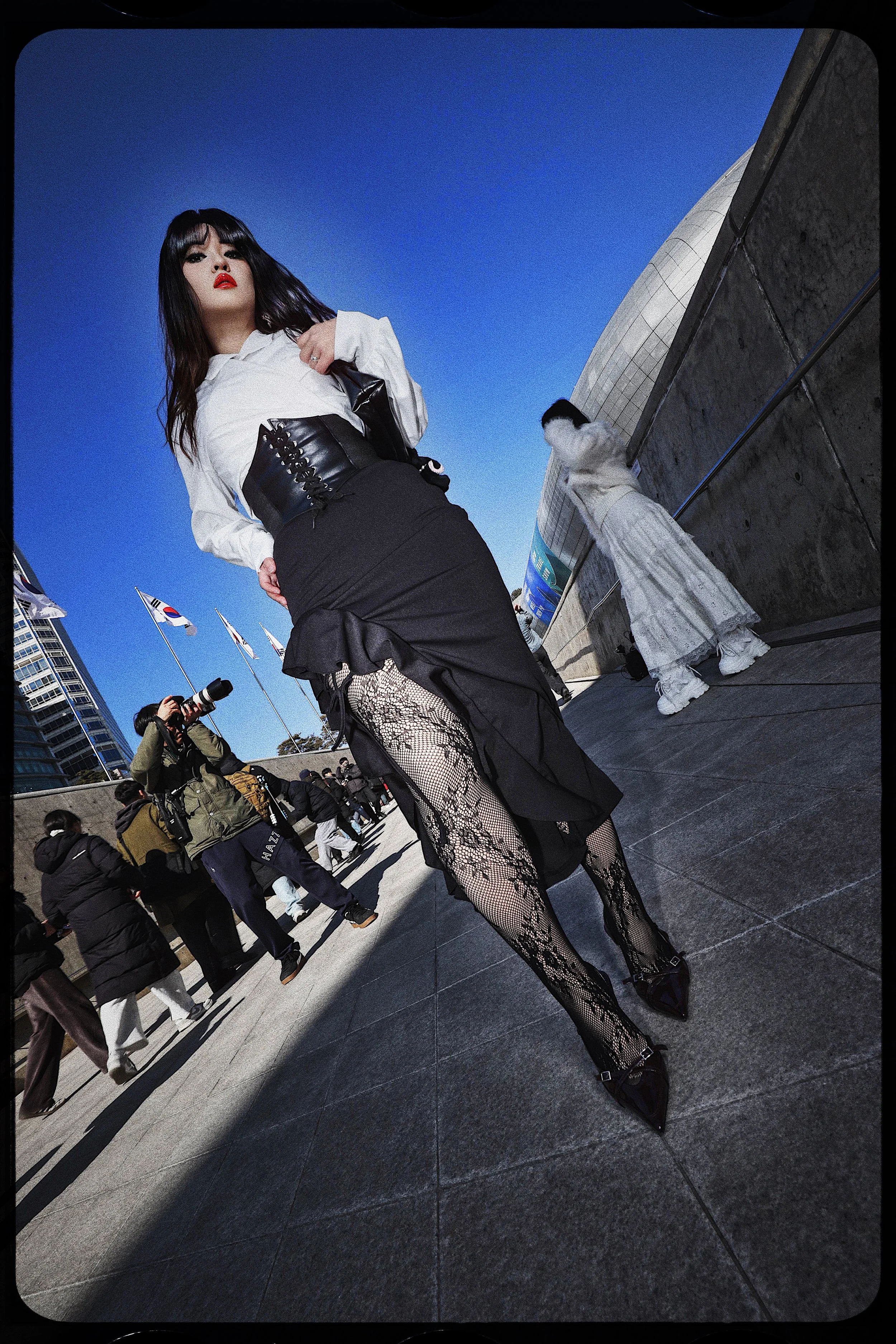
Model @hanul.ee.ph alights down the ramp at Seoul Fashion Week last February 2026. . From across the plaza: controlled, black and white, contained. Get closer — lace fishnet tights, an asymmetric skirt hem, patent buckle heels, red lips that somehow did not register until now. This is gguan-ggu as calibrated disclosure. The outfit is architecture designed to reward proximity.
This is also what makes 꾸안꾸 partially untranslatable into Instagram content — which is why two billion hashtag views are somewhat misleading. What you can capture from fifty meters, the general vibe and clean silhouette, isn't 꾸안꾸. The close-range detonation doesn't survive compression into a thumbnail.
The Paradox That Doesn't Resolve
So here's where I've landed, after 127 interviews and more photographs than I can count and a theoretical framework I'm still working through:
꾸안꾸 went viral precisely because Korean content is optimized for kinesthetic transmission — for teaching bodies things that can't be said in words. Victoria in Kazakhstan didn't learn 꾸안꾸 by reading a definition. She learned it the way anyone learns anything real: through repeated embodied exposure until the pattern was hers.
Which means the globalization of 꾸안꾸 hasn't killed it — it's demonstrated its thesis. The whole point of 꾸안꾸 is that genuine mastery travels below the level of conscious articulation. And it turns out genuine mastery can cross borders that way too.
What I don't know yet: whether this changes what 꾸안꾸 means in Seoul. Whether the concept shifts when it's no longer insider knowledge. Whether the crack in the facade — the one deliberate reveal — means something different when the audience can be anyone, anywhere, watching from Almaty.
The data told me there's a pattern. It didn't tell me where the pattern goes.
Why Seoulacious Sees This Differently — And What You Can Do With It
Most fashion coverage of 꾸안꾸 is a styling tutorial. Here's how to layer. Here's how to add one statement piece. Here's how to look like you didn't try. Good luck.
That's not wrong. It's just the wrong level — and operating at the wrong level means missing the most interesting thing about the concept entirely. FashionChingu and Korea.net tell you what to wear. They can't tell you why the system works, where it came from, or what it's actually doing to the people who perform it and the people who witness it. For that you need a different set of tools.
The Seoulacious approach is a researcher's approach: get close, collect systematically, sit with the data until it tells you something you didn't expect. Erica Seo's 50+ interviews didn't confirm a trend we already believed in. They surfaced a pattern nobody had been steering toward. That's a different kind of knowledge — slower, less convenient, harder to package into a carousel post, and considerably more true.
But here's the thing about that kind of knowledge: once you have it, you can use it everywhere. The 꾸안꾸 framework — hide the effort, perform the ease, place the deliberate reveal — isn't just a description of one Korean fashion concept. It's a lens. Point it at K-beauty's "no-makeup makeup." Point it at the way Korean café interiors look effortlessly minimal while requiring obsessive curation. Point it at the choreography in an idol group that looks spontaneous and took six months of twelve-hour days to perfect. The same logic is running in all of them.
That's what Seoulacious is here to give you: not a trend report, not a shopping guide, but an analytical tool you can keep. A way of seeing Korean culture at the level where it actually operates — below the surface, in the mechanism, in the gap between what looks effortless and what it cost.
꾸안꾸 rewards the person paying close enough attention to catch the reveal. We think good cultural analysis works the same way. The close-range detonation is always there. You just have to be willing to get close enough to see it.
That's the Seoulacious eye. It's a researcher's eye. And it changes what you see.