ATTACK OF THE 50-BILLION-WON SPACESHIP!!! Or, the New Cultural Vandalism Dressed Up as Policy
IT CRASHED IN DONGDAEMUN! POLITICIANS WANT IT DESTROYED! FASHION WEEK WON'T LET IT DIE!
Korean textile exports: $10 billion.
Olive Young sales to foreign tourists: 1 trillion won.
One number goes down every year. One goes up. And together they explain why Seoul's massive alien spaceship has become election-season ammunition for politicians who want things to go back to the way they were.
This February, Rep. Jeon Hyun-hee stood beneath the silver dome and announced her campaign pledge: tear down the $341 million structure and rebuild the baseball stadium that used to be there. She calls it a "symbol of dysfunctional administration." She wants to build "the world's largest Seoul Dome"—convertible between baseball, soccer, e-sports, and fashion shows at "the push of a button."
Nobody who knows anything about the spaceship—officially called Dongdaemun Design Plaza, designed by Zaha Hadid—takes this seriously.
Urban planning scholars pushed back immediately. "DDP is an iconic architectural asset and a highly used public space," said Suh Jin-hyung, a professor of real estate law at Kwangwoon University. "It deserves preservation, and demolition would waste national resources." The opposition party asked "who among the people of Seoul would support tearing down a fully functioning building only to construct another one in its place?" The city government responded with data: 17.1 million visitors in 2024, credit card spending in the area up 25.5 percent, foreign transactions up sixfold.
But when Karl Lagerfeld brought Chanel's Cruise Collection to Seoul in 2015, he understood what the spaceship actually was. He didn't choose a palace. He didn't choose a traditional hanok village. He chose the building Korean politicians had been calling "an alien spaceship that crash-landed in Dongdaemun."
Because that's exactly what it is. An alien object that landed in Seoul and proved Korea's economic transformation worked.
That building has since hosted Dior, Cartier, Fendi, and Seoul Fashion Week for 12 consecutive seasons. Thirteen million visitors come annually. It won the Guinness World Record for the world's largest architectural projection surface. It swept the top three international design awards. It appears in Korean dramas, Chinese variety shows, American fan conventions. It's Seoul's #1 Instagram location.
The demolition proposal isn't a serious policy debate. It's a test: Do you understand that Korea makes money from designing things now, not making things? Or do you miss when economic value was something you could count—ticket sales, concession revenue, merchandise purchases?
The spaceship proves Korea's economic transformation worked. That's exactly why some politicians want it gone.
The proposal won't happen—experts, opposition politicians, and the city government all reject it. But it reveals Korean fashion's deepest contradiction: the industry thrives globally through aesthetic innovation while its manufacturing base collapses domestically. The spaceship—what Zaha Hadid called a "metonymic landscape" that literally embodies Seoul's transformation from production to branding—has become a political flashpoint because it makes that transformation impossible to deny.
While politicians throw red meat to nostalgic voters, Seoul Fashion Week just concluded its F/W 2026 season inside the spaceship. Same as always. Because after one season attempting to escape to "traditional" venues across Seoul, fashion week discovered what architects knew all along—there's nowhere else that works.
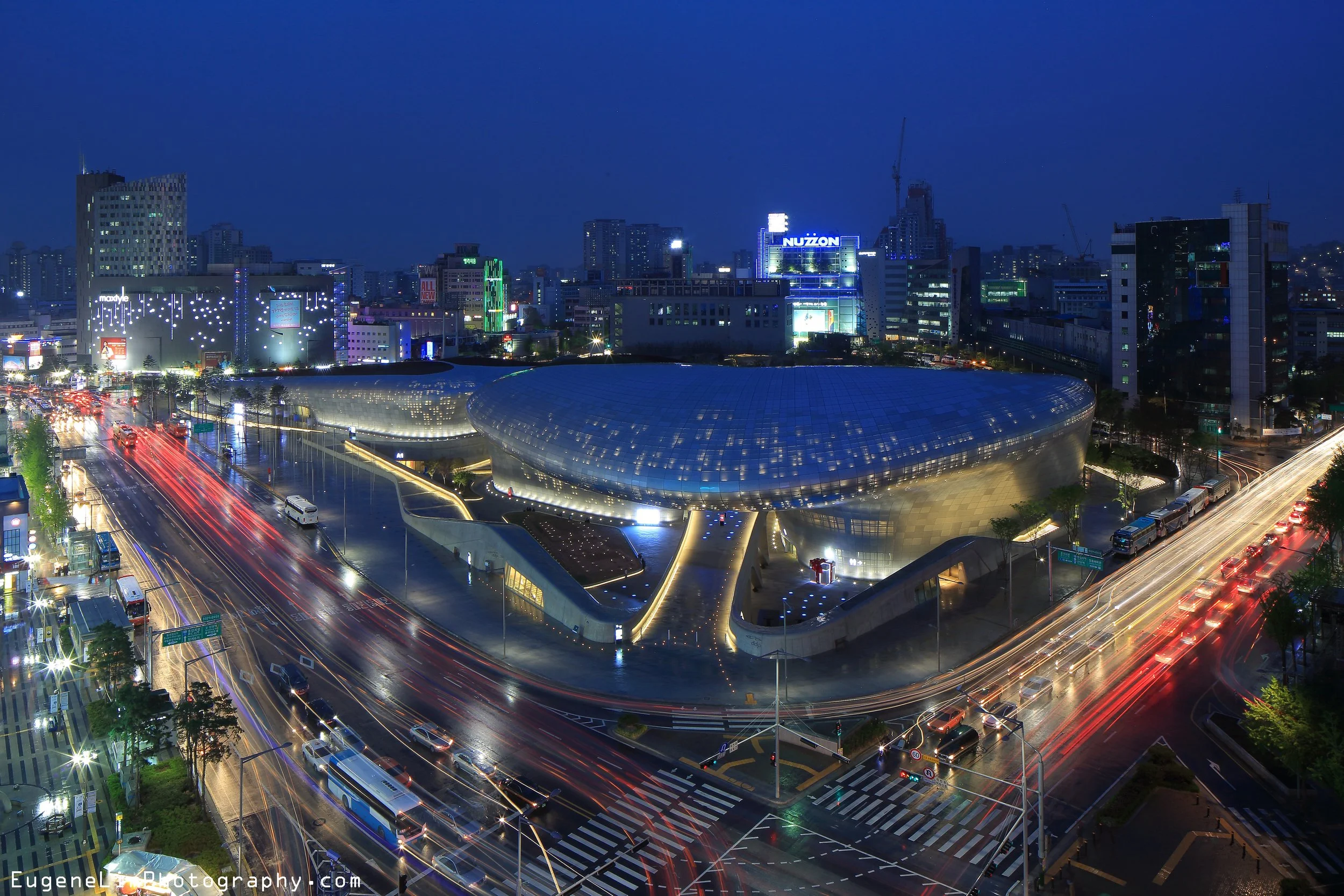
By Eugene Lim - commons:File:Dongdaemun Design Plaza at night, Seoul, Korea.jpg, CC BY 2.0, https://en.wikipedia.org/w/index.php?curid=68358278, taken in April 2014.
WHAT "METONYMIC LANDSCAPE" ACTUALLY MEANS (AND WHY IT MATTERS)
When Zaha Hadid won the 2007 design competition, she titled her proposal "Metonymic Landscape." The term sounds academic, but it describes something simple: the building doesn't just sit IN Seoul—it BECOMES Seoul.
Think about how metonymy works in language. "The White House said..." doesn't mean the building spoke—it means the presidency. "Wall Street is panicking" represents financial markets, not a literal street. One thing stands for something bigger.
Hadid's move: she studied how Dongdaemun actually works and encoded that into the building's form.
Dongdaemun has always been a place where multiple things happen at once. Wholesale vendors sell to retailers while individual shoppers browse. Seamstresses manufacture clothes upstairs while stores sell downstairs. The neighborhood shifts from wholesale business during the day to retail shopping at night. Everything overlapping, everyone sharing the same space without getting in each other's way. Seoul's famous "flexible sociality"—spaces that change function based on who's using them and when.
Hadid designed DDP to do the same thing architecturally. During Fashion Week, her entrance ramp becomes five different things simultaneously—runway, photo studio, networking lounge, pop-up shop, and red carpet—without any of these uses conflicting. Traditional buildings can't do this. A hotel ballroom is a hotel ballroom. A museum gallery is a museum gallery. A temple courtyard is a temple courtyard. When Seoul Fashion Week tried using these spaces in S/S 2026, it failed and retreated back to DDP for F/W 2026.
The building works because it was designed to embody how this specific city actually functions. Architecture that doesn't just sit in a place, but captures how that place works and amplifies it.
Here's the irony: Politicians say DDP "failed to connect with Dongdaemun's identity." But DDP is literally designed to BE Dongdaemun's identity—the flexible, overlapping, 24-hour, multi-functional character of the district. The problem isn't that DDP doesn't connect to Dongdaemun. It's that Dongdaemun's economic model is dying, while DDP represents what Dongdaemun is becoming.
And politicians can't forgive the building for making that impossible to ignore.
THE TIMELINE TELLS THE REAL STORY
2007: Design competition announced. DDP concept wins. 2009: Construction begins. Cost: 484 billion won. 2010: Seoul named World Design Capital based on DDP's promise. 2014: DDP opens. First year: 8.5 million visitors. 2015: Chanel Cruise Collection show. Karl Lagerfeld validates DDP globally. 2016-2024: Korean fashion explodes globally. Manufacturing moves to Vietnam. 2024: Olive Young makes 1 trillion won from foreign tourists. Korean textile exports: barely $10 billion. 2026: Rep. Jeon Hyun-hee proposes demolishing DDP for baseball stadium.
Notice what happened during DDP's construction, from 2009 to 2014: the entire Korean economy transformed.
Musinsa, founded in 2001, exploded in the 2010s. Fast fashion and Chinese manufacturing killed Dongdaemun wholesale. K-pop and K-dramas created global appetite for Korean aesthetics. Korea became curator and designer, not manufacturer.
DDP opened into a completely different economy than it was designed for.
And it worked anyway.
That's not a bug. That's the feature politicians want to demolish.
WHAT DDP WAS DESIGNED FOR VS. WHAT IT ACTUALLY DOES
The 2007 vision was straightforward: support Korea's transition from manufacturing to design, house the fashion and design industries, revitalize Dongdaemun as a design district, create a landmark worthy of Seoul's World Design Capital bid.
The 2014-2026 reality turned out different. Seoul Fashion Week uses it as a B2B platform for Korean designers selling globally, not locally. Luxury brands like Chanel, Dior, Cartier, and Fendi use it to prove Korea equals Paris culturally. Thirteen million annual visitors treat it as a tourist attraction with top international media coverage. Seoul Light DDP wins global design awards as a media art platform. The building itself sells "Korea as design nation" as national brand infrastructure.
Here's what nobody predicted in 2007: these functions would matter MORE than supporting local manufacturing.
When Hadid designed DDP, Korean textile exports were still significant. Dongdaemun wholesale markets still bustled. The assumption: build infrastructure for Korean designers who would manufacture in Korea and sell globally.
By 2014, that assumption was dead. Korean designers manufacture in Vietnam and Bangladesh. Dongdaemun wholesale serves Chinese tourists, not Korean retailers. The entire production chain moved offshore.
But DDP didn't fail. It adapted.
This is what "metonymic flexibility" actually means in practice: the building was designed to capture Seoul's character—spaces that shift function based on who's using them and when. When the economy shifted faster than anyone predicted, DDP's parametric design allowed it to serve new functions without modification.
The same Art Hall hosts fashion shows, art exhibitions, tech product launches, and fan conventions. The same plaza space works for outdoor film screenings, music festivals, and casual tourism. The same rooftop functions as walkable park, photo destination, and event venue. The same underground passages serve as exhibition space, shopping corridor, and circulation network.
Traditional architecture can't do this. A stadium is a stadium. A museum is a museum. A convention center is a convention center. DDP is whatever its current occupants need it to be.
Patrik Schumacher, Hadid's partner who theorized "parametricism," wrote in 2014 about DDP specifically: "Legibility in the service of quick, intuitive orientation and navigation—prerequisites of the building's social functionality—are the accomplishments of these strategies of tectonic articulation."
Translation: The building communicates what it is through its form, and adapts to what people need without requiring signs or instructions.
In 2016, Schumacher wrote that parametricism needed to "shift its focus away from foregrounding formal principles and instead place more emphasis on functional principles and societal purposes."
DDP does exactly that. It's a working proof-of-concept for how parametric architecture handles contemporary social complexity.
And now politicians want to demolish it because they're measuring the wrong things.
THE MEASUREMENT PROBLEM: WHAT POLITICIANS SEE VS. WHAT DDP ACTUALLY DOES
Rep. Jeon Hyun-hee's proposal claims DDP "failed to revitalize local economy," that "the building is cut off from fashion districts," and the area became a "ghost town." Her evidence: DDP construction cost 500 billion won, Dongdaemun wholesale market decline continues, Gocheok Sky Dome replacement would cost only 200 billion won, and local vendors keep complaining.
The data tells a different story. During seven major cultural events in 2024, DDP commercial area sales increased 12.2 percent. The entire Dongdaemun district increased 10.8 percent. DDP Spring Festival saw foreign visitor spending increase 21.7 percent in the immediate vicinity, 22.8 percent in the broader district. Annual visitors: 13 million. Cumulative since opening: 100 million.
So why do politicians say it failed? Because they're measuring DDP by metrics designed for manufacturing-era economics. They're asking: "How much revenue does the building generate on-site? How many Dongdaemun vendors profit directly?"
These are the wrong questions.
BASEBALL NOSTALGIA = ECONOMIC NOSTALGIA
Jeon's proposal isn't really about sports. It's about mourning an economic model that doesn't exist anymore.
The Dongdaemun Stadium era, from 1925 to 2007, meant manufacturing jobs for seamstresses, fabric cutters, and wholesalers. It meant working-class entertainment through affordable baseball. It meant spatial integration where production, wholesale, and retail were co-located. Most importantly, it meant a clear economic model: make stuff, sell stuff, profit. You could see the money. You could tax it. You could measure it on a balance sheet.
The DDP era, from 2014 to present, means creative economy jobs for designers, curators, and marketers. It means elite cultural capital through fashion week, luxury brands, and art exhibitions. It means spatial fragmentation where design happens in Seoul, manufacturing happens in Vietnam, and sales happen globally. Most confusingly for politicians, it means unclear value capture where influence and soft power don't equal direct revenue.
How do you measure Korea's global image as a "design nation"? The value of 13 million Instagram posts? Chanel validating Seoul as equal to Paris? Korean designers using Seoul Fashion Week to reach global buyers? Tourists coming to Seoul specifically because they saw DDP online?
You can't. So politicians say "it doesn't generate revenue."
But the entire Korean Wave works this way. BTS concerts don't capture full economic value—the real money is in Samsung phones looking cooler because Korea is cool. Squid Game streaming revenue doesn't show up in Korean GDP—the value is in making Korean content command premium prices globally. K-beauty influence doesn't appear in cosmetics export numbers—it appears in Olive Young making 1 trillion won from foreign tourists buying Korean curation, not necessarily Korean-made products.
Korea's actual economic model: cultural influence that enables premium pricing globally. DDP is infrastructure for that model. But you can't see it on a balance sheet.
The baseball dome proposal is a wish to return to when economic value was legible. When you could count tickets sold and concessions purchased and merchandise revenue. When the connection between investment and return was direct and obvious.
That economy is gone. Demolishing DDP won't bring it back.
THE SPACESHIP'S ARCHITECTURAL LEGACY (AND WHY THAT ACTUALLY MATTERS)
There's another reason DDP matters beyond Korean economics, though politicians never mention it: the building is Zaha Hadid's last fully realized vision of parametricism before her sudden death in 2016.
When Hadid died of a heart attack at age 65—just two years after DDP opened—she left dozens of unfinished projects. Her firm continued under partner Patrik Schumacher, but DDP represents something specific: the complete implementation of what Schumacher called "Parametricism 2.0," where every single element becomes parametrically variable and mutually adaptive.
The 45,000 aluminum panels covering DDP's exterior aren't decorative—they're the physical manifestation of computational design solving real problems. Each panel is unique, sized according to the curvature beneath it. The entire facade is a tectonic system where engineering logic becomes spatial communication. This wasn't Hadid experimenting. This was Hadid proving her theory worked at urban scale.
DDP opened in 2014 as the largest parametric project ever built, earning Seoul designation as World Design Capital in 2010 based on its promise alone. Two years later, Hadid was gone. Her firm continues, but DDP is Hadid's own work, completed under her direct supervision—the fullest expression of her vision that architecture should capture and amplify how cities actually function.
Let's be absolutely clear about what's being proposed: the demolition of one of the most significant architectural achievements of the 21st century. The destruction of the only complete built manifestation of parametricism at urban scale. The obliteration of the final masterwork of the first woman to win the Pritzker Prize.
And why? To pander to ggondae (꼰대)—stubborn old-guard boomers clinging to outdated hierarchies—and their nostalgia for a baseball stadium that died as an irrelevant flea market.
Let's talk about what Dongdaemun Stadium actually was by 2007. Not the gleaming sports shrine of 1925. Not the packed baseball venue of the 1960s. By the 1990s, it was a glorified flea market. After the Seoul Olympics in 1988, the stadium was abandoned for sporting events and became a chaotic warren of cheap goods vendors. The stadium had already failed. It was demolished because it had no purpose.
And now politicians want to destroy a globally significant architectural landmark to rebuild that failure? This is cultural vandalism dressed up as a campaign promise designed to extract votes from aging voters who romanticize a building that lost its relevance decades ago. DDP becomes the victim of cynical political theater aimed at voters who can't accept that Seoul's economic model changed.
The building that the Royal Institute of British Architects celebrated. The structure studied in architecture schools globally as the definitive example of parametric urbanism. Seoul's politicians want to tear it down for a multi-purpose dome that converts between baseball and soccer "at the push of a button."
You know what already hosts fashion shows? DDP. Successfully. For twelve years straight. Without needing to "convert" into anything because it was designed from the beginning to be multi-functional.
This is the civic equivalent of demolishing the Sydney Opera House to build a multiplex cinema because "it would generate more ticket revenue." It's architectural philistinism of a scale that would embarrass cities actively hostile to culture—except those cities usually destroy buildings out of ideology. Seoul's politicians want to destroy DDP to win an election.
The stadium nostalgia isn't even real—it's manufactured sentiment for a building voters stopped caring about thirty years ago. When the stadium was actually standing and available for "preservation," where were these passionate defenders? They weren't even shopping at the flea market that had replaced the baseball games. They didn't save the stadium then. They're not trying to save anything now. They're trying to demolish something that makes them uncomfortable.
What's being proposed isn't policy. It's vandalism. The destruction of irreplaceable cultural heritage to satisfy nostalgia for a building that ended its life as a discount shopping venue. The sacrifice of global architectural significance on the altar of local electoral math.
This isn't about economics. This is about whether Seoul wants to be remembered as the city that built the future or the city that demolished it to make boomers feel better about the past. Whether this generation of politicians will be remembered for vision or for vandalism in service of electoral cynicism. Whether Seoul has enough civilizational maturity to recognize what it actually has—and enough self-respect not to destroy it for campaign promises aimed at voters nostalgic for a flea market.
WHY SEOUL FASHION WEEK CAN'T LEAVE (AND WHY THAT PROVES THE SPACESHIP WORKS)
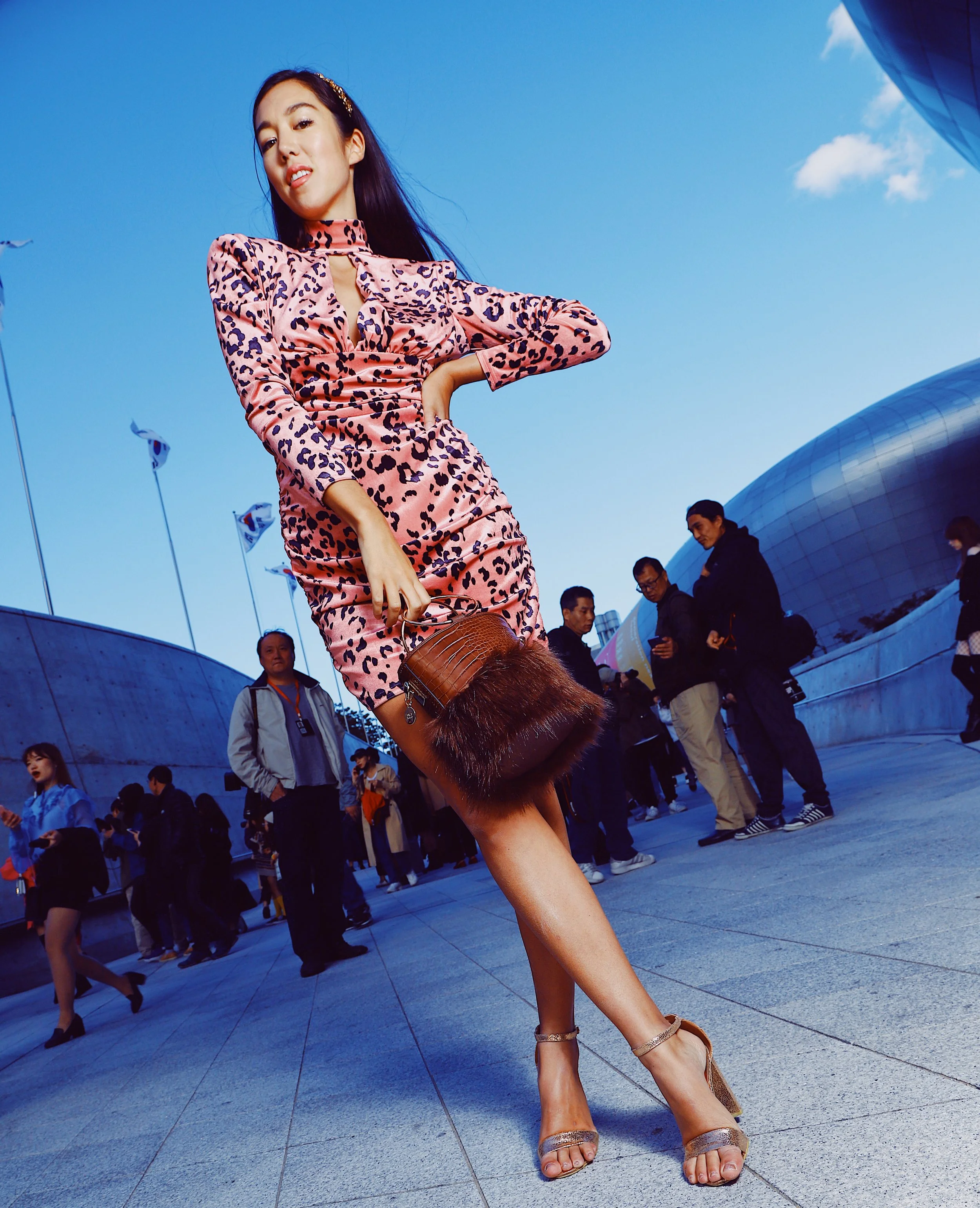
Seoul Fashion Week in October 2018 on the DDP ramp, which has become the event’s main (social) “runway.” It is from this main stage of South Korea’s fashion that the country and its nascent fashion greatness got SEEN.
Here's the experiment that settled the question.
Seoul Fashion Week's S/S 2026 season, held in September 2025, celebrated the 25th anniversary with "city as runway" expansion. For the first time they tried "expanding beyond DDP." Andersson Bell opened at Deoksugung Palace street. Shows scattered across Hongje Yuyeon, Heungcheonsa Temple, Mondrian Seoul Itaewon, and Oil Tank Culture Park. Presentations spread across Seongsu, Hannam, and Gangnam showrooms.
The result: logistical nightmare. Press complained. Buyers frustrated. Designers stressed.
Seoul Fashion Week F/W 2026, held in February 2026, marked an immediate retreat. Back to "one-site format." All 15 runway shows at DDP Art Hall 1 and 2. Nine presentations at DDP venues, with some brands at Cheongdam and Bukchon showrooms. Trade show at DDP Design Lab.
"City as runway" lasted exactly one season.
Why can't Seoul Fashion Week leave DDP? Not because of dependence. Because of proof.
Fashion week tried traditional venues—temples, hotels, palace roads—and discovered they can't do what DDP does. Those spaces are beautiful. They're historically significant. They're photogenic. But they're functionally rigid.
A temple is a temple. One function, one atmosphere, one way to use it. A hotel ballroom is a hotel ballroom. Fixed capacity, fixed layout, fixed identity. A palace road is a palace road. Beautiful backdrop, no infrastructure, no flexibility.
DDP's parametric design means spaces morph. Art Hall 1 runway converts to trade show floor, converts to conference venue. Underground passages become showroom tour routes, become exhibition galleries. Rooftop landscape becomes photo backdrop, becomes outdoor screening venue. Oullim Square becomes festival space, becomes casual hangout.
The 45,000 unique curved aluminum panels aren't just aesthetic—they create spatial flexibility. No right angles equals no fixed room definitions equals spaces flow into each other based on use.
Seoul Fashion Week doesn't need to leave DDP. DDP was built specifically to BE Seoul Fashion Week's infrastructure.
This isn't a failure of the building. It's validation of Hadid's design philosophy.
Schumacher wrote that DDP demonstrates "the use of complex geometries with modulated curvatures and gradient transitions" that allow "complex spatial arrangements where many events come into view simultaneously."
During Fashion Week, this is exactly what happens. The building supports runway shows (scheduled, ticketed, exclusive) alongside trade appointments (private, by arrangement, business-focused) alongside street style photography (spontaneous, public, content-creation) alongside press interviews (scheduled but flexible, media-focused) alongside brand activations (semi-public, marketing-driven) alongside casual tourism (walk-ins, exploration, discovery). All happening simultaneously. In the same building. Without conflict.
Traditional architecture can't do this because traditional architecture assumes single-use programming. DDP was designed for multi-use simultaneity. That's what "metonymic landscape" means in practice: a building that works the way Seoul works.
Politicians call this "dependency." Architects call it "proof of concept."
THE ECONOMIC SHIFT NOBODY WANTS TO ACKNOWLEDGE

Here are the numbers politicians don't mention. Korean textile and apparel exports in 2023: $10.5 billion. Musinsa revenue: growing exponentially, now valued at $2 billion. Olive Young foreign tourist sales: 1 trillion won annually.
The pattern: Korea makes money from branding Korean aesthetics, not making Korean products.
This isn't new. This is how K-pop works. BTS doesn't make money from album sales—they make money from making Korea cool, which helps Samsung sell phones at premium prices. Squid Game's value isn't Netflix subscription revenue—it's making Korean content command premium prices globally.
K-beauty works the same way. The 10-step skincare routine, glass skin, cushion compacts—these are Korean innovations. But the products? Increasingly manufactured in Southeast Asia. The value is in Korean curation and branding.
K-fashion follows the pattern exactly. Korean designers export aesthetic curation. The clothes are made in Bangladesh and Vietnam. Seoul Fashion Week functions as a B2B platform where international buyers discover Korean design sensibility, then manufacture it offshore.
DDP is infrastructure for this model. It's not a factory. It's not a wholesale market. It's a stage where Korea performs its role as global aesthetic curator.
When politicians say DDP "failed to save Dongdaemun manufacturing," they're blaming the building for an economic transformation that was already complete before DDP opened.
The timeline is clear. In 2009 DDP construction began, and Dongdaemun wholesale was already struggling. The 2010s saw fast fashion and Chinese manufacturing kill Korean textile production. In 2014 DDP opened into an economy where Korean manufacturing was already offshore. The 2015 Chanel show proved DDP's actual function: cultural capital, not production support. Now in 2026, politicians blame DDP for a shift that happened during construction.
This is like blaming the thermometer for the fever.
WHAT DIES WHEN YOU DEMOLISH A FASHION DISTRICT (HINT: NOT WHAT POLITICIANS THINK)
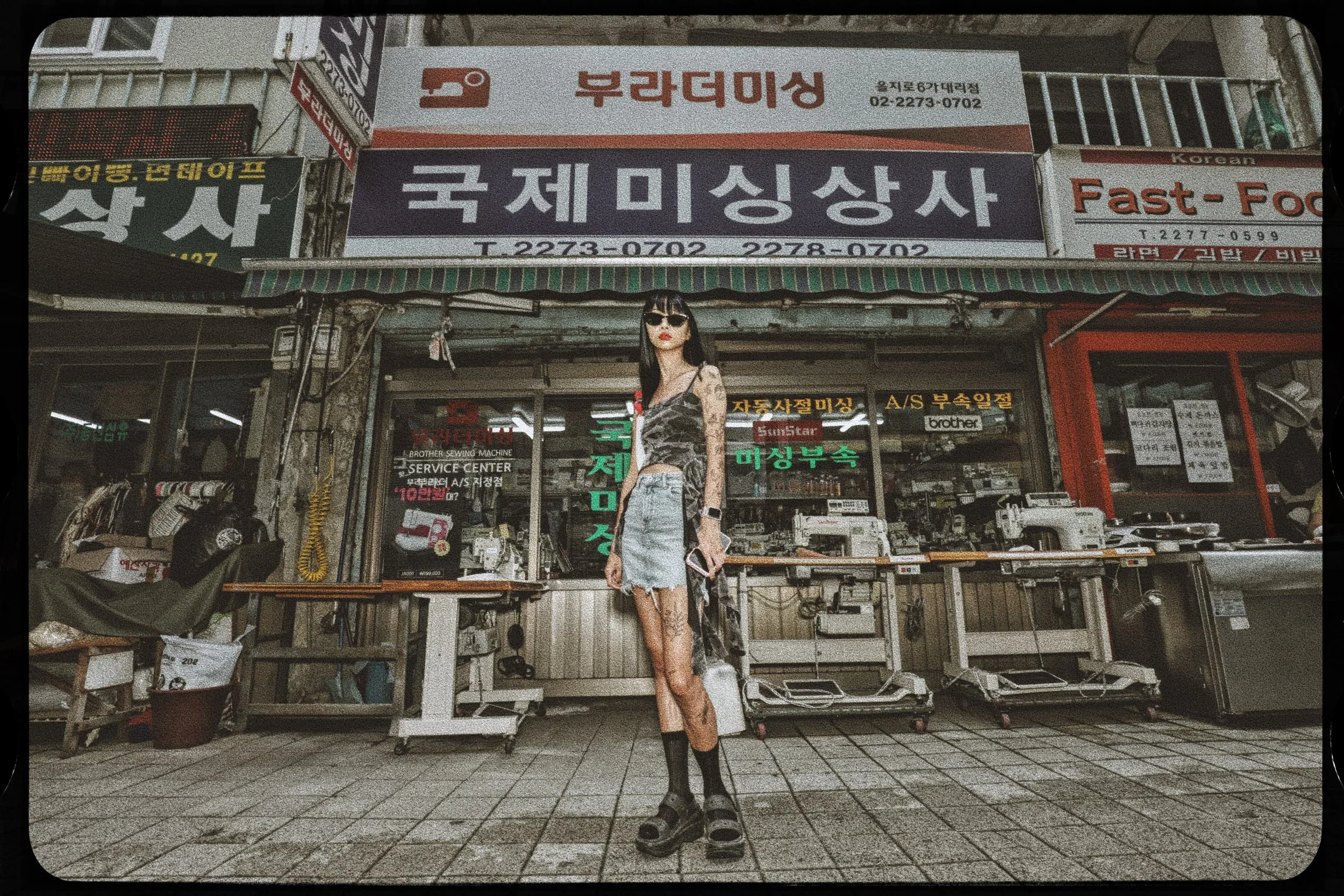
Remnants of the old Dongdaemun persist and evolve…somewhat.
Jeon's proposal reveals a fundamental misunderstanding of what Dongdaemun has become.
She thinks what died was manufacturing jobs, wholesale markets, and local economic vitality.
What actually died was a business model where fashion production, wholesale, and retail were spatially co-located in one neighborhood.
What replaced it was a global value chain where Seoul does design and curation, Vietnam does manufacturing, and the entire world does retail.
DDP's role: physical headquarters for Seoul's design and curation function.
Demolishing DDP won't bring back Dongdaemun's wholesale era any more than demolishing smartphones would bring back Nokia. The economy changed. Technology changed. Global supply chains changed. DDP changed with it.
That's the part politicians can't forgive—the building succeeded by adapting to an economy they didn't want to accept.
THE BUILDING THAT OUTGREW ITS PURPOSE (AND PROVED IT WAS RIGHT ALL ALONG)
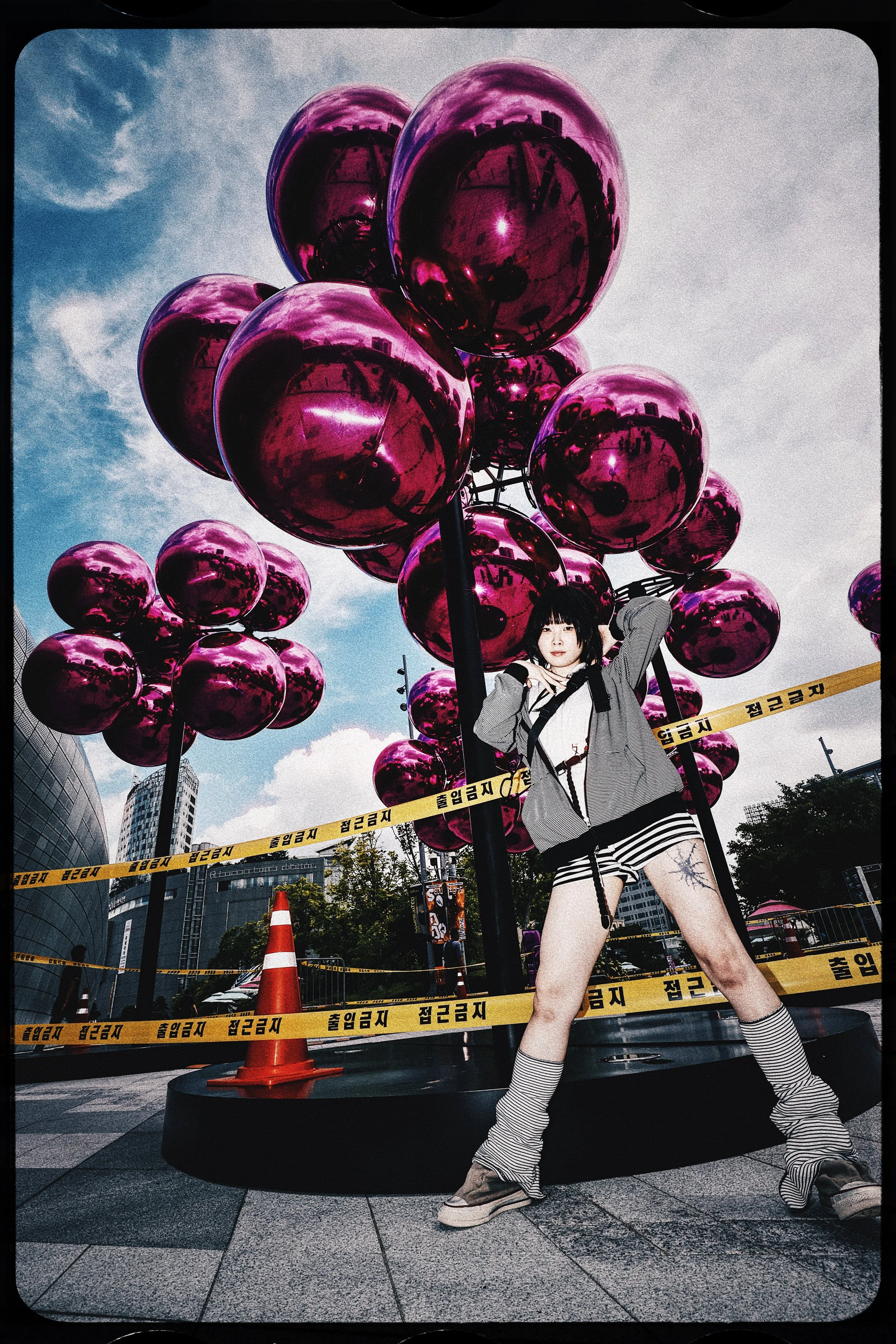
Nooks and crannies in the DDP afford all sorts of wonderfully absurdist connections.
Here's what makes DDP remarkable: it was designed for one economy and thrived in another.
The 2007 brief: create infrastructure to support Korea's transition from manufacturing to design. The 2014 reality: Korea's manufacturing had already moved offshore. The transition was complete. What happened: DDP served the post-transition economy better than anyone predicted.
This is what parametric architecture means: spaces designed to adapt to whatever Seoul becomes, not preserve what it was.
Hadid's "metonymic landscape" concept wasn't about freezing Dongdaemun's identity at a specific moment. It was about encoding Seoul's fundamental characteristic—flexibility, simultaneity, multi-use spatial culture—into the building's DNA.
When the economy shifted, the building shifted with it.
The 2007 vision asked DDP to support Korean designers (they now show at Seoul Fashion Week and manufacture globally), create a design hub (luxury brands validate DDP as cultural capital), revitalize Dongdaemun (13 million annual visitors, district sales up during events), and establish Seoul as design capital (World Design Capital 2010, global media coverage).
Functions nobody predicted in 2007: soft power infrastructure where the building itself sells "Korea as future-forward nation," media art platform where Seoul Light DDP wins global awards, tourist attraction as the #1 Instagram location and international filming location, brand validation space where luxury brands use DDP to prove cultural equivalence to Paris and Milan.
The building didn't fail its mission. The mission evolved, and the building evolved with it.
That's not a happy accident. That's metonymic flexibility working exactly as designed.
THE REAL QUESTION ISN'T WHETHER DDP SHOULD SURVIVE
Politicians want to demolish DDP because it represents an economy they don't understand and can't measure.
But that economy—where Korean cultural influence commands global premiums, where aesthetic curation matters more than manufacturing capacity, where soft power generates harder returns than textile exports—is already here.
DDP didn't cause it. DDP captured it.
Look at the evidence. Korean textile exports: $10 billion. Olive Young tourist sales: 1 trillion won. Korean fashion influence: global, but manufactured offshore. Seoul Fashion Week function: B2B platform for international buyers, not local production support.
The economic transformation is complete. Korea is a design nation, not a manufacturing nation. Korean fashion's global success is built on aesthetic curation, not production capacity. DDP is the physical proof.
The building works because it was designed to embody Seoul's essential character—spaces that adapt to whoever uses them, whenever they use them, for whatever they need. When the economy shifted from manufacturing to curation, DDP shifted from production support to cultural capital infrastructure.
The 45,000 parametrically-generated aluminum panels that wrap the building aren't decoration. They're a spatial flexibility system that allows the same volumes to serve fashion shows, art exhibitions, tech launches, and fan conventions without modification.
The flowing curves that make the building look "alien" aren't aesthetic indulgence. They're legibility systems that help 13 million annual visitors navigate complex interior spaces without signage.
The suppression of windows behind perforated metal isn't hiding failure. It's prioritizing the building's role as monolithic urban sculpture over ancillary programmatic requirements.
Every formal decision serves the building's core function: be flexible enough to serve whatever Seoul becomes. And it worked.
Seoul Fashion Week can't leave because traditional architecture can't replicate DDP's multi-modal simultaneity. Luxury brands keep returning because the building validates them culturally. Tourists photograph it obsessively because it looks like the future.
The building makes it impossible to deny that Korea's economy has fundamentally changed.
That's why politicians want it gone.
WHAT HAPPENS IF DDP SURVIVES
If the demolition proposal fails—and the data suggests it should—DDP will continue doing what it's been doing: serving as infrastructure for Korea's design-based, culturally-driven, soft-power-generating economy.
Seoul Fashion Week will keep using it because nowhere else works. Luxury brands will keep validating it because it signals cultural capital. Tourists will keep photographing it because it represents "future Korea." Media artists will keep using its 222-meter facade as the world's largest projection surface.
Korean fashion will keep conquering global markets by doing what DDP does: curating aesthetics, not manufacturing products. The building will keep proving that parametric architecture can handle contemporary social complexity better than traditional alternatives.
What happens if it's demolished? Seoul Fashion Week scatters to hotel ballrooms and museum galleries, loses the multi-modal simultaneity that makes it function, becomes just another regional fashion week instead of Asia's premier B2B platform.
International buyers lose faith in Seoul as serious fashion capital. "They tore down their landmark to build a baseball stadium" is not the message that commands premium prices.
Korea loses physical proof of its economic transformation. The building that demonstrates "we design things now, we don't just make them" gets replaced by nostalgia infrastructure.
And the lesson to the architecture world: Don't build buildings that adapt to economic reality. Build buildings that reinforce political fantasy.
THE BUILDING KOREA NEEDS BUT POLITICIANS HATE
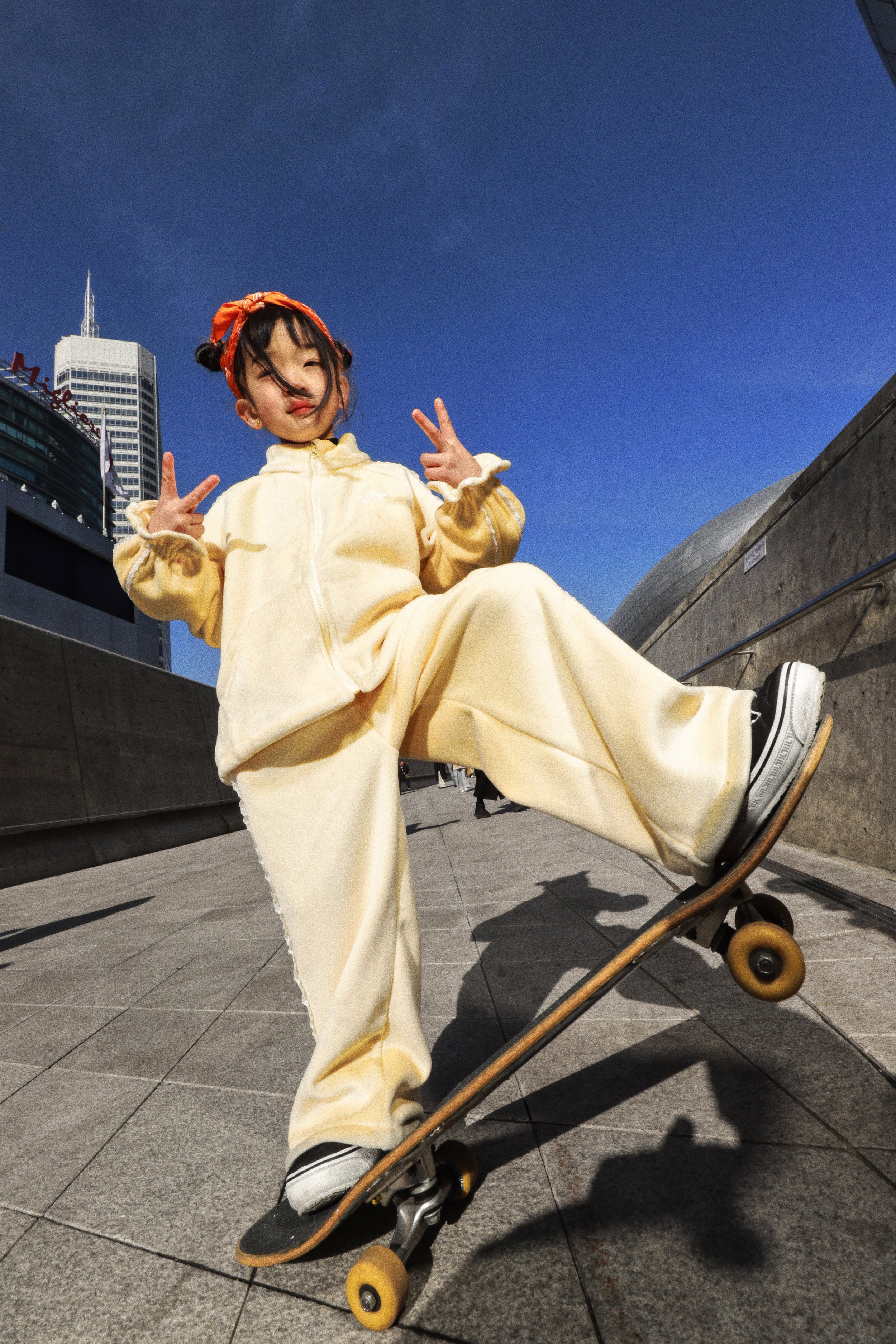
The DDP may never in fact have a giant girl in a designer dress and combat boots riding and sliding down its moonlit roof and facades, and that sort of thing will likely never make money or profit we can measure, but as diffuse as its spectacular influence may be, it can certainly inspire us to dream.
The real question isn't whether DDP should survive.
It's whether Korea is ready to accept what DDP proves: that the country's economic future lies in cultural capital, not manufacturing nostalgia.
Dongdaemun's wholesale markets are dying because online shopping and Chinese manufacturing killed them, not because a Zaha Hadid building appeared. Korean textile factories are closing because Bangladesh workers cost less, not because DDP failed to support them. Korean fashion brands manufacture offshore because that's how global supply chains work now.
DDP didn't cause any of this. DDP adapted to all of it.
The building opened in 2014 into an economy that had already shifted, and it worked anyway. It served functions nobody predicted in 2007. It validated Korea's role as global aesthetic curator. It proved that parametric architecture can create spaces flexible enough to handle whatever comes next.
Politicians want to demolish it because they can't measure its value on a balance sheet, because they want to return to an economy where you could count ticket sales and know exactly what you made.
But that's not Korea's economy anymore. Korea's economy runs on BTS making Samsung phones cool, Squid Game making Korean content command premium prices, and Olive Young selling the curation skills that Korean beauty brands export globally.
DDP is infrastructure for that economy.
The building that was supposed to mark Korea's transition from manufacturing to design has become proof that the transition was right. The metonymic landscape that was meant to capture Seoul's character has demonstrated that Seoul's character—flexible, simultaneous, multi-use—is exactly what contemporary global culture needs.
The parametric design that politicians call "disconnected from local identity" is actually the only architecture that can handle local identity when that identity is "we adapt to whatever works."
Demolishing the evidence won't change the answer.
Korea is a design nation now. Korean fashion succeeds globally through aesthetic curation, not production capacity. The manufacturing jobs aren't coming back. The wholesale markets aren't reviving. The spatial integration of production-wholesale-retail isn't returning.
DDP proves all of this. And that's exactly why politicians want it gone.
The building Korea needs is the building Korea has: adaptive, flexible, metonymic infrastructure for an economy based on cultural capital. The building politicians hate is the building that won't let them pretend otherwise.
Tearing down DDP won't bring back Dongdaemun's wholesale era. It will just eliminate the physical proof that moving forward was the right choice.
The question is whether Korea is brave enough to keep the evidence.