Certified Korea™: On Cheese Lobster Tails and the Official Sloppification of Knowledge about Korea
How a failed national-branding project built a subcommittee, the subcommittee built a content farm, and the content farm ended up helping manufacture the slop in everybody's algorithm
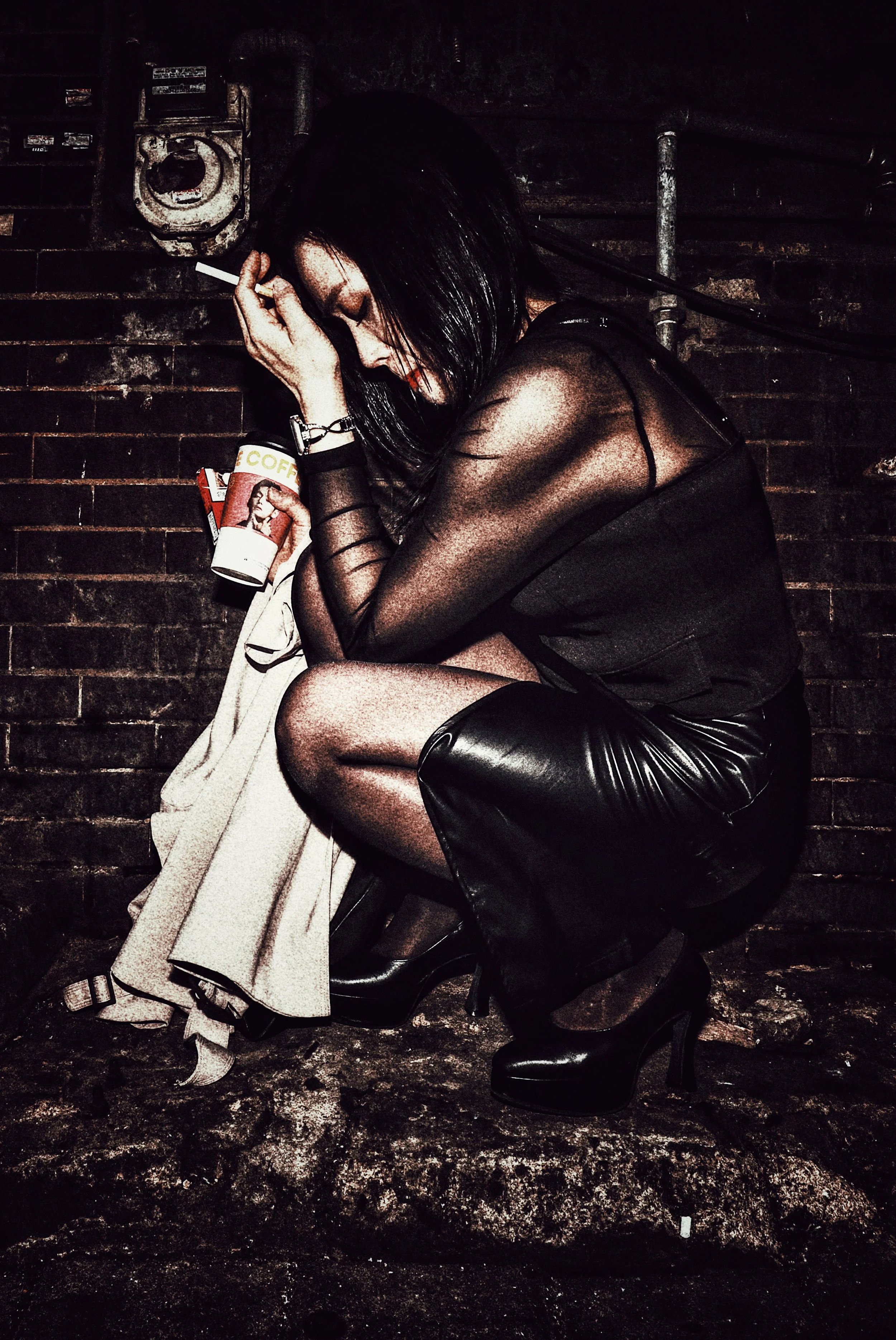
Model @shinyjaky medidates in a Jongno side alley during the lunchtime hour — a woman crouched against a brick wall, cigarette lit, coffee in hand, coat pooled into a neat bundle beside her, a moment of peace, alone during the mid-workday. Her cigarette will offer her a singular moment of solace. She is performing a slice of lived reality for an editorial that is realer than real.
There's a woman crouched in a Jongno backstreet on her lunch break, cigarette in one hand, coffee in the other, coat pooled on the ground beside her because there's nowhere else to put it. She isn't looking at anything. She isn't performing anything. She's stolen ten private minutes out of a workday that resumes whether she's ready or not, and for those ten minutes, nobody was supposed to see this — a mood that has more in common with Oldboy and Parasite than with anything a tourism board has ever paid a firm to produce.
That's the whole argument, standing right there against the brick. Nobody scripted that fatigue. Nobody could have. Model @shinyjaky is a “senior model” who actually has lived this 9-to-5 rat race and knows the streets, knows the beats. And it sits closer to the actual, load-bearing image of Korea that broke the rest of the world open than any of the content currently being manufactured to represent it — because increasingly, the algorithm and the government have agreed, for entirely different reasons, that the manufactured version is the one that should win.
This is a story about how that agreement happened. It starts with an ad campaign that got a cartoon foreigner kicked in the groin, runs through a committee meeting I sat in nearly two decades ago, and ends with a discovery that should worry anyone who thinks "government-controlled" and "algorithm-driven" describe two different problems. They don't. They're the same problem wearing two different uniforms.
THE KOREA SPARKLING ERA
In 2007, the Korea Tourism Organization launched a new national slogan: "Korea, Sparkling." It was mocked immediately, in Korea and abroad, for sounding like a soft drink. The accompanying promotional content — official government output — featured a cartoon foreigner getting kicked in the groin, beaten with sticks, and having his head explode from eating Korean food, in what someone in a ministry meeting apparently believed was an endearing representation of cultural exchange. The campaign's actual video spots ran a gentler version of the same aesthetic — no groin kicks, just every Korea-marketing cliché of the era stacked into ninety seconds, shot competently enough that it takes a second look to notice how empty it is.
The "Korea, Sparkling" era, in one frame — a hanbok-clad Korean girl rides an extreme version of the Joseon-era swing game called geunettuigi (그네뛰기), while a B-boy is captured mid-spin, punctuated by an ebonics-inflected heralding of “K-boys!” because apparently nobody in that ministry meeting could imagine a subtler way to say "we contain multitudes" than physically colliding two dancers from different centuries, while borrrowing from the American Black hip hop culture that was at the same time the very thing that made the b-boying “low” culture to offset against something represented as “high culture.” This is the very racist/classist assumption that gives the contrast fuel in the first place. And still, it's not even an isolated bad idea; an actual, real, government-adjacent stage production called The Ballerina Who Loved a B-Boy ran on this exact premise starting in 2005, the same era the Korea Tourism Organization was bankrolling B-boy world championships as a national branding line item. The outro shot is its own small masterpiece of the genre: a grandfather dressed head to toe as a yangban — the old Confucian scholar-gentleman class — seated on a sleek modern train, watching World Cup highlights flip across the screen of a state-of-the-art Samsung phone, framed so the viewer can properly marvel at five hundred years of tradition colliding with next-generation hardware in one shot.
Yawn.
Here's the part worth saying plainly rather than politely: none of this was ever actually aimed at an actual foreign viewer. It's Koreans performing their own modernity for themselves, dressed up as an appeal to outsiders — a very old reflex with an actual name, 사대주의 (sadaejuui, the historical habit of measuring your own worth by whether a more powerful outside civilization has noticed and approved of you). The specific audience being courted isn't "the world." It's what I've called the White West elsewhere — North America and Western Europe, specifically, the imagined tribunal of "good white people" whose recognition Korean institutions have spent decades treating as the only recognition that counts, first China's court, then this one. Watching a country get visibly thrilled that the White West might be watching and might approve is its own genre of humiliating, and this video is doing it at national scale, on a state budget, with a completely straight face — kissing up to an audience that was never even the one paying attention. Then it lands the whole thing on Rain — Jung Ji-hoon, one of the biggest stars Korea has ever produced — delivering the line "Korea, Sparkling" directly to camera with the kind of overacted sincerity usually reserved for late-night infomercials, as if saying the tagline slowly and meaningfully enough could retroactively make it a good tagline. It cannot. This is professionally lit, competently edited, expensively produced content, fronted by a genuine A-list star, and it is somehow still one of the most punishable sixty seconds of soft power a national government has ever paid to have written, shot, approved, and released into the world.]*
Before that there was "Dynamic Korea." After it, "Imagine Your Korea." In 2015, Seoul rolled out "I.Seoul.U," which became an international punchline within hours of its unveiling. The Presidential Council on Nation Branding — established in 2009, an 81-billion-won annual budget, 47 advisers including eight cabinet ministers — didn't survive one presidential term. The National Assembly itself would later call the flagship "Globalization of Hansik" campaign, which put bibimbap commercials in Times Square, an outright failure.
Billions of won. Multiple ministries. Presidential-level attention. International embarrassment, on a loop, for the better part of a decade.
And the entire time this was happening, without any help from a single one of these campaigns, Korean culture became the most desired cultural export on the planet — on the strength of exactly the material these campaigns were built to avoid.
Because here's what actually broke through, while the ministries were workshopping mascots: Oldboy, a film about incest, imprisonment, and a man eating a live octopus, took the Grand Prix at Cannes in 2003 and became the founding myth of the entire global Korean cinema wave. Parasite took the Palme d'Or and the Best Picture Oscar on the back of class rage and a family living, literally, under another family's house. Squid Game didn't need a marketing campaign because it wasn't selling an experience of Korea to outsiders — it was documenting 헬조선 (Hell Joseon), the bitter shorthand young Koreans use for a hyper-competitive, debt-choked, credential-inflated present, so precisely that audiences with no connection to Korea at all watched it and felt recognition rather than tourism. The transgression wasn't a flaw the world tolerated on the way to loving Korean culture. The transgression was the transmission mechanism. Every official campaign tried to sell the version of Korea that Korea wanted the world to see. Every actual breakthrough sold the version Korea was trying to keep quiet.
You would think, given a decade of this exact lesson repeating itself with increasingly expensive stupidity, that someone in a position of institutional authority might have noticed the pattern.
I WAS IN THE ROOM
I noticed it. I said so, in a room where it mattered, in the early years of that same failed branding apparatus.
I was invited onto the Presidential Council on National Branding during Lee Myung-bak's administration — the era that would go on to produce the sparkling widget and, eventually, the 81-billion-won council that outlived its own usefulness by about eleven months. At the time, I was one of a small handful of people whose work already functioned, whether the government wanted to admit it or not, as the actual foreign-facing press corps for Korean culture. The Marmot's Hole was the biggest of us English-language bloggers — general Korea coverage, politics, the daily churn of expat and Korean-interest news. Zenkimchi — Joe McPherson, one of the actual OGs, still writing about Korean food two decades later — owned the food beat alongside Fat Man Seoul, butin a different register: a plain daily accounting of cafeteria lunches, strange and compelling enough that I stole its bones outright and inverted them into Feetmanseoul, my own street-fashion project — instead of documenting what people ate, I documented what they wore, shot from the ground up, the same way he'd shot his lunch tray every day without ceremony. And I was running Scribblings of the Metropolitician, which did social criticism and analysis— the kind of writing that got me reliably attacked by Korean nationalist commenters, because saying something true and uncomfortable about the country you're documenting was never going to win a popularity contest. Not that it was ever supposed to be one.
None of us were credentialed by anyone. We were read anyway — by more people, more consistently, than the English-language arms of Korean newspapers were managing at the time. European fashion buyers found Korea’s first English-language fashion blog Feetmanseoul, on their own and passed it along to colleagues because there was, simply, nowhere else to find what I was documenting. Seoul Fashion Week gave me a press pass in 2007 not because anyone believed in what I was doing, but because nobody else was covering Korean fashion in English at all, and they needed the coverage — and then, having given me the credential, spent the next several years faintly resentful that I used it to photograph the parking lot instead of the runway, because I understood something the organizers didn't: whatever was happening on the runway inside, something was also happening outside, and the two shows were in conversation with each other in a way that mattered more than either alone.
The committee, when I sat in on it, was preoccupied with something else entirely: elaborate strategies for reaching foreign correspondents and international press bureaus — press releases, media outreach plans, the whole traditional apparatus for getting Korea's message into somebody else's newspaper. My point, when I finally got the floor, was almost embarrassingly simple by comparison. You already have people commanding more eyeballs and more actual influence than the entire English-language desk of any Korean newspaper, or any of the outreach you're describing — and one of them is sitting at this table right now. Nobody on that committee had heard of a single blog I mentioned. Not The Marmot's Hole. Not mine.
So I gave them a data point instead of an argument, because the argument clearly wasn't landing. In April 2007, when Seung-Hui Cho — a South Korean national — carried out the shooting at Virginia Tech, people came to Marmot's Hole and to my site before a single English-language section of a Korean newspaper had published a word, because we ranked first on Google and an audience already trusted us to have something to say. In the confused first hours, when early reporting had the shooter's nationality tangled up with a visa record traced through China, I wrote that it was at least as plausible the shooter was Korean — a guess that turned out to be exactly right. A writer at Salon called the comment racist. Nobody ever walked that back. But the traffic numbers didn't lie, and neither did the outcome: we were faster and more accurate than the actual press, running on nothing but an audience's trust, with zero institutional backing at all.
They formed a subcommittee anyway. What it eventually recommended wasn't recognition — it was recruitment: commission foreign creators, formally, through the government, from scratch. At a follow-up meeting, I told them directly this would produce a rubber-stamp situation — that the real qualifying criterion would quietly become who could produce the most flattering content, not who had actually earned an audience's trust. They insisted, at length, that this wasn't censorship and wouldn't become censorship. They were technically correct and completely wrong at the same time, because the rubber-stamp effect was never going to require a formal rule to begin with. Put a room full of government officials in charge of who gets access to any benefit at all, and the filtering happens on its own, informally, every single time. I was the person who told them this to their face before the program existed. I still ended up outside the version of it they eventually built.
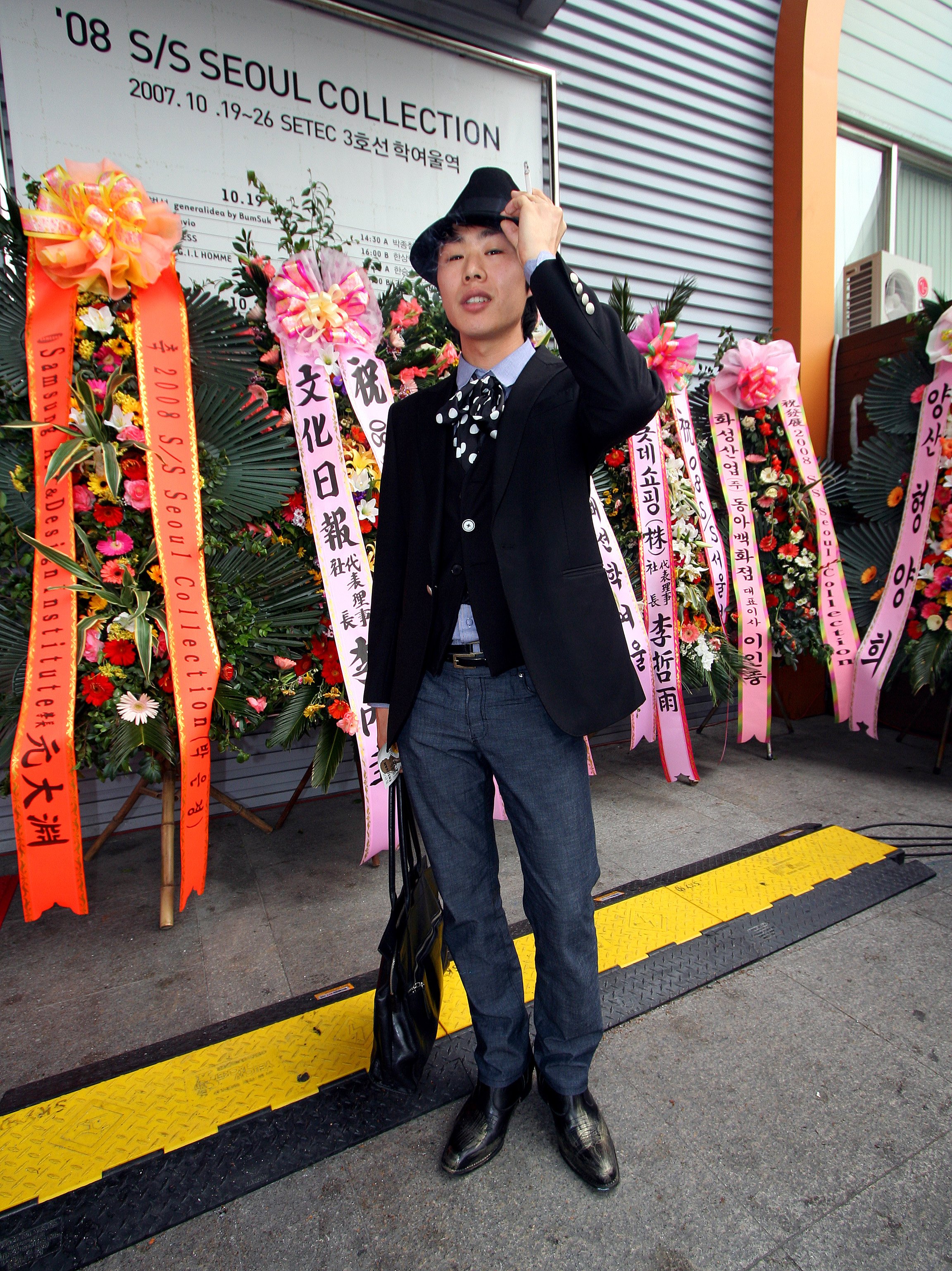
October 25, 2007. At the Seoul Collection (not yet permanently called “Seoul Fashion Week”), busy bieng the first non-Korean on the scene, making fashion content that would be shipped out across the world on the Feetmanseoul.com blog. i was the street fashion guyu and arguably the only person shooting and shipping Korean fashion images to anyone who cared outside of Korea. There were a few others like me, covering food, film, and other important aspect of Korean popular culture and society. All out shit was professional. And real. Seoulacious was there before they even decide dto CALL the ”Seoul Collection” a proper “Fashion Week.”
THE SAUSAGE FACTORY
What emerged wasn't recognition. It was manufactured enthusiasm.
Where I'd proposed extending standing outward — to people who'd already earned an audience, on the audience's terms, including people whose work was frequently critical — what emerged instead was a program that generates its own approved corps from scratch. You don't get into the K-influencer track by having already built something. You apply for it. The 2026 cohort drew a record 4,184 applications from 134 countries; the program has, since 2020, produced more than 20,000 pieces of content and grown its flagship channels from a combined 39,000 views to roughly 700 million. By its own internal metrics, it is an enormous success. Selected creators receive training, a government certificate, mentoring, and — as of recently — formal instruction in using AI tools to produce content faster. It is, in the truest sense, no longer a group of independent voices the state has chosen to platform. It is a sausage factory the state built, stocked, trained, and now actively teaches to run faster — raw applicants fed in one end, a uniform, pre-approved, positivity-grade product coming out the other, indistinguishable from each other because indistinguishability was the whole point.
There's an old line about not wanting to watch how the sausage gets made. This factory runs on the opposite problem: the entire product depends on looking like it was never made at all — like it's just an enthusiastic foreigner spontaneously loving Korea on camera, rather than an applicant who filled out a form, sat through a training module, and picked up a government certificate on the way to the microphone.
Nobody had to write a censorship directive to make this factory produce nothing but positivity. That's the part worth sitting with, because it's not a conspiracy — it's simpler and more durable than a conspiracy. A pair of researchers who studied this exact program, Jin Lee and Crystal Abidin, found the mechanism operating in plain sight: creators who post the kind of content the ministry wants — the loves-Korea narrative, the wide-eyed appreciation, the visually attractive foreigner charmed by K-culture — get paid work, official favor, continued access. Creators who post anything critical get trolled by the audience the program has helped cultivate, and quietly stop getting invited back. Nobody bans anyone. Nobody needs to. The reward structure does the filtering on its own, continuously, without a single meeting about it. That's the rubber-stamp effect, and it's important to be precise about what kind of thing it is. Uncritical enthusiasm is not a rule, but an emergent property — the predictable output of a system that pays for one kind of content and starves the other, running long enough that everyone downstream learns which kind to make without ever being told.
This is exactly the outcome I argued against in that committee meeting, wearing a different uniform than the sparkling widget but running on the identical fear: that Korea's image needs to be managed, that the raw, unapproved version is a liability rather than the actual asset, that the fix for bad official messaging is better official messaging rather than less official messaging. The subcommittee that came out of my proposal took the diagnosis and inverted the treatment. I said: the patients already know how to walk, let them into the building. They said: let's build new patients from scratch who'll walk exactly where we point.
THE OTHER SLOP MACHINE
Here's where it gets worse, and where the piece stops being only about one government program: the state's positivity machine isn't even the only slop machine running right now. It's just the one with a certificate.
The open platform economy has its own version of the same failure, arrived at through completely different math. A researcher studying Korean YouTube's monetization structure, Dasol Kim, found that self-exoticizing, simplified, easily-legible content — the othering version of Korea, performed for an audience that wants Korea explained rather than encountered — actually earns better ad rates, a kind of arbitrage built into the platform's own economics. Nobody at YouTube is enforcing positivity either. The algorithm doesn't care about Korea's reputation one way or another. It's optimizing for a completely different variable — engagement, watch time, CPM — and it happens, for reasons that have nothing to do with nationalism, to reward almost exactly the same flattened, simplified, safely-legible output the state program rewards for reasons that have everything to do with nationalism. Two entirely separate machines, one running on ministry anxiety and one running on ad economics, are converging on the same shape because both replaced an earned filter with a gameable one.
You can watch Korean creators understand this instinctively the moment the camera points outward. A 2023 SisaIN investigation into Korea's biggest travel YouTubers found them freely admitting, on camera, that developed and comfortable destinations are commercially dead — one of them called Europe a content graveyard, in so many words, because nothing goes wrong there worth filming. 고생은 돈이 된다 — hardship makes money — is apparently understood well enough in the industry to be a stated principle. These are Korean creators who know, cold, that difficulty and specificity sell better than polish and safety when they're filming somebody else's country. It is a genuinely strange blind spot that the same instinct evaporates completely the moment the camera turns back around to face home, where an entire state apparatus now exists specifically to reward the opposite lesson.
And a Hankook Ilbo investigative series on Korea's most Instagram-famous domestic tourist villages — Gamcheon, Bukchon, Ikseon-dong (익선동) among them — turned up the visitor-side version of the same complaint, in reviews from foreigners who'd actually shown up expecting culture and found photo-ops instead: don't be fooled by the word "culture," there's nothing cultural here. One visitor compared marketing a repainted hillside village as "Korea's Santorini" to calling a third-division team Liverpool FC. These aren't hostile reviewers. They're disappointed ones — people who came because Squid Game and Parasite told them something raw and real was here, and got handed a photo backdrop instead.
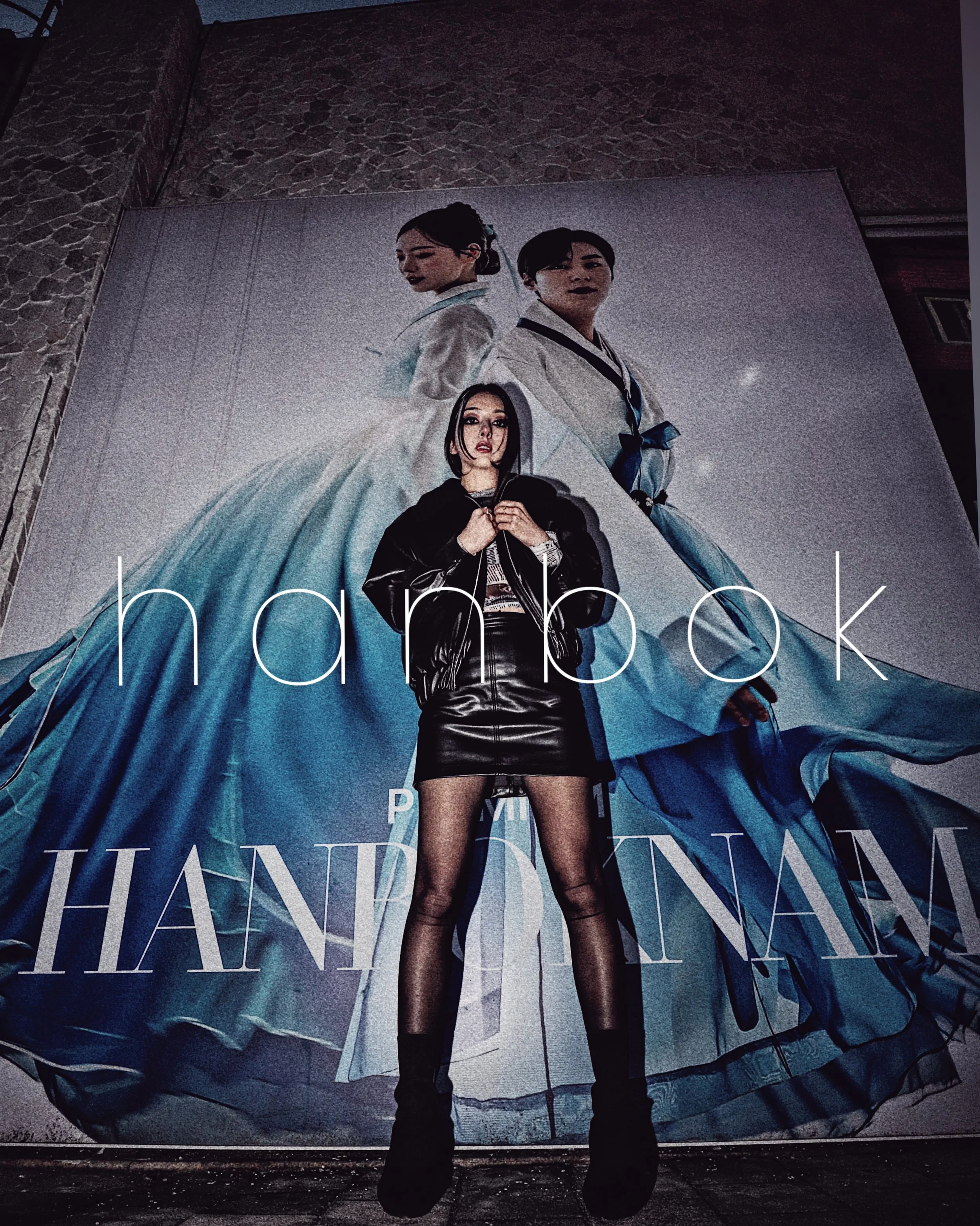
Seochon (서촌, "west village") sits just west of Gyeongbokgung, historically home to mid-level court officials, translators, and craftsmen rather than the yangban aristocracy who lived in Bukchon to the east. These days it's Seoul's other hanok neighborhood — smaller, quieter, a few years behind Bukchon on the same gentrification curve. The mural's own subject matter isn't incidental to any of this: the hanbok itself has been repurposed into a tourism product in exactly this part of the city, ever since the government began offering free palace admission to anyone wearing one. Rental shops now cluster around Gyeongbokgung and both hanok villages, renting out costume-grade hanbok by the hour to visitors chasing a specific photo rather than the garment's actual history, which makes a mural selling "real" hanbok on this particular street its own small joke, whether any retailer intended it or not.
A friend put his finger on the mechanism better than any of the literature did, watching yet another Korean creator run the explaining Korea in English, to the algorithm, for an audience that has apparently decided we all live here now format. Neither of us could tell you her name. That's not an insult — it's the point. Nobody making this content actually cares whether a stranger has a good trip. They're producing followers, not experiences, and the content only has to perform, not hold up. Which is why the genre's supposed correction to itself — the insider tip, the skip the obvious spot, go here instead video — isn't actually a correction at all. Tell everyone to skip Gwangjang Market and go to Mangwon-dong, and Mangwon doesn't become a secret. It becomes the new Gwangjang: new photo queue, new "actually, skip Mangwon, try—" video eighteen months later, same treadmill, one neighborhood over. This is the part worth naming precisely, because it's the version of the disease that even good-faith correction reproduces. Pointing at something less trampled isn't a cure for the trampling. It's the trampling's delivery mechanism, running one step ahead of itself, forever. Kyle Chayka's writing on algorithmic culture flags the identical pattern in Iceland — a "hidden gem" survives exactly as long as it takes the discovery itself to get distributed. After that, only the map's legend has changed.
THE LOBSTER TAIL
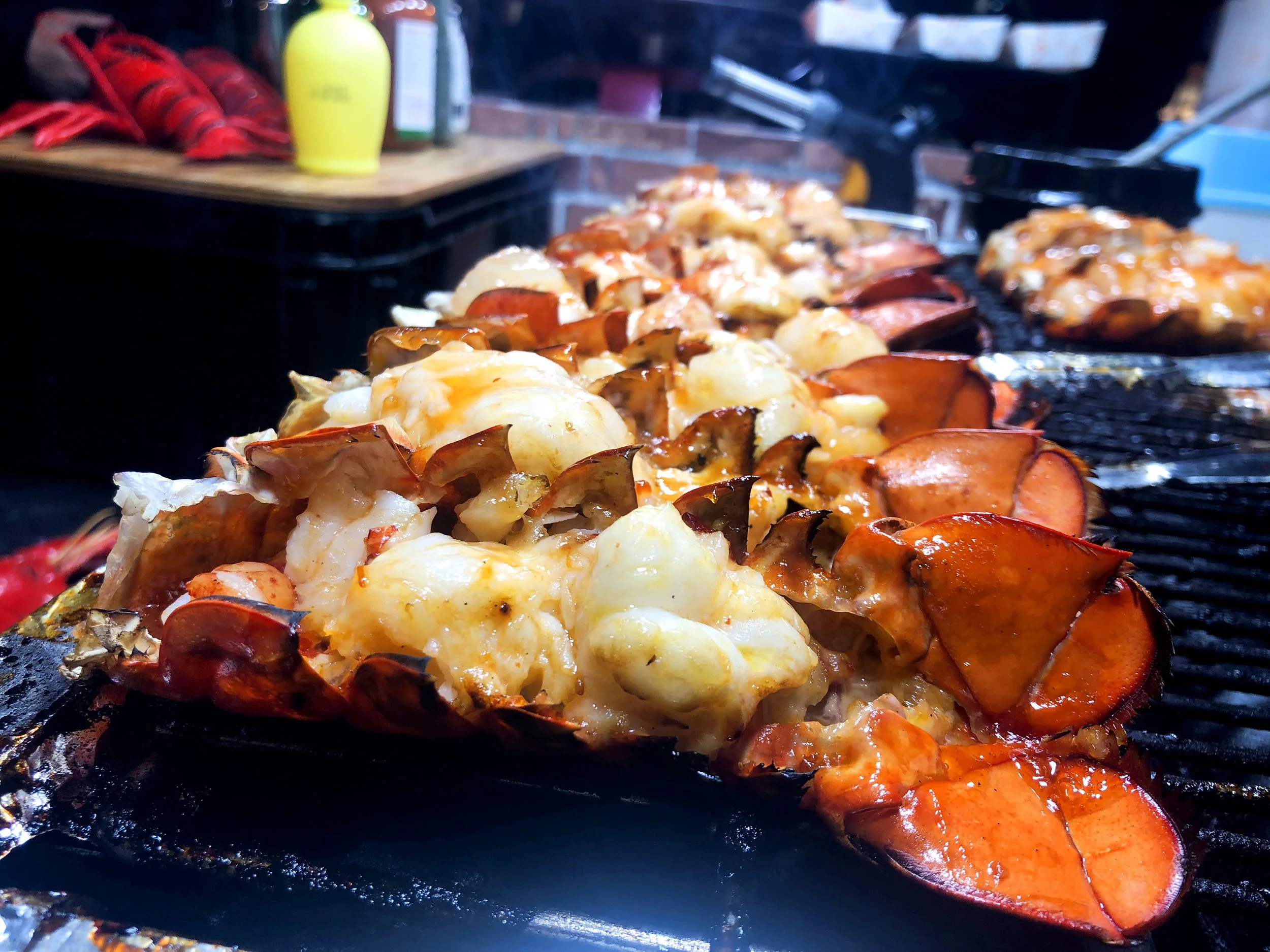
Shot in 2019, on the central strip every Myeongdong food tour stops at. This lobster tail is a spectacle object — the single clearest symbol of tourist-driven sloppification of Korean knowledge and the Disneyfication that follows it. It has never, at any point in this country's history, actually been Korean street food. Not even close. It’s the polar oposite of what that was — cheap, hearty, and good. This is a Disneyland ride.
Take the treadmill one step further, though, because Myeongdong shows you where it actually ends up, and it's worse than relocation.
For years, the strip near Myeongdong's main entrance ran on ordinary street-stall economics: a handful of ajummas, some of the best-known in the neighborhood (and alsso the city), feeding a dense, tired, working population on its way home, customers hunched shoulder to shoulder right up against the counter because there was nowhere else to stand. You could get udon standing up. You could get tteokbokki (떡볶이, spicy stir-fried rice cakes) that had been rolling on a low flame for hours, the sauce a deep, glossy red that only got darker and more caramelized toward the end of a shift — I watched one of the ladies dump what looked like an entire bag of sugar straight into the pot herself, before the evening rush, cutting the chili heat with plain sweetness the way it's actually done on the street, not the way a recipe card says it's done. Beside it, trays of twigim (튀김, fried items) under foil, skewers stacked upright in a bundle, gloved hands ladling sauce over rice cakes for the next person in line. You could get eomuk-guk (어묵탕, fish-cake broth) with a whole radish and sometimes half a crab bleeding flavor into the stock, and a gyeran-ppang (계란빵, egg bread) on your way out. All of it for a few dollars. None of it photogenic. All of it real, in the specific sense that it existed because hungry people needed something hot and cheap on the way home, not because anyone thought it would perform online.
That strip doesn't exist anymore. In its place: guys selling actual lobster tails with melted cheese on top, plated with restaurant-grade styling, at a price that has nothing to do with feeding a tired commuter and everything to do with matching what a decade-plus of YouTube thumbnails have told an audience "authentic Korean street food" is supposed to look like. There has never, at any point in this country's history, been a street stall selling cheese-topped lobster tail as a traditional Korean snack. It doesn't reference anything real. It's Disneyland — a set built to resemble a culture that never actually produced the thing being sold, assembled entirely out of the pre-formed expectations of an audience that watched the videos before it ever got on the plane.
None of this happened by accident. Call it semiotic slippage if you want the academic name for it, but the plainer version is simpler: someone ran the numbers and made a bet. The vendors on that strip didn't get confused about what Korean food is. They made a calculated switch, because the street's actual customers had already changed underneath them. A Seoul AI Foundation study of foot traffic at the city's major attractions put a number on it: 47.1% of everyone walking through Myeongdong on a given day is a foreign tourist — nearly half, among the highest share anywhere in the city. Commercial vacancy on the strip, over 50% as recently as 2021, has collapsed to around 5%, filled almost entirely by businesses built for that new customer, not the old one.
The stronger proof isn't the percentage, though. It's what happens when the tourists stop coming — which has happened twice, for two completely different reasons, with the same result both times: nothing was left. In 2017, China banned group tourism to Korea in retaliation over THAAD, and Chinese arrivals collapsed from roughly 8 million to 4 million in a single year. Korean business press described Myeongdong's cosmetics shops that year in one word: 휑한 — desolate. Nearly customerless, for the better part of two years. Then COVID hit, and vacancy on the strip spiked to that same 50% mark, on its own. A geopolitical shock and a public-health shock, six years apart, and the neighborhood emptied out the same way both times. That's not a Korean neighborhood that also happens to draw tourists. That's a tourist neighborhood that Koreans happen to walk through.
Take that same lobster tail and set it down in front of the old crowd — commuters with a few thousand won to spend before catching the subway — and nobody buys it. It wasn't built for them. It was never Korean food to begin with. It's tourist food, priced in a currency of dollars and euros, built for the exact customer who has, measurably, replaced the one the street used to feed. Baudrillard thought this kind of thing happened by accident — a copy drifting slowly away from its original until nobody remembers there ever was one. This one wasn't an accident. Someone built it on purpose, the day it started making money, for a customer who had already replaced the one the real dish was cooked for.
Here's the detail that makes it worse than ordinary gentrification, and it isn't really about one street copying another. It's a loop. The bright, glistening, restaurant-lit version of Korean street food that circulates on YouTube and Instagram creates an expectation in the audience before anyone's even left home. Vendors, watching that expectation rather than any actual tradition, start producing to match it — because that's what sells now, and selling is the job. Run that cycle enough times, at enough stalls, over enough years, and it doesn't just add a shinier option next to the real thing. It slowly cycles the real thing out of the system. A few ajumma stalls one street over are still standing, still selling exactly what they always sold — but they're the holdout now, not the norm, and the direction of travel only points one way. That's Baudrillard's hyperreality, with a receipt attached: not two things sitting peacefully side by side, but one version quietly replacing the other, one vendor's decision at a time, until there's nobody left producing the thing itself instead of producing the picture of the thing, and then producing the real thing that’s based on the picture of the thing that never really existed in the first place.
That's the word for it, in the end. Slop. Not because it's low-effort — because it's a copy of a copy of a fantasy, manufactured entirely out of other people's manufactured content, with nothing underneath it holding it up.
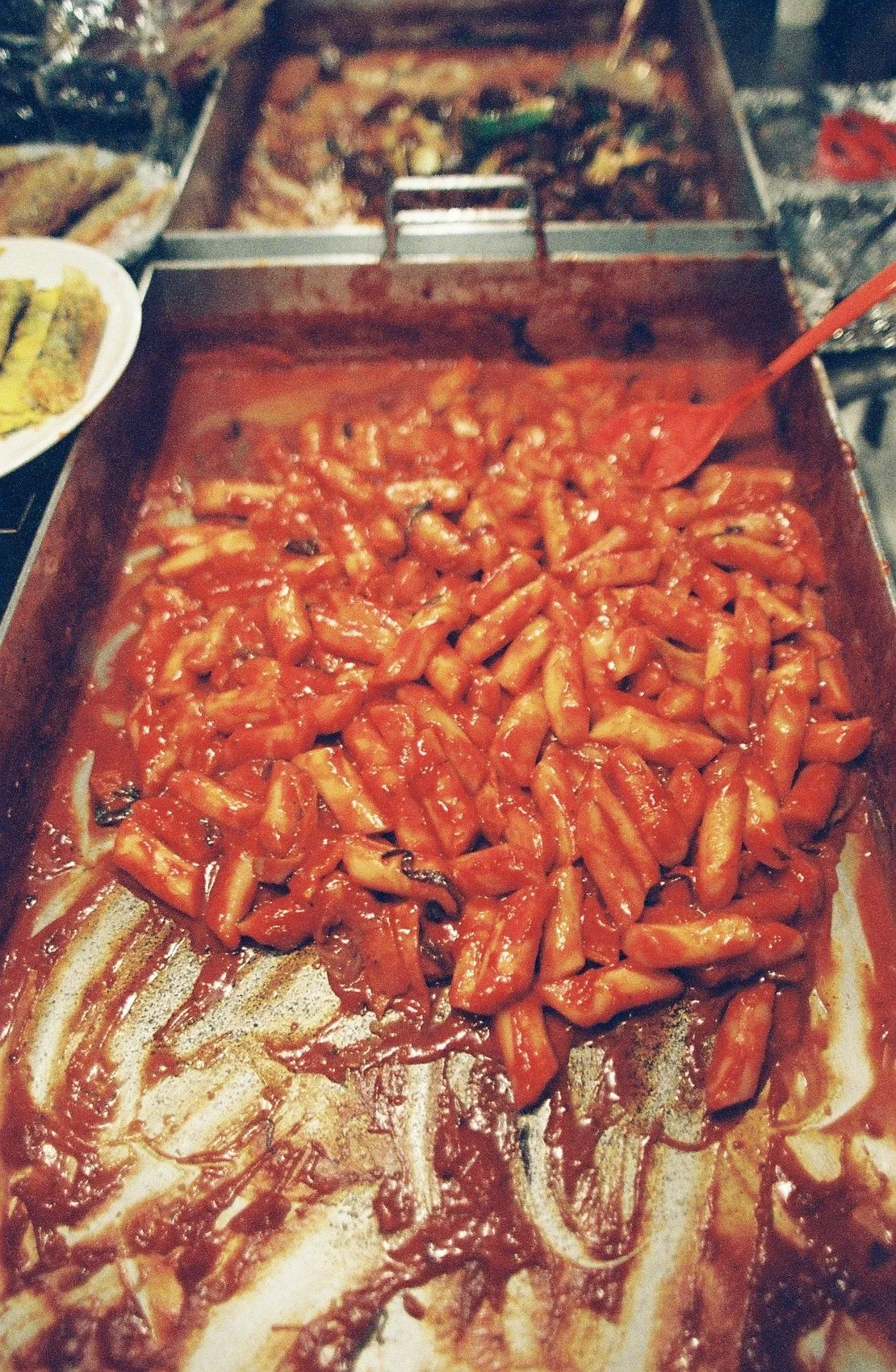
Real ddeokbokki, however, did look sloppy, but it was not the slop we have now. (This batch of the stuff was from 2005.) The original was made for good eatin’ and to taste spicy and satisfy. It was made to the ajumma’s tastes, not yours. And it stayed in on the hot plate until it was sold out, or the last batch thrown away.
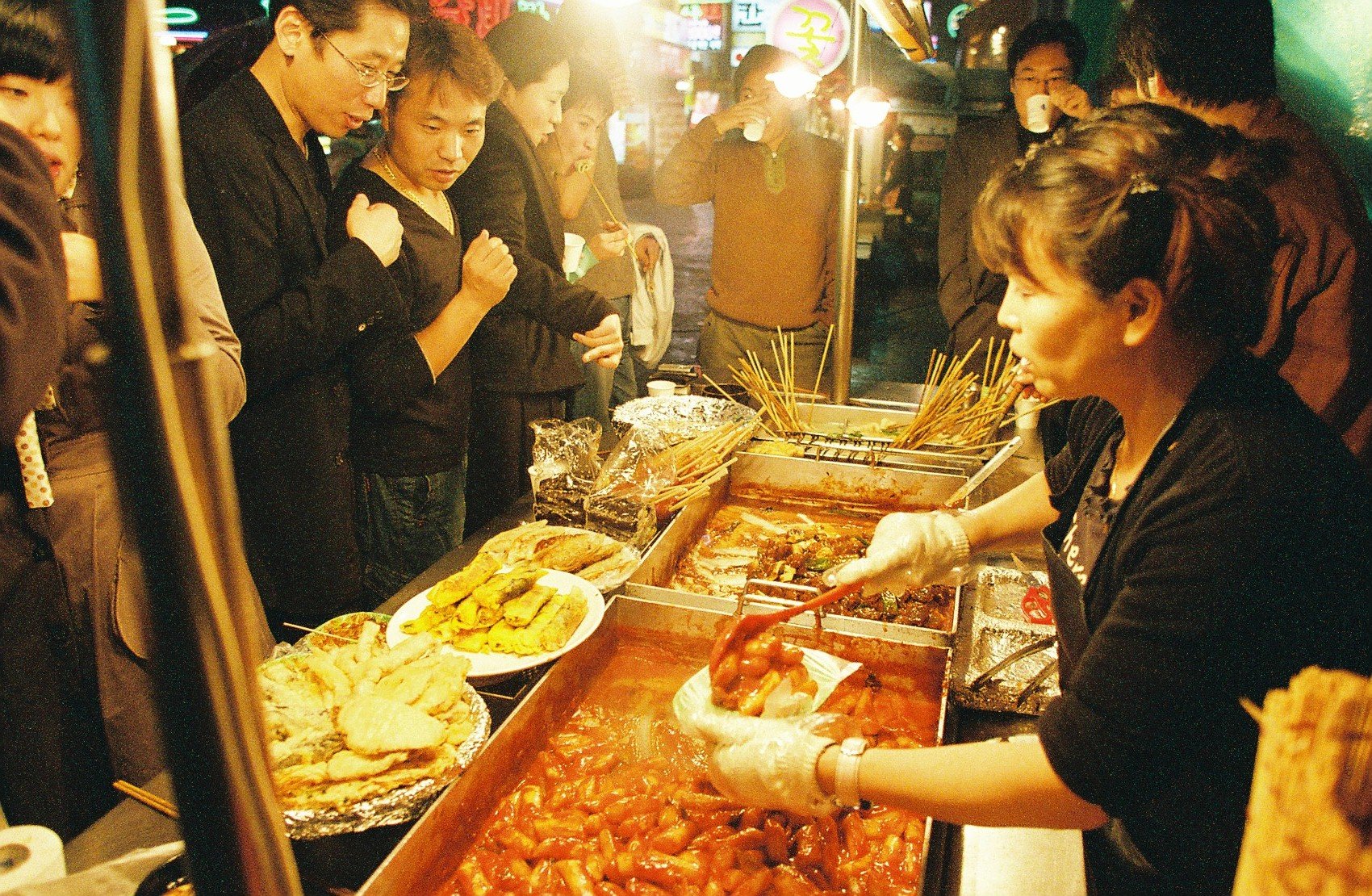
For your reference: an actual, active street food stall from November 2005 in Myeongdong. This was when Myeongdong and its street food stalls were filled with Koreans, and foreign faces were a rarity, at least in terms of squaring up in a chair and ordering in Korean from the ajumma running it.
THE MACHINES CONVERGE
The two machines aren't running in parallel anymore, either. That's the newest and least comfortable part of this. The K-influencer program's own literature now describes training its selected creators specifically in AI content generation — meaning the state's positivity-selected cohort is increasingly producing its output with the exact same generative tools flooding the rest of the internet with algorithmically-optimized travel slop. The compliance filter and the engagement filter used to at least select for their content independently. Now they're converging inside the same pipeline: creators pre-selected for positivity, trained on tools optimized for engagement, producing content that has been double-filtered for exactly the two things least correlated with anything true, specific, or worth a stranger's attention.
This is why the resulting content is, in the plainest possible language, laughable — not despite the enormous investment behind it, but because of what that investment was actually optimizing for. A machine built to produce approved content and a machine built to produce engaging content have discovered, independently, that they want almost the same thing: something safe, something legible at a glance, something that doesn't require the viewer to sit with anything uncomfortable for longer than eight seconds. Neither machine is optimizing for the thing that actually built global interest in Korea in the first place, which was never safety. It was Hell Joseon. It was the octopus. It was a family living under a staircase.
THE AUDIT THAT ALREADY HAPPENED
None of this requires a state solution, which is the part worth ending on, because it's the part my original proposal got right even though nobody built it. The ecosystem I was pointing at in that committee room in the 2000s didn't need training, didn't need vetting, didn't need a certificate program, because the actual vetting had already happened — slowly, expensively, the only way it can happen: an audience deciding, issue after issue, post after post, whether you were worth their attention, and leaving if you weren't. Zenkimchi is still standing, still working, still a name people trust on Korean food, decades on, without ever having applied to anyone for the right to say what he thinks. That's not nostalgia. That's the entire argument in one data point: the market already ran the audit the government keeps trying to simulate with a training curriculum and an AI toolkit, and it ran that audit for free, continuously, for twenty years, and it is still the only version of "vetting" that actually correlates with anything worth reading.
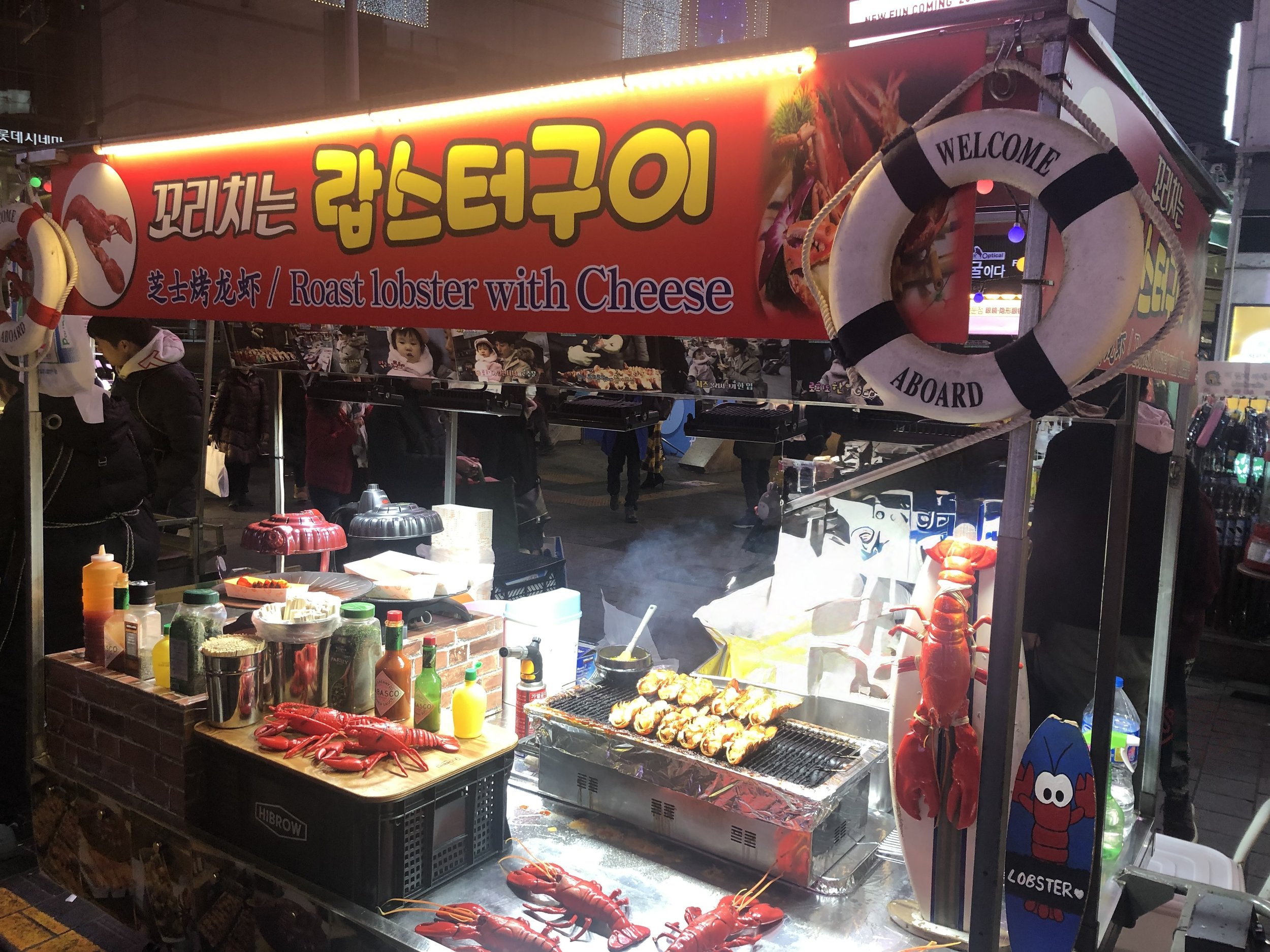
This lobster tail street food stand is a Disney attraction standing in Myeongdont to enthrall the visiting masses. It is not a piece of Korean/Seoul street food culture, and neither is the long strip of similar, Disneyworld-type foods on offer there. NOTE: Generative AI was used to eliminate the woman running the stall, who was originally standing behind the cooking lobsters on the grill.
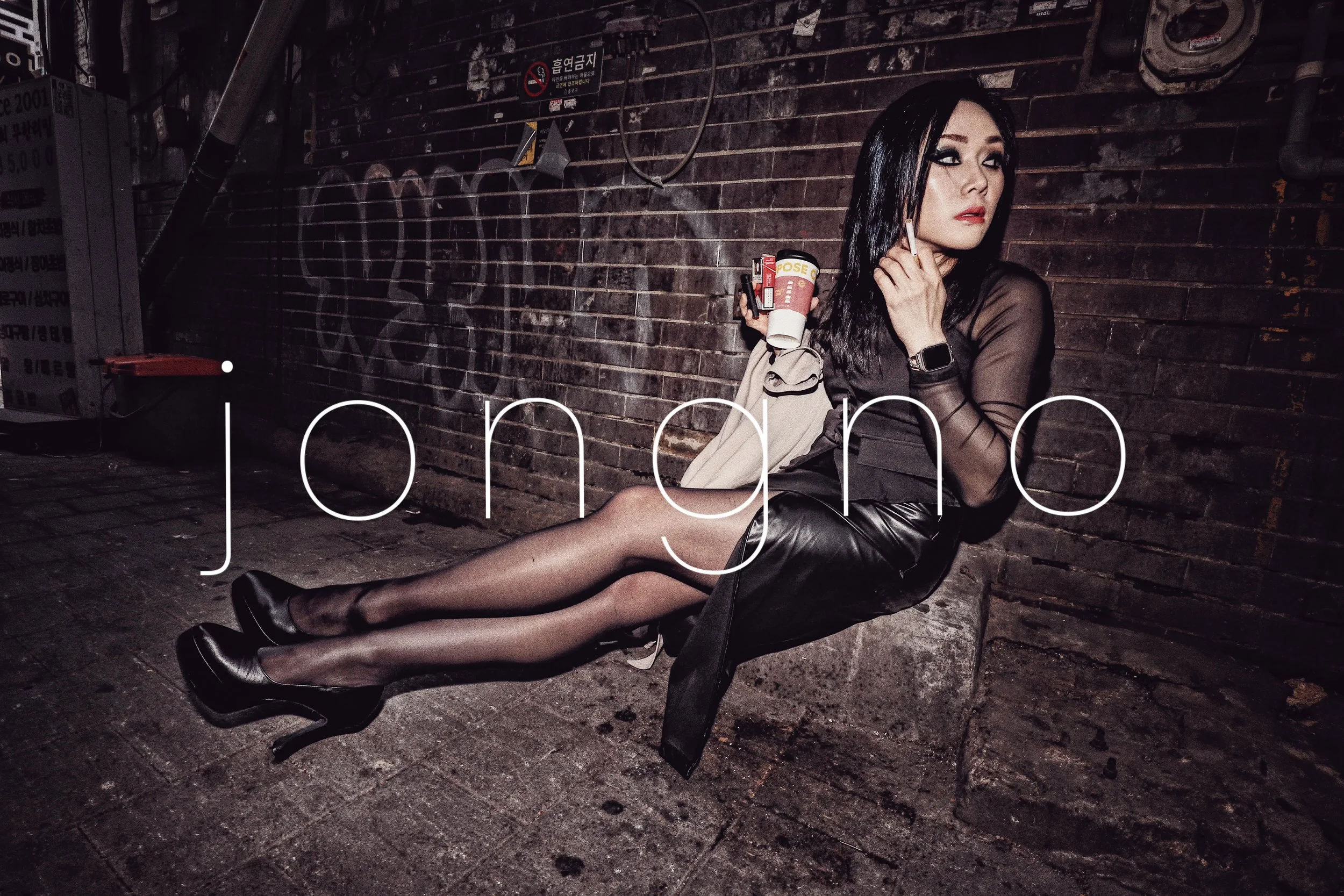
“This. Is. Jongno.” This is reality. This isn't a styled, staged, "gritty Korea." Real grime on the ground, not set dressing, is why model @shinyjaky is perched on the raised mini-pylon instead of dealing with having to crouch or squat on the ground — this one of the only clean spots available. The pose and the leg line weren't choreographed — they're what her body did to solve a real problem. The heels do likely push past the limits of typical Korean office wear, though not by much; plenty of Korean offices run their own quiet “fashion shows” anyway, indoors slippers notwithstanding. Even the possible editorial exaggeration here answers to something real. Staged, yet truer for it — proof a directed photograph can document reality more precisely than a documentary photograph recording something that was never real to begin with.
Go back to that woman in the Jongno backstreet, cigarette burning down between her fingers, ten stolen minutes nobody scripted — except, in the literal sense, someone did. That's a staged editorial shot: a model, direction, lighting, an actual shoot. And it's more real anyway, because the staging was in service of something true — a considered attempt, in the posture, in the exhausted tilt of the head, to channel what an actual office worker in that actual alley, at that actual hour, might actually be feeling.
Now go to Myeongdong, a few subway stops away, and look at the cheese melting over a lobster tail that has never once, in this country's history, been Korean street food. Nobody staged that. It's a completely unstaged, documentary-real photograph of an object actually sitting on a grill, actually being sold to someone right now. And it might be the least true image in this whole piece, because nothing about it channels anything a Korean person has ever actually lived.
Both images are real, in the narrow sense — a camera pointed at something that existed in front of it. Only one of them is true. The difference now is you know which is which, and by whom it was approved — and it's worth asking, every time you watch someone reset for a twelfth take of the same three steps toward the same café door, who exactly they're performing for. It was never really the audience.