Pretty Is a Brand Now: A Short History of "Seongsu"
A SEOULACIOUS · UNCUT SEOUL Editorial
The building is six stories tall and every inch of it is a woman's face. Half-closed eyes, a hand cradling her own jaw, a bottle of serum held up like an offering — the mural is for Yepoda (예쁘다, "pretty"), a K-beauty label that just opened its first Korean storefront a few blocks from here, on the same street as the neighborhood's most famous café. We'll get to why that matters. It matters more than it looks like it should.
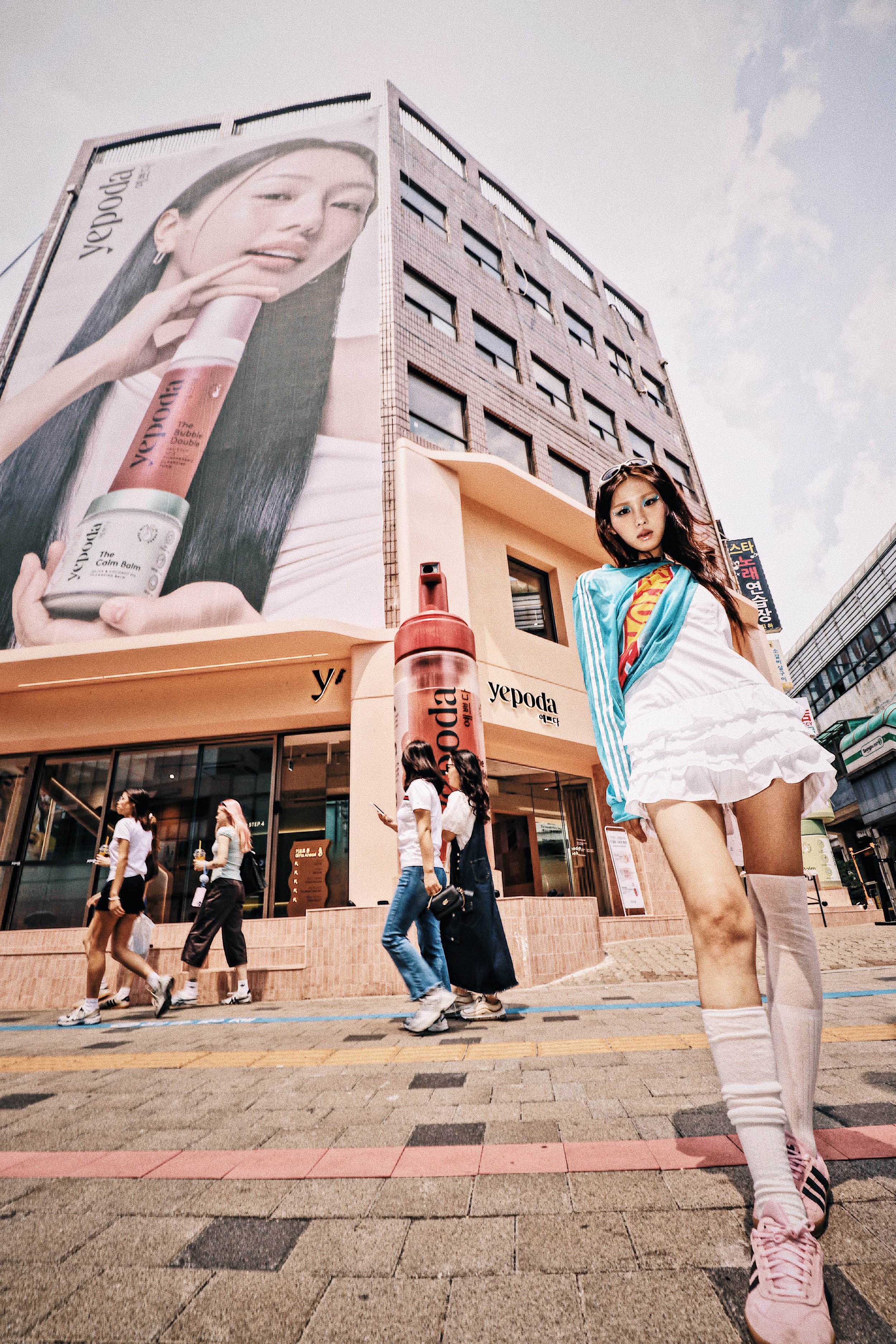
Six stories of frozen face loom behind her. Model @rose.0__ crosses the street below it, matching its aesthetic power at human scale.
Underneath that face, on the actual sidewalk, a much smaller woman is crossing the street — in a piece with real provenance, not a costume pulled at random off a rack. The jersey is teal mesh, numbered "03," a Hot Wheels graphic streaked across the chest: the actual 2022 collaboration between adidas Originals, Los Angeles designer and Round Two founder Sean Wotherspoon, and Mattel — released as a limited capsule through adidas Confirmed rather than any mass retail line. White ruffled skirt underneath it, knee socks, pink sneakers, sunglasses shoved up into her hair. Behind her, further down the block, actual pedestrians move past an actual pop-up storefront. She is not an advertisement. She is @rose.0__, and unlike the face six stories above her, she's not frozen in the same expression forever — she's just one more moving person on a street that's full of them, underneath the one thing in the frame that never moves at all.
That's stage one of what happened to this neighborhood. It's not the last stage, and it's not even the first — the first stage happened eight years ago, in a district office, and almost nobody outside Seongsu-dong noticed.
There's an actual academic term for what's about to happen to this neighborhood, over and over, at increasing scale — and it's worth knowing before we go any further, because geographers have been studying this exact phenomenon since long before anyone put a six-story serum ad on a factory wall.
It's called critical toponymy — the study of place names not as neutral labels but as claims, staked by whoever has enough power to make them stick. The field got its modern shape in 2010, when geographers Reuben Rose-Redwood, Derek Alderman, and Maoz Azaryahu published a paper arguing exactly that: a name is never just a name. Their original examples were political — colonial powers renaming conquered cities, new regimes erasing old street names to erase the old regime along with them. But the same corner of geography that studies Stalingrad becoming Volgograd has, in the years since, turned its attention to something quieter and stranger: stadiums, arenas, subway stations — public infrastructure whose names are now, in city after city, simply for sale. Geographer Duncan Light has a name for that specific version of it: toponymic commodification.
Keep that phrase in your pocket. We're going to need it later, when the subway itself changes its name.
What this ground used to make
Fifty years before anyone put a face on a building here, this was a shoemaking district — not metaphorically, literally. Monami moved its pen factory in in 1963. Kumkang Shoes followed in 1967, and behind Kumkang came a cascade of leather suppliers, sole-cutters, and stitching subcontractors, until by the 1970s roughly 3,000 manufacturers were running out of Seongsu-dong. At peak, around 900 of those were shoe businesses, together producing an estimated 70 to 80 percent of every handmade shoe sold in South Korea.
The 1997 financial crisis broke it. Cheap Chinese imports finished the job through the 2000s. "There used to be over 600 shops," one longtime factory operator told Korean media. "Now maybe 100 remain." What was left was red brick — cheap, cavernous, structurally sound, built for machines, standing empty.
Which turned out to be exactly what the next tenants needed. Not to make anything. To photograph it.
Move Zero
Seoul Forest opened in 2005. Artists started moving into the empty factory shells around 2010, for the rent, not the aesthetic. In 2016, a former metal factory on Achasan-ro reopened as Café Onion — raw brick, exposed steel trusses, the industrial bones left standing on purpose. Korean media had the "Seoul's Brooklyn" label in print within months.
Here's the part that makes Seongsu different from every other neighborhood that ever got that nickname: the district government didn't just let the comparison ride. In 2017, Seongdong-gu — acting on a tip from designer Ji Chun-hee — passed the Red Brick Building Preservation and Support Ordinance, subsidizing new construction in the exact style Onion had made famous. Over the next decade, 130 buildings went up under it. The same year, the district also passed Korea's first anti-gentrification ordinance, trying to protect the small businesses that same aesthetic was about to price out.
Both ordinances came from the same good-faith impulse: hold onto something before it disappears. One tried to preserve the look. The other tried to preserve the people. The look won.
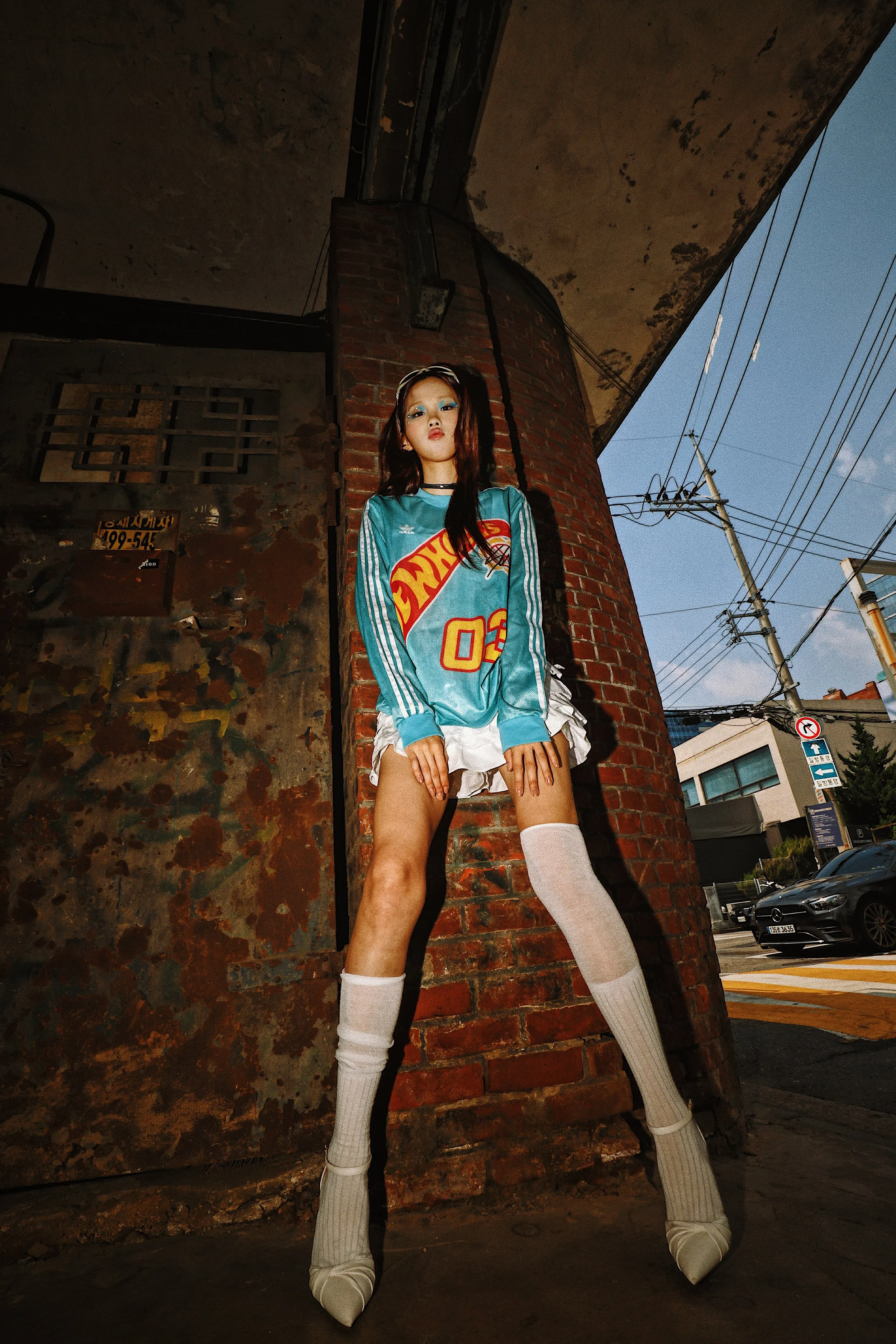
Model @rose.0__ presses into a rusted brick pillar inside Cafe Onion's walkway — a real, fifty-years of decay, not a styled prop.
Fifty meters down the street from Onion's front door, there are still shoe workshops running out of identical 1970s buildings — leather cutters showing up at seven in the morning to do work that has nothing to do with anyone's feed. The subsidized version of Seongsu's industrial past and the actual, ongoing, unphotographed version of it are operating in the same eight-block radius, mostly invisible to each other.
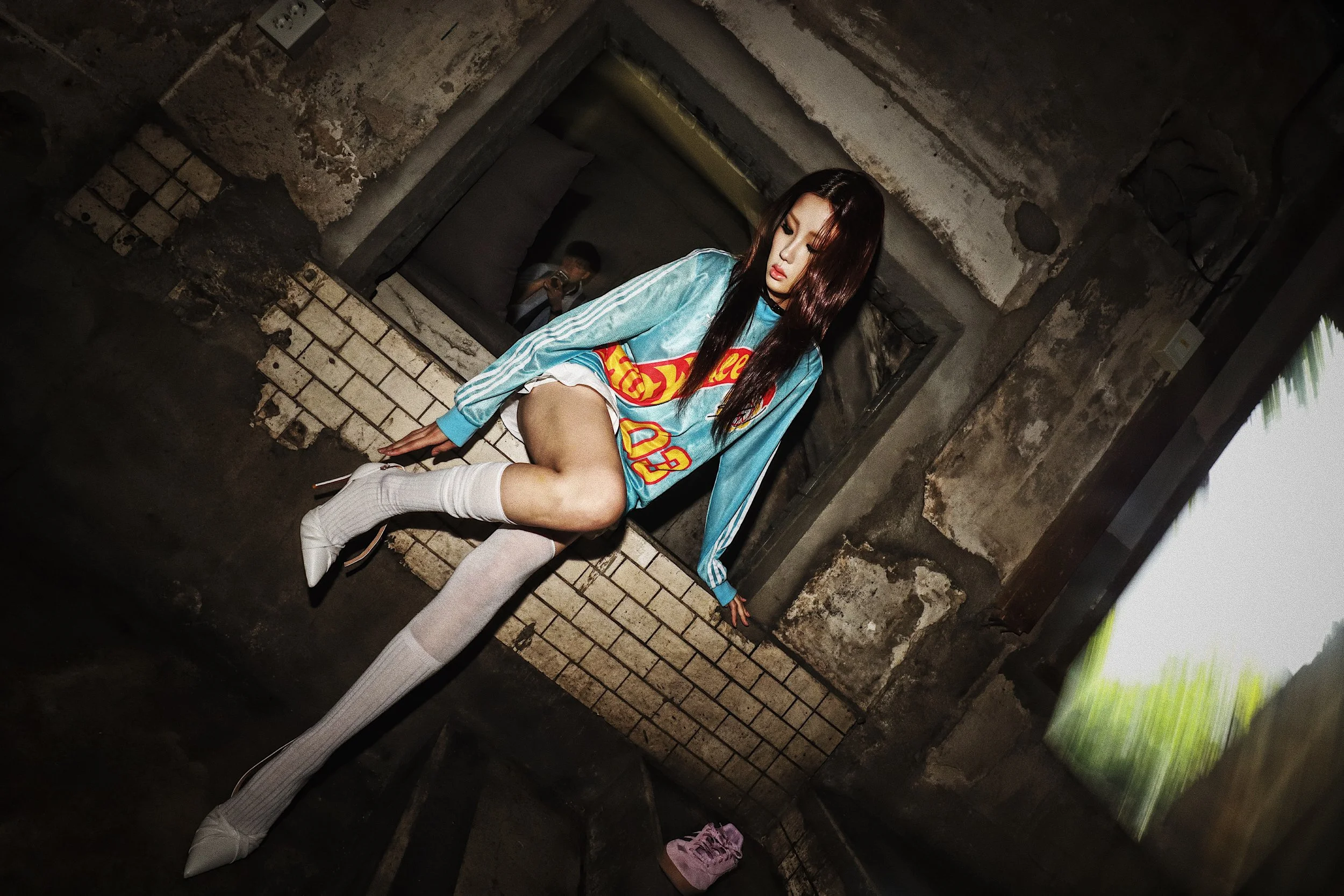
Model @rose.0__ drapes across a brick stairwell, one sneaker left on the step below her — brick that's outlasted three economies. The jersey's barely three years old.
A model in a Hot Wheels jersey, styled to look mass-produced and disposable, is parked against a wall that's outlasted three separate economic eras and one government ordinance designed specifically to keep it looking exactly like this.
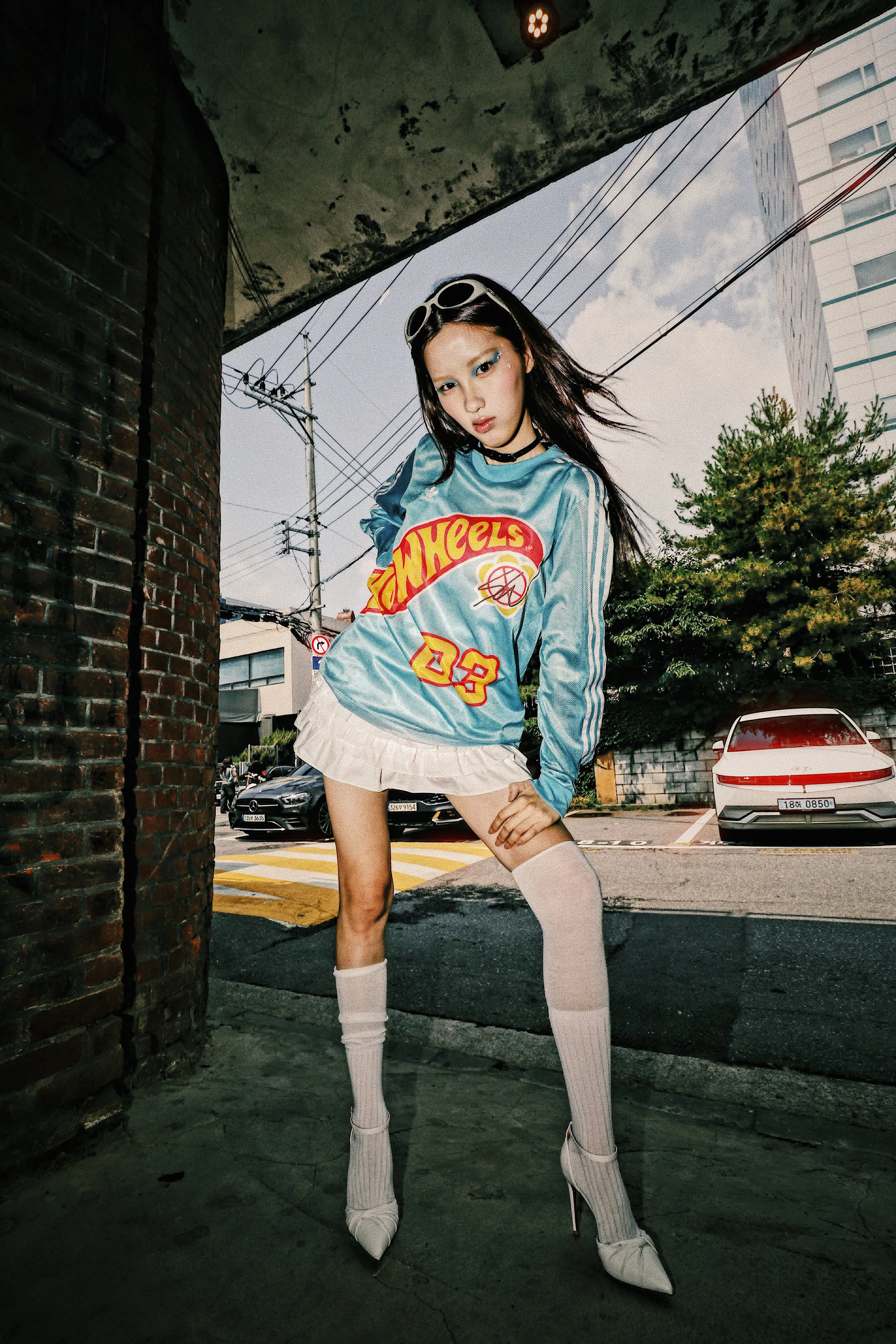
Model @rose.0__ in a breezeway that used to move metal stock. Now it moves content.
She's standing full-body, dead-on, in a covered breezeway that used to move metal stock in and out of a working factory and now mostly moves phones toward faces.
None of this happens without someone standing an arm's length outside the frame, and it's worth stopping on her for a second — because the same argument this piece keeps making about subsidized authenticity versus the labor underneath it plays out at human scale too, not just at the scale of a subway station.
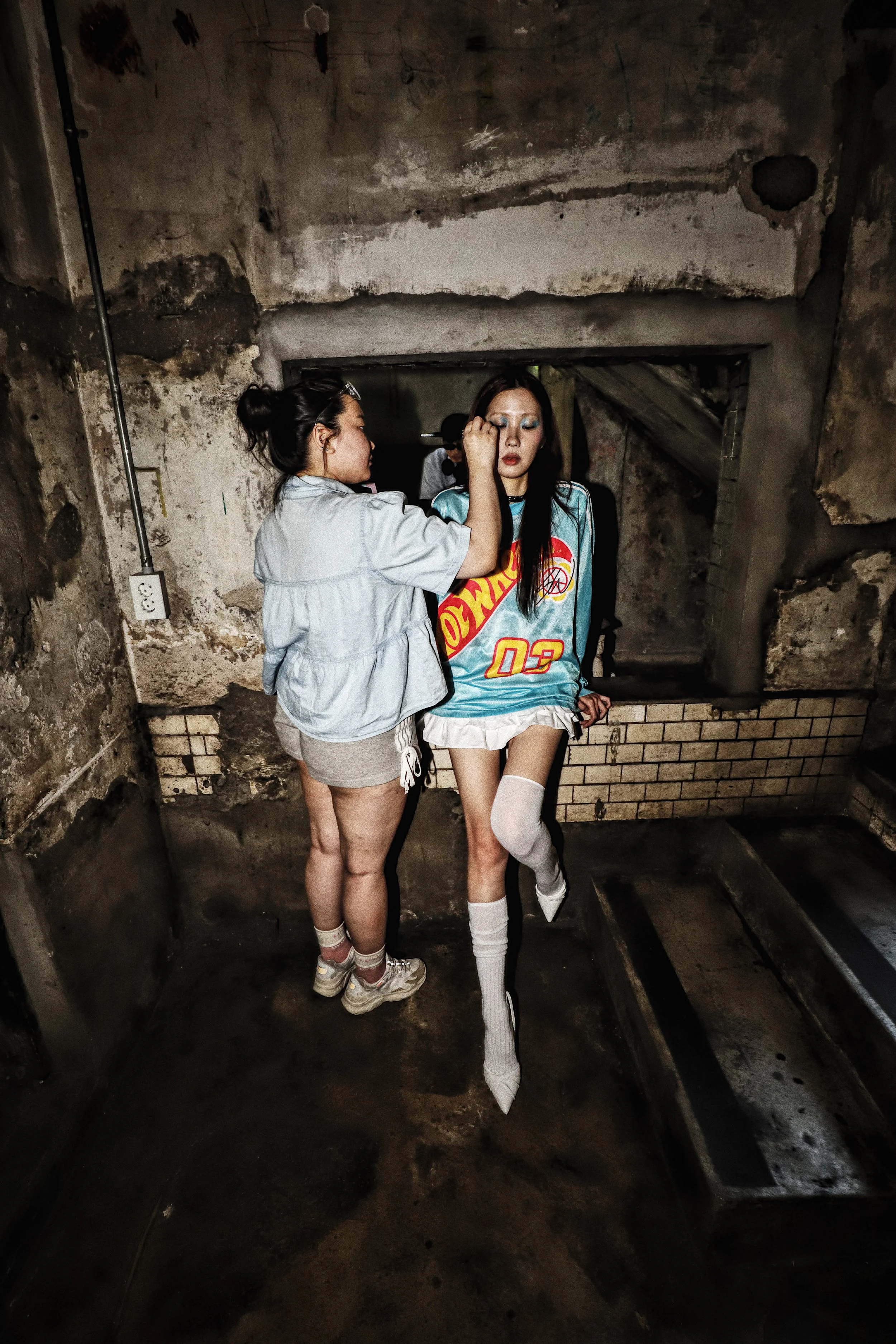
Makeup artist LuvLee touches up model @rose.0__'s eyes in the same stairwell, forty seconds before the camera turns back around."
That's LuvLee — @artblockeddd, the same makeup artist credited on every UNCUT SEOUL shoot — working in the exact stairwell forty seconds before the camera turned around. No ring light, no studio; the crumbling brick was doing the job a soft box would do anywhere else. The finished frame upstream of this one looks effortless because a professional was standing in wet concrete, out of shot, making sure it would.
What capital does once the state's done the work
Once the look was underwritten, the bigger money followed fast. Dior opened a permanent 210-pyeong flagship in 2022. Krafton bought the neighborhood's E-Mart building in 2021 for 1.22 trillion won. By 2024, the district counted 19,200 businesses — nearly double the 2013 figure — with 30 to 50 pop-up stores running at once and weekly rents topping 200 million won. In 2025, Time Out ranked Seongsu-dong the fourth coolest neighborhood on Earth.
One of those pop-ups belongs to TIRTIR, the Korean cushion-foundation brand whose Mask Fit Red Cushion became the best-selling foundation on Amazon in 2024 — ten million units and counting, BTS's V as global ambassador. TIRTIR's own biography is worth pausing on, because it's the neighborhood's story again, just compressed into a single company. Founded by beauty influencer Lee Yu-bin, it grew the way Onion did — organically, on an actual product actual people actually liked, no institutional backing. Then, in 2023, once the brand was proven, its founder sold roughly 60 percent of the company to a Korean private equity fund for 89 billion won. Build something real. Let the market validate it. Watch capital arrive to buy the validated version. It's the same transaction at every scale this piece keeps touching.
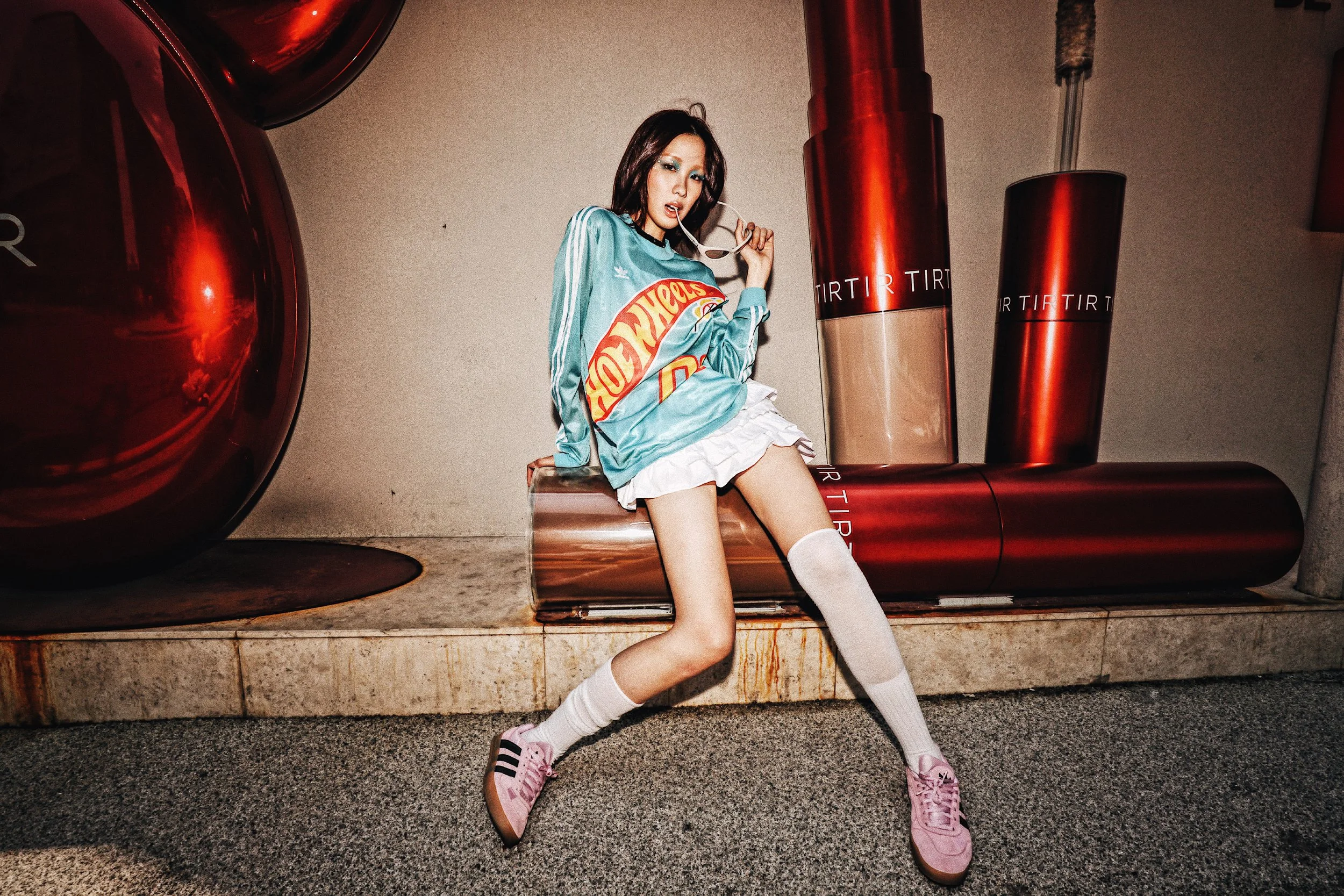
Model @rose.0__ sits on a two-meter TIRTIR cushion compact, sunglasses at her lips — the woman it was built to make you want to be.
She's sitting on a two-meter replica of a cushion compact. The actual company that compact represents has already been through the exact transaction the rest of this piece is describing.
TIRTIR calls its Seongsu space "SHADE VALLEY" — built around the brand's whole pitch, which is shade inclusivity: forty-five foundation colors, an AR tool that previews all of them on your actual face before you buy. The red isn't decorative, either. It's the brand's signature color, lifted directly from the Mask Fit Red Cushion, the compact that made TIRTIR an Amazon bestseller — just built to furniture scale. Nobody at the company has explained, on the record, why a beauty brand decides to seat customers next to two-meter replicas of its own packaging. You don't need the explanation to see what it's doing. The product stops being something you pick up and becomes something you sit inside. She isn't posing next to TIRTIR's product. She's positioned like a giant who's wandered into a world built for something that isn't human — casually inhabiting oversized versions of the same tiny object millions of people carry in a purse. Scale the thing you're supposed to want up far enough, and you become the one who looks small next to it.
There's a name for what happened next, and it's worth knowing, because it explains why this felt inevitable in a way most gentrification stories don't quite manage to. David Harvey — a British geographer who, by citation count, is the most-cited academic geographer alive — wrote an essay in 2002 called "The Art of Rent" about exactly this mechanism. His argument: capital will pay an enormous premium for anything genuinely singular — a place, a tradition, a specific unrepeatable local texture — precisely because that singularity can't be manufactured anywhere else. He called it monopoly rent. The catch, which Harvey names in the same essay, is that capturing the singularity is usually what kills it: the more successfully a place's uniqueness gets sold, replicated, and licensed, the less singular it actually stays.
That's the trap the district backed its way into without meaning to. Subsidizing the red brick didn't just protect an aesthetic. In Harvey's terms, it took the risk out of betting on Seongsu's singularity — it told capital that this specific, hard-to-fake authenticity was stable enough to build a business plan around. Everything that came after is capital buying into something a government office had already proven would hold its value.
Then, on December 10, 2025, the subway itself changed its name — toponymic commodification, right on schedule, except this time the toponym wasn't a stadium. It was the neighborhood's own name. Seoul Metro had spent over a year fumbling the naming rights to Seongsu Station — CJ Olive Young won the bid first, at roughly three times appraised value, then surrendered it fifteen months later under public backlash, since Olive Young had no actual roots in the neighborhood. Musinsa, the fashion platform that had already opened eleven stores and three offices here since 2022, took the rights instead, for a suspiciously specific 329,292,929 won — a nod to its subsidiary 29CM, priced the way a brand prices a limited drop rather than the way a city prices infrastructure. Every train announcement says it now: this stop is 성수(무신사) — Seongsu, Musinsa.
Inside the station, there's a 130-meter exhibition called Shu Spot, built to honor the neighborhood's handmade shoe heritage. It sits inside a station named for a company whose entire relationship to shoes has always been curatorial, not productive: Musinsa started in 2001 as a website whose literal Korean name translates to "the site with an incredible number of shoe photos" — a fan community built around photographing sneakers, not making them. Twenty-five years later, the company does sell shoes now, including through Musinsa Kicks, a multi-brand shoe boutique that's run pop-ups in Seongsu itself — but it's still curation. Still Nike, Adidas, Converse, selected and displayed, not cut and stitched. The company's entire identity, from founding myth to flagship store, has been about arranging other people's shoes, never making its own.
A shoe museum, inside a station named for a company that has spent twenty-five years perfecting exactly that distinction, standing on ground where actual shoemakers still are, a few blocks away, unnamed by anyone.
If the Red Brick Ordinance was the state branding the look, Musinsa just bought the name.
The company that bought its own origin story
Which brings us back to the face on the building.
Yepoda isn't Korean. It's Yepoda GmbH, incorporated in Berlin in 2019 by Sander van Bladel and Veronika Strotmann, funded through a Series B round, sold across Sephora Europe. The whole brand was built to sell Korean skincare to people who've never been to Korea — a European D2C company that picked 예쁘다, the ordinary Korean word for "pretty," as its name, and then spent five years selling an idea of Korean beauty to European customers who had no way of checking the idea against the actual place.
This past May, the company opened its first Korean storefront — The Yepoda Haus Seoul — on Achasan-ro, the same street Onion is on, in the neighborhood the government spent eight years and 130 subsidized buildings turning into the most legible "authentic Korea" backdrop in the city. Co-founder and CEO Sander Joonyoung van Bladel described it not as market entry but as a symbolic homecoming — the brand returning to the Korean roots it claims, even though the company itself started in Berlin, not Seoul. Korean trade coverage framed the move as Seongsu shifting, for Yepoda, from where the product used to get made to where the brand's story now gets made.
That's four different actors, four different scales, doing structurally the same thing. The district branded the look. Musinsa bought the name. Yepoda is buying the origin myth — renting physical proximity to a neighborhood's authenticity in order to claim roots it doesn't have, using the exact vocabulary of return and homecoming, on a street the government had already spent a decade making legible as "real Korea" to exactly the kind of company that needed to borrow it.
Every account of a neighborhood like this reaches for the same two comparisons: Williamsburg, Shoreditch — cheap rent, artists, capital noticing, artists priced out. Seongsu fits that pattern well enough on the surface. What it doesn't share with either of those neighborhoods is who's actually doing the harvesting, or which direction the value is moving in. Williamsburg got gentrified by New Yorkers, for New Yorkers. Shoreditch got gentrified by Londoners, for Londoners. The genuinely distinctive thing about this case is that Seongsu is being harvested for two different audiences at once, in two different directions. Musinsa is extracting value domestically — buying the name to capture Korean foot traffic and Korean brand loyalty. Yepoda is extracting value internationally — using the same street to manufacture export-grade authenticity for a European customer who will never set foot here, who'll just see a Seoul storefront in someone's Instagram story and trust the serum a little more. Same red brick. Same government subsidy. Two completely separate economies running through the same block, harvesting the same authenticity for two audiences who have nothing to do with each other.
Yepoda didn't manufacture Seongsu's authenticity. It's renting the state's.
Even the jersey is doing it
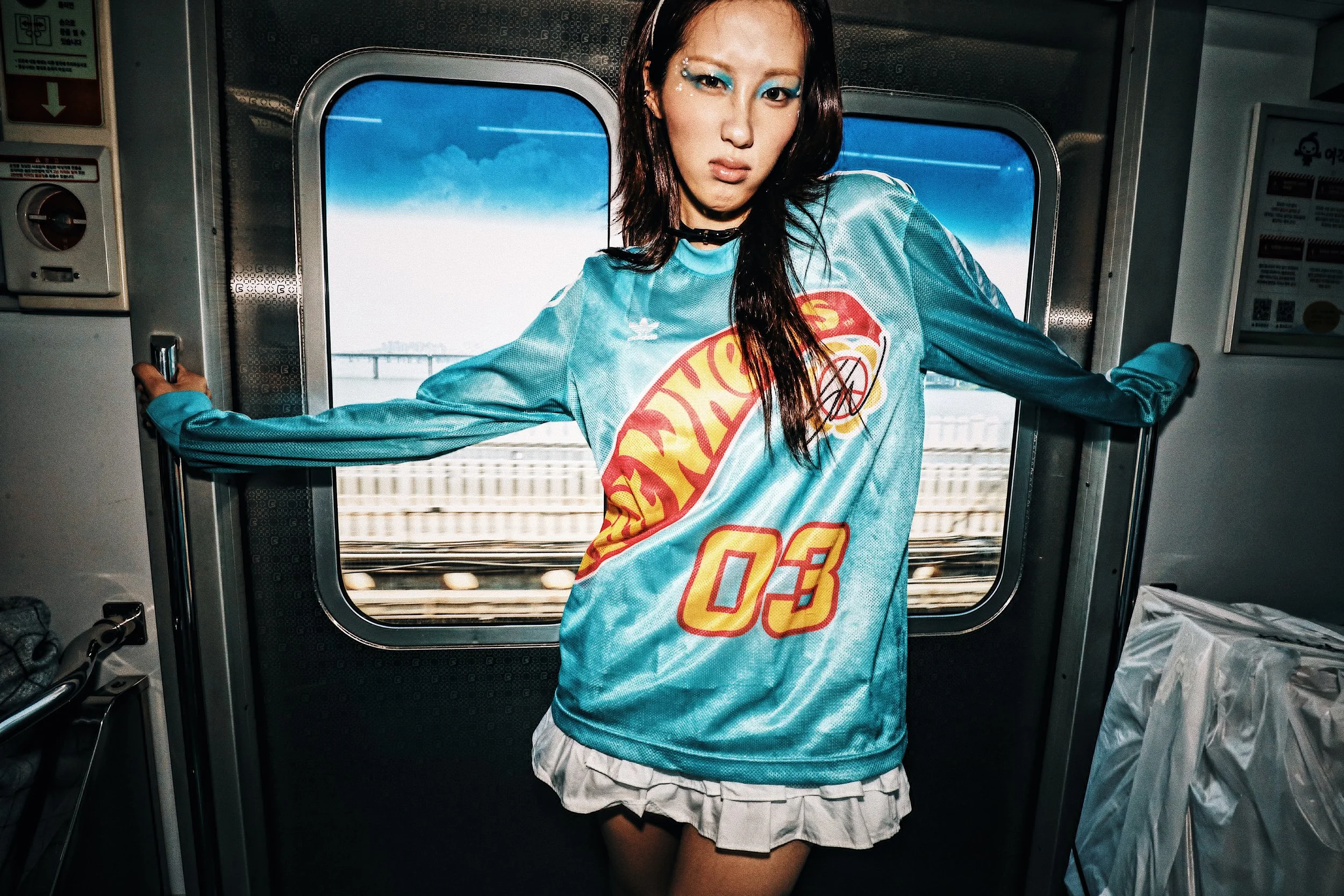
Model @rose.0__ poses in a subway doorway crossing the river, playing 애교 (aegyo) against the toy the jersey is named after — styling instinct as much as outfit.
Zoom in far enough and the pattern doesn't stop at the neighborhood, or the company. It's on her body too.
That expression is worth pausing on, because it's not incidental — it's the correct read of the whole concept. 애교 (aegyo) breaks down as 愛 (ae, "love") plus 嬌 (gyo), a character that technically means "lovely" or "charming" rather than "child." But the register the word actually describes is unmistakably a childlike one — the same sweetly persuasive, delighted performance a kid uses when they want something and know exactly how to ask for it. Hot Wheels is a toy built for precisely that age bracket, kids racing die-cast cars across a kitchen floor. Matching the two isn't incidental styling. She isn't just wearing a piece of childhood nostalgia. She's producing the actual emotional register the toy was designed to create, on command, mid-shoot, standing in a train doorway while the car crosses a river. And she doesn't flatten it into a simple baby face to get there — the easy version of aegyo, the one most people default to. The expression stays lit, composed, genuinely editorial: cute without tipping into cutesy, playful without losing the polish the rest of the shoot runs on. That's the harder version of the skill. Holding the actual charm of the expression without surrendering the sophistication the format demands — matching not just an outfit but the feeling underneath it, and doing it with craft instead of just cuteness.
We named that jersey's actual provenance at the top of this piece for a reason. Once you know it's a real adidas x Sean Wotherspoon x Hot Wheels collaboration — mesh construction, "03" numbering, the trefoil and three stripes on the sleeves all matching the retail piece down to the style code, not costume-department fast fashion — the object turns into something worth actually tracing.
A toy company licensed its name to a sportswear conglomerate. The sportswear conglomerate licensed the design further through an independent designer's personal brand. The finished object got sold, resold, and eventually ended up on a body in Seongsu-dong — photographed against a wall the government subsidized to look a certain way, near a station a platform bought the name of, down the street from a store a German company opened to buy back an origin myth. Nobody planned that stack. It's just what happens to almost anything that passes through image-economy Korea for long enough. It acquires another license, another brand, another layer — whether it's a neighborhood, a subway stop, or a shirt.
Getting out
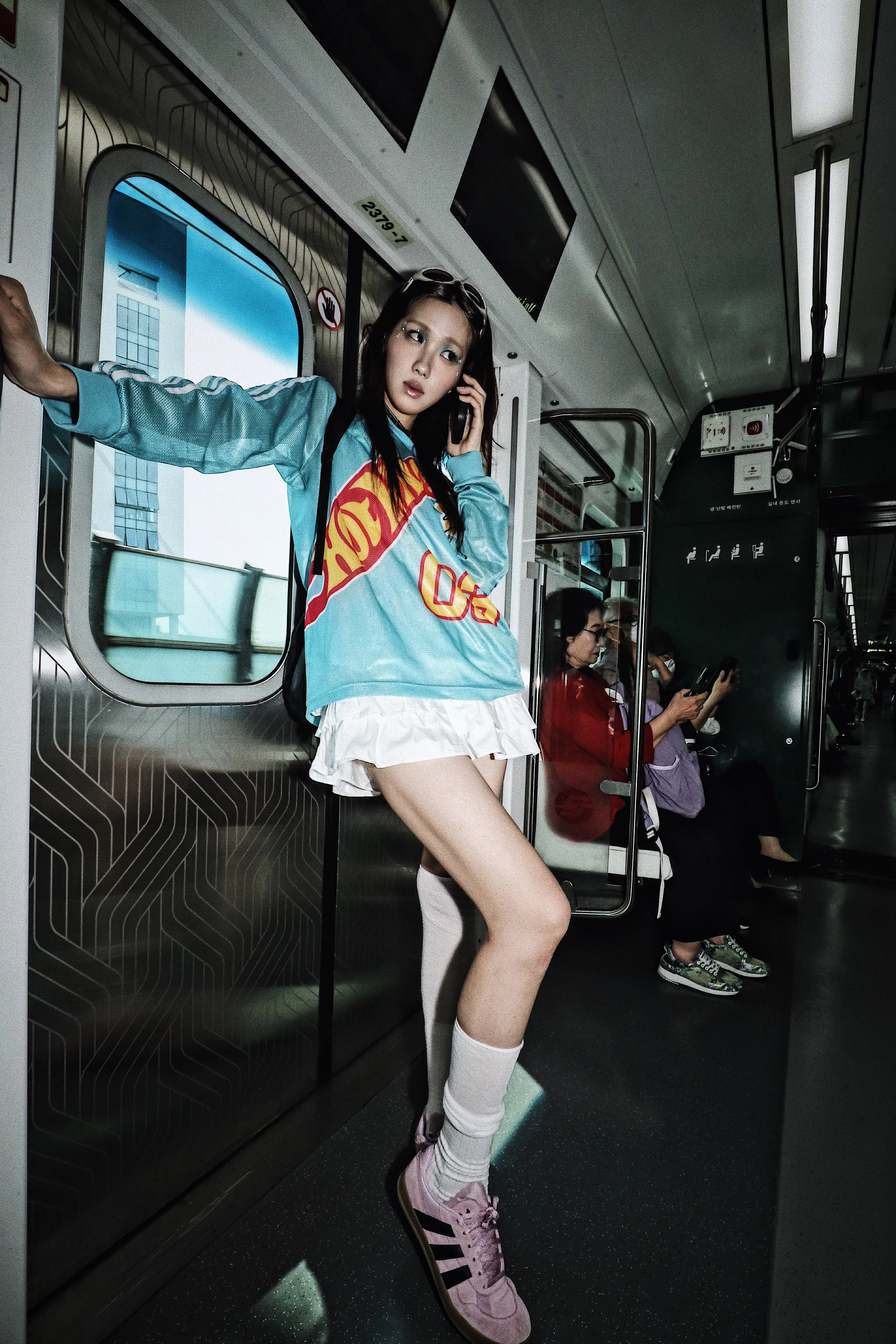
Model @rose.0__ grips an overhead subway rail, phone to her ear, performing a scene none of the seated commuters behind her know is even a scene until the flash pops. But Seoulites have seen everything and just can’t be pressed to notice, let alone care.
Every stop after this one is the neighborhood letting go of her, a little at a time.
Look at what's actually happening in this specific frame. One arm is stretched fully overhead to the rail — a genuine editorial line, the kind of shape a photographer usually needs a cleared studio to get, not something anyone lands on by accident while holding on through a turn. The other hand holds a phone to her ear, playing a specific character beat: mid-call, distracted, glamorous — none of which has anything to do with an actual commuter train at rush hour. Behind her, the real passengers are holding the real version of the same prop, phones out, heads down, actually checking messages instead of performing one. That's the whole gap contained in a single frame: one person constructing a scene, three feet from several people who have no idea a scene is being constructed. Holding a full, lit, in-character pose inside that gap — with zero guarantee a stranger won't stare back, step into frame, or just find the whole thing strange — is a harder thing to pull off than it looks. Plenty of trained models would break character the second the illusion of a closed set disappeared.
It's not incidental that this shoot runs through EMA. An agency built specifically around representing the people the mainstream industry wrote off — models past the arbitrary age line the rest of the business still enforces — tends to select for exactly this kind of range: the ability to hold a performance with no controlled environment backing it up, no crowd cooperating, no guarantee the illusion survives contact with actual strangers. That's not a side effect of who EMA represents. It's close to the whole philosophy — competence built without the industry's usual scaffolding, because the scaffolding was never offered in the first place.
Seongsu made her the center of the frame for an afternoon. The subway doesn't know who she is, and it isn't going to learn.
The one stop that isn't a brand yet
The shoot didn't end in Seongsu. It ended several stops down the green line, at a bench on the platform at Jamsillaru — a station named for absolutely nothing anyone would license. No mural. No flagship. Mustard tile, fluorescent tube light, a directional sign in three languages nobody's monetized. @rose.0__ sitting sideways across the bench like she's been there twenty minutes, backpack down, phone face-up beside her, the jersey finally at rest.
For most of the ride here it looks like the one unbranded stop this piece's argument can't reach. It isn't. Look at the sign over her head: the station's actual full name is 잠실나루(수협중앙회공제보험)역 — Jamsillaru, officially co-named after the National Federation of Fisheries Cooperatives' mutual aid insurance product. Seoul Metro runs a standing program for exactly this, separate from the kind of deal Musinsa cut: 부역명, secondary station names sold off individually, mostly to hospitals and neighborhood clinics, priced by foot traffic — Euljiro 4-ga goes for 220 million won a year, Nowon for 180 million, Ttukseom for 130 million. A quiet residential stop like this one goes for whatever a regional fisheries cooperative's insurance arm was willing to pay, which is a number nobody bothered to make public because nobody was watching closely enough to ask.
That's the actual ending, and it's a harder one than "she found the one unbranded corner of the city." There isn't one. There's just a price low enough that nobody gets angry about it, and a name small enough that nobody reads the whole thing on the platform sign. Everything else in this piece got contested — public backlash, a surrendered contract, a co-prosperity agreement, a comment section. This one didn't, because nobody thought it was worth the fight. The cheapest brand on the whole route is also the one that got away with it cleanest.
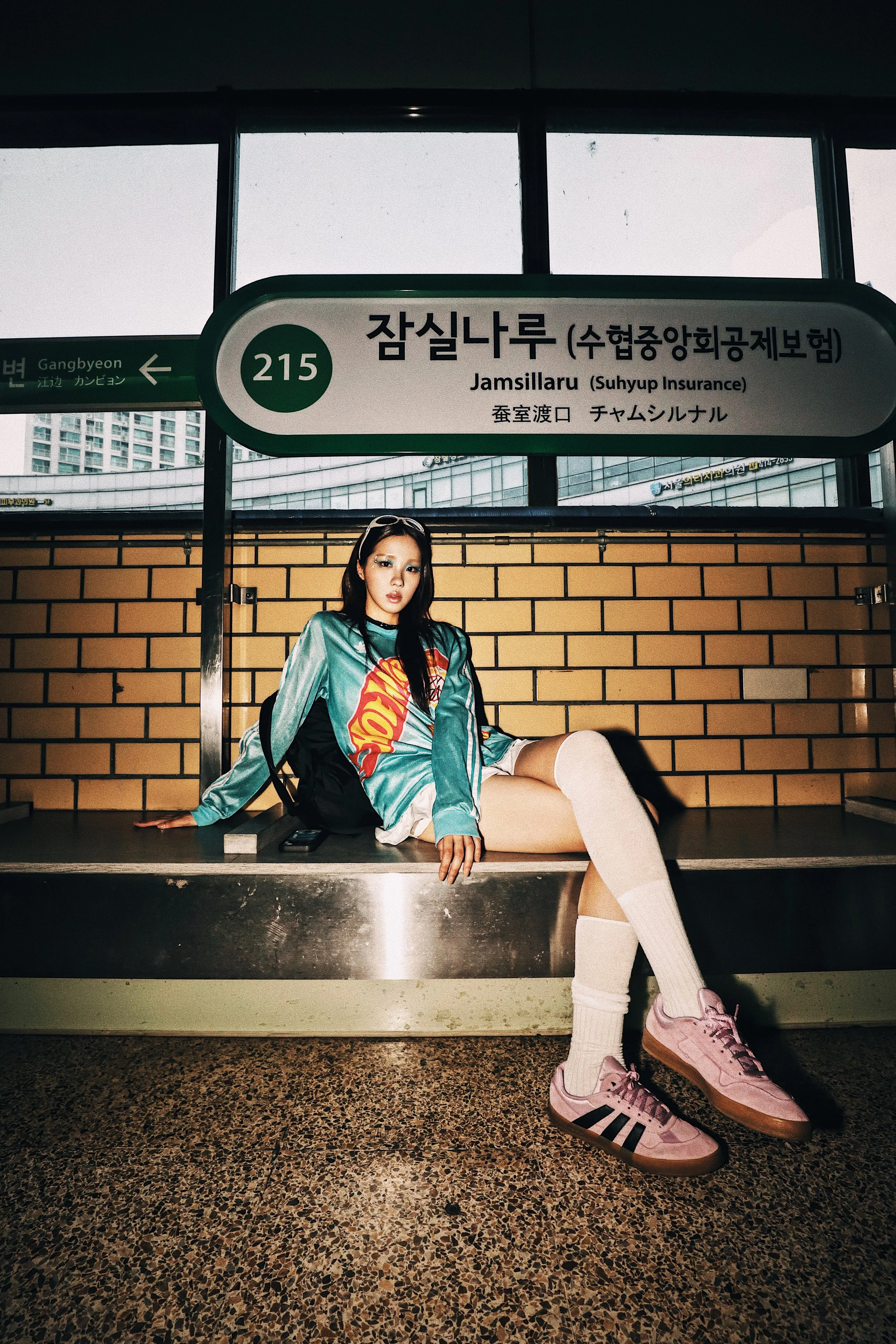
Model @rose.0__ sits sideways on a bench at Jamsillaru Station, the jersey finally at rest — the one stop that looked unbranded until you read the whole sign.
This is the method behind every UNCUT SEOUL shoot: put a real person's body through a real neighborhood and follow with a camera, rather than staging a set that performs "Korean style" for an algorithm.
The closest real precedent isn't a fashion shoot. It's a French idea from 1956 called the dérive — literally "drift." Guy Debord, a filmmaker and theorist who co-founded a group called the Situationist International the following year, proposed it as a specific technique: drop your usual reasons for moving through a city — commute, errand, destination — and let yourself be pulled instead by what he called the city's psychogeography, its actual emotional and physical contours, the way certain streets pull you forward and certain corners make you want to turn back. Debord's own description of it: "a technique of rapid passage through varied ambiances." The point wasn't just a walk. It was a method for letting a place tell you what it actually is, instead of deciding in advance and going out to confirm it.
That's the shoot, functionally. Nobody pre-scripted a body moving from a beauty mural to a converted factory to a pop-up shop to a subway bench that turned out to be sold too, just more quietly. The neighborhood's actual currents did that — the pull of Onion's Instagram gravity, the pull of Yepoda's new flagship, the pull of the green line home. A subsidized wall can't generate a current like that. A subsidized wall just repeats the same look, forever, whether anyone's paying attention to what it cost to build.
The partnership behind that method matters here too. This shoot was cast through Elite Model Agency Korea (EMA), under casting director NA-YEON KANG (Joanne) — an agency whose founding logic runs on roughly the same instinct as this series. Founder Alex Kang built EMA around a blind spot he'd lived himself: the Korean modeling industry draws a hard line around age thirty, past which working professionals simply stop existing as far as casting directors are concerned. EMA exists to correct that specific exclusion. Kang's own summary of the philosophy: you only really grow old the moment you stop taking on challenges. The agency has since broadened into general representation across the age spectrum — which is where talent like @rose.0__ comes from — but the founding instinct is the same one this series runs on: build the legitimizing structure yourself, when the mainstream system won't extend it to you.
A district government branded a look. A platform bought a name. A German company bought an origin story. A fisheries cooperative bought the cheapest name on the route, so quietly nobody thought to complain. A woman walked through all four, for free, and got on a train home.
CREDITS:
Photography: @seoulstreetstudios
Model: @rose.0__
HMUA: @artblockeddd
Casting Director: NA-YEON KANG (Joanne)
Agency: @ema_model_official
A SEOULACIOUS × EMA collaborationUNCUT SEOUL by SEOULACIOUS · seoulacious.com