Fair warning before you commit: this piece is long, deliberately so, and it is not built to be skimmed. If you want the highlights reel, there's a "Top 5 Coolest Neighborhoods in Seoul" post one tab over — ninety seconds, five pins on a map, tastes exactly like the last ten you've already read. That's the McDonald's version: fast, familiar, forgotten by dinner. This isn't that. This is closer to a home-cooked, slightly indulgent, French-theory-filled kind of meal — the kind you sit down for and need to think about the tastes hitting your tongue. If what you actually want tonight is the thoughtless ease of a Big Mac and fries, no judgment. But this isn't the place for that.

The best way to gather social data is to literally take to the streets and go on a psychogeographic dérivein order to drift into that data.
Still here? Good. What follows asks more of you than a listicle does, and it pays back more than a listicle ever could — the kind of payoff that's genuinely hard to explain to someone who bailed at paragraph one.
Here's what you actually get by the end of this piece: the ability to stop asking other people where to go — to get off somebody else's grid and onto your own two feet.
Not "here's a better list than the last list." A different relationship to the city entirely. Right now, when you plan a day in Seoul, you're almost certainly working from somebody else's grid — a TikTok, a travel blog, a "10 Hidden Cafés" post that was itself assembled from five other "Hidden Cafés" posts, each one a slightly more degraded copy of whatever the original was. Nobody in that chain visited most of what they're recommending recently. Nobody's checking if it's still there. You're not touring Seoul — you're touring last year's consensus about Seoul, filtered through however many bloggers it passed through to reach you.
That's the actual difference between a passive tourist and an active explorer — not budget, not attitude, but who's doing the reading. A passive tourist needs the place translated for them: the list, the pin, the "here's what this means." An active explorer reads it directly, off the street in front of them. That's not a metaphor about being a better traveler. It's a literal skill, and it's transferable to a block you've never stood on before, the same way knowing grammar lets you read a sentence you've never seen.
Dérive, psychogeography — these aren't decoration. They're a real discipline, invented by a group of theorists radical enough to get themselves surveilled by the French police for it, and what you're about to learn descends directly from their method. Not "wing it and hope." Something closer to an actual technique.
There's a way to get that fluency, and it isn't "find a better list." It's learning to read a neighborhood yourself. Once you can do that, you don't need anyone's map. You can build your own, in real time, standing on a street that doesn't have a single post written about it yet — which, in a city changing this fast, describes more of Seoul than any blog will ever catch up to.
Here's the test case, because it's easier to learn a grammar on a sentence you already half-know.
You get off at Seongsu Station (성수동), and for about ninety seconds, you can't tell if you're in the interesting part yet. To your left: auto-repair shops, the smell of solder, roll-down metal shutters untouched since the 1980s, back when this district stitched a meaningful share of Korea's leather shoes. To your right — sometimes on the same block, occasionally in the exact same building — a concept store with a line outside, a café built into a former loading dock, a pop-up that'll be a different brand in two weeks. Same neighborhood, speaking in two tenses at once.
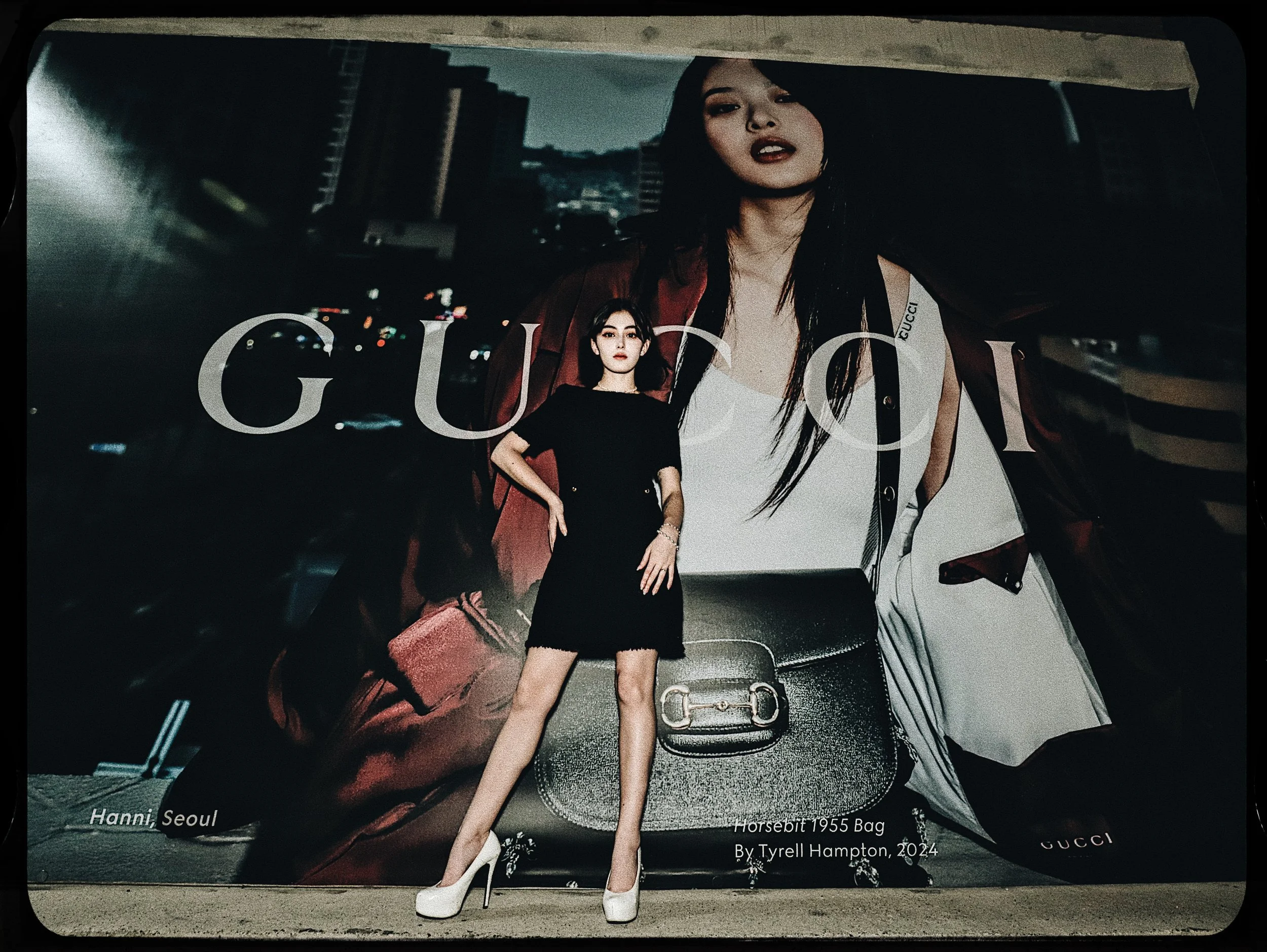
What we understand “Seongsu” to be is partially as the corporatized vanguaerd of advertising — or an homage to the classic era of fashion ads — that the place has become. Model @emmagauthier commands attention next to the Dior (permanent) “popup” back in 2024.

“Seongsu” is still a place haunted (and made cool) by its industrial/colonial ghosts. Model @zibi1ooo channels the newer forces of youth and fashion inside the older and rougher industrial spaces of Seongsu’s still-active machine shops while the guy in chargetakes a snoke break.
Most people solve that confusion the way you'd handle a sentence in a language you don't speak: you look up the translation instead of learning to read it. What you're about to learn instead is two questions that function like grammar rules — apply them to any block, anywhere in the city, and you'll be able to parse it yourself, no dictionary required. Seongsu's just where you practice, because you already half-recognize the sentence. Once the method checks out here, you can point it at a street with zero posts written about it and watch it resolve anyway.
When Space Becomes Place
Start with one distinction: the difference between a space and a place.
A space is just coordinates. Square footage a map app can draw a box around, indifferent to whether anyone's ever felt anything standing inside it. A place is a space that's accumulated a center, a boundary, a name people agree on, a feeling you'd recognize if you were dropped into it blindfolded. Every neighborhood you already know how to picture — wherever you grew up, Hongdae, your own front door — stopped being mere space for you a long time ago. So long ago you don't remember the conversion happening.
Here's what that means for what you're about to learn to do: a neighborhood is a place, but almost everything inside it is still just space — buildings, corners, thresholds that haven't necessarily been activated into anything yet. Some of those spaces do get activated. Something invisible — money moving through real estate, a half-century of industrial history, a trend arriving from somewhere else entirely — gets translated into them, and they become something you can stand inside and recognize. Those activated spaces are what the rest of this piece calls urban interfaces — the constitutive pieces that, stacked together, are what turn a bare area into a place with an actual personality.
Push that far enough and a place stops being a location at all. Say "Hongdae" and you're not really naming coordinates — you're naming an idea, a claim about what a certain kind of night out is supposed to feel like. Say "Seongsu" and you're asserting a whole position: industrial authenticity, curated grit, a specific relationship between old money-making and new money-spending. By the time a place has fully arrived, it isn't a place anymore so much as a spatial argument — a position other neighborhoods, whether they mean to or not, end up getting read against.
So the whole method comes down to two moves, in this order: figure out where the place actually is, and then catalogue the spaces doing the work of making it one.
Go Get Your Steps In: Seoul Drift and Coffee
Here's your actual excuse to get outside: everything from here forward happens on your feet, not on a screen. You can't catalogue the spaces inside a place until you know where the place itself ends — where it stops being neutral space and starts being this specific, felt thing — and that's not homework, that's the fun part. Most people never do this. They absorb a neighborhood's boundaries secondhand, from whatever a map app decided to draw a pin cluster around, and they miss the actual discovery waiting on the other side of it: the coffee shop nobody's put on a top-five list yet, because nobody's walked far enough past the main street to find it. You're about to do it yourself, in three moves.
Move one: find the center — and don't just decide, ask. Every neighborhood that actually functions as a neighborhood — as opposed to just an administrative label nobody feels — has a gravitational center. Something you'd point to without hesitating if someone asked "where is this place, really." Don't guess it alone: ask a barista, a shop owner, anyone who looks like they've been around a while, what they'd call the most "it" spot — the place that basically is this neighborhood. A station exit. A market gate. A shrine wall. Whatever name comes back, the test is the same: if you erased this one thing, would the neighborhood stop feeling like itself? If yes, you've found a center. Stand there. That's your origin point — and if you ask a few different people, don't be surprised when you end up with more than one.
Move two: walk the gradient. Pick a direction and walk. Notice the moment "still here" starts to thin out — the signage stops matching, the foot traffic changes character, the buildings stop performing the same function they were three blocks back. Do this in more than one direction, because neighborhoods almost never fade symmetrically. One edge might be a hard line — a six-lane road, a rail track. Another might dissolve so gradually you can't mark the exact sidewalk crack where it happened.
Move three: notice what you actually walked into. You'll land in one of three places. A hard edge into somewhere else. A slow fade into a quieter cousin of the same place. Or — this one's worth pausing on — a seam with no center of its own at all. Sadang (사당) is the clean case: three districts converge there, roughly 150,000 commuters move through it daily, and there's no single anchor pulling meaning toward one identity the way Seongsu's warehouse core does. Walk into a seam like that and the normal cues stop working. Nobody's sure whose rules apply. That's not a failure — it's its own kind of destination, worth noticing instead of walking through like a hallway between two real places.
By the time you've done this once, you've drawn something no map app gave you: the actual, felt boundary of a place, built from your own two feet. That's the place. Now let's look at what it's made of.
The City's Home Screen
Start with your phone. You don't see the processor. You don't see the radio signal pinging a tower somewhere out of sight. You just tap an icon, and all of that invisible machinery turns into something your thumb can actually use. The icon isn't the technology — it's the translation of the technology into something usable.
A city block does the same job, just at a bigger scale.
Call the result an urban interface. It's the physical spot where something too big to see directly — money moving through real estate, a half-century of industrial history, a global trend that arrived from nowhere in particular — gets translated into something you can actually stand inside. Not an abstraction. A place you can walk into and touch.
You already know what these look like. You just haven't had the word for them. The café that used to be a garage. The warehouse doing double duty as a boutique. The market stall that's secretly a stage. Each one is a piece of the place you just bounded, activated — an icon on the neighborhood's home screen, turning invisible pressure into something you can touch, order, or walk through.
Here's what that buys you: once you can see interfaces instead of just "stores," a place stops being a vibe. It starts being legible as a structure.
The 11 Urban Interface Types
Here they are — eleven recurring types, catalogued across years of walking this city block by block. You don't need to memorize the names. You need to start noticing that you already recognize every one of them.
Adaptive reuse. A building doing a completely different job than the one it was built for, with the old job still visible underneath. Yeonnam-jang (연남장) is the textbook case — roughly 200 square meters of former public bathhouse, now running as something else entirely, the tiled walls and drainage grates still telling you what this room used to be for even as it hosts a use nobody in 1985 would have predicted.
Industrial-heritage transition. Not reuse — transition, meaning the industrial function hasn't fully left yet. Euljiro (을지로) is still a working printing district by day: metal type, ink smell, men in aprons. At night, the same buildings turn into hidden bars. Both things are true simultaneously, on a rotating shift.
M-space. This is the one worth slowing down for, because it's the most misunderstood. An M-space is mediated, multi-modal, multiple-use — designed less to sell you a product than to sell you an experience of being inside it. A selfie studio is one flavor of M-space, but it's just one. The Wiggle Wiggle pop-up in Apgujeong (압구정) is a purer example: floral wallpaper, an upside-down window frame, an interior with no function beyond being photographed. People lined up not to buy anything, but to document having been inside. The coffee, the merchandise — incidental. The experience of being-photographed-inside-it is the actual product.
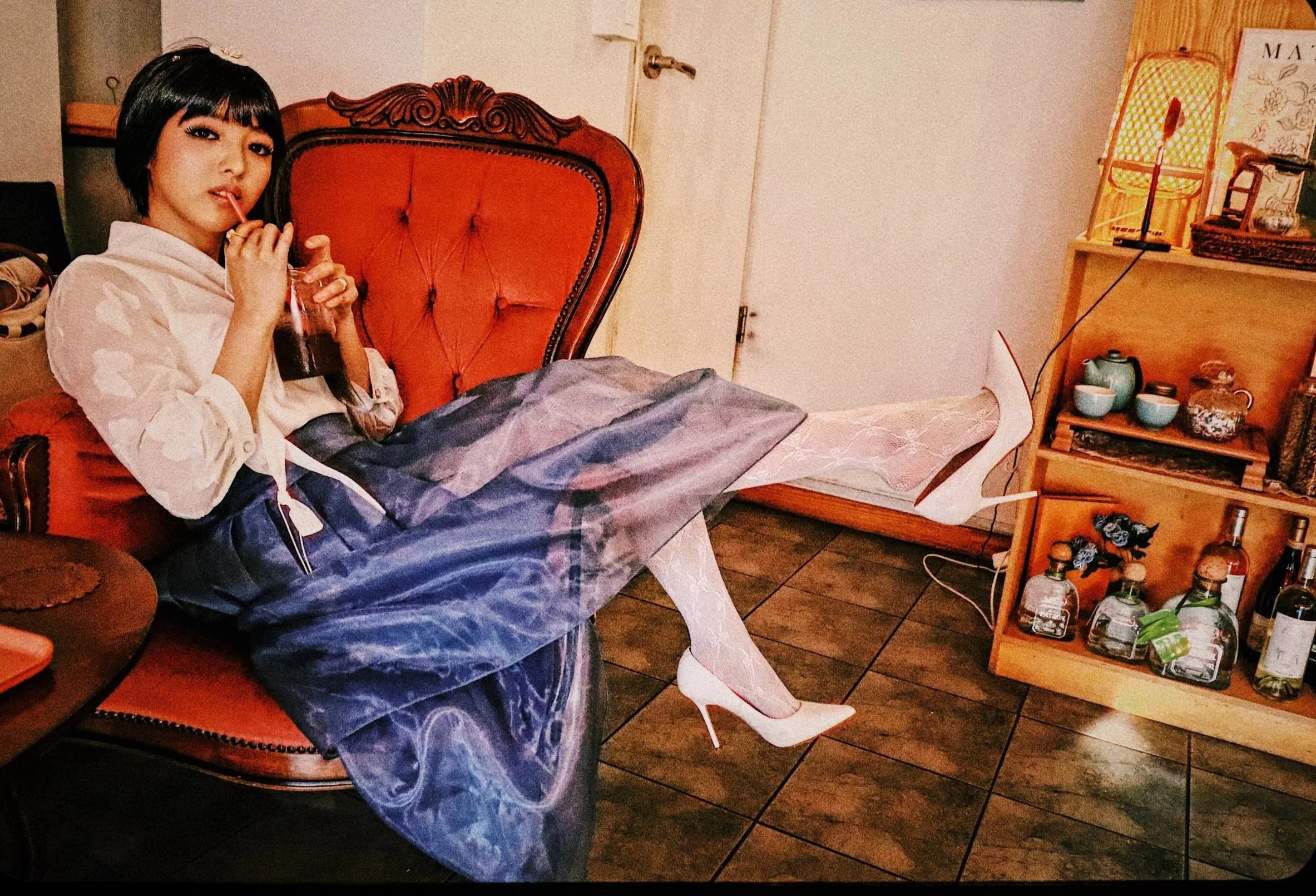
Rather than offer up a theoretically purer (and frankly, easier) example of a crazy-cool popup space, the moretypical example of a creatively designed, real coffee shop that exists TO SELL COFFEE AS ITS PRIMARY MEANS OF PROFIT is better, since the choice of vintage furniture, retro-kitsch-nostalgia chotchkies, and every single visual-aesthetic choice in the place is made for a picture or the POSSIBILITY of being in a picture — which invites and focuses a certain kind of social action in front of a camera lens. Model @youbin_ey channels the logic of the kitchy space and her modern hanbokto explicate the overall logic of the coffee shop, which, incidentally, was demoloshed and disappear completely by the following month.
Traditional residential. The baseline every other type interrupts. Quiet, low-rise, ordinary — the fabric a neighborhood is stitched onto before anything more interesting happens to it.
Luxury consumption. Cheongdam-dong (청담동) energy wherever it shows up: designer flagship stores, valet stands, an entrance that makes you check what you're wearing.
Commercialized youth zone. Hongdae (홍대) energy: loud, dense, built around nightlife and a twenty-something audience with disposable time rather than disposable income.
The temporal popup. Here for a week, then gone, replaced by something unrelated. This is a density multiplier more than a type on its own — one popup slot can cycle through completely different identities dozens of times a year, which is exactly why Seongsu registers so much higher than almost anywhere else: forty to sixty pop-up installations move through its warehouse spaces in a given week.
Underground and hidden. Spatial concealment as its own genre — a bar behind a working refrigerator door, a wine bar you duck through a low entrance to reach. 장프리고 (Jean Frigo) and 머리조심 (Meori Josim, literally "watch your head") are both this, and both prove the type doesn't require confusion to work — a hidden entrance can be a well-marketed genre convention as easily as a genuine mystery.
Traditional culture consumption. Hanbok rental counters, heritage-branded storefronts. Ikseon-dong (익선동) runs this type at absurd density — five or six interface types packed into an 80–100 square meter hanok footprint, the highest density per square meter anywhere in the city.
Traditional food tourism. Market stalls doing double duty as heritage performance — Gwangjang Market (광장시장) is the reference case, street food that's simultaneously a meal and a folklore exhibit.
Transit-adjacent emergence. A commercial cluster that exists specifically because a subway exit made a corner suddenly walkable. This is the type that explains why some interesting neighborhoods have no historical or cultural reason to exist where they do — the reason is entirely infrastructural.
That's the vocabulary. Once you can name these, you'll start seeing them stacked — sometimes two or three deep, in the same building, at the same hour.
When the Spot Gets Crowded
Interface density is just a count: how many of those eleven types are stacked into one footprint. Most streets in most cities run one, maybe two. Seongsu runs eight or nine, in the same warehouse blocks, simultaneously — industrial-heritage transition, adaptive reuse, luxury consumption, commercialized youth zone, M-space, and the temporal popup layer cycling through all of it forty to sixty times a week. That's not a neighborhood with a lot of good shops in it. That's a neighborhood running close to the maximum number of translation surfaces a single footprint can carry.
When It Gets Smooshed
Density has a ceiling, and past a certain point, interface types stop sitting politely next to each other and start occupying the exact same square footage at the exact same time. Call that a singularity — the moment "what actually is this place" stops having one clean answer, because it isn't one thing following another, it's several things happening at once.
Ado (아도), a signless tea house tucked into Mullae-dong's (문래동) still-active ironworks blocks, is a clean case of it. Noon to 4pm, the room runs as a tea ceremony and exhibition space — quiet, instructional, herbal. At 4pm, the identical room becomes something else entirely: a "midnight tea house," serving tea-cocktails and tea-highballs, alcohol dressed in a tea-house frame. Same walls, same furniture, same address. One hard switch at 4pm, and the room stops being one business and starts being a different one, without anybody moving a chair. That's temporal collapse: the mechanism doesn't need more physical space to generate more density, it just needs the clock to stop separating functions that used to take turns.
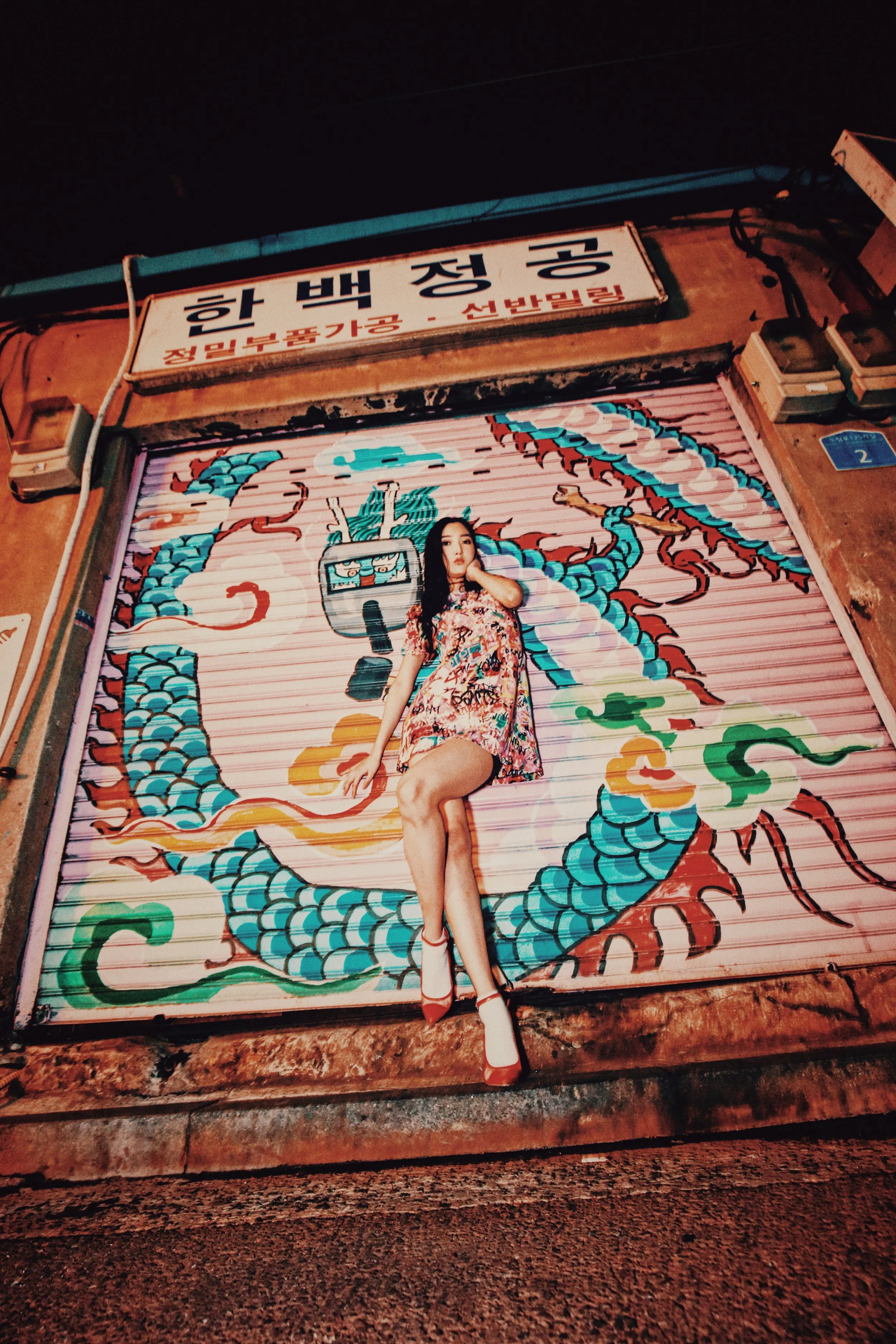
Model @clap_been stands in front of the shutter of a real, working, and stiil-in-business metalworking shop that has obviously acquiesced to the use of its door to meld into the changing purposes — and interfaces — of this corner of Mullae-dong, an industrial-to-hip, gentrifying part of Seoul. Directly across the street is a flower shop that has become a galbi joint but left up all the florist-related signage.
[IMAGE PLACEHOLDER]Suggested shot: Mullae-dong street level — a welding shop or ironworks storefront with sparks or metal shutters visible, ideally with a café or gallery signage in the same frame to show the collision directly. A second option: Ado's unmarked entrance itself, if identifiable without compromising the spot. Suggested caption: Mullae-dong (문래동): a welding shop, a café, and — somewhere on this block, unmarked — a tea house that becomes a bar at 4pm.
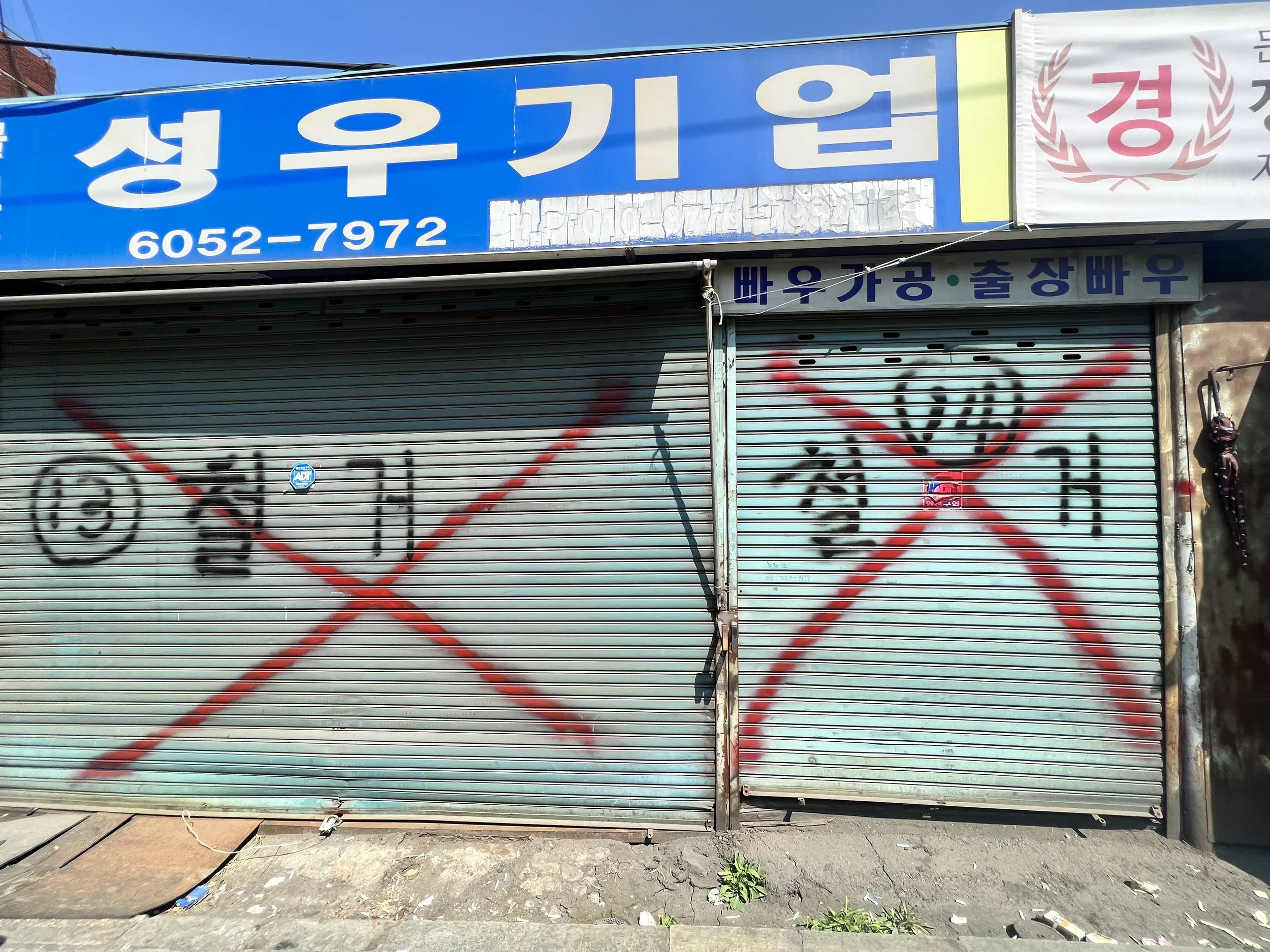
This is what the front shutters of several other metalworking shops looks like just around the corner of the previous picture. The entire block was slated for demolition, zoned for redevelopment (재개발). Might fear of this eventuality be exactly what motivates other places to be more “cooperative” with gentrification flows and allow the expanding capital of cool to affect their aesthetics?
Has the Sentence Finished Forming?
Density tells you how much is happening in a footprint. It tells you nothing about whether the city has actually agreed on what to call the result. That's a separate question, and it matters more than it sounds like it should — because a neighborhood's name isn't just a label, it's a record of which spatial argument won.
Between 2013 and 2016, a 600-meter alley near Seoul National University Station had three names. Food bloggers and students called it 봉리단길 (Bongnidan-gil) — "Bongcheon-dong's version of Gyeongnidan-gil," borrowing a naming template spreading across half the alleys in the city. A smaller crowd called it 봉로수길 (Bongnosu-gil), borrowing a different template. A third group called it 샤로수길 (Sharosu-gil) — 샤 for the sculpture at Seoul National University's front gate, 로수길 for "tree-lined street."
Nobody voted. Then in 2014, the Gwanak District Office made a call, and signage went up for 샤로수길 the following year. The other two names didn't survive it. Today, "Bongnidan-gil" describes real, unrelated streets in Daegu and Gimhae — the original, Seoul version is a ghost, surviving only as a dead tag on a government web page nobody clicks.
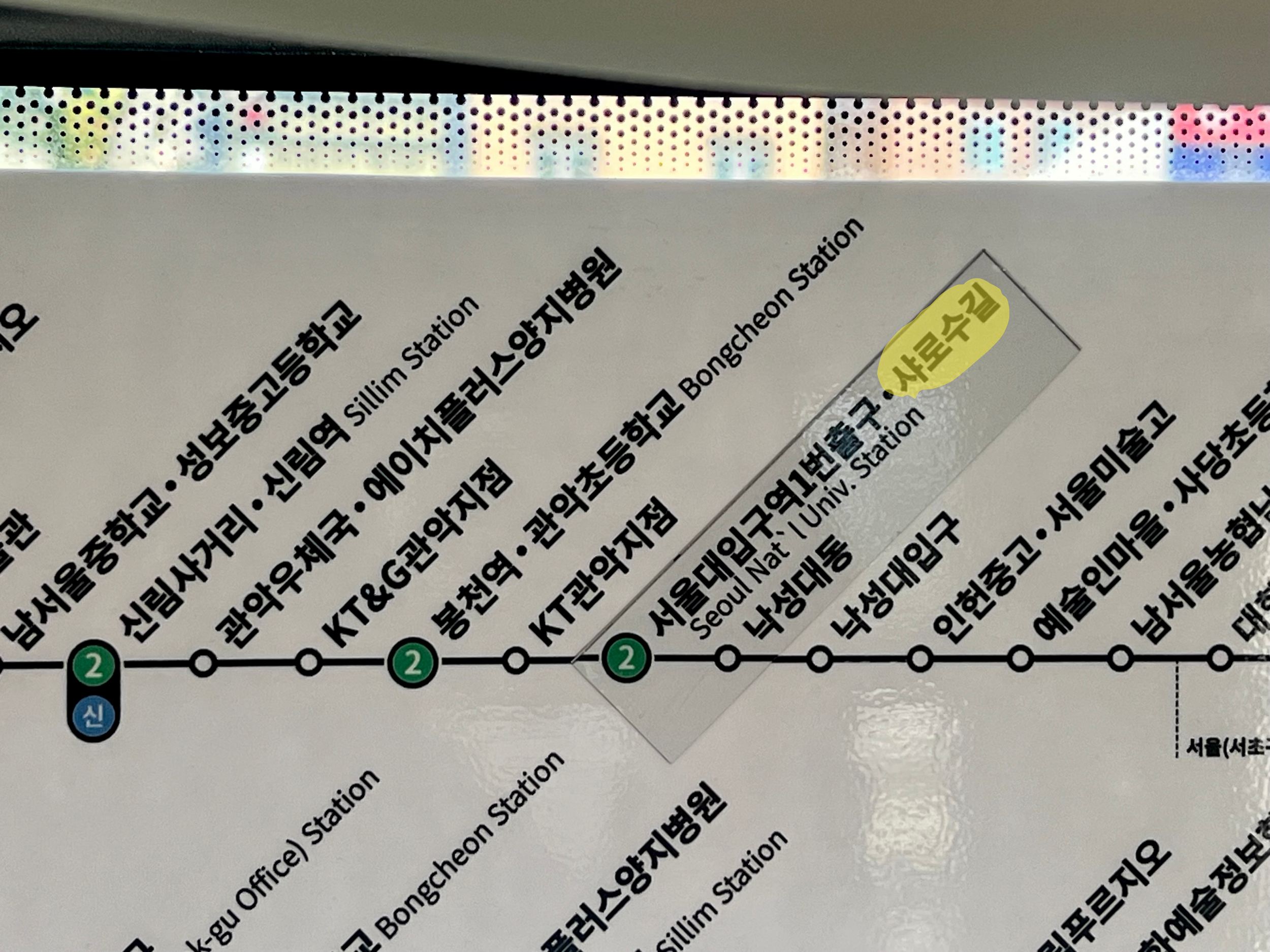
On a city bus that goes through the Seoul National University/Shillim-dong area, I heard a group of ajumma musing about the name when it came on the PA system, chuckling that this was the much-talked about “Sharosu-gil” and I heard them repeating the sme to each other becasuse they seemed amused by it. But it was now as official to them as the new neighborhood descripter that had obviously been recently updated when I took this picture earlier in 2026.
[IMAGE PLACEHOLDER]Suggested shot: The Sharosu-gil signage itself, or the SNU gate sculpture the name references, ideally framed so both the street and the landmark are legible in one shot. Suggested caption: 샤로수길 — the name that won, because it pointed at something you could actually stand in front of.
Here's the part that matters more than the trivia: the winning name was the one that pointed at something real. 샤 referenced an actual landmark, a gate you can stand in front of. Both losing names referenced 봉천동, the administrative dong — a label on a map that nobody feels while they're buying tteokbokki in the alley. The neighborhood wasn't won by the cleverer name. It was won by whichever name correctly located the place's actual center — which means legibility and the boundary-work from earlier were never really separate questions. They're the same question, asked twice.
Not every neighborhood has settled its argument yet. Mullae-dong (문래동) — the still-active ironworks district turning slowly into an art scene — is currently mid-fight the way Bongcheon-dong's alley was in 2014. A signless tea house runs as a class space by day and something closer to a bar by night, on a block where a welding shop sits next to a Mexican restaurant sits next to a tarot-card parlor. Nobody's put up the signage yet. Come back in five years and there might be one name everyone uses without thinking about it. Right now, there isn't.
Interface Density Isn't the Same as Confusion
Here's the part that should feel wrong, and doesn't hold up: you'd assume the neighborhoods with the highest interface density — the most types stacked into one footprint, the most simultaneous — are also the most confusing ones. They're not. Interface density and unresolved legibility are two separate axes, and they don't automatically travel together.
Seongsu and Ikseon-dong both run extreme interface density — eight-plus types in Seongsu's case, five or six packed into single hanok footprints in Ikseon-dong's — and both are completely legible. Everybody already knows what they are. The density got narrated into a stable story a long time ago.
Mullae-dong runs comparable interface density and hasn't been narrated yet. Same mechanism, unresolved argument.
Meanwhile Gangnam Station and Myeongdong (명동) run low interface density and high legibility — chain stores, ranked lists, stable categories, nothing left to argue about. And somewhere in the city, right now, there's a single strange venue with no interface cluster around it at all: low interface density, and still completely confusing, because confusion doesn't actually require company. It just requires one category that refuses to resolve.
High interface density doesn't mean weird. Weird doesn't require interface density. Once you can hold those apart, you stop assuming "crowded and photogenic" is the same thing as "interesting," and you start noticing the actual signal — whether a place has finished being explained yet — instead of the noise around it.
Try It: The Dérive
The technique has a name, and it's a genuinely good one to drop into conversation. Dérive — French, pronounced roughly "day-REEV," literally "drift." Once you know it, you'll never do this the boring way again, and you'll sound a little insufferable at dinner the first time you use it, which is honestly part of the fun.
In 1950s Paris, a group of radical artists and theorists calling themselves the Situationist International — fronted by a filmmaker and agitator named Guy Debord — turned "getting deliberately lost" into an actual discipline, rigorous enough that Debord wrote theory about it and the French police apparently found the whole group suspicious enough to keep tabs on. Their argument: ordinary city life is a script. Streets are built to move you efficiently from home to work to shop, and that efficiency is itself a form of control, routing your body through capitalism's preferred paths so smoothly you stop noticing you'd stopped choosing. The dérive was their refusal of the script — walking with no destination, letting psychogeography decide your route instead of a map. Psychogeography is the actual technical term, and it's worth keeping: it names the way a built environment produces feeling and behavior in the people moving through it, mostly beneath conscious notice — the felt pull of one street over another, registered by the body before the mind can name it. Debord's claim was that every city has psychogeographic gradients most people never notice, because they're always walking somewhere specific. Stop being somewhere specific, and the gradients become the whole experience.
That's the mode you want here — not a checklist, a dérive. The three things you're paying attention to — a center, a count of interfaces, a read on whether the place has a settled name — aren't three sequential errands to knock out. They're what you're noticing while you dérive, not instead of it.
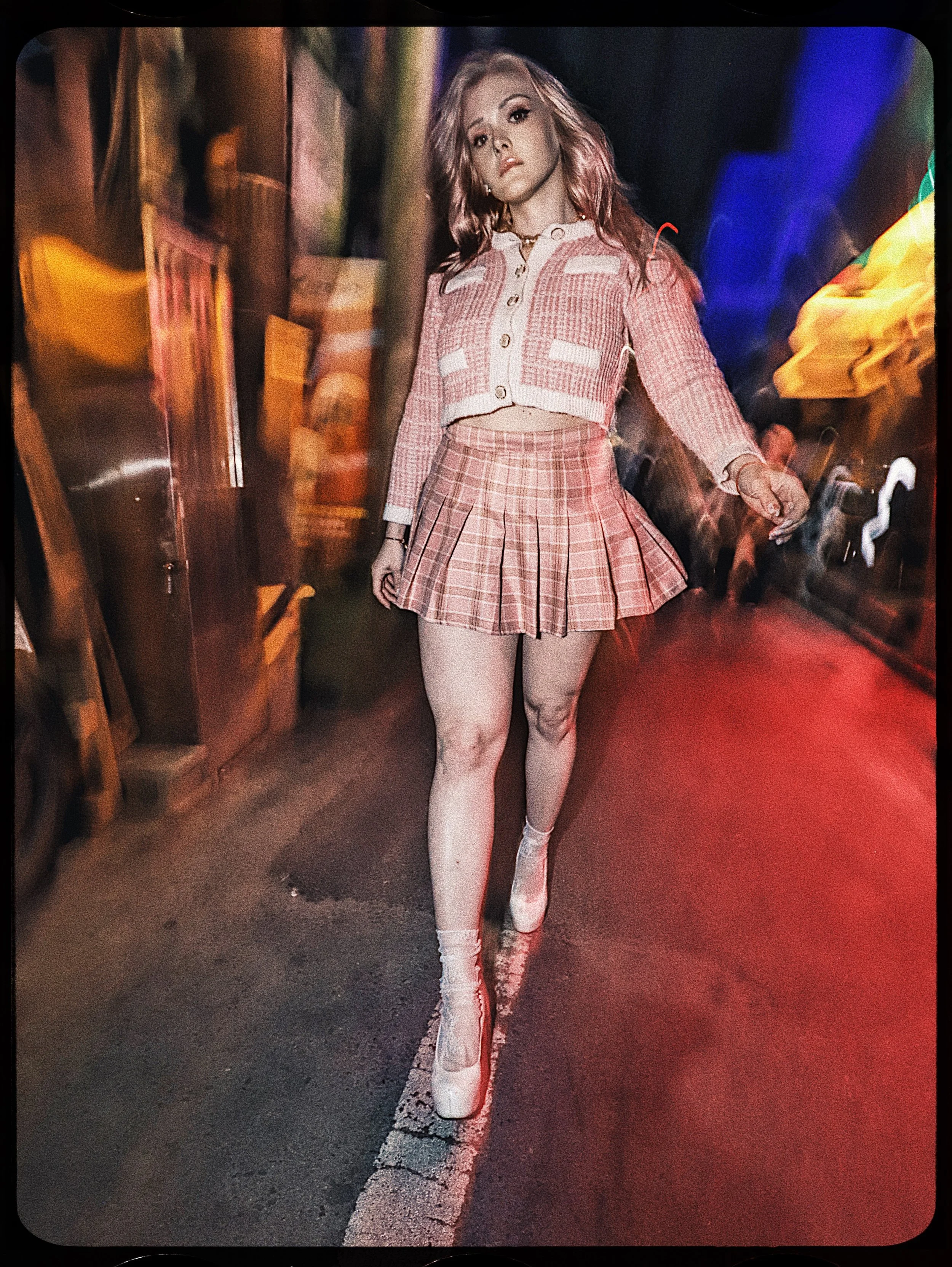
Strut with 멋 (mut/style). Go off the map. Use the Forcre — just the pull of one streett, one spot, over another. Model @raqulaaa uses that force to navigate down a side street in Euljiro in summer, 2024.
[IMAGE PLACEHOLDER]Suggested shot: A mid-motion, feet-forward or over-the-shoulder shot on an ambiguous Seoul side street — no landmark in frame, nothing identifiable, just the sense of movement without a destination. Suggested caption: No map. Just the pull of one street over another.
Follow attraction, note repulsion. If a street pulls you down it for no articulable reason, go. If you feel resistance — too quiet, too residential, wrong energy — that's data too, not a wrong turn. The pull itself is the information; that's psychogeography in practice, the entire Situationist method, borrowed intact.
Ask, and let the answer redirect you. This is where finding the center actually lives — not standing still and deciding, but asking a barista or a shop owner what the real "it" spot is, and then going there, even if it's not where you expected. Ask five different people in Seongsu and you won't get five matching answers: some will point you to Café Onion (카페 어니언), the original industrial-chic café that arguably invented the whole genre the district now runs on. Others will send you toward whatever pop-up happens to be running that month — a Dior installation, say — in a completely different corner of the neighborhood. Both answers are correct, and neither cancels the other out. They're two different gravitational pulls the same neighborhood can have at once, and going wherever you're sent — even somewhere you'd have walked past — is the dérive working exactly as designed: your instinct, routed through someone else's local knowledge instead of a map.
Treat surprises as findings, not errors. The place someone recommended turns out closed, or nothing like what they described, or the boundary you thought you found dissolves the moment you cross it — none of that is a failed excursion. It's what researchers in this tradition call productive failure: the moment your expectation collides with what's actually there is usually the moment worth paying attention to, not the moment to route around and forget.
Do this for real — not five minutes, but an afternoon — and by the end you'll have found what you came for without ever running a checklist: a center, probably more than one, offered to you by different people who don't agree. A rough count of how many interfaces are stacked into whatever boundary you ended up tracing, higher than you expected if you let yourself get pulled somewhere unplanned. And a read on whether the place has a name everyone uses without thinking, or whether you just spent an afternoon inside an argument that hasn't been settled yet.
No Korean required for any of it. Attraction and repulsion don't need translation, and inconsistent signage is its own kind of evidence, readable in any language.
The City's Rough Drafts
Somewhere on a Seoul city government web page, "봉로수길" and "봉리단길" still sit in a forgotten list, attached to an alley that no longer answers to either name. Nobody wrote an obituary for them. They just stopped being used, one blog post at a time, until a name that pointed at a real landmark outlasted two that pointed at a bureaucratic label. They're a rough draft of a neighborhood that got revised down to one clean version — and once you know to look, you'll find drafts like that everywhere: an old shutter under new signage, a name half the block still uses that the other half already dropped, an argument that hasn't finished yet.
Every dense, unresolved neighborhood you walk through now is mid-argument the same way that alley was in 2014. You don't need anyone's list to tell you how it comes out anymore — you can just dérive through it and watch, noticing the version of the city that almost happened right alongside the version that did. That's the trade you made back at the start: an afternoon of walking, for tools instead of pins. From here, every move through this city is one you get to make yourself.