The (Truer) Face of Korea™ Project
The Seoul You Think You Know Doesn't Exist
Starting where Koreans actually live — not where the content tells you to look. Here's exactly what we're going to prove, and how.
There are two Seouls.
One of them you already know. Seongsu-dong's brick walls, the hanok rooflines of Ikseon-dong , Hongdae at midnight, the Han River at golden hour. The Seoul that exists to be photographed, that has been optimized for the frame, that a TikTok tourist can land in on a Thursday and have a full content calendar by Sunday. That Seoul is real. It's also a performance — a city-sized editorial set built over the last decade to produce a specific image of what Korea looks like.
The other Seoul is where Koreans actually live.
This is the story of the second one.
The address nobody's filming
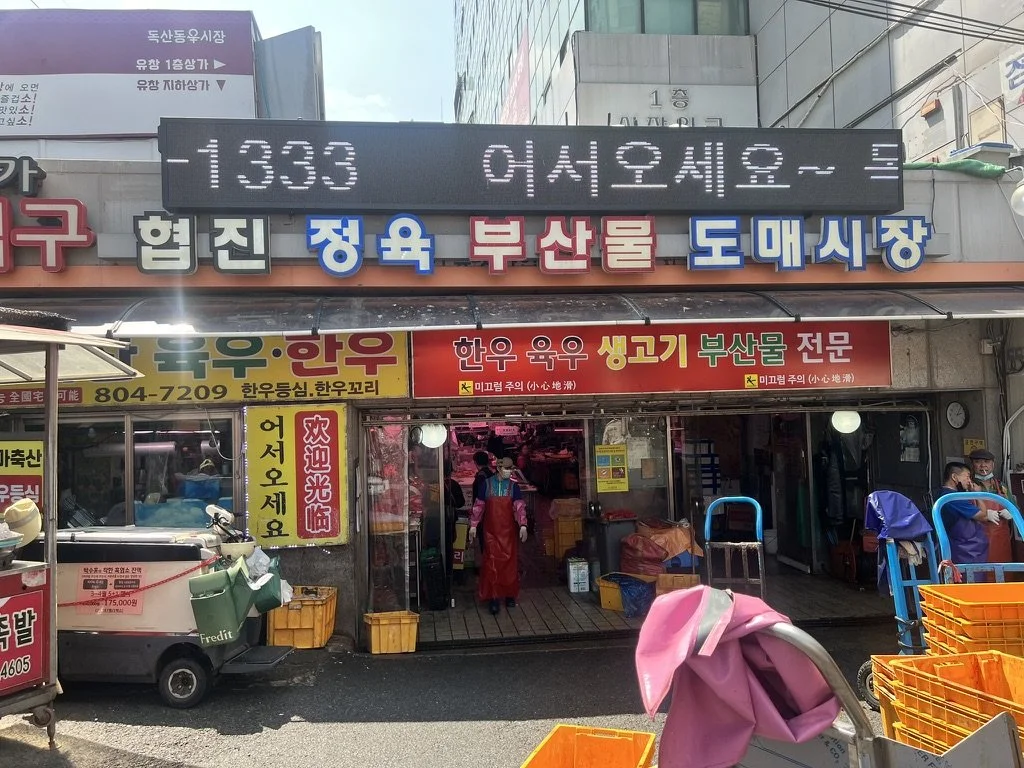
Welcome to our hood!
독산동 (Doksan-dong) is in 금천구 (Geumcheon-gu), the southwestern edge of the city, accessible via Line 1 and Line 7 at 독산역 (Doksan Station). It doesn't appear on any "best neighborhoods in Seoul" listicle. No travel blog has a 48-hour guide to it. The Airbnbs here are not decorated with exposed concrete and monstera plants. The cafés, if you can find one that isn't a 편의점 (pyeonuijeom — convenience store), are not photogenic.
What 독산동 has instead is a wholesale meat district — 협진 정육 부산물 도매시장 (Hyeopjin Wholesale Meat By-Products Market) — a covered market tunnel running off a main street where butchers and restaurant owners come in the early morning to buy in bulk. Green-painted concrete stairs. A red cylindrical 정육용품 (jeongyuk yongpum — butcher supplies) tank bolted to the wall. Yellow plastic crates stacked at loading docks. The smell of refrigeration and raw protein.
It is, in every way that Seoul content currently values, completely wrong.
We shot a fashion editorial here anyway.
What the sign says
Here's the detail that stopped me when I first scouted the location.
At the entrance to 협진 정육 도매시장, there are two welcome signs. The one at the top, scrolling across an LED board: 어서오세요 (Eoseo oseyo). The one below it, printed on a panel at eye level: 欢迎光临 (Huānyíng guānglín).
Both mean "welcome." Neither acknowledges the other.
독산동 has a significant Chinese-Korean residential population — not as a tourist attraction, not as a multicultural branding exercise, but because people from China and the Korean-Chinese diaspora have been living and working here for decades, and the businesses that serve them are written in the language their customers actually read. The bilingual signage isn't performing diversity. It's commerce. It's 欢迎光临 because that's how you tell your customers to come in.
This is not the Seoul you see in the content. This is the Seoul that exists before anyone decided to make content about it.
This is what "real" looks like: two languages, one entrance, nobody making a thing of it.
The problem with pretty neighborhoods
Here is the argument at the center of everything we're doing with Face of Korea™:
Korean style doesn't need a beautiful neighborhood. It generates its own context.
This sounds simple. Prove it and it becomes a thesis. The way you prove it is you take a model — in our case @youngseova, who lives in 독산동, who shops at the meat market we shot in front of — and you put her in front of the most aggressively ordinary backdrops you can find, and you see what happens.
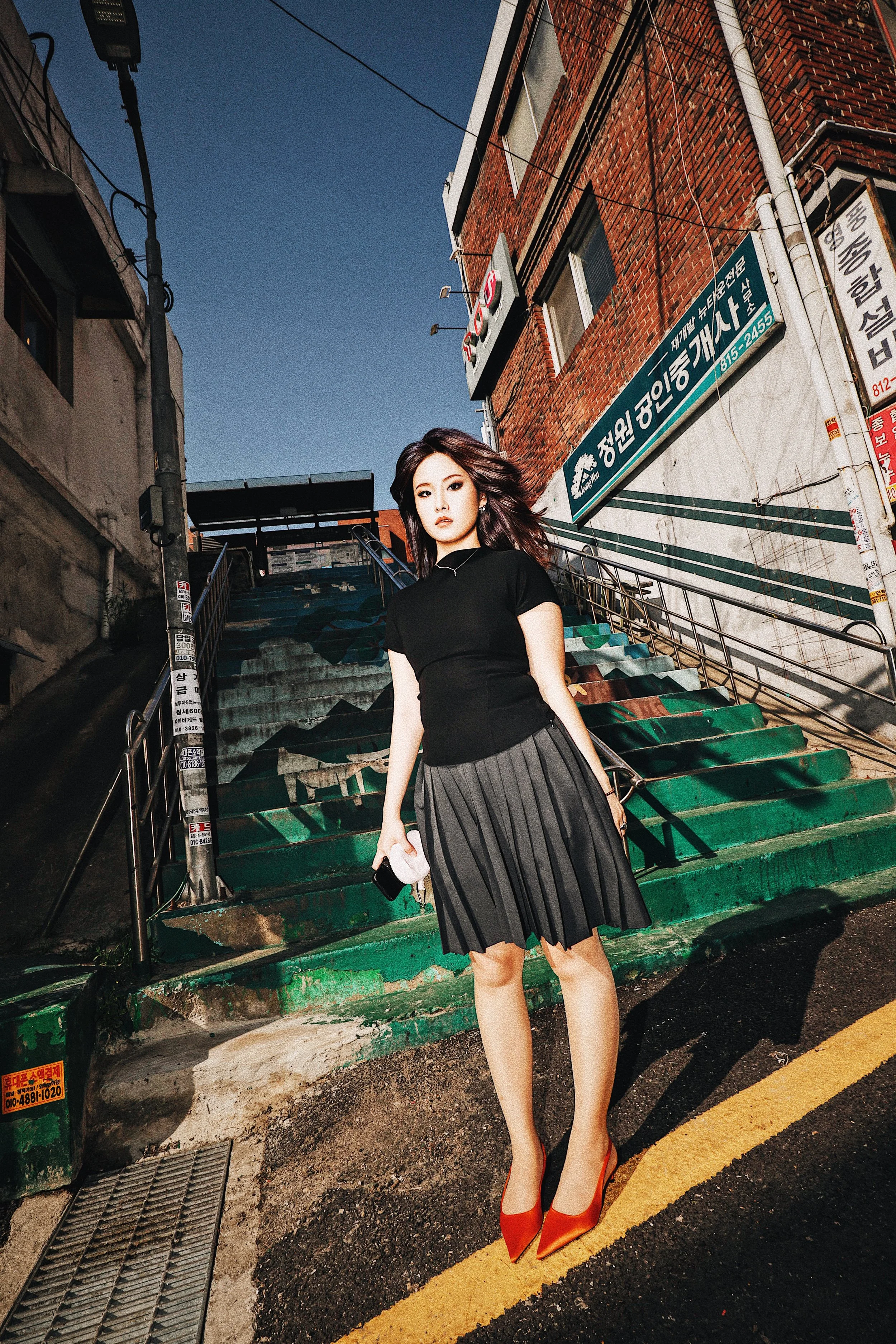
@youngseova conquers Heokseok-dong.
What happens is: it still reads.
The styling reads. The proportions read. The specificity of the Korean fashion sensibility — what participants in our 127-person Seoul Fashion Week ethnographic study called 꾸안꾸 (kku-an-kku, roughly "effortlessly put-together") — reads, even against a red 정육용품 tank and a yellow plastic crate and a 부산물 (by-product) wholesale sign.
This is not a coincidence. It's a structural feature of how Korean style actually works — as an embodied practice, a grammar of dressing that operates independently of its backdrop. The beautiful neighborhoods of Seoul content are not where Korean style comes from. They're where Korean style gets exported to — staged and photographed for foreign consumption. The thing itself lives somewhere less convenient to film.
The cigarette butts on the ground
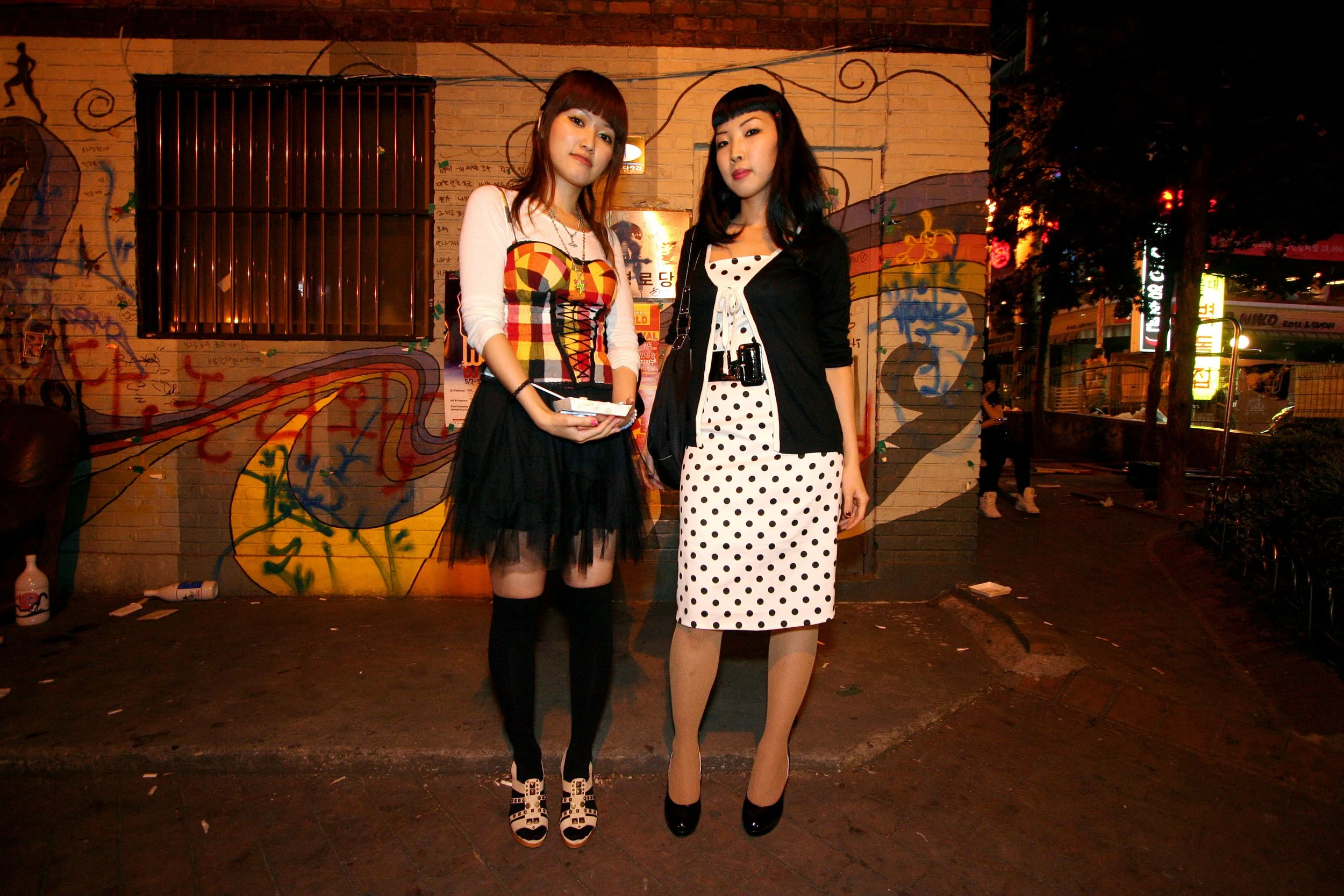
The (in)famous playground in Hongdae in 2009, where the cool kids used to congregate (and even take pictures of one another in front of the actual , real graffitti wall) — it has all since been demolished for the safe, clean, shopping mall-like outdoors zone that is there now. The actual youth culture that used to smoke, drink, vomit, pose for pictures, make out, and even sleep there until the sun came up has now all been scrubbed clean for the tourists.
To understand what happened in 2009, you need to understand what Korean fashion looked like before it.
If you wanted to know what young Korean women were wearing — the freshest cuts, the most current silhouettes, what was actually moving through the culture — you went to 명동 (Myeongdong). That was the answer. Myeongdong was a Korean neighborhood then, mostly Korean shoppers, Korean brands, Korean street life. It was the commercial center of youth fashion in a way that felt real because it mostly was. The foreign tourist takeover that eventually hollowed it out hadn't happened yet.
Street fashion as a concept — the idea that the clothes people wore on actual streets, without styling or direction, constituted a form of fashion worth documenting and analyzing — barely existed as a defined category in Korea. It lived in the margins. A few hipsters understood it. It filtered through platforms like Hiphoper.com, an early Korean street style site that was doing something genuinely new but reaching a narrow audience. The mainstream hadn't caught up. The average Korean person, asked to define street fashion, would not have had a clear answer.
홍대 (Hongdae) in 2009 was genuinely alternative — grungy, edgy, cheap rent, art students, indie bands, the kind of neighborhood that produces actual subculture because it hasn't yet been discovered by the forces that turn subculture into content. I shot there. I shot in neighborhoods all over the city, mostly north of the river, documenting what people actually wore on actual streets with no styling, no direction, no editorial mediation.
And then I made the call.
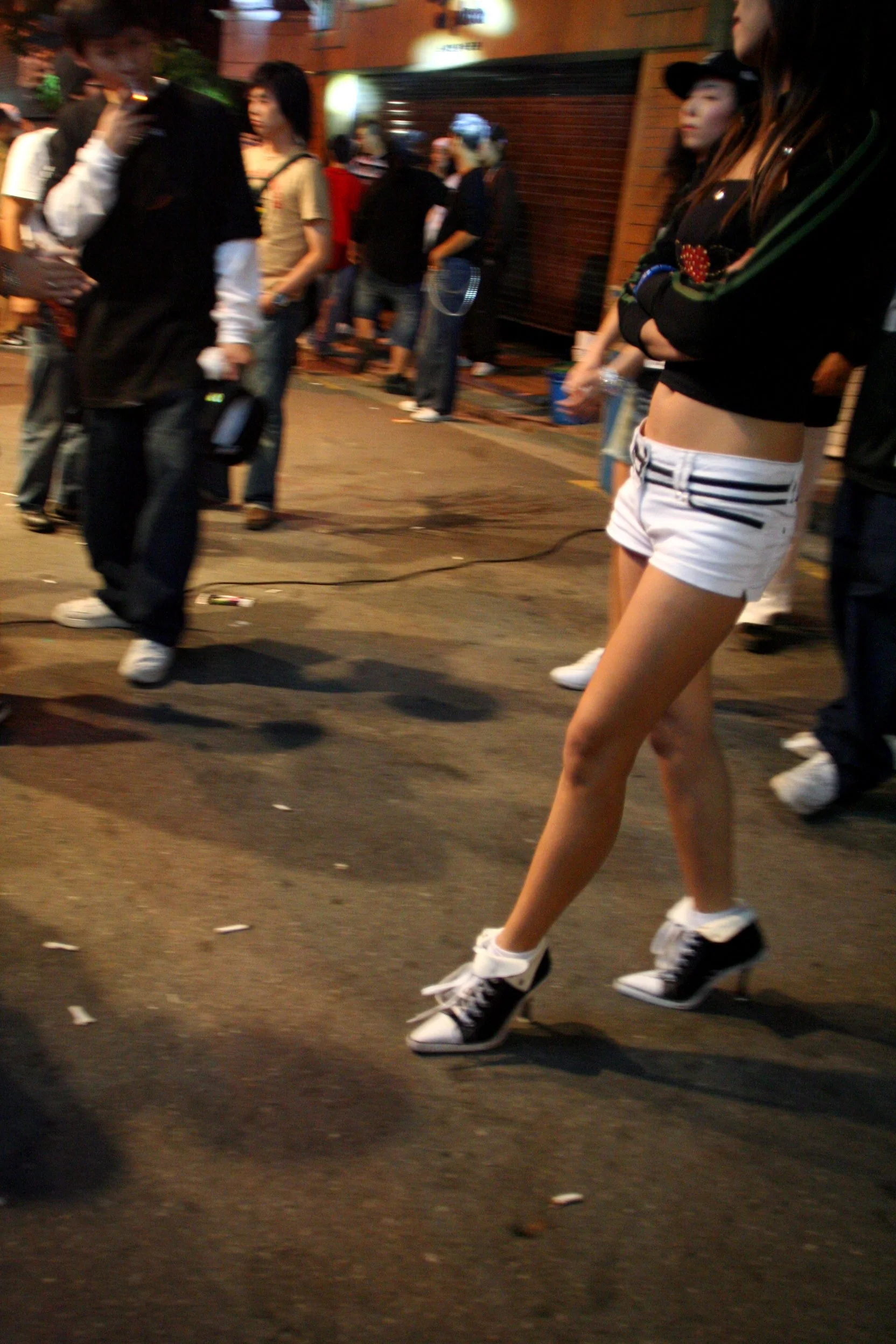
“Hunting” in Hongdae outside one of the old, original clubs, roundabout 2007.
The call was this: Hongdae was not just an alternative neighborhood. It was a fashion neighborhood — specifically, the place where the most genuinely Korean street fashion was happening, unmediated, unproduced, right there on the pavement among the cigarette butts. More than that: the street in its uncut form, the kids in their actual clothes on their actual block, represented something real about Korean style that the official fashion industry was not only failing to document but was actively incapable of seeing. Because Hongdae was youth-driven, because it was bottom-up, because it was embodied by kids who weren't asking anyone's permission — that was the fashion. That was Korea's style avant-garde, and it was living in a neighborhood that the Seoul Fashion Week apparatus considered irrelevant.
That argument — that the street had more to say about Korean fashion than the runway, that Hongdae's unglamorous reality was more interesting than Myeongdong's commercial shine — was what I put in the Seoul Fashion Report in 2009. The first dedicated photographic treatment of Korean street fashion ever published. Not the first good one. The first one, period.
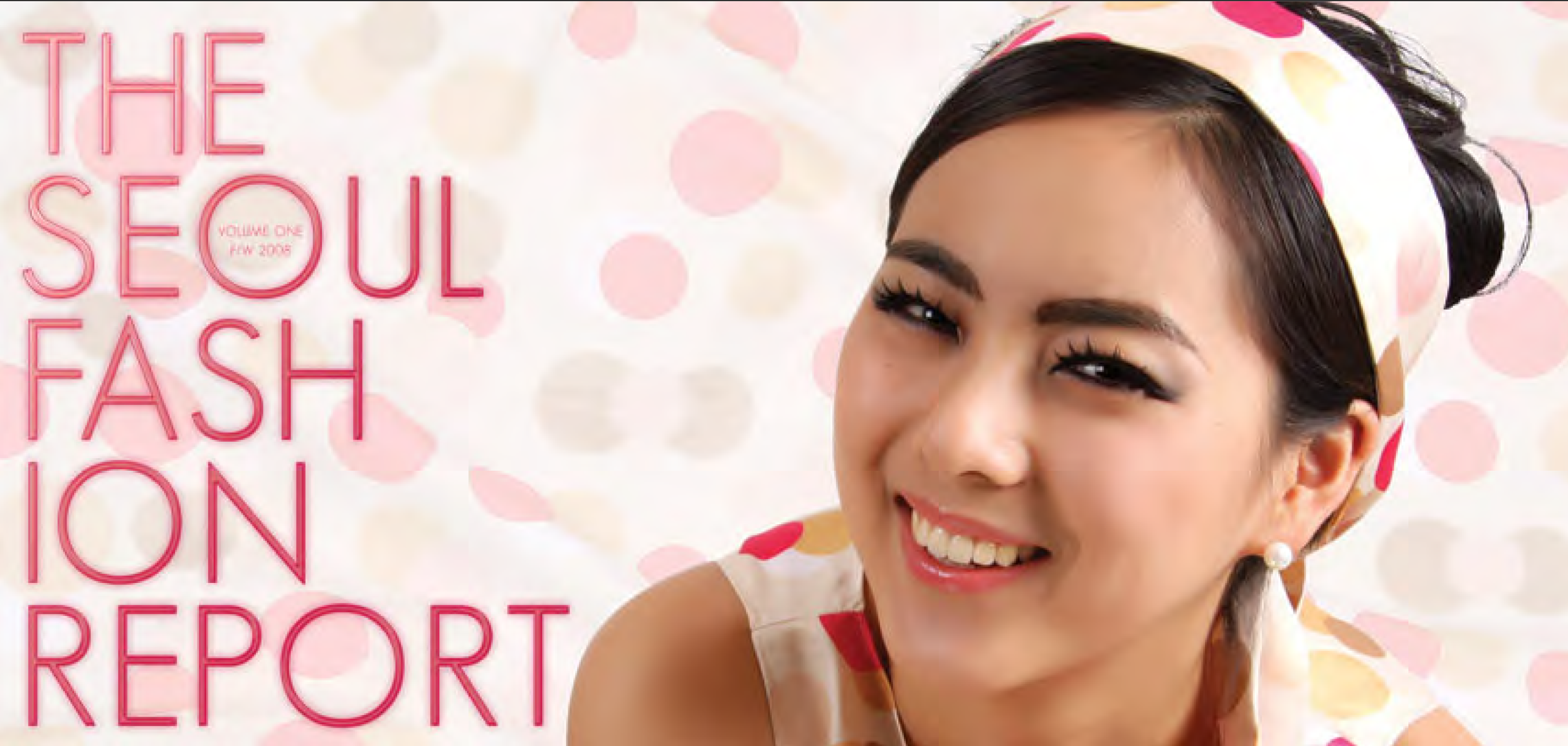
The first book in English about Korean fashion and style, published in 2009.
Seoul Fashion Week's organizers banned it from the event.
Not quietly. Explicitly. They told me that if they saw the bookon the premises, they would be trashed and I would be expelled. The official objection, delivered with full institutional seriousness, was this: some of the photographs showed cigarette butts on the ground.
The argument was that if foreigners saw images of cigarette butts on Korean streets, it would create negative impressions of Korea abroad.
This was not really about cigarette butts. It was about the claim underneath the images — that the real face of Korean style was unglamorous, youth-driven, street-level, and happening in a neighborhood the official fashion world had written off as too alternative to matter. That claim was intolerable. Because if it was true, then the Seoul Fashion Week apparatus wasn't documenting Korean fashion. It was producing a fiction about it.
I disagreed then. I disagree now. But I lost the argument because I didn't have the infrastructure to distribute content on my own terms — no platform, no audience, no channel that didn't run through the gatekeepers who had decided that Korea's image required management. The Seoul Fashion Week apparatus was not in the business of showing Korea as it was. It was in the business of showing Korea as it wanted to be seen.
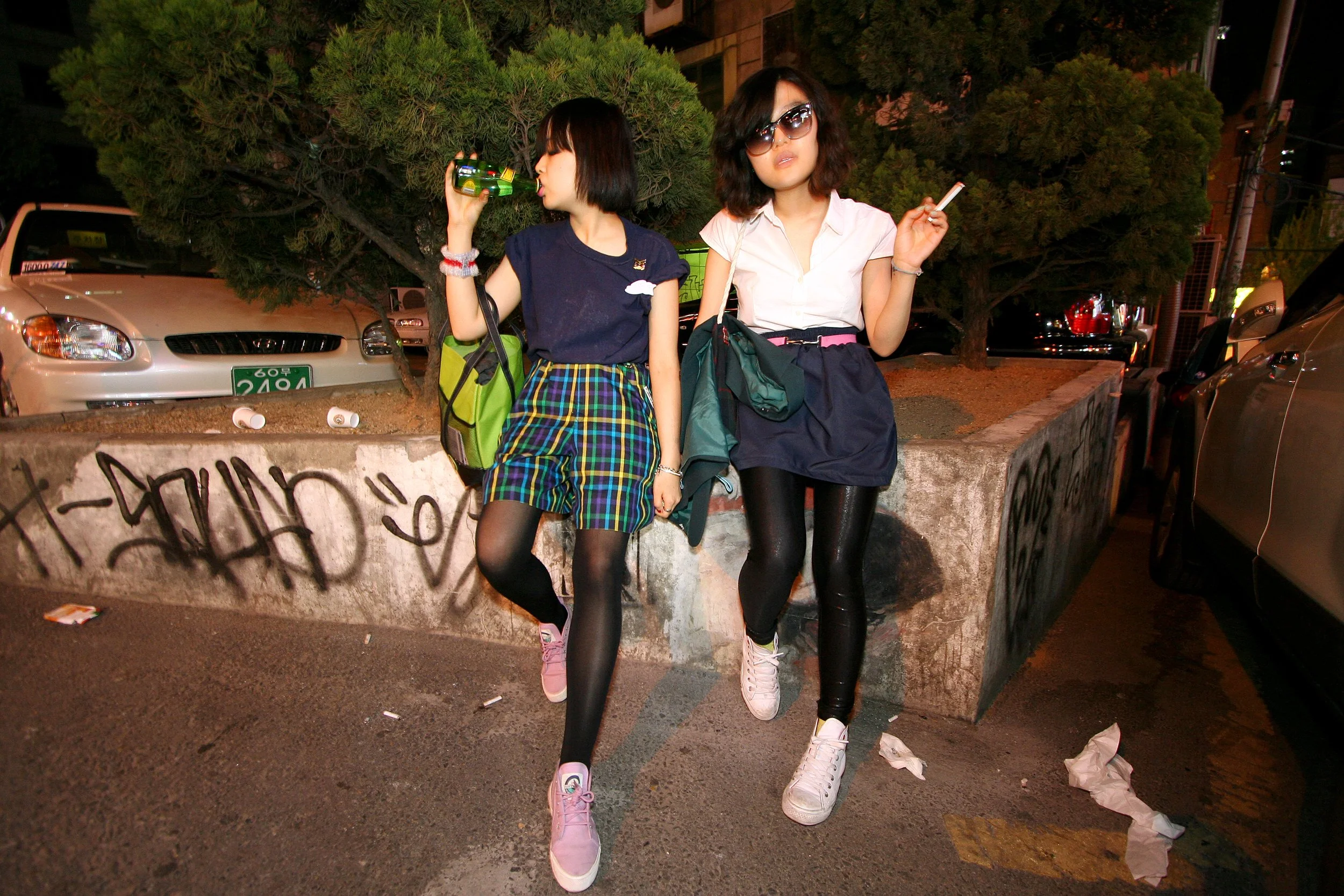
The real cool kids in Hongdae and its environs that nobody was talking about as global fashion creators, back nobody cared about Korea. But this picture defined “nara mangshin” or “national disgrace/dishonor.” Because there was trash on the ground.
That is still the business. It has just been massively scaled.
What changed is who's running it. The institutional image-management of Korea's fashion culture — once the exclusive project of government agencies, tourism boards, and official cultural promotion bodies — has been enthusiastically adopted by an entire ecosystem of foreign content creators who figured out that "Seoul content" performs well and that the formula is simple: beautiful neighborhood, beautiful café, beautiful person, trending audio, repeat. The bright and photogenic Seoul that government agencies once promoted through official channels is now being promoted for free by thousands of TikTok tourists who have no idea they're doing PR work, who genuinely believe they've discovered something real, who are getting their information about the city from other TikTok tourists who got their information from other TikTok tourists — an infinite regress of secondhand impressions laundered through enough repetition to feel like knowledge.
Nobody in this chain has been to 독산동. Nobody photographed cigarette butts on the ground in Hongdae and thought: this is also Korea, and it's worth showing.
I have. For thirty-plus seasons of Seoul Fashion Week, down streets and through markets and into neighborhoods that don't make the algorithm happy, I've been documenting the version of this city that doesn't perform for the camera. That work got banned from an event once. Now it's a series.
The parallel — and what it doesn't mean
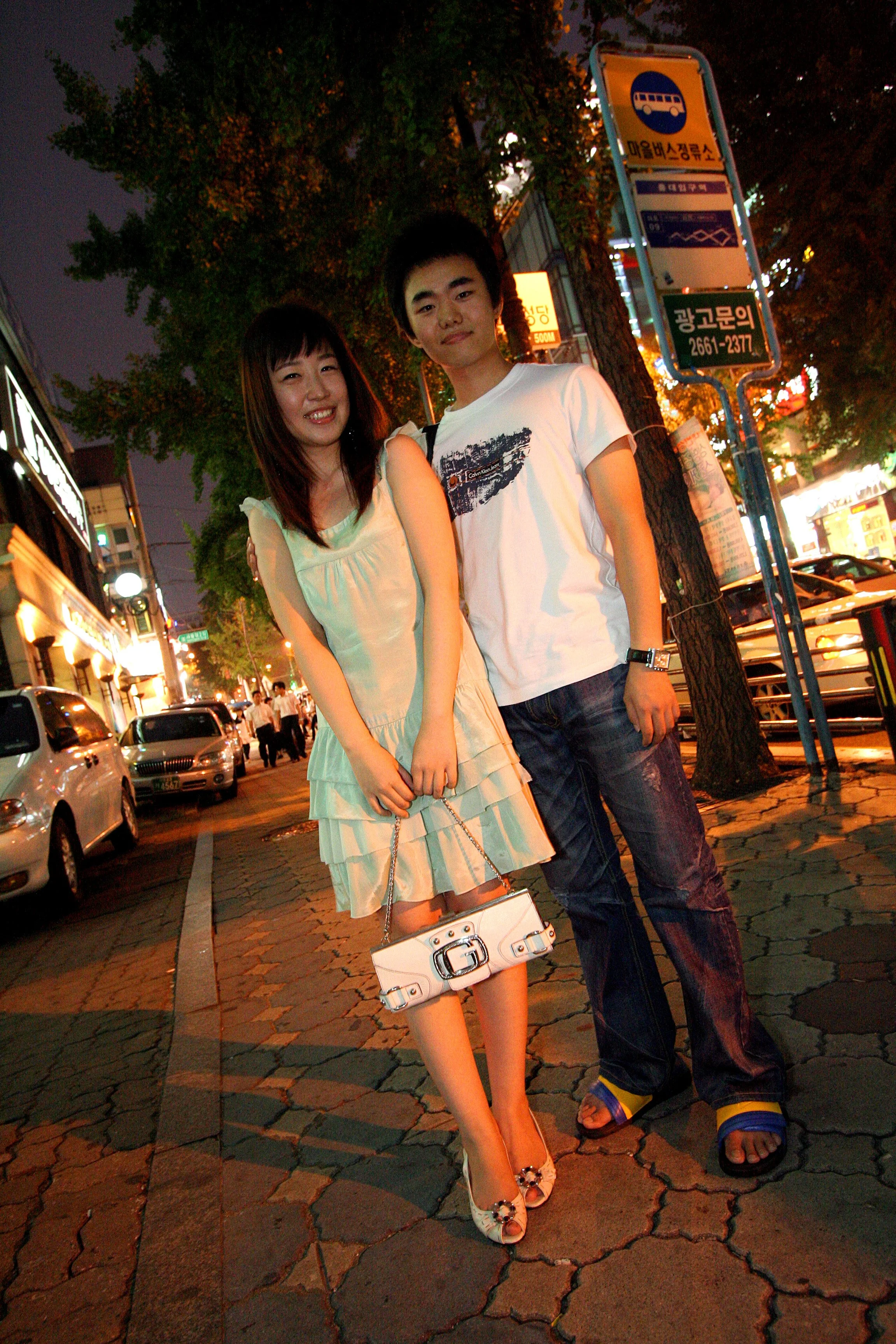
Hongdae roundabout 2008 or so. It was never gonna be “Korea’s Harajuku” or some easy shorthand idea like that. But it was still where the cool kids went, where real couples enjoyed a Friday night, where real Korean style — no matter your preference — flourished.
Here is the part I want you to hold onto.
In 2009, I called Hongdae. I said it was a fashion neighborhood — that the kids on those streets, in those cheap bars, in front of those indie venues, were producing something that mattered more to Korean style than anything happening on an official runway. The gatekeepers disagreed. They banned the book. They told me cigarette butts were the problem.
Hongdae is now the single Seoul neighborhood most likely to be known by a non-Korean tourist before they ever set foot in the country. Internationally recognized, culturally exported, algorithmically dominant. The call was correct. The gatekeepers were wrong.
I am not saying 독산동 is the next Hongdae. That is not the call.
The call is simpler and more damning than that: our aesthetic eye is exact, and we know what we're talking about. Seventeen years of documented calls, made before they were obvious, say so. Which means when we tell you that the current discourse about Seoul style is a phantasm — constructed by people optimizing for Instagramability rather than any actual understanding of how Korean style systems or the logic of this city actually work — that is not an opinion. That is a diagnosis from people who were here before the content was, and will be here after it moves on.
Here is the actual problem with the way Seoul gets covered now.
The gaze goes where Instagram rewards it. Not where knowledge leads. Not where style actually operates. Where the light is good and the walls are photogenic and the café has the right kind of ceiling. The result is a self-reinforcing loop: beautiful neighborhoods get photographed, photographs get engagement, engagement signals to the next person where to go, they go there and photograph the same walls, and the loop tightens until the entire global understanding of Seoul style is determined not by anyone who knows anything about Korean fashion but by whoever found the most Instagrammable corner of Seongsu-dong and got there first.
You already know the script. You've seen it a hundred times:
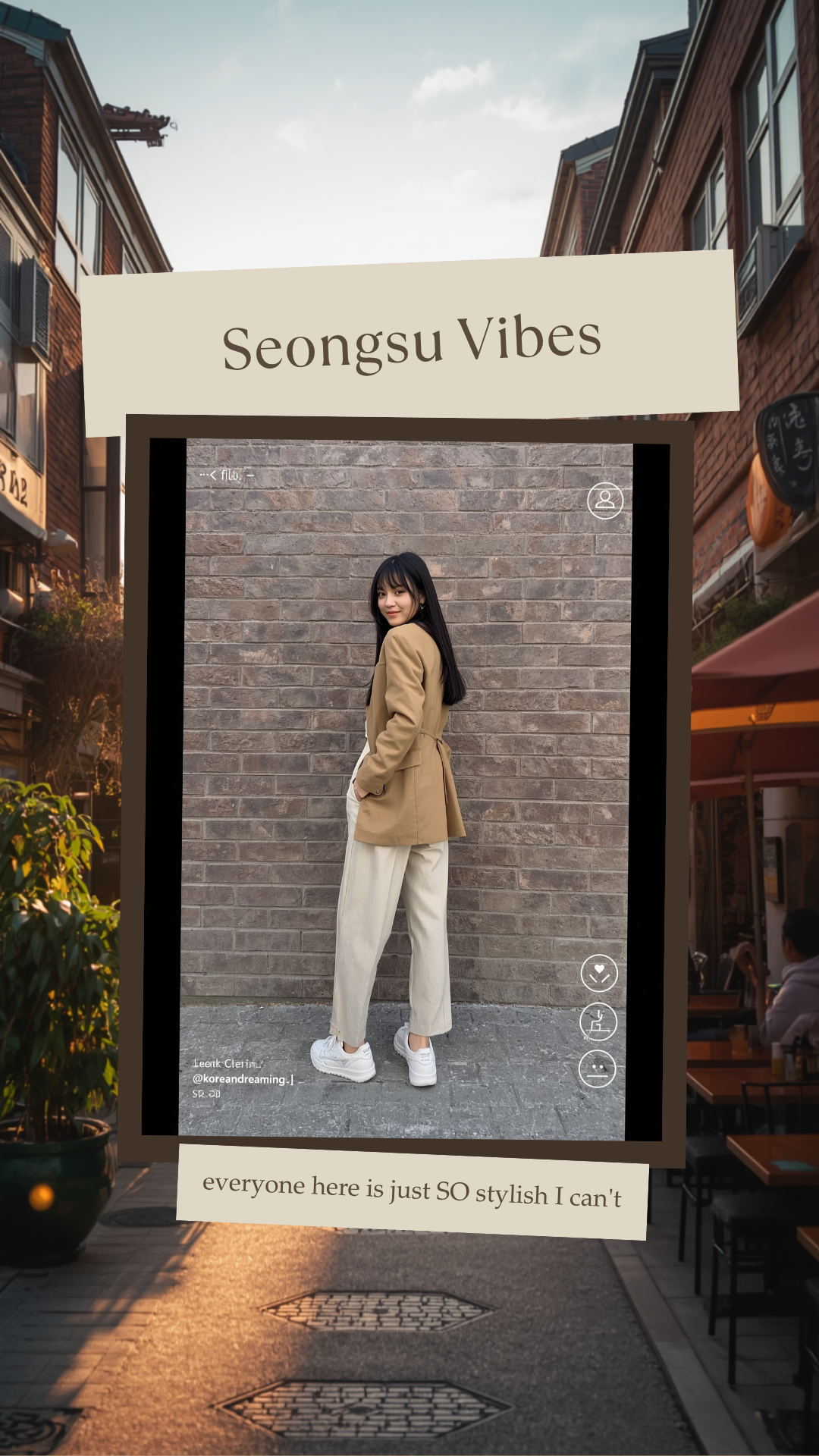
One would think that after a while, the content about a single thing would deepen because there’s a limit to how many times you can say the same thing about the same topic. But most of the content is just a constant declaration of surprise by first-time trips and continuous incredulous takes.
[trending audio, something with a ukulele and a bass drop, currently at 2.3M uses]
"okay hiiii so I literally just landed in Seoul and oh my god I am already OBSESSED and I haven't even left the airport yet—"
[cut to Seongsu-dong brick wall, creator pointing at it with both hands like she discovered it]
"—okay so this neighborhood is called Seongsu and it is literally giving Brooklyn meets Tokyo meets like... art? and everyone here is just SO stylish I can't—"
[cut to café, terrazzo floor, oat milk latte in a glass shaped like a beaker, both hands wrapped around it, eyes closed in performative bliss]
"—and the CAFÉS. I'm sorry. I'm so sorry. Eight dollars and it comes with a little cookie that has your name on it in Korean, I literally cried—"
[cut to extremely thin person walking past in an oversized coat, filmed without their knowledge or consent]
"—like do you SEE how everyone just DRESSES here?? no one told me Korean fashion was going to make me want to completely reinvent my entire wardrobe and personality—"
[creator now at Han River, golden hour, same exact shot 40,000 other creators have posted, wind machine optional but preferred]
"—okay I've only been here for like six hours but I genuinely feel like I understand this culture on such a deep level, like Seoul just gets me, you know?—"
[direct to camera, very sincere, hand on heart]
"—if you want my FULL Seoul guide it's linked in my bio, I cover everything you need to know, all the hidden gems, okay byeee"
This person has been in Seoul for four days. They have visited Seongsu, Hongdae, Bukchon, and Gyeongbokgung (경복궁). They have not been above Mapo-gu or below the river except to access the Han River park. They do not speak Korean. Their understanding of "the real Seoul" comes entirely from other TikToks about Seoul made by people who also did not speak Korean and also stayed in the same four neighborhoods. The brick wall they filmed in Seongsu has appeared in approximately four thousand pieces of content this year. They have 340,000 followers and a Seoul city guide in their bio for $12.
They are not lying. They are not bad people. They are the product of a content ecosystem that rewards Instagramability over knowledge, repetition over discovery, and the appearance of authenticity over the thing itself.
They are also, functionally, doing the same image-management work that the Seoul Fashion Week bureaucrats were doing when they banned my book in 2009. Different gatekeepers. Same gate.
This is not documentation. It's a filter. And what it filters out is most of the city.
The cigarette butts on the ground in 2009 were not a problem to be solved. They were data. They were evidence of a real neighborhood where real people dressed in real ways that had nothing to do with official fashion and everything to do with how Korean style actually moves through a population — bottom-up, youth-driven, embodied in kids who weren't asking anyone for aesthetic permission.
The same data exists now in 독산동. In 가산동. In 신림동 and 사당동 and 봉천동 and 노량진. In 구디 (구로디지털단지 / Guro Digital Complex) — one of the largest commuter transit hubs in the city, tens of thousands of people moving through it daily, a complete and functioning urban fashion ecosystem that has never once appeared in a Seoul style piece. And in 대림 (Daerim) — which deserves its own mention, because 대림 is where the bilingual welcome sign argument doesn't just appear in one market entrance but runs the entire length of the commercial strip, where the Chinese-Korean community is not a footnote but the neighborhood itself, where the food and the signage and the social fabric are doing something genuinely complex and legitimately important to understanding how Seoul actually works. 대림 is not hidden. It is not undiscovered. It is well-known to anyone who actually lives in this city. It simply does not cater to Western tourists, does not present itself in ways that photograph easily, and cannot be made to look like the Seoul that content has already decided it wants to show — so it gets left out, not because nothing is happening there, but because what's happening there requires actual knowledge of the city to see. The bilingual welcome sign at the 협진 정육 도매시장 is not photogenic in any way the algorithm rewards. It is, however, a precise and accurate image of how Seoul actually works — spatially, commercially, demographically — in ways that no amount of Seongsu content has ever come close to showing.
The Instagrammable Seoul and the actual Seoul are not the same place. The people telling you about one don't know the other exists.
We do. That's the difference. That's why you should be reading us.
The body that lives here
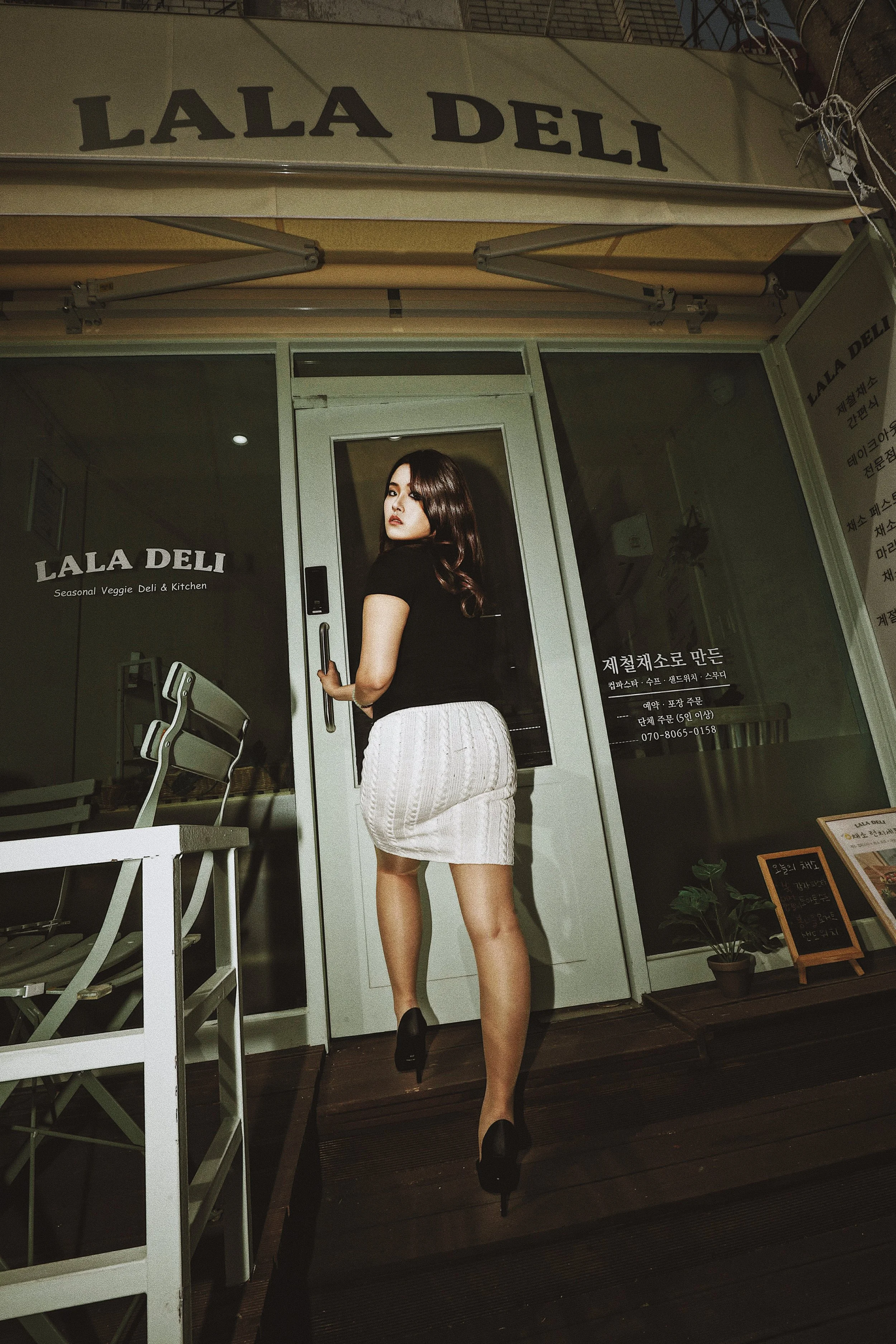
@youngseova models a deli in Heukseok-dong as a test run for The Face of Korea™ project.
@youngseova is a 내츄럴사이즈모델 (naechyureol saijeu model — natural size model). She's also a resident of 독산동. This matters more than it sounds.
Korean fashion media shoots teenagers for brands that teenagers can't afford, in neighborhoods styled to look like the brands' aesthetic, in body types the brands have decided represent aspirational Korea. It is, by design, a closed loop — self-referential, self-confirming, and largely disconnected from the actual bodies and actual neighborhoods of the people who buy the clothes.
Face of Korea™ breaks the loop by taking it literally. The face of Korea is not a 19-year-old in Seongsu. It's a woman in her own neighborhood, in clothes that fit her body because they're supposed to fit her body, standing in front of a market entrance where both languages of her neighborhood's daily life are printed on the wall.
This is not a statement about diversity, though it is diverse. It's not a campaign about representation, though it does represent something true. It's documentation — the simple act of going to where something is actually happening and recording what's there.
What's there, it turns out, is more interesting than the set.
The market, 8:30am
The vendors don't care that there's a fashion shoot happening in their market.
This is the detail that makes the shoot work. In Seongsu, if you set up a camera in front of a well-known café, you will attract people performing awareness that a camera is present. In front of the 협진 정육 도매시장 at 8:45 in the morning, with the LED sign scrolling 어서오세요 and the yellow crates staged for a delivery and a worker in a red apron walking through the frame, nobody adjusts their behavior. The market is operating. The shoot is happening inside the market's operation, not the other way around.
This is what the location scouts don't understand when they reject places like this. The indifference of the space is the point. A backdrop that doesn't care about you produces images that aren't about the backdrop.
The green stairs in the 정육용품 alley, the tunnel depth of the covered market receding into darkness behind them, the 우리식당 (Uri Sikdang — "Our Restaurant") facade with its yellow sign and stacked CASS beer crates and rectangle of AstroTurf — none of this is trying to be beautiful. That's exactly why it works.
Exceptional vs. representative — and why the difference matters
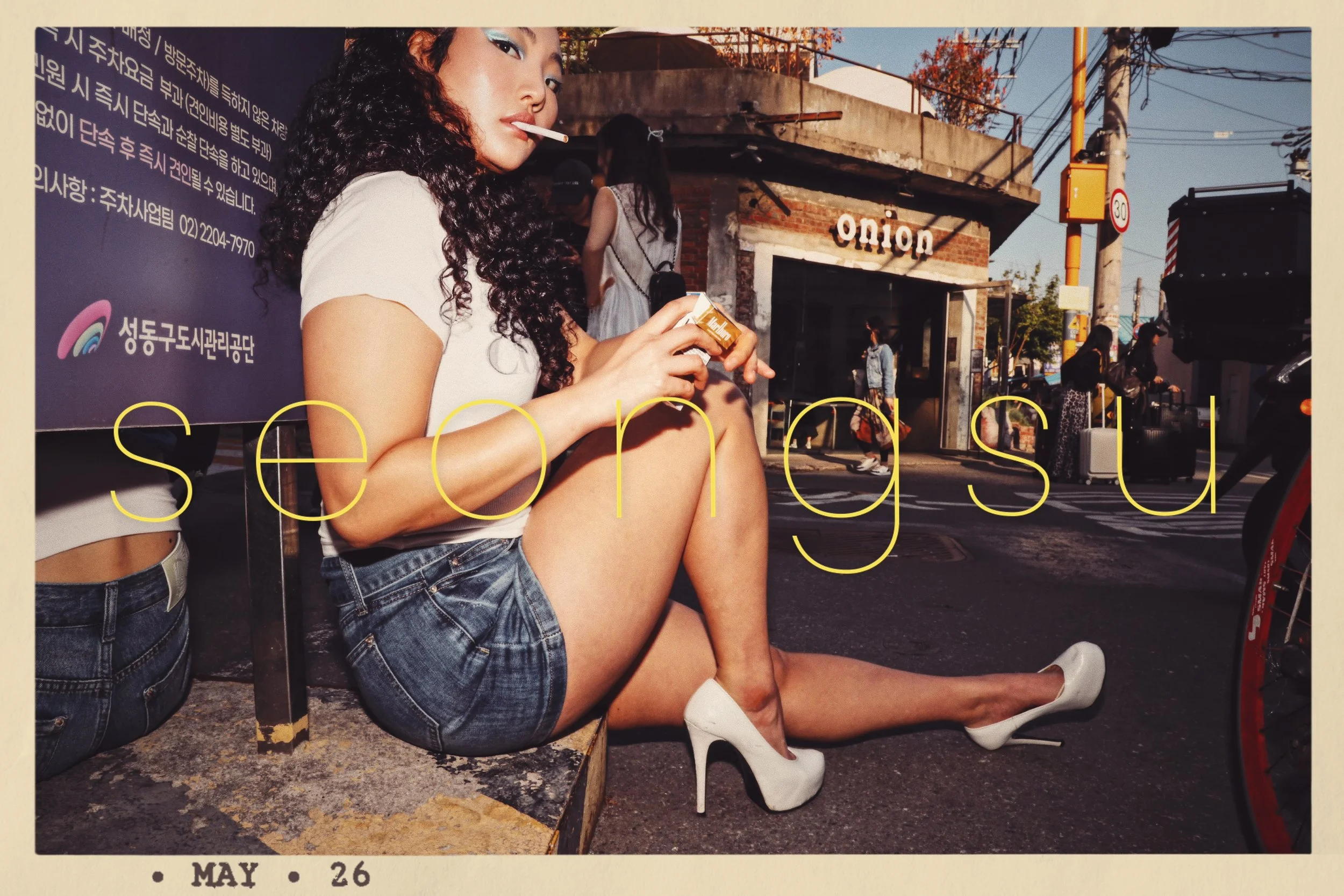
There’s nothing wrong with shooting in front of Seongsu’s most famous café. There’s no need to avoid it just for the sake of avoiding it. But there’s no reason one has to shoot it the same way evetrybody else does. And moreover, why wouldn’t one just shoot the working-class, industrial cool area for being what it’s famous for? Not doing so seems almost…dishonest.
Here is something the content ecosystem will never tell you, because it requires knowing more than the content ecosystem knows.
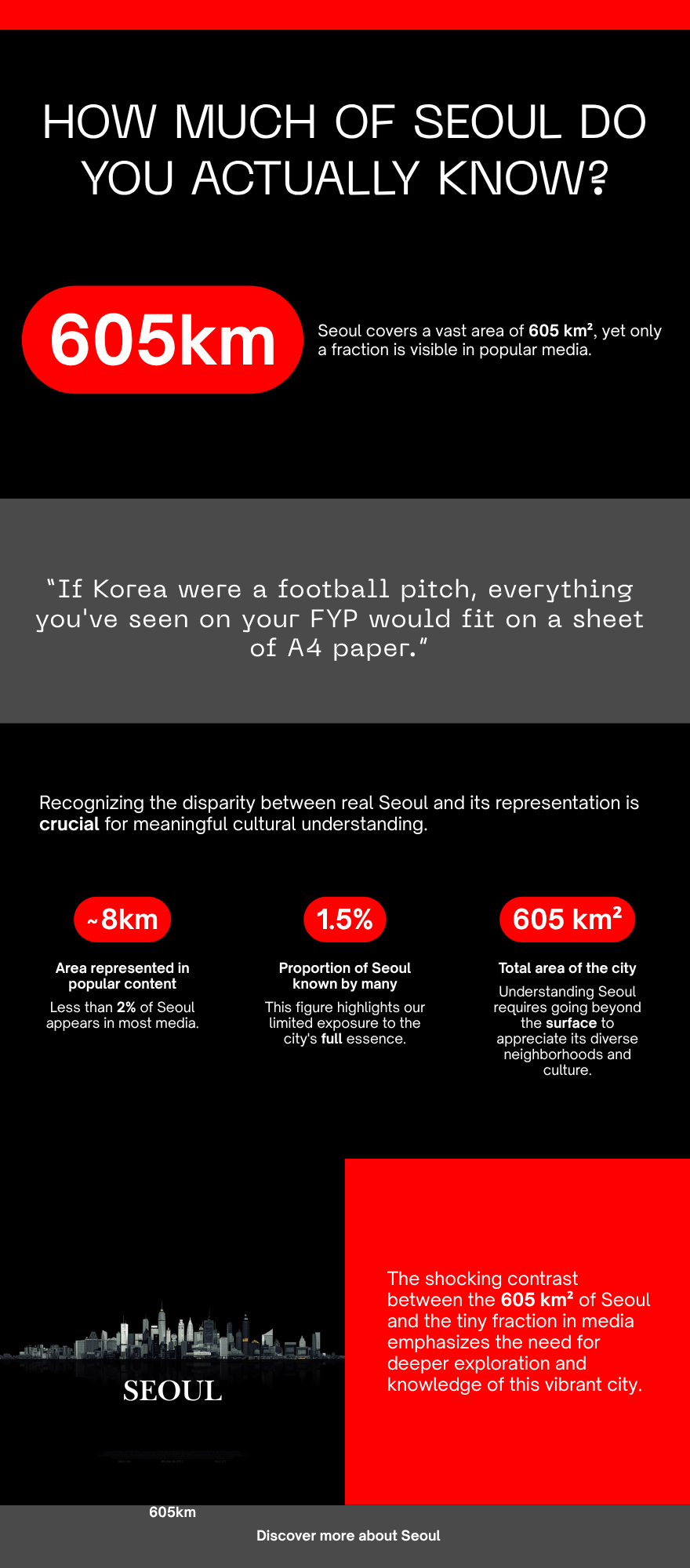
Seongsu-dong is 1.7 square kilometers. Seoul is 605 square kilometers. South Korea is 100,364 square kilometers. The neighborhoods that appear in the top 100 Seoul content posts on any given week represent maybe 8–10 square kilometers of the city.
That is 1.49% of Seoul. It is 0.009% of South Korea. It is one part in eleven thousand. If South Korea were a football pitch, everything you have ever seen about Korea on your For You Page would fit on a single sheet of A4 paper sitting in the corner of the field.
You are not looking at a country. You are looking at a sheet of paper and calling it a country.
It isn't. It's 독산동 and 노량진 and 봉천동 and 신림동 and 구로동 (Guro-dong) and 상계동 (Sanggye-dong) and a hundred other neighborhoods where people wake up and go to work and shop at wholesale meat markets and live their actual lives with none of the content infrastructure the algorithm requires.
But here's the point that doesn't get made enough — and it's not just about fairness to the overlooked neighborhoods. It's about whether you actually understand the neighborhoods you think you know.
Seongsu-dong is exceptional. That's real. The industrial-to-creative transformation, the specific texture of its commercial streets, the way it sits on the eastern bank of the Han River with a particular relationship to light and space — these things are genuinely distinctive. Seongsu is not like the rest of Seoul.
But you cannot know that if you don't know the rest of Seoul.
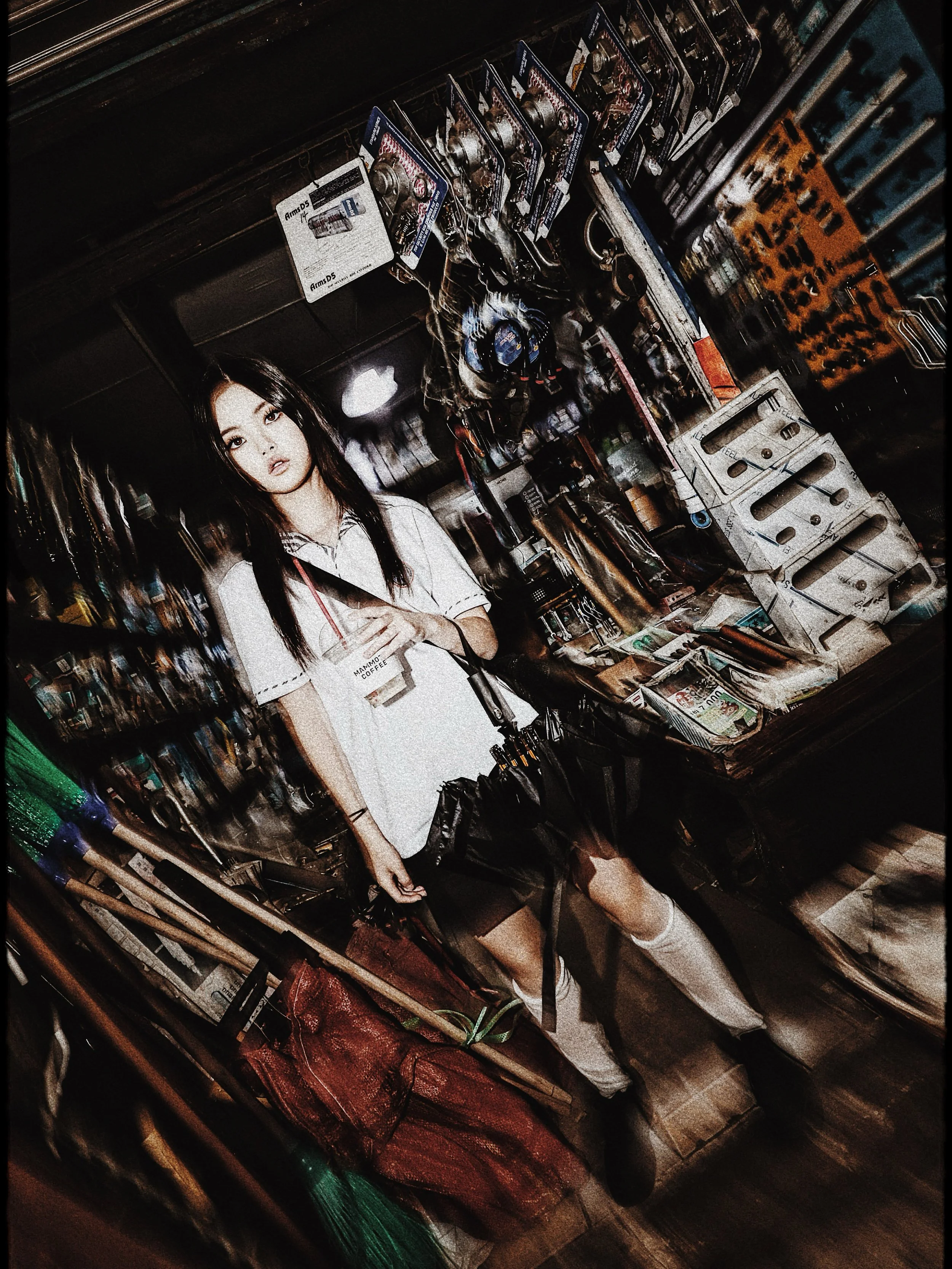
Whether it’s a model in the tool shop of industrial Yeongdeungpo market nursing her iced Americano or another moment of place-specific culture in the city of Seoul, these slices of life are important to have if you ever want to understand how Korea, Korean style, or anything else here actually WORKS.
Seongsu's exceptionalism is only legible against the baseline of what most Seoul neighborhoods actually look like — the concrete residential blocks, the functional commercial strips, the working-class markets, the unglamorous infrastructure of a city of ten million people going about their lives. Seongsu is the exception to that rule. But to understand why it's an exception, and what kind of exception it is, and what it means that this particular neighborhood transformed in this particular way — you need to know what the rule is first.
The TikTok tourist who arrives in Seongsu having watched two hundred Seongsu TikToks doesn't know it's exceptional. They think it's representative. They think this is what Seoul looks like. Which means they don't actually understand Seongsu — they've just consumed it. They've mistaken the exception for the norm because nobody showed them the norm.
You cannot read the exception without knowing the rule. And the rule is 독산동. The rule is 대림. The rule is 구디 and 봉천동 and every neighborhood this city runs on that your algorithm has never once suggested you visit.
That city — the one that doesn't know it's a backdrop — is where Korean style actually lives. We know that because we've been documenting it for thirty years, and what we found isn't what you'd expect: it's not less fashionable than Seongsu. It's not less interesting. It's not less distinctly Korean.
It's just not trying to be filmed.
Here's what's going to happen
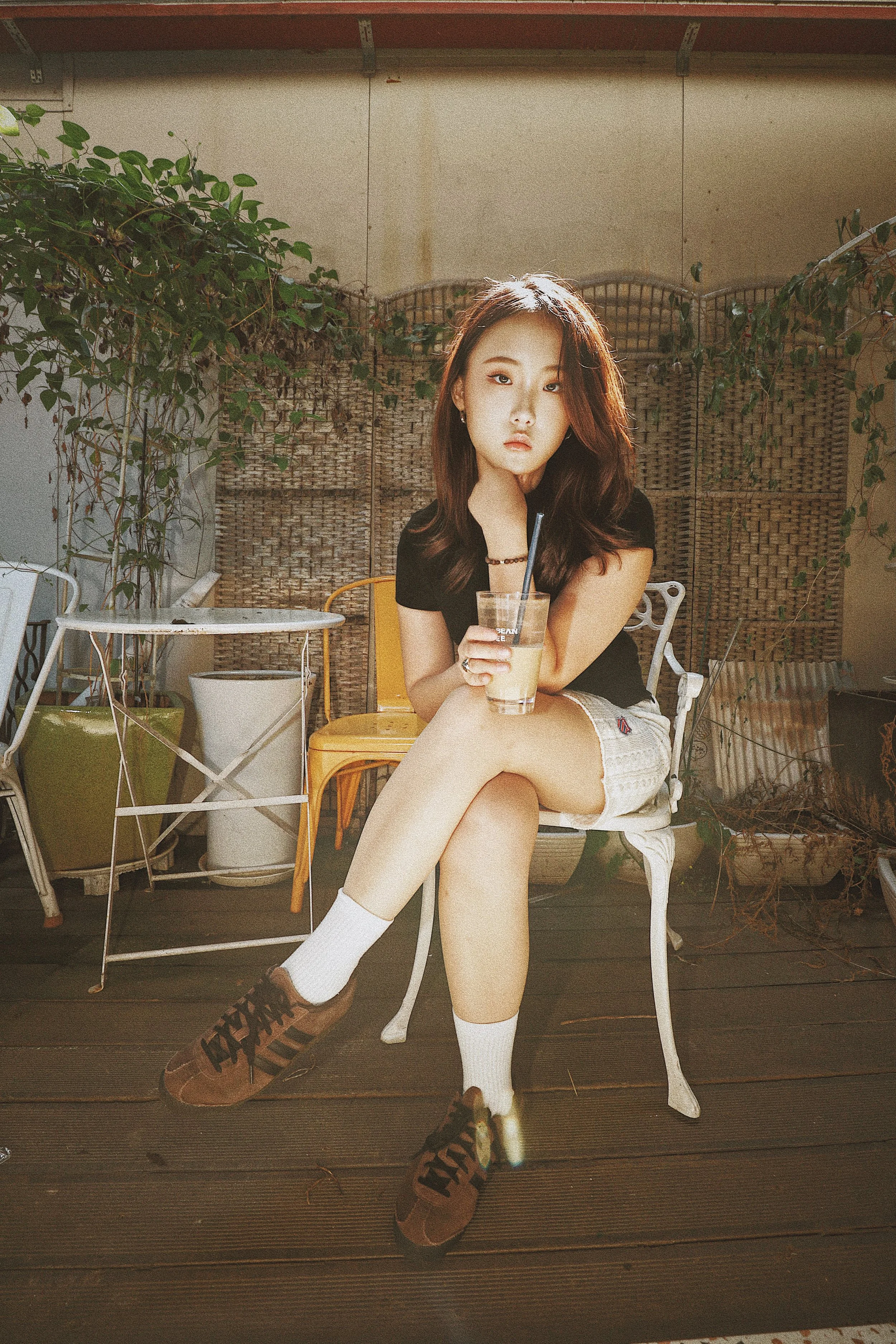
Moving through the city with Model @youngseova, The Face of Seoul™ will offer up slices of real Seoul culture, give visual anthropology insights into life here, and offer real content that gives you something substantial to chew on — not just pop culture effluvia and visual pap. We also don’t pull our editorial punches or talk down to our readers.
We’re calling the shots now, before the series runs, so there's a record of it.
Face of Korea™ is an ongoing editorial series. @youngseova moves through Seoul's uncovered neighborhoods — the ones that don't appear on your For You Page, the ones that constitute the actual grammar of this city — and we document what Korean style looks like when it has no aesthetic assistance from its backdrop. Each episode is a fashion editorial. Each one is also an argument.
The series has no fixed endpoint. Seoul has more neighborhoods worth documenting than any series could exhaust. What follows is a representative selection — not a complete list, but a demonstration of range. Each one has a specific angle, a specific cultural dimension of Seoul that is genuinely interesting, genuinely important, and genuinely absent from the content ecosystem.
Read through these. Then ask yourself honestly: if you've been to Seoul — once, five times, ten times — how many of these did you know about? How many of these dimensions of the city were part of your understanding of Korean culture and Korean style?
If the answer is none, or one, or vaguely — then what exactly do you know?
독산동 (Doksan-dong) · 금천구The angle: The villa neighborhood — ordinary Korean residential life in its most typical, unperformed form Where the series begins. Not primarily because of the Chinese-Korean bilingual layer — though that's real and it's there — but because 독산동 is one of the most genuinely representative residential neighborhoods in Seoul. The 빌라 (billa — Korea's ubiquitous low-rise multi-family housing), the apartment complexes, the local market, the ordinary commercial strip: this is the texture of daily Korean life for millions of people. 금천구 is also one of the most recently incorporated districts in Seoul — not long ago this area was functionally 경기도 (Gyeonggi-do), the province that surrounds the capital, and it still has that feel. It looks like the outskirts because it was the outskirts. That's precisely why it's the right place to start. @youngseova lives here. The series begins in her neighborhood because her neighborhood is the rule that everything else is an exception to.
대림동 (Daerim-dong) · 영등포구The angle: The most significant Chinese-Korean neighborhood in Seoul that Seoul content has never visited 대림 is where the 독산동 bilingual sign argument doesn't just appear at one market entrance — it runs the length of the entire commercial district. The food, the signage, the social fabric: operating in two languages because that's who's there. Legitimately important to understanding how Seoul works demographically, commercially, spatially. Hard to Instagram. Never covered. There's also a telling story embedded in its recent history: the city has at various points floated the idea of officially branding 대림 as a Chinatown special district — a tourist infrastructure designation that would turn what is currently a functional, unselfconscious community into a legible attraction for outside consumption. The neighborhood's response has been divided and contested, which is itself the story. Some residents welcome the economic potential. Others — particularly longer-term Korean residents — resist the label because of the negative associations it carries in Korean public discourse. Nobody agrees on what to call it or who it belongs to. That contested identity is more interesting than any Chinatown branding would ever be. If you've been to Seoul ten times and never came here, you have a gap in your knowledge of this city that Seongsu cannot fill.
구로디지털단지 (Guro Digital Complex) · 구로구The angle: 106,000 people a day, zero fashion coverage — the busiest above-ground station in the country Known to everyone in Seoul as 구디. 구로디지털단지역 handles 106,085 passengers daily, ranking 12th nationally — but more specifically, it is the single busiest above-ground station in the entire country, and among non-transfer stations ranks third nationally. Over a hundred thousand people move through this one station every day, commuting to the digital campuses that anchor Seoul's technology workforce. The station also functions as the primary transit gateway for 금천구 residents — including 독산동 — because the Gyeongbu Line runs too far to the edge of the district and is blocked by military facilities, so residents take buses to 구디 and transfer here. The first neighborhood in the series and this one are already spatially linked in ways the content ecosystem has never noticed. The fashion here is functional, considered, entirely its own register. A hundred thousand people a day. Zero editorial coverage. Nobody's pointed a camera here and called it fashion. We are.
노량진 (Noryangjin) · 동작구The angle: What you wear when your entire life is on hold The exam district. Korea's 고시생 (gosisaeng — civil service and professional exam candidates) live here in cheap housing, studying for the examinations that determine whether they enter the careers they've been preparing for since childhood. The fashion register of someone dressing for eighteen-hour study days while their social life is deferred indefinitely is one of the most specific and unexamined aesthetics in Korean culture. It has never appeared in a fashion editorial. It tells you more about Korean society than any café in Seongsu.
사당동 (Sadang-dong) · 동작구 / 서초구The angle: The ultimate cross-section — and the gaps that every other episode leaves behind 사당역 (Sadang Station) sits at the intersection of Line 2 and Line 4 and serves as the southern terminus for commuters arriving from Gwacheon, Anyang, Gunpo, and Suwon — which means it handles one of the most genuinely diverse cross-sections of Seoul's population of any single point in the city. Office workers, students, market vendors, delivery workers, older residents, younger residents, commuters from outside the city, people transferring between lines, people who live here, people who are just passing through: all of them, every morning and evening, in the same space. At its peak 사당역 ranked among the top three busiest transit stops in South Korea.
This series cannot touch on the life of every type of Korean. No series could. What 사당 gives us is the opportunity to document what all the other episodes have left out — the types, the registers, the fashion stories that don't belong to a wholesale meat district or an exam neighborhood or a tech commuter corridor, but that exist in the gap between all of them. 사당 is where we shoot what we haven't shot yet. The ultimate intersection becomes the episode that fills the space between every other episode — the cross-section that makes the series whole.
봉천동 (Bongcheon-dong) · 관악구The angle: The hillside neighborhood and the coexistence of generations Dense residential, steep topography, built around the mountain rather than the plan. Home to a significant student population from nearby Seoul National University living alongside long-term working-class residents who've been here for decades. Two populations, two fashion registers, one neighborhood — and the friction between them produces something specific and unrecognized. The hills are compositionally extraordinary. Nobody's shooting here. We are.
These neighborhoods are not hidden. They are not undiscovered. Every Korean person reading this knows exactly where they are. What they are not is Instagrammable in the way the algorithm rewards — and so the algorithm has never suggested you go there, and so you haven't, and so your understanding of Seoul, however many times you've visited, however many reels you've watched, however confidently you speak about Korean culture and Korean fashion, has a shape that looks less like a city and more like a highlight reel of its most photogenic corners.
The Face of Korea™ is the rest of the city.
The TikTok tourists are going to do what they're going to do. The content grifters will keep filming the same brick walls and the same cafés and the same Han River sunsets, and honestly — go ahead. Visit Seongsu. Enjoy Hongdae. Take the selfie in Bukchon. Those places are real, they're worth seeing, and they'll give you a good time. Nobody here is telling you not to go.
What we're telling you is: if you actually want to understand what you're looking at when you get there — if you want to know why Seongsu is interesting instead of just that it is, if you want to read the city instead of just consuming it — you need to spend time in the normal parts first. The villas and the markets and the transit hubs and the exam districts and the bilingual commercial strips. The neighborhoods that don't know they're backdrops. The places where ten million people live their actual lives without any content infrastructure to make it legible to outsiders.
Do that, and the trip to Seongsu becomes something else entirely. The brick wall means something different when you've stood in front of a 정육용품 sign in 독산동. The café hits differently when you've had 순대국밥 in 노량진 at 7am next to someone who's been studying for twelve hours. The sparkly parts get sparkly-er when you know what they're exceptions to.
If you want to spend the energy actually learning about this city — what it is, how it works, why Korean style looks the way it does and moves through a population the way it does — come here. This is where that knowledge lives. The rest is content.
We begin in 독산동 because 독산동 is the median. It is the stylistic and social baseline of what ordinary Korean life actually looks like — the villas, the markets, the commuters, the neighborhood that doesn't know it's supposed to be interesting. Without that baseline, you have no way to understand why the sparkly parts are sparkly, why the bling-bling neighborhoods are exceptions worth noting, why Seongsu transformed the way it did and what that transformation actually means. The baseline is not less interesting than the exceptions. It is the condition that makes the exceptions legible.
If you want to understand Korean fashion and Korean culture — not consume it, not perform familiarity with it, but actually understand it — you start here.
The shot is called. The series is running.
Face of Korea™ is an ongoing SEOULACIOUS editorial series featuring @youngseova. Photography: @seoulstreetstudios. Coming soon.