회식 (Hoesik): A Field Guide to Surviving Mandatory Office Fun
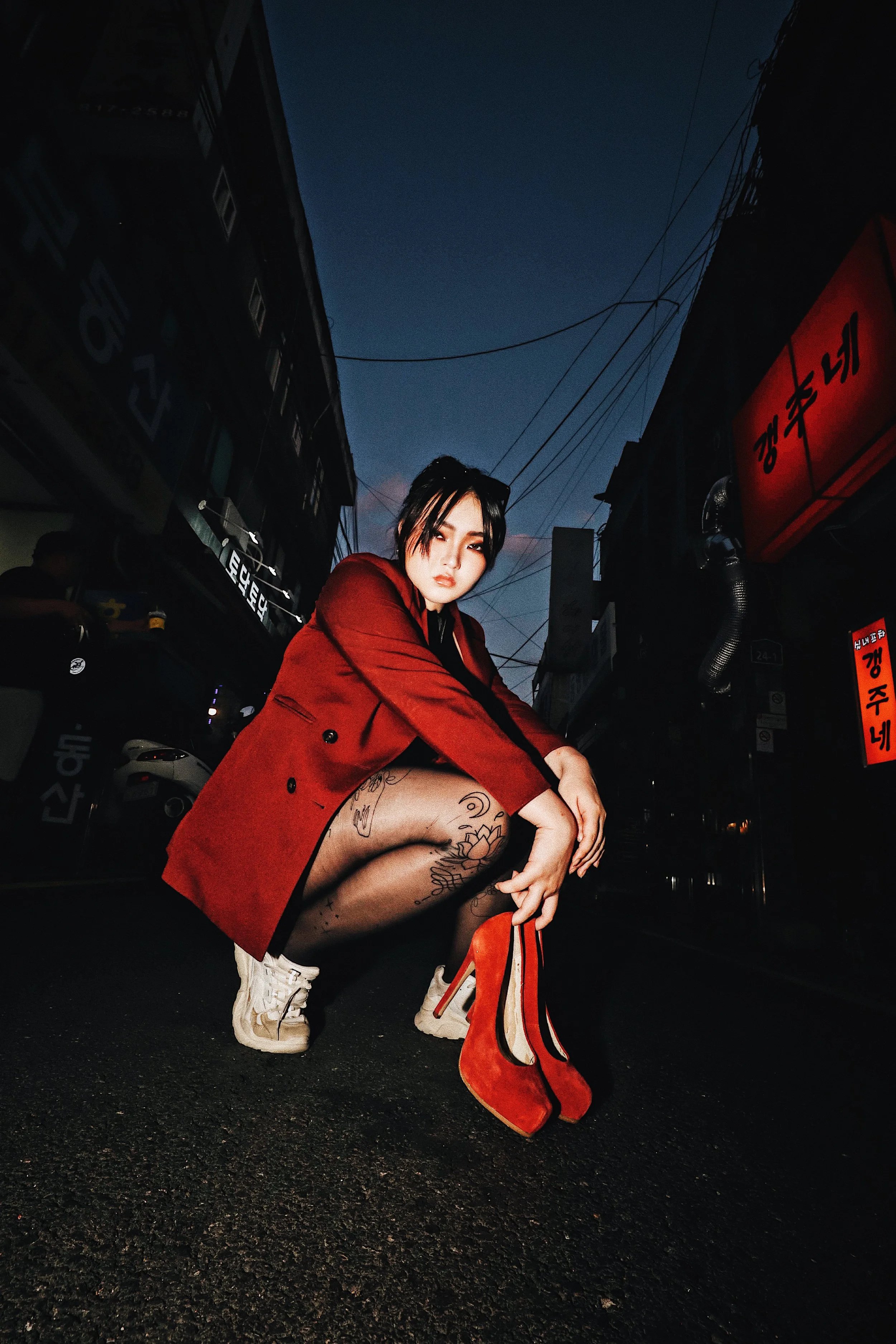
Last Round (@artblockeddd) survived the night.
A SEOULACIOUS FASHION FICTORIAL — 흑리단길 (Heuknidan-gil) · Heukseok-dong · Seoul
A neighborhood that got a name but not full respect. A night that happens every week in every company in this country. Five women. One set of rules.
Cool Boss. It Girl. Pretty Maknae. Last Round. Paepi.
Every Korean office has its own taxonomy — unofficial names that circulate in the group chat that doesn't include management, in the smoking area, in the thirty seconds between the elevator doors closing and opening again. Nobody assigns these names formally. They accumulate. These are five of them.
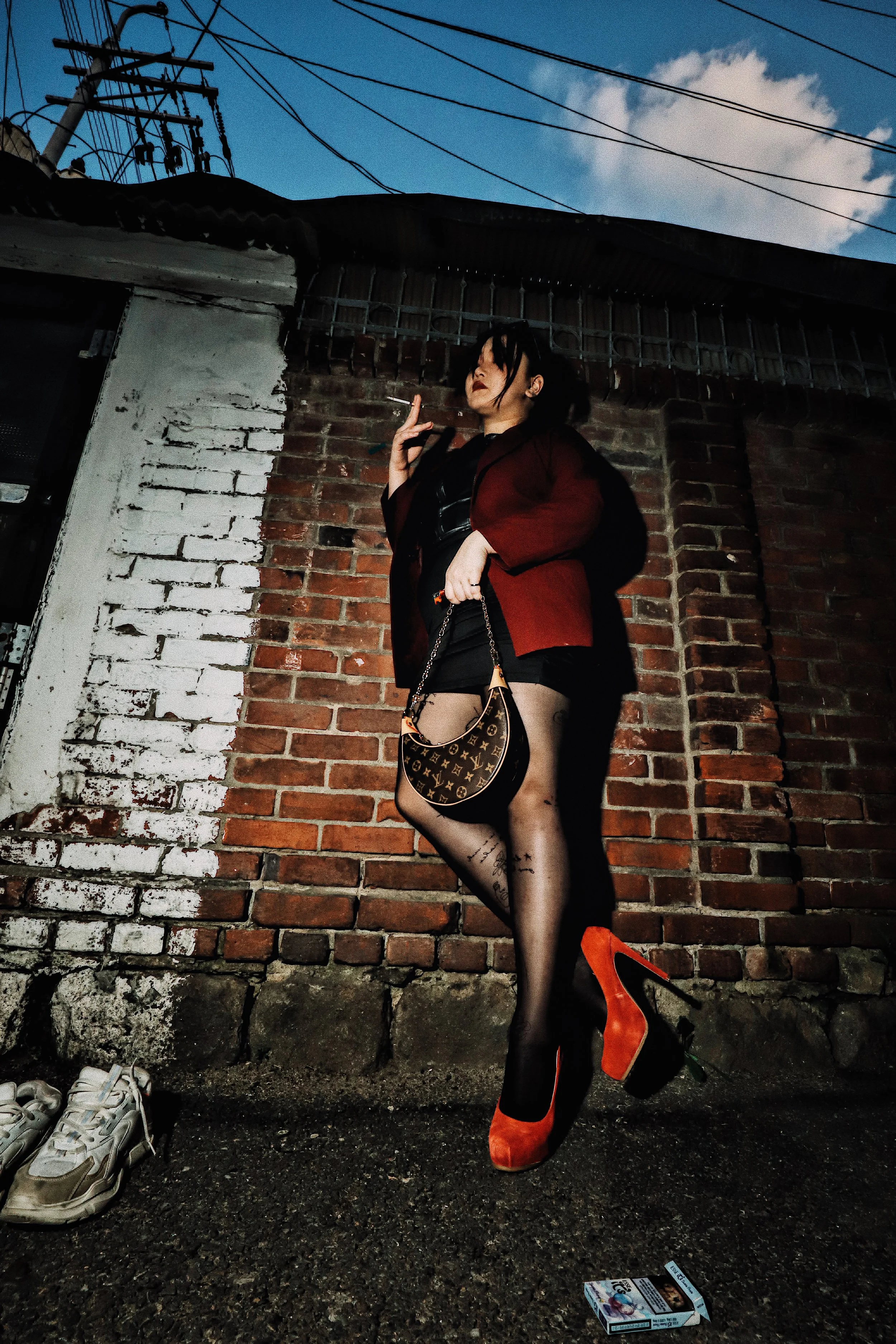
Last Round (@artblockeddd) — brick wall, cigarette lit, red heels on, LV bag. The night isn't over. Or she decided it is. Same thing.
"LAST ROUND" — In action movies, the last round isn't wasted. It's saved. Held in reserve for the final gambit, the decisive moment, the move nobody sees coming. She operates the same way. Serious, reliable, hardcore. The one you want in your corner when the situation gets complicated. She's still here. That's not an accident.
She's standing against a brick wall in Heuknidan-gil (흑리단길) at an hour when the subway is still running but only just. The cigarette is lit. The bag is Louis Vuitton. The heels are red and she is wearing them, which means the night isn't over yet — or she's decided to end it on her own terms, which amounts to the same thing.
The tattoos on her tights — small crosses, script, flowers — read differently depending on who's looking. To certain 부장님 (bujangnim — department heads), they read as a problem. To everyone else, they read as information. She has already told you everything about where she stands before you've read a single rule.
Here are the rules.
THE HOESIK: WHAT YOU'RE WALKING INTO
Korean office culture runs on a parallel operating system that nobody gives you documentation for. The official system is your job description, your performance review, your org chart. The parallel system is everything else — the unwritten code that governs how you eat, how you drink, how you laugh, where you sit, when you leave, and what it means that you did all of those things in the specific way you did them. Violation of the official system gets you a warning. Violation of the parallel system gets you something harder to name and slower to resolve.
회식 (hoesik, pronounced "hweh-shik" — the mandatory company dinner and drinking event) is where the parallel system runs hottest. It is the institution within the institution: a ritual that Korean companies have practiced for decades, that exists ostensibly to build team cohesion, and that functions in practice as a full audit of where everyone stands. Who pours for whom. Who sits where. Who stays until the end and who leaves after the first round and what each of those decisions costs.
This is the field guide to that system. Specifically: what it demands of the women inside it, on a night in Heuknidan-gil (흑리단길), with a female boss, in a neighborhood that is also still figuring out what it's allowed to call itself.
RULE 01: You Will Attend.
회식 (hoesik) is the mandatory company dinner and drinking session that anchors Korean workplace culture so deeply it has its own vocabulary, its own etiquette, its own injury statistics. The message arrives in the group chat at 4pm, phrased as a question — "오늘 회식 어때요?" (oneul hoesik eottaeyo? — "How about hoesik tonight?") — and the question mark is doing a lot of work it was never designed to do. It is not a question. It is a summons with punctuation.
The mythology around hoesik is that it builds 정 (jeong — the Korean concept of deep relational bonding forged through shared experience, the glue of Korean social life). And it does. It also builds leverage, hierarchy confirmation, and institutional memory of who showed up and who didn't. Absence is noted. It is always noted. The junior employee who declines because she has a prior engagement will find that her prior engagement becomes, somehow, institutional information.
What hoesik looks like, however, has shifted considerably. COVID did what decades of worker complaint could not: it imposed a hard stop. Gathering restrictions meant hoesik either didn't happen or ended at 10pm by law, which meant no 2차 (i-cha — second round), no 3차 (sam-cha — third round), no noraebang, no taxi home at 2am. Workers came home for dinner. They discovered they preferred it. A 2022 survey by HR firm Incruit found that over 94% of Korean workers were satisfied with the shorter, changed hoesik culture that had emerged — and that while nearly 69% of workers over 50 still preferred the traditional alcohol-heavy evening format, only around 34% of MZ generation workers did. The workplace anonymous app Blind (블라인드) filled with posts from workers openly dreading the return of old-style hoesik as COVID restrictions lifted, with one worker summing up the generational position precisely: he'd rather skip the taxi money the 팀장 hands out at the end of the night than be in the situation that requires it.
The hoesik didn't die. But it got shorter, lighter, and in many companies, optional in ways it never was before. Lunch hoesik — 점심 회식 (jeomsim hoesik) — became a legitimate format. Departments started asking what people actually wanted to do. The institution absorbed the pressure and adapted, the way Korean institutions tend to: not by abolishing the form, but by quietly renegotiating its terms. Tonight's version — two stops on the 6641, a neighborhood nobody's been to, a female boss who chose the venue — is exactly what the renegotiated hoesik looks like.
The outfit is also, separately, a competitive act. Korean office culture has produced a phenomenon so widespread it has its own vocabulary: 출근룩 (chulgeun-look — literally "commute-look," the daily outfit assembled specifically for the arrival at work). What began as practical dressing has evolved, particularly among young women in their 20s and early 30s, into something that functions more like a daily fashion show — carefully assembled, Instagram-documented, discussed on office anonymous apps like Blind (블라인드) with the same analytical intensity Koreans bring to everything competitive. Even Samsung's official newsroom runs features profiling its most stylishly dressed employees, calling them 패피 (paeppi — fashion people), the office-appropriate version of the street style obsessive. The daily commute, in other words, is already a performance before the 4pm group chat message even arrives.
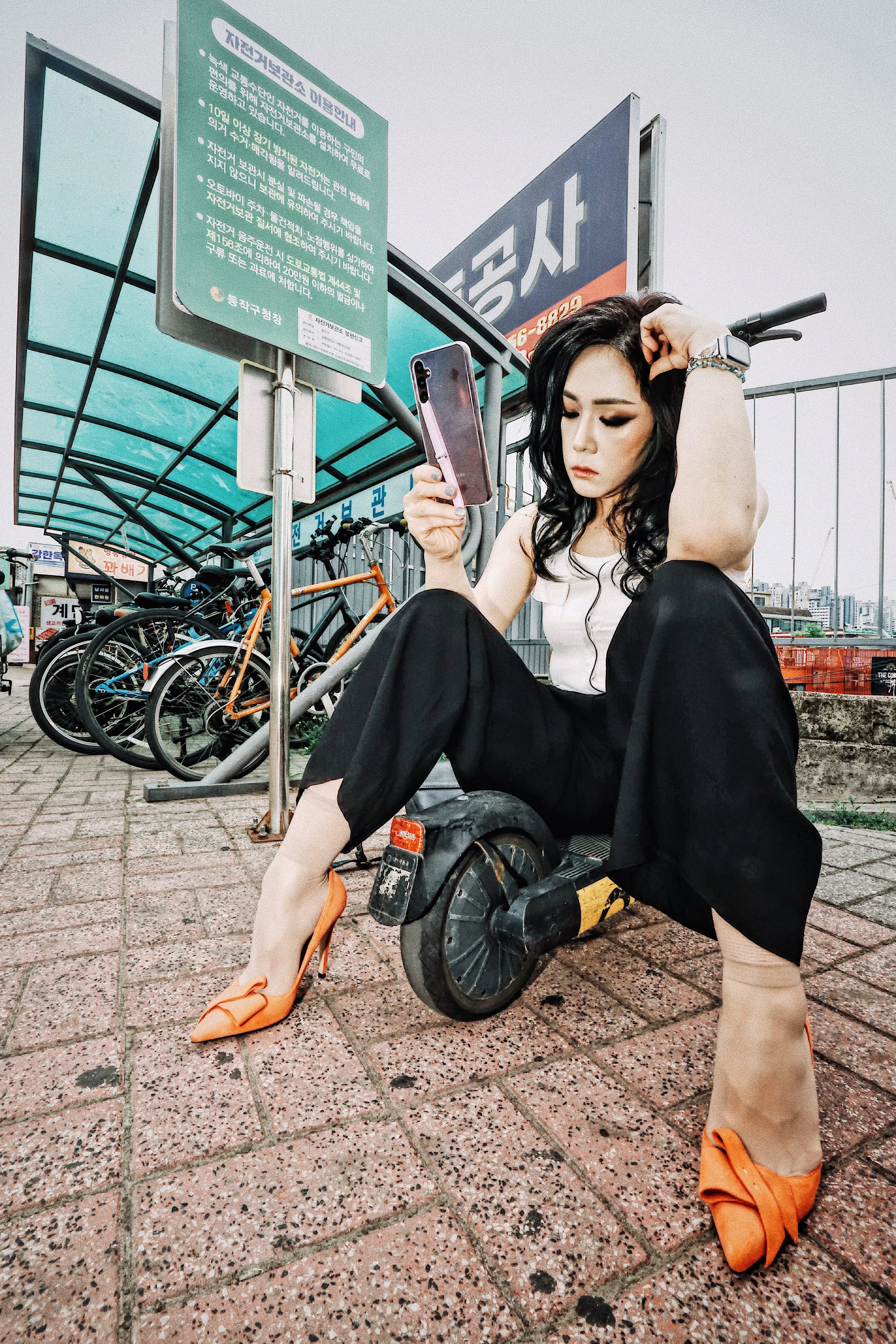
Cool Boss (@shinyjaky) — 자전거보관소, Heukseok Station. Already here. Still working.
"COOL BOSS" — Mid-40s, 팀장 (teamjang — team lead), the kind of manager whose approval people actually want rather than just need. She's called Cool Boss not because she tries to be cool — trying is the opposite of the point — but because she runs a tight ship and somehow makes it feel like a choice. She chose Heuknidan-gil tonight. The team noticed.
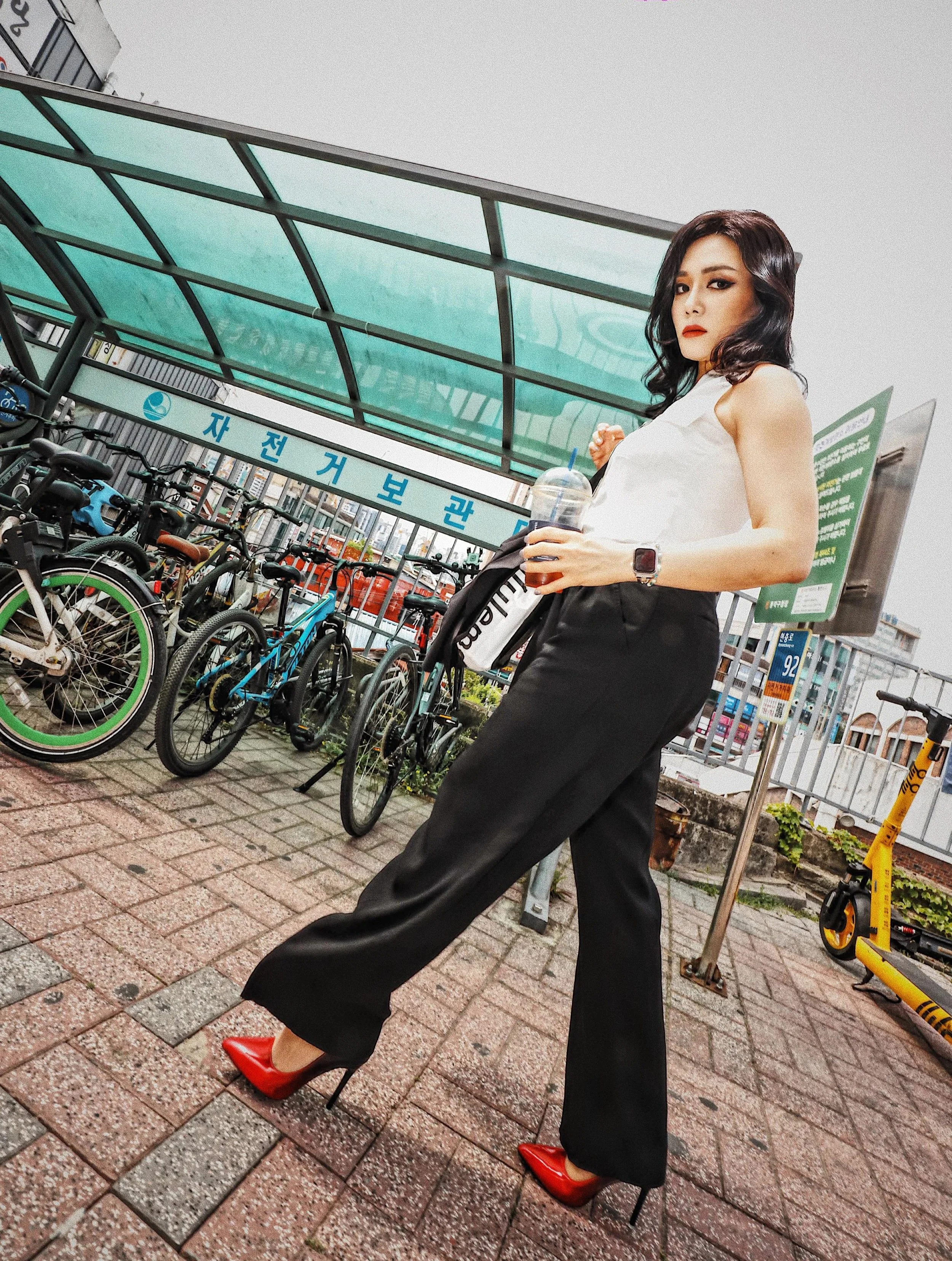
Cool Boss (@shinyjaky) power walks to the beginning of the hoesik.
She's already here — already dressed for it, already on her phone. Wide-leg black trousers, white top, the Apple Watch that says she tracks time because time matters to her, and also that she bought it herself, and also that she is reachable at all hours, which is not unrelated to why she's where she is. The hair is also perfect, which the office has been quietly noting all afternoon — a full workday in, and not a strand has decided to have an opinion about it. Nobody knows how she does this. Nobody will ask. She's power walking over past Heukseok Station on the way to the restaurant, iced coffee in hand, looking back over her shoulder with the expression of someone who knows exactly who's behind her and has already assessed the situation. The red stilettos are blood red and pointed and she keeps them in her desk drawer for specific occasions — bought on Temu, thirty thousand won, completely ruthless. She does not bring them out often. When she does, people notice. When people notice, that's the point. Tonight qualified.
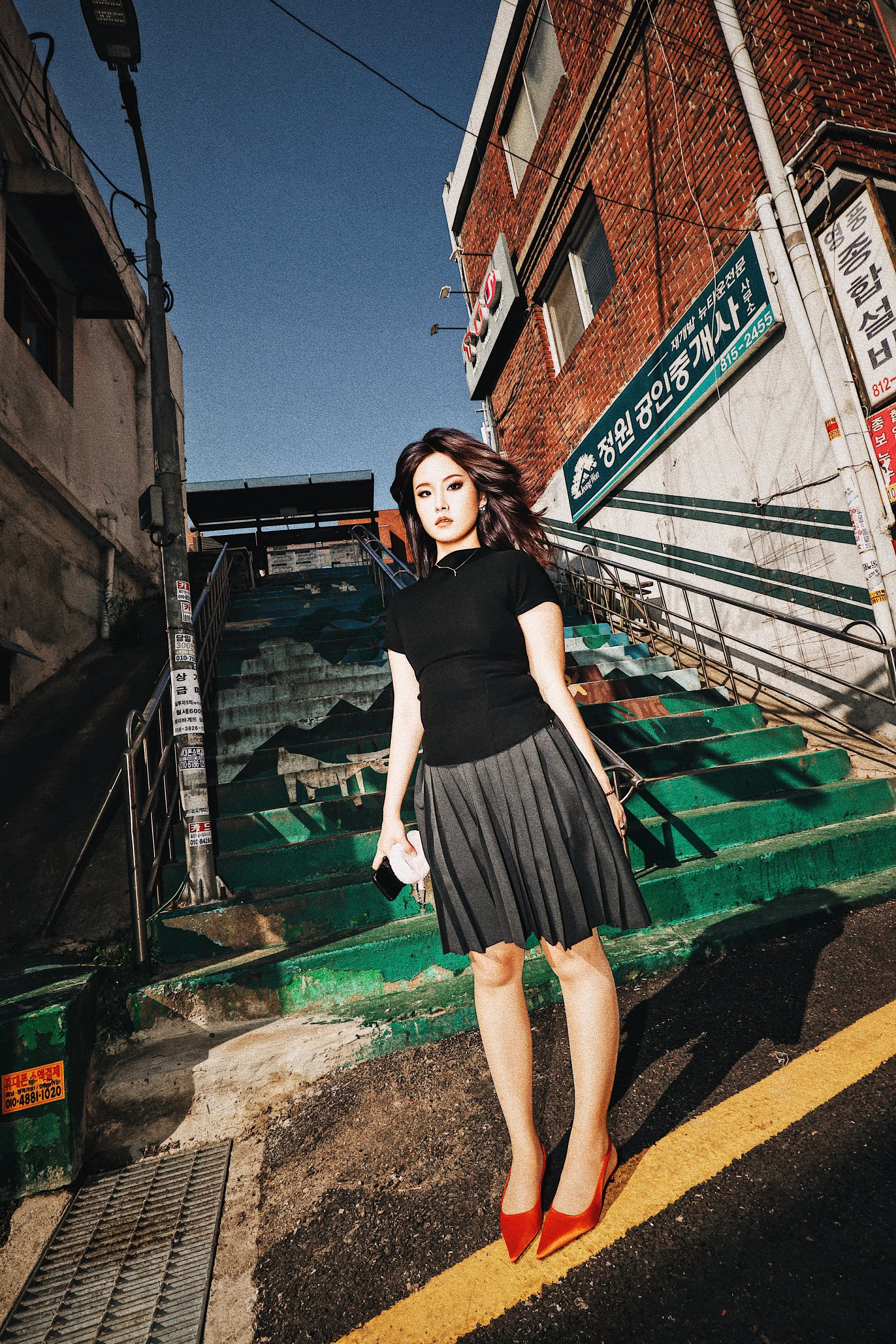
It Girl (@youngseova) — Heuknidan-gil alley, yellow road line. The city painted it there for her. Probably.
"IT GIRL" — The office It Girl is a specific and ancient institution. Every floor has one. She's not necessarily the most accomplished or the most senior — she's the one whose outfit the whole floor clocks every morning without discussing it out loud, whose presence at any event raises its social register by a measurable increment, and who has understood since approximately age nineteen that this is a form of capital she can spend strategically. She attends hoesik on her own terms. She always has.
It Girl (@youngseova) — somewhere in Heuknidan-gil (흑리단길), Naver Map open, converging on the venue. She will find it.
Every office has one. The person whose 출근룩 the rest of the floor registers the way you register weather — involuntarily, immediately, with an opinion forming before you've decided to have one. @youngseova is that person. Black fitted top, grey pleated midi skirt with the kind of movement that doesn't happen by accident, red pointed heels on the yellow road line of a Heuknidan-gil alley like the city painted it there for her specifically. She's navigating toward the restaurant on her phone — Naver Map open, probably, because even the most stylistically assured people get lost in neighborhoods that haven't quite decided what they are yet. The 공인중개사 (gongin jungaesa — licensed real estate agent) sign on the brick wall behind her is the neighborhood's actual text: the infrastructure of valuation, the bureaucratic machinery that decides what a place is worth before the 리단길 suffix even arrives.
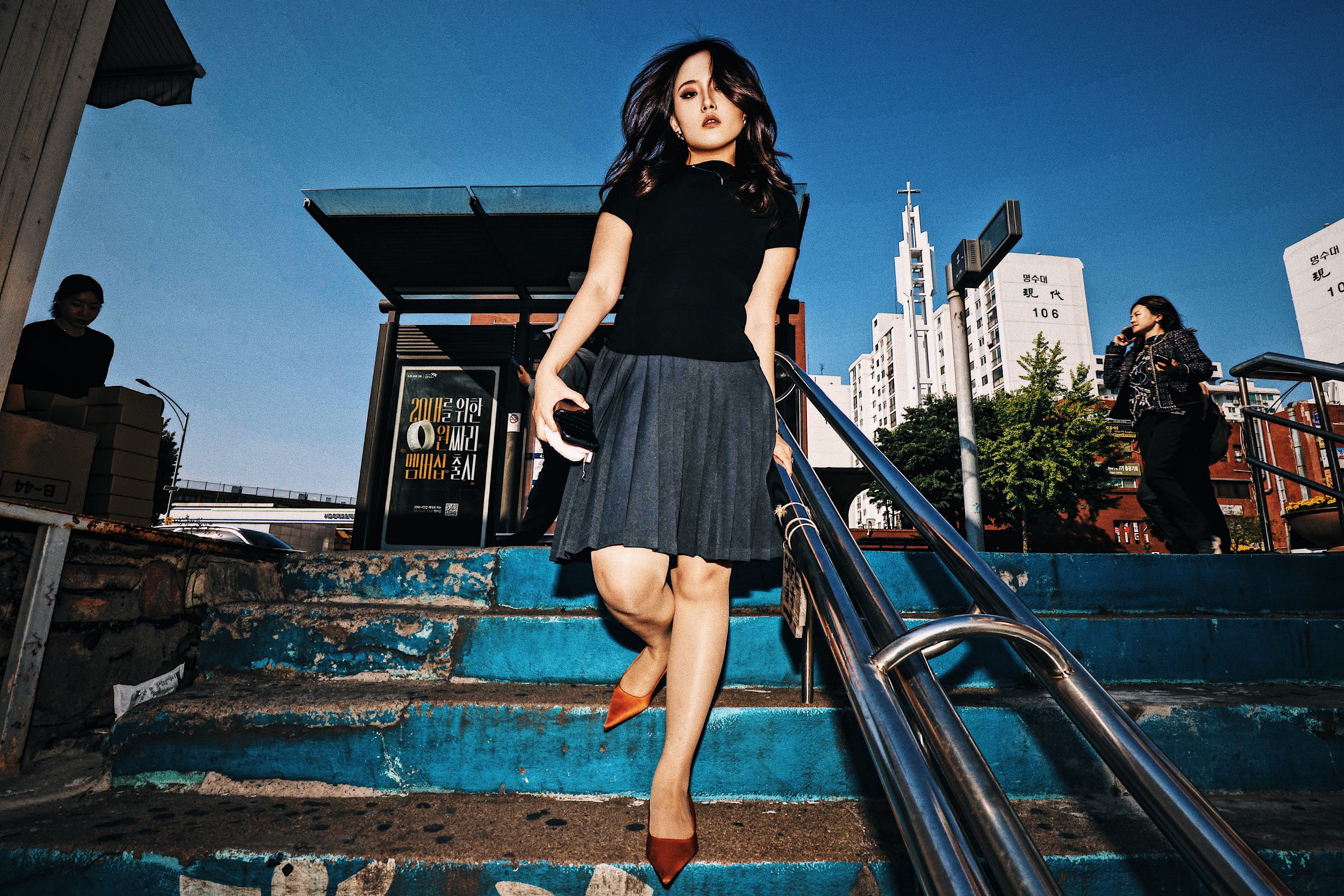
It Girl (@youngseova) — alighting into the neighborhood. The stairs did not ask to be a runway. But they served as one anyway.
She will arrive. She will be noticed — this is not vanity, it is fact, the same way an orange heel on a yellow line is fact. She will have one drink, maybe two. She will laugh at the right moments, which for her requires no calibration because she is genuinely charming and has always known it. She will stay exactly long enough that her departure reads as graceful rather than early. Then she will make her exit — something credible, delivered warmly — and her 팀장 will nod because the transaction is complete. It Girl came. She participated. She graced the evening with her presence, which is all she was ever really required to do, and all she was ever going to do, and everyone at the table understood this going in. Her attendance is a gift the office accepts on its own terms. The field guide has a rule for this: it's called knowing your value and not discounting it.
She took a later bus. Separately. This was not accidental. The rest of the team arrived together on the 6641 in a group chat cluster — someone texted the wrong exit, someone's T-money card failed, the usual chaos of collective navigation. She arrived when the chaos had resolved, when everyone was already seated and the first drinks were being poured, which is the only moment worth arriving for. The bus stop is behind her now. She has stepped off it and is descending the neighborhood stairs into Heuknidan-gil itself — the actual entrance to the strip, the transition point between the ordinary city and whatever this neighborhood is deciding to be tonight. The stairs are painted and peeling and completely indifferent to her. She descends them like she designed them. Two women in the background are on their own business and have no idea they are in her frame, briefly included in her world without knowing it. The orange heels have not wavered. The hair has made its choices and committed. This is what it looks like when someone treats every surface as an entrance — including the one that leads into a neighborhood that hasn't fully decided what it's called yet.
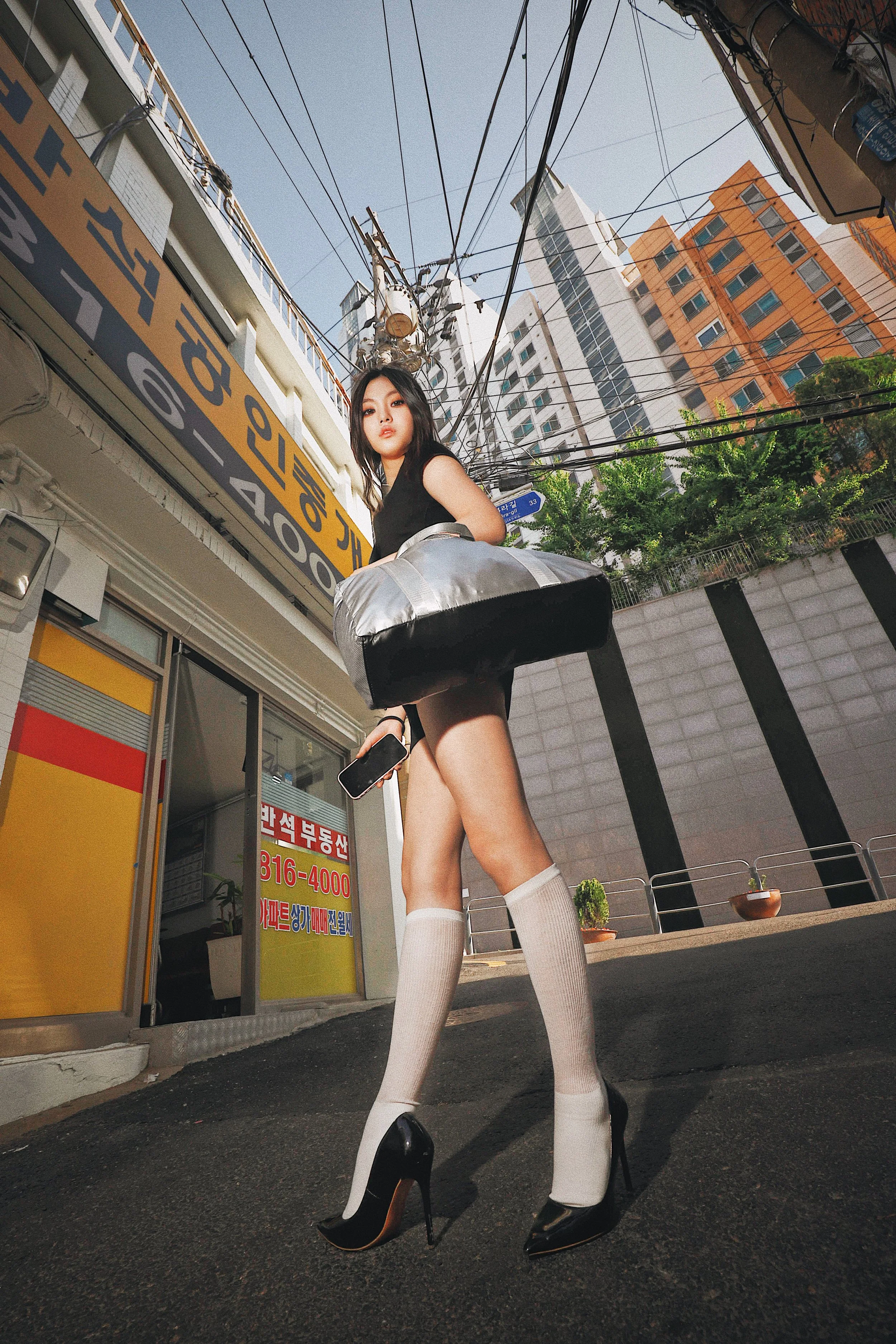
Paepi (@0.8.730) — arriving from the wrong end of Heuknidan-gil. Last, as expected. But worth it.
"PAEPI" — 패피 (paeppi) — short for 패션 피플 (paesyeon pipul — fashion people). The intern who read the office 출근룩 culture, clocked it as permission, and went considerably further than anyone else dared. Cool Boss specifically invited her. Nobody else was sure why yet. They're starting to understand.
She took a taxi because she was already late and thought it would help. The driver didn't know the specific alley — nobody does on the first try, and Kakao Maps has opinions about Heuknidan-gil that don't always match reality — so she got dropped at the far end of the strip and walked the whole length of it in stilettos with the silver bag. This means Heuknidan-gil got the full show before the restaurant did. The 반석 부동산 (Banseok Real Estate — the office that brokers properties in a neighborhood still arguing about its own name) caught her mid-stride and had no comment. She arrived last. Everyone was already seated. Cool Boss looked up. It Girl clocked the knee socks without moving her head. Pretty Maknae immediately wanted to know where the bag was from. The table recalibrated. This is what Paepi does without trying — she changes the register of whatever room she enters, including rooms she's twenty minutes late to.
None of them had to come tonight. There was a plausible excuse available — a work thing that would have held up under scrutiny, a yoga class, a family obligation phrased just right. Any of them would have worked. And yet.
The boss tonight is a woman. That changed the calculation entirely.
A 여성 팀장 (woman team leader) convening a hoesik is a structurally different event from a male one. More on what that means in Rule 05. First: the location.
Heuknidan-gil (흑리단길) — the suffix tells you everything. In Seoul, -ridan-gil (리단길 — literally "-ridan street") is a naming convention that started with Gyeongnidan-gil (경리단길) in Itaewon, a genuinely cool strip in the early 2010s that subsequently collapsed under its own real-estate premium. What followed was a wave of copycat naming across the city — any alley with a few cafes and a photogenic wall suddenly became someone's -ridan-gil. Korean internet debated each one: earned or manufactured? Organic or 부동산 업자 (budongsan upja — real estate agent) marketing copy? Heuknidan-gil sits firmly in the contested tier. The locals have a complicated relationship with the name. So does the internet. Which makes it, paradoxically, the most interesting place in the neighborhood to have dinner.
The office is in Noryangjin (노량진) — two stops on the 6641 bus, five minutes door to door. Close enough that nobody can complain about the commute, far enough that it feels like a destination. For the younger team members who would never make it out to Heuknidan-gil on their own — too off the radar, too easy to miss, and honestly too close to the office to bother with on their own time — this is exactly the kind of low-stakes new-neighborhood experience a good boss quietly provides cover for.
Which is exactly why a female 팀장 would choose it. A male boss picks the usual galbi place near the office — known menu, known parking, known private room upstairs. A woman who got to 팀장 by reading rooms correctly picks somewhere slightly new, slightly unresolved, interesting enough that the younger team members are curious rather than just compliant. You make attendance feel like a choice rather than a sentence. It still isn't. But it feels like one. That's the art of it.
RULE 02: You Will Drink. Or Perform It Convincingly.
Korea's drinking culture operates on a seniority axis so precisely calibrated it makes corporate org charts look casual. The 부장님 pours. You receive the glass with two hands — both hands, always, the left supporting the right wrist if not the glass itself, because one-handed receiving is either foreign or arrogant and neither plays well. You do not refuse. If you cannot drink for medical reasons you say so once, quietly, and then you perform the motions for the rest of the evening: glass raised, lips touched, glass returned to table with appropriate timing.
If you are a woman, this calculus has an additional variable. Drinking too little reads as standoffish. Drinking too much reads as a problem. The acceptable window is narrow enough that navigating it requires a kind of ongoing micro-calculation that runs parallel to the actual conversation all evening — a second job nobody hired you for and nobody will compensate you for.
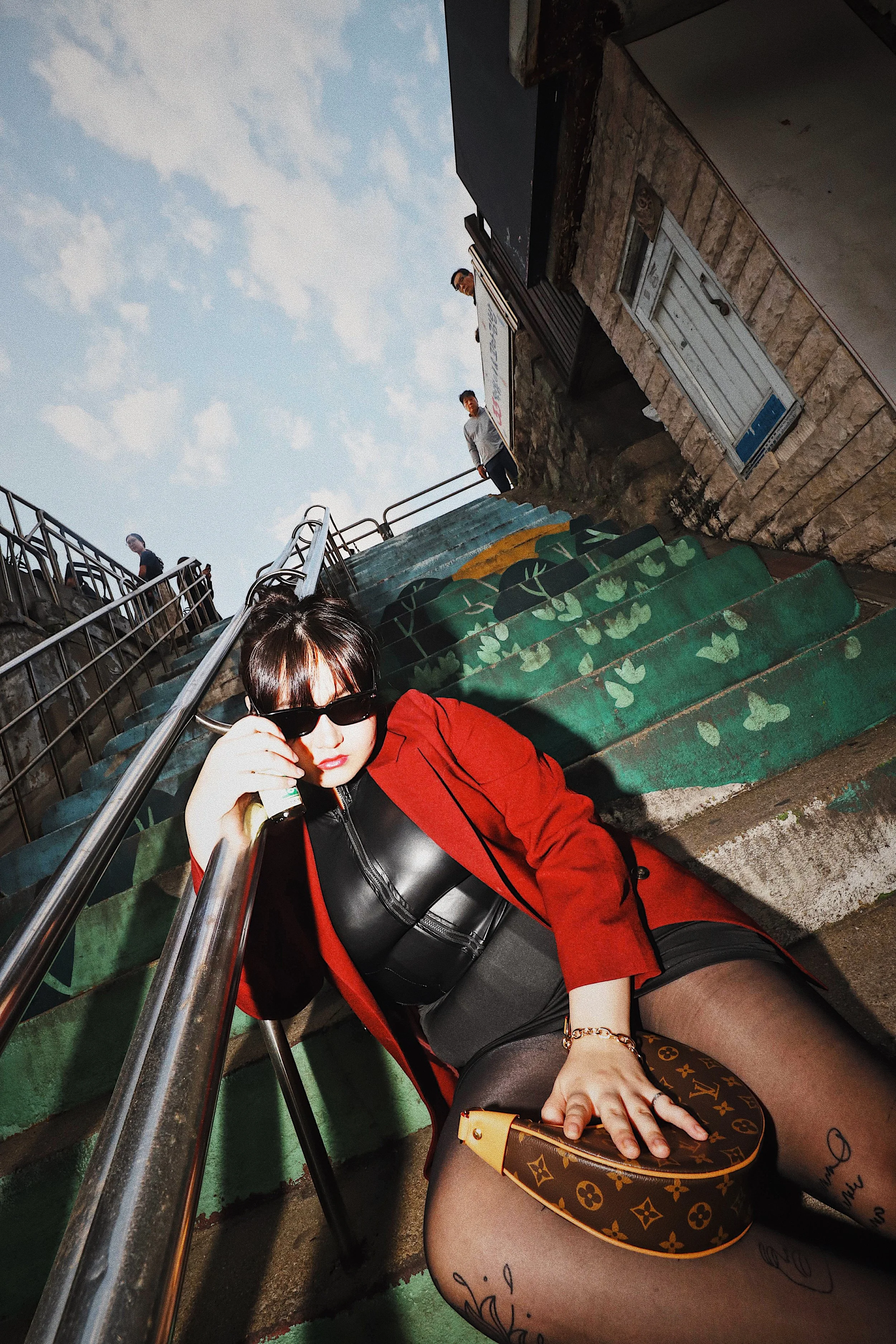
Last Round (@artblockeddd) — Heuknidan-gil staircase. She slept here. She's fine.
The head is down because she just raised it. The bag is still clutched because she never let go of it — not through the last round, not through the blacking out, not through however many hours she spent on this staircase using her own arm as a pillow. The heels are still on. This is either impressive or terrifying and the distinction doesn't matter because she is upright, which relative to the last several hours counts as ready to go. There's a man at the top of the stairs clocking the situation and deciding not to involve himself, which is the correct decision. She didn't ask for his assessment then. She doesn't need it now. The LV bag made it through the night undamaged. Some things are built to last.
RULE 03: You Will Eat Less Than You Want To.
The food at hoesik is usually good. Sometimes excellent — galbi, samgyeopsal, jokbal, whatever the 팀장 chose because she's been to this restaurant before and knows the kitchen. You will eat approximately 60% of what you want because the other 40% is occupied by monitoring: your portion size, your chewing speed, whether you're eating too eagerly or not eagerly enough, whether the 부장님's glass needs refilling before you reach for more meat.
This is not paranoia. This is accurate perception. Korean workplace culture is a social performance so dense with legible signals that eating — the act of feeding yourself, the most basic — becomes one more data point in the ongoing evaluation.
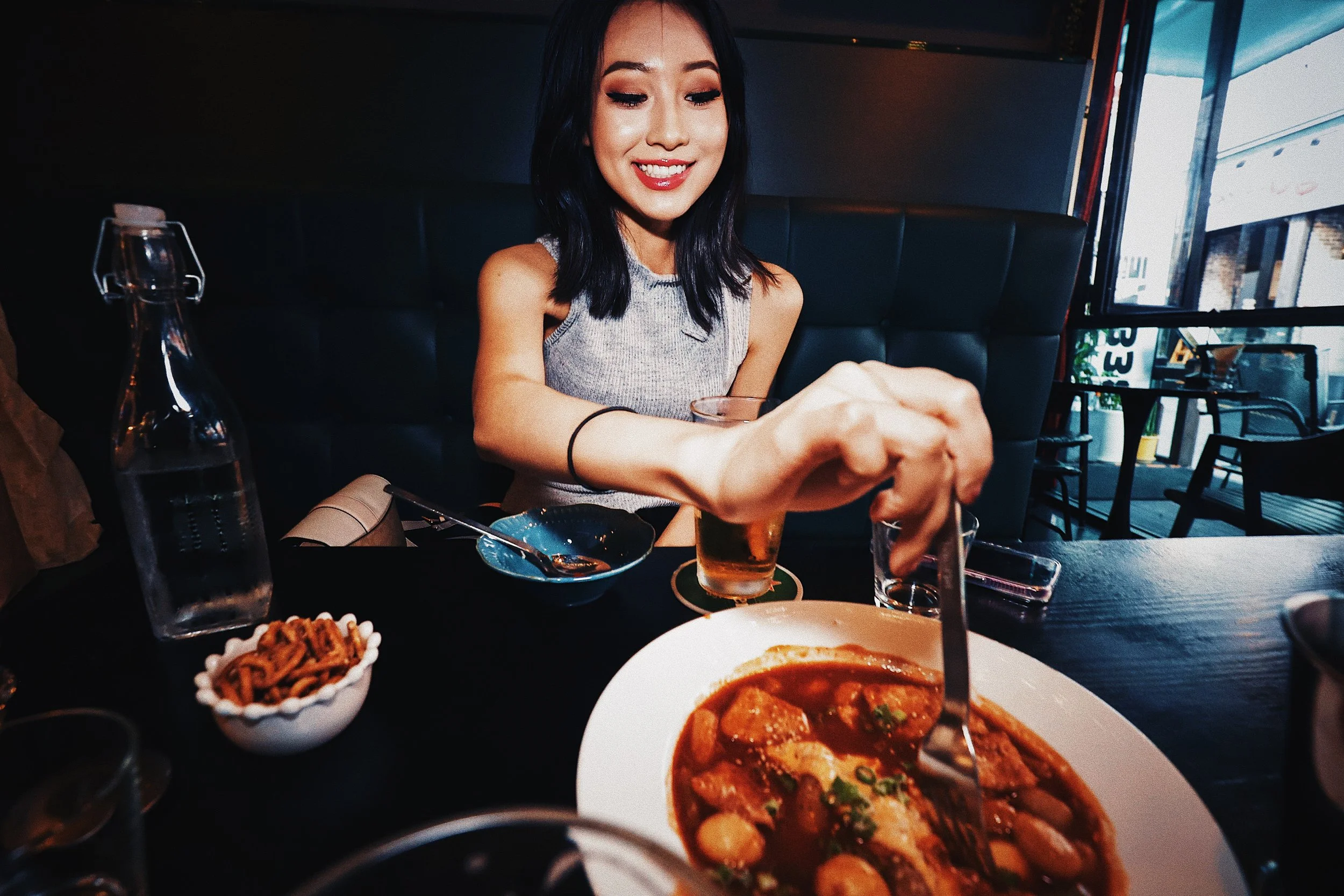
Pretty Maknae (@solsolyou) — inside the 모던비어433 (Modern Beer 433) sake bar, Heuknidan-gil.
"PRETTY MAKNAE" — 막내 (maknae) means the youngest one. She is. The office registered this on day one and has been quietly protective ever since — which is exactly why nobody saw what was coming. She outlasted everyone. Stayed out all night doing who knows what, showed up the next morning still pretty. Nobody clocked it. That's the whole game.
She's sneaking real bites. Actually getting some eating in — leaning forward, fork moving with intent, the smile involuntary because the food is good and nobody is watching whether she's eating too much of it. This is what hunger looks like when it's finally allowed to be hunger. This is the meal she deserved to eat at hoesik and spent the entire evening pretending she didn't need.
RULE 04: You Will Laugh at the Right Moments.
There is a taxonomy of hoesik humor. The department head makes a joke. It may be funny. It may not be funny. The correct response exists on a spectrum from polite smile to full laugh, calibrated by three variables: your rank relative to the joke-maker, your gender, and your immediate professional needs. Junior staff laugh more fully. Senior staff smile with more authority. Women navigate an additional calibration — too much laughter reads as performing for approval, too little reads as difficult, and the correct middle register requires ongoing maintenance.
The jokes themselves follow predictable grooves: self-deprecating references to the company's performance, mild mockery of rival departments, occasionally a comment about someone's personal life that goes slightly further than it should. The comment about someone's personal life would often be about the youngest woman at the table. Her age. Her relationship status. Her plans. Delivered with warmth, which made it harder to decline to answer.
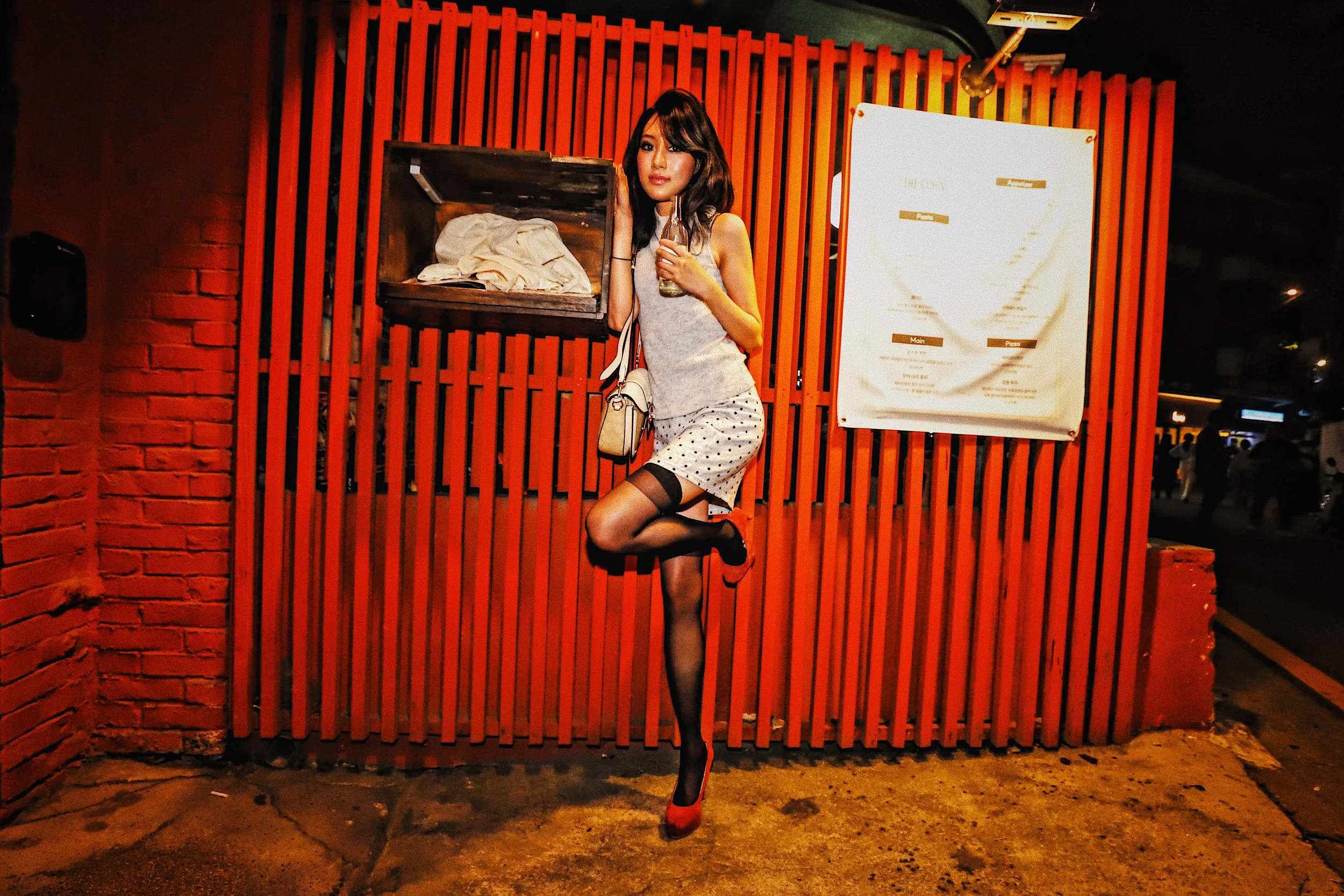
Pretty Maknae (@solsolyou) — outside 더큐어링 (The Curing), between the first and second round. Stockings already doing what they want.
더큐어링 (The Curing — deo kyueo-ring) is a fusion charcuterie and wine bar on the Heuknidan-gil strip, open Monday to Saturday from 5pm to midnight. Closed Sundays, which in Seoul's hot place economy is a data point: a place that has truly arrived does not get to be closed on Sundays. The Curing is still arriving. Its red wooden slat exterior looks like it belongs to a barbecue joint until you notice the menu card on the wall listing charcuterie boards and natural wine. That gap between what it looks like and what it is — that's Heuknidan-gil in one building.
She is outside it between rounds, one heel kicked back against the wall, drink in hand, small bag hanging, thigh-highs at whatever level they've decided on. She is not managing anything. The stockings situation has been assessed — in the mirror, in the photograph, in the decision to keep it — and it has been filed under: fine. More than fine. She looks like she is exactly where she planned to be, which may or may not be true, and the distinction has stopped mattering.
RULE 05: You Will Manage the Hand.
This is the rule that doesn't appear in any company handbook, any HR orientation document, any of the poster campaigns that Korean corporations began running in earnest after the 미투 (MeToo) movement hit Korean media in 2018 and suddenly every 부장님 in the country was in a one-day sensitivity training session wondering which specific things he needed to stop doing.
Here is what the rule is actually about: in every hoesik, for as long as hoesik has existed, there has been a question of whose body is whose. The answer was never in doubt. It was structural. It was institutional. It was social fact.
Before 2018 — and in some companies, before the 직장 내 괴롭힘 금지법 (jigjang nae goeroum geumjibeop — Workplace Harassment Prevention Act) finally came into force in July 2019 — the hoesik had a known geometry if the manager calling the shots happened to be a man. Drinks would accumulate. The formal distance of the office would soften. And if you were the youngest woman at the table, seated within reach, the evening had a predictable arc. A hand would find a knee. A thigh. A shoulder. The table understood the geometry. The woman in question would perform not noticing — or perform finding it acceptable — because her evaluation was attached to this man's assessment of her, and the room had a clear read on whose comfort mattered more.
The geometry got worse if the evening went to a noraebang (노래방 — karaoke room, literally "singing room") for the third round. This was the classic hoesik maneuver: dinner, then a bar, then noraebang, each stage a further loosening of the institutional architecture that held behavior in check at the office. The noraebang room is semi-public and yet entirely private — a booth, a closed door, a darkness broken only by the glow of the lyrics screen, the company arranged on banquettes close enough that proximity becomes its own permission structure. The hand that had been careful at the restaurant found bravado in the dark. The song covered whatever sound might follow. The room understood. The room always understood.
This permission structure didn't begin in the office. It was rehearsed first at university, during MT — 엠티 (em-ti), short for Membership Training, the overnight group bonding trip that Korean departments and clubs have run for decades. Freshmen, upperclassmen, sometimes professors, a remote 펜션 (pension, pronounced "pen-shun" — a Korean-style private rental guesthouse, typically a villa or lodge outside the city, booked by groups, communal areas, multiple rooms, thin walls) or resort, two days of forced sociality and mandatory drinking. The MT was where you learned how the group worked — who had power, who deferred, what the unspoken rules were.
It was also, among male upperclassmen, crassly and openly understood to be a prime opportunity to get laid. Not whispered. Said. The remote location, the mandatory alcohol, the mixed sleeping arrangements at a pension where the room assignments were decided by whoever arrived first — all of it added up to a permission structure that older male students discussed with the casual entitlement of people who had inherited a system and saw no reason to question it. The freshman women arriving at MT knew this. They had been warned by older female students, by older sisters, by the specific kind of advice that passes between women in the form of practical instructions rather than outrage. The outrage came later. First came the instructions.
Cases surfaced regularly enough that they became their own genre of campus news: at Seoul National University in 2015, male students were found to have entered sleeping female classmates' rooms during an MT and sexually assaulted them, with the university initially suppressing the complaint entirely. It was not an isolated incident. It was a pattern with a setting.
MT culture was already weakening before COVID arrived to finish it off. MeToo did the real structural damage first. When the pattern of what happened at MT started being named publicly — the drinking, the dark rooms, the pension geometry, the senior male students who had inherited the system and assumed they'd keep it — the institution became very difficult to defend out loud. Universities and departments began quietly discontinuing MTs from around 2018 onward. Some banned them explicitly. Others just stopped organizing them and waited for the tradition to die of neglect. By the time COVID arrived in 2020 and made overnight group gatherings impossible, MT was already on life support. COVID pulled the plug. What replaced MT for the MZ generation is mostly just group chats and shared playlists — which is, on balance, probably fine. The hoesik, however, survived. It is harder to abolish something that happens in a restaurant two stops from the office on a Tuesday. The darkness just moved indoors, rearranged itself around a table, and waited for the noraebang invitation.
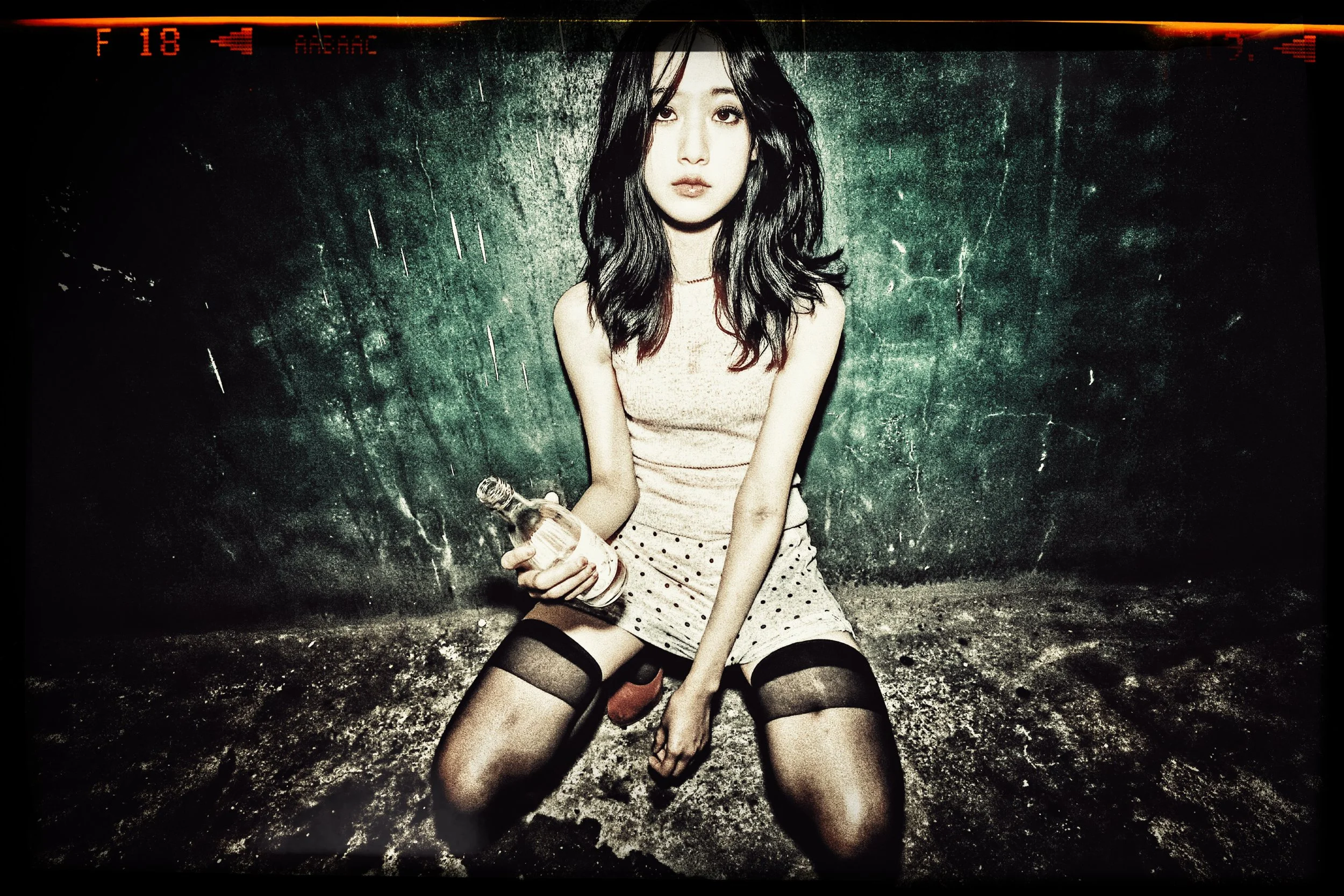
Pretty Maknae (@solsolyou) — the version of the evening that won’t go in the Kakao chat recap.
Those thighs. In the old hoesik — pre-2018, pre-legislation, pre-the-reckoning-that-didn't-fully-reckon — those thighs would have been exactly the target. The 부장님's hand finding its way there with the practiced casualness of someone who had never once been told no in a way that had consequences. Not because he was a monster. Because the room allowed it. Because the institution protected it. Because the woman kneeling there would calculate, correctly, that objecting cost more than enduring.
"The hand didn't disappear after 2018. It became more careful. More deniable. The calculation didn't disappear either. It just became the woman's alone to perform."
Korean #MeToo changed some of this. Changed it publicly, loudly, with prosecutions and resignations and genuine institutional reckoning in some sectors. The legislation created formal reporting mechanisms and made retaliation illegal on paper. HR departments that previously functioned as management protection services began at least performing the motions of employee protection.
And then came the videos. Every Korean company is now legally required to complete annual sexual harassment prevention training — 직장 내 성희롱 예방교육 (jigjang nae seonghilong yebang gyoyuk) — at least once a year, with fines of up to five million won for non-compliance. The Ministry of Employment and Labor produces the official training video itself. In practice, this means that once a year, every office in Korea gathers — or clicks through individually, which is more common — to watch a government-produced video explaining that harassment is bad, that there are procedures, that you can report things. The video runs about an hour. There is a quiz. There is a completion certificate. It is, at many companies, watched on fast-forward with the sound off while doing something else, which is both a damning indictment of the system and a completely accurate description of how much of Korean mandatory training gets absorbed. The older men in the office, the ones who remember when the video didn't exist, tend to watch it with the specific expression of someone sitting through a speed limit lecture after forty years of driving. The younger women watch it and then go back to calculating the same risks it was supposed to eliminate. The government's own harassment prevention guidelines note, with bureaucratic delicacy, that organizations where training is conducted 형식적으로 (hyeongsikjeok — perfunctorily, as a mere formality) are precisely the ones where harassment rates remain highest. Nobody in those organizations finds this surprising.
And yet. The hoesik still happens. The seniority gradient still operates. The youngest woman at the table still runs the ongoing calculation — not whether something might happen, but how to navigate the specific way this particular 부장님 expresses the entitlement he has carried his whole career and now expresses more quietly. That the calculation still has to be performed is the problem. That it runs parallel to the actual job, consuming energy that the men at the table are not spending, is the problem.
This is why the female 팀장 matters. When she is running the table, the hand does not materialize. Not because men become better people in the presence of a woman in authority — the data on that is complicated — but because the room's permission structure changes. The institutional cover evaporates. The person who would have looked away now has someone to answer to who wouldn't. The atmosphere of managed threat drops several degrees. Not to zero. But enough that the youngest woman at the table can eat her full 100% of the food instead of 60%, and laugh when something is actually funny, and leave when she needs to leave without the exit being recorded as something it isn't.
And enough, it turns out, that Pretty Maknae could let her stockings slide.
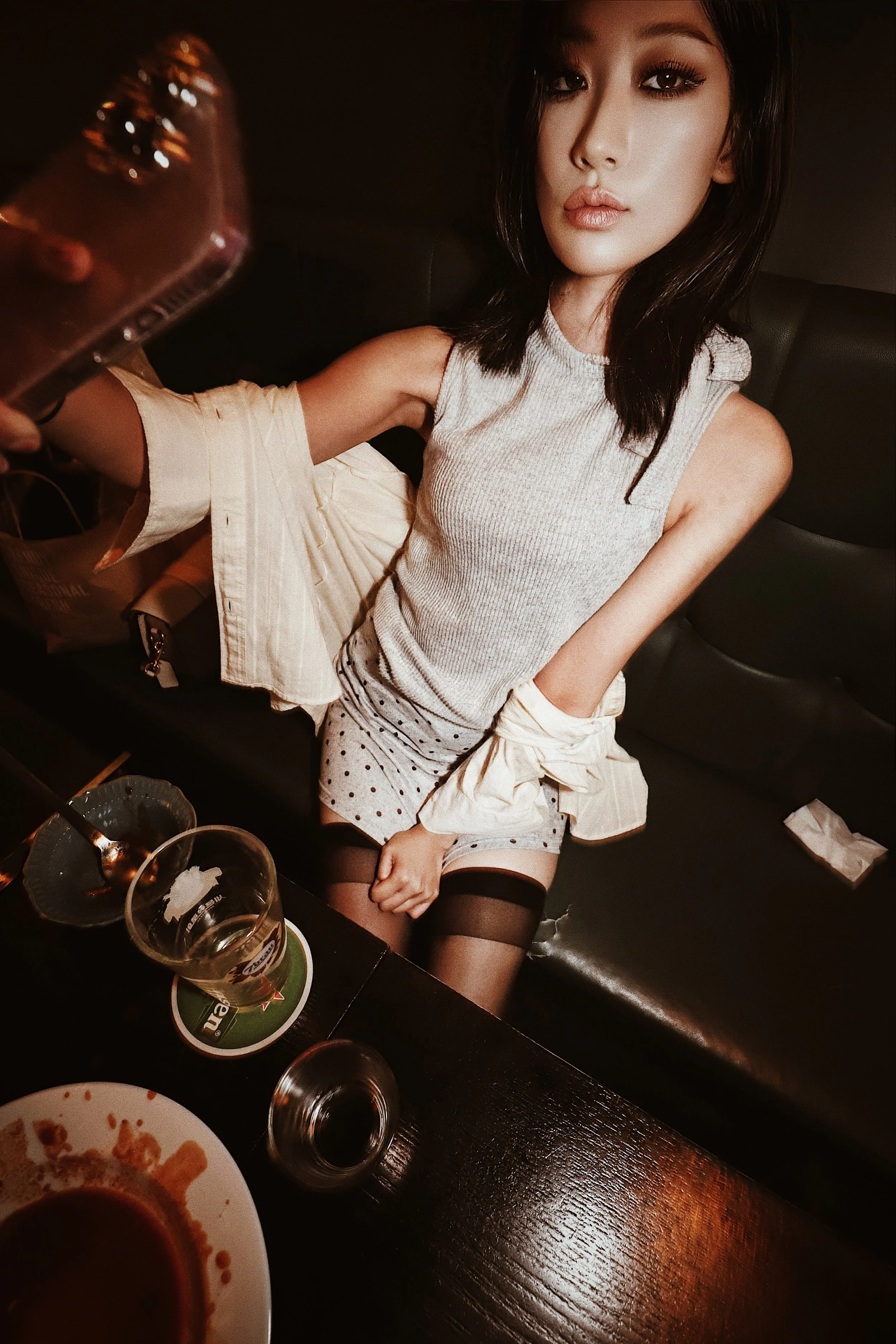
Pretty Maknae (@solsolyou) — somewhere between the second and third round, after the fusion ddeokbokki had been completely dispatched. The stockings made making a decision that she had to confirm with a selfie. She followed their advice.
She found the arched mirror inside 모던비어433 (Modern Beer 433) and stopped. 모던비어433 is a sake bar on the Heuknidan-gil strip — 43 posts on Instagram, still under the radar, the kind of place you find because someone in the group chat knows someone. Its existence is not accidental. Japanese-style drinking spots — izakayas (이자카야) — Japanese pub-style establishments serving drinks and small plates), sake bars, whisky bars with Tokyo aesthetics — have become a fixture in Seoul's hot neighborhoods over the past several years, driven in no small part by the fact that roughly 30% of Korea's outbound travelers went to Japan in 2023 alone. Koreans who've been to Tokyo bring the aesthetic home. The result is a specific genre of Seoul bar: Korean-operated, Japanese-inflected, slightly hidden, exactly the kind of place that populates a contested -ridan-gil strip that's still figuring out its own identity. The neon smiley face above the mirror offered no opinion on the stocking situation. The neon smiley face above the mirror glowed its one-size-fits-all opinion on the situation. She looked at what the mirror was showing her, photographed it, kept it. The thigh-high band sitting exactly where it had decided to sit was no longer a wardrobe malfunction. It was the look. First shot fired in the evening's unofficial fashion competition, delivered via mirror selfie to nobody in particular and everyone who would eventually see her Instagram.
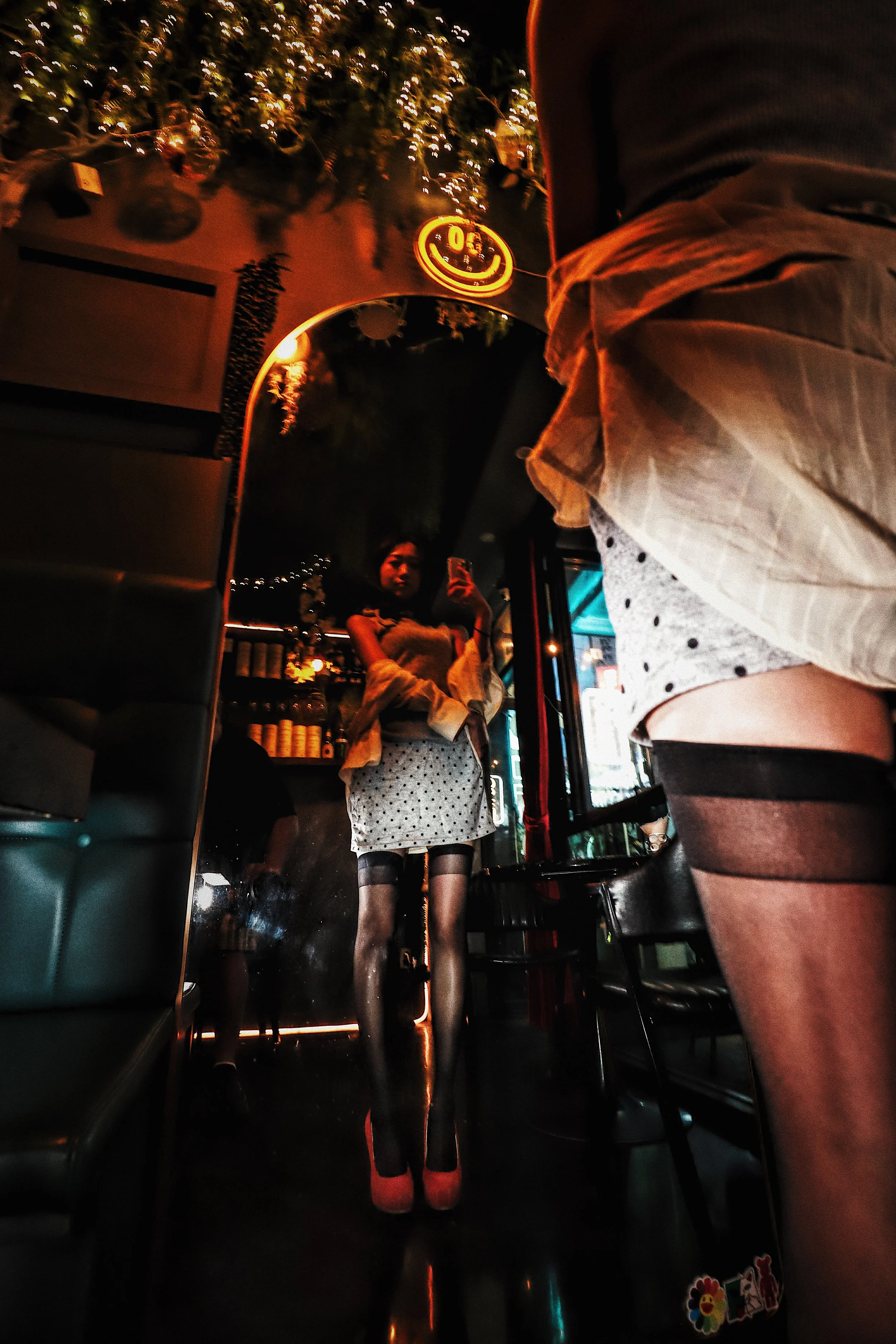
Pretty Maknae (@solsolyou) — inside 모던비어433 (Modern Beer 433). The mirror had opinions. She agreed with them.
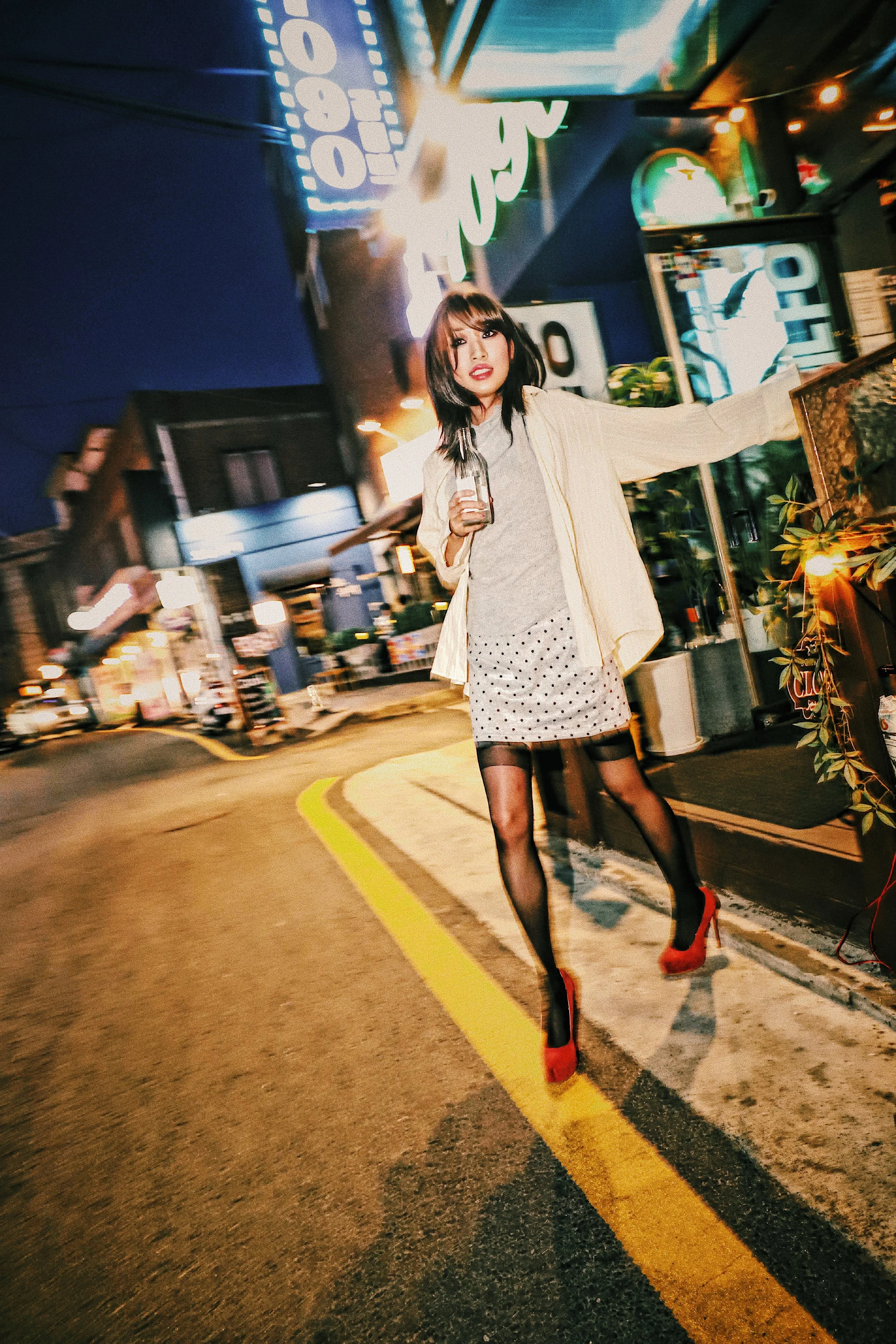
Pretty Maknae (@solsolyou) is more of a firecracker than she publicly lets on — and actually is often the starter of trouble once alcohol os uncorked. Sometimes a search party has to be sent out.
This is what happens when the permission structure changes. When the hand isn't coming, when the room isn't a threat, when the person running the evening is someone who would actually hear a complaint — the youngest woman at the table gets to be something other than careful. The white jacket is open because she opened it. The bottle is in her hand because she picked it up. The stockings have descended to a level that in any other hoesik would have been a liability — something to manage, to worry about, to pull up discreetly before the wrong person noticed. Tonight it's just a fact about where the stockings are. Nobody is managing it. She is standing on the yellow road line like she drew it there herself, and the neon is doing exactly what neon does, and this particular corner of Heuknidan-gil has no idea it's been claimed. That's the thing about a mostly-female hoesik run by a Cool Boss: the brazen become possible. The maknae gets to be a little bit feral. The night expands.
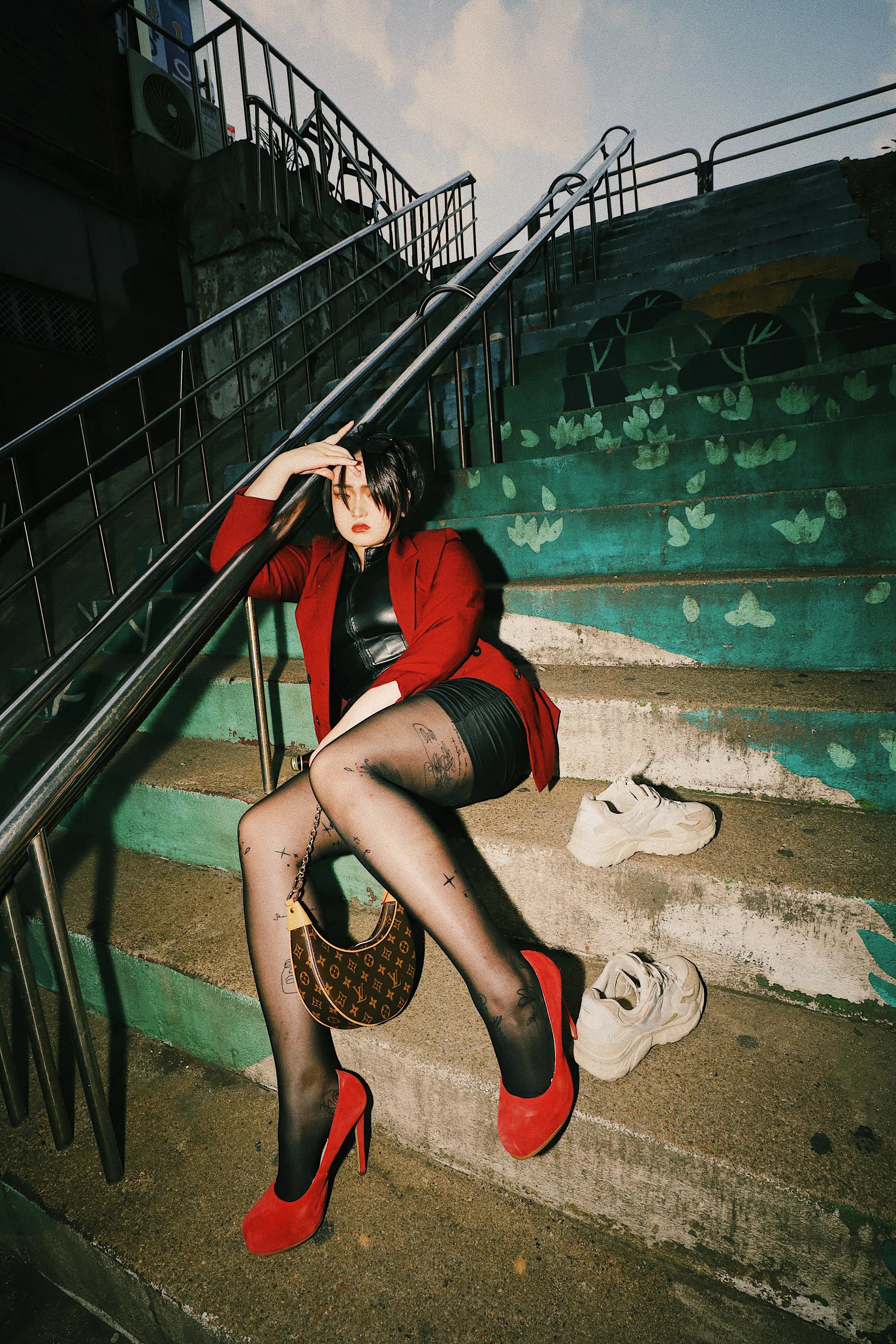
Last Round (@artblockeddd) recovers far below the frame's horizon line, but she is still above water, surviving the nigh unmolested and will show up to her desk completely nonplussed.
She is below the frame's horizon line, yet she isn’t in a sunken place. The leather corset under the red blazer is armor that chose to look like provocation, which is a decision, and the decision is the point. She dressed this way knowing where she was going. The field guide has no rule for women who refuse the calibration entirely. They are not a problem the field guide was designed to solve. RULE 06: You Will Get Home.
The final rule has the most variables. Subway if you timed it. Kakao T if you didn't — and you will pay for it yourself because that's not a reimbursable expense. Walk if the night resolved into something manageable. The streets of Heuknidan-gil at midnight — a neighborhood that has been trying to prove itself since 2018 and is still having the argument — are the terrain of this commute. They are not built for the shoes the evening required.
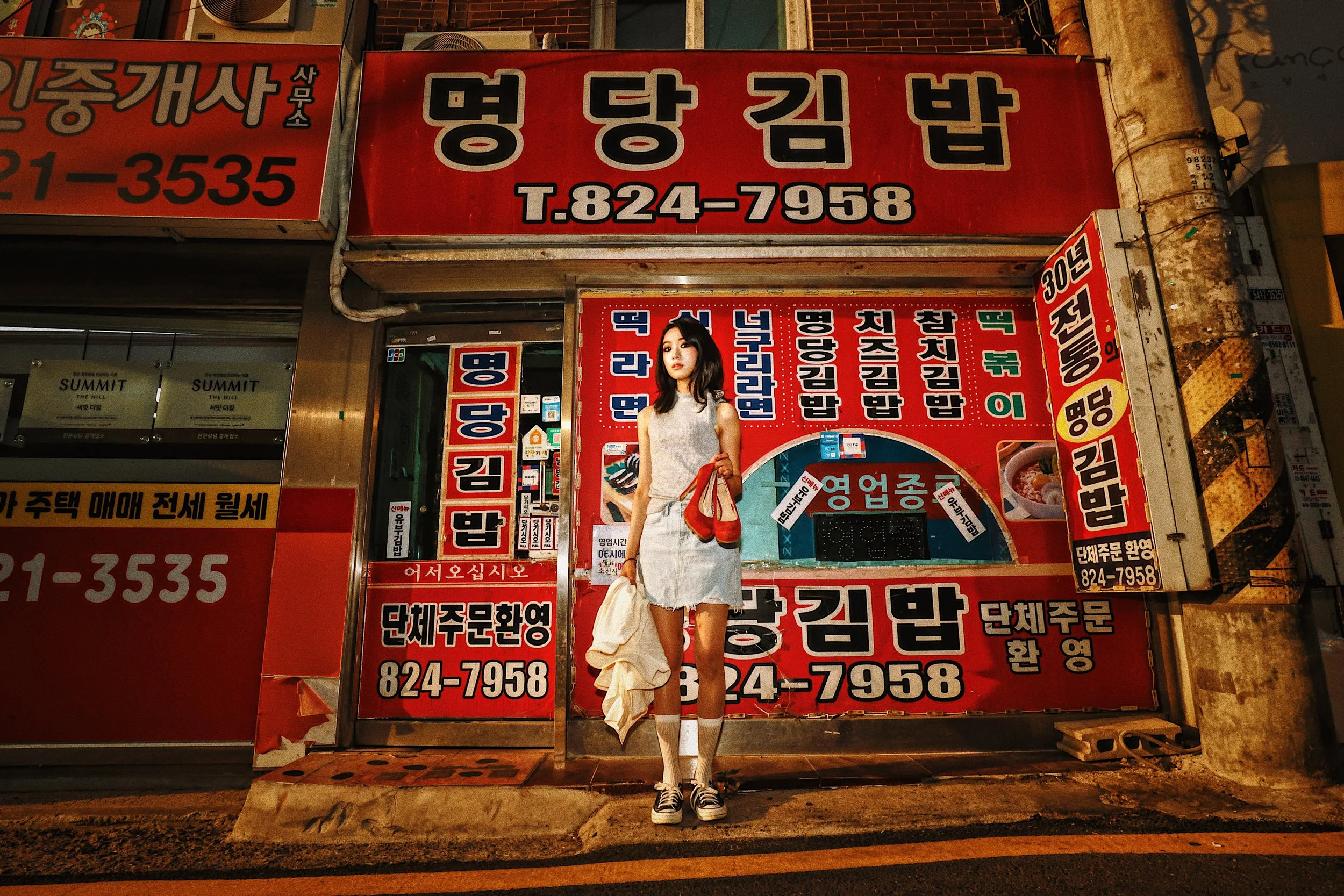
명당김밥 (Myeongdang Gimbap — myeong-dang gim-bap) is still on this corner in the sense that the sign is still there and nobody has bothered to take it down.
명당김밥 (Myeongdang Gimbap — myeong-dang gim-bap) is still on this corner in the sense that the sign is still there and nobody has bothered to take it down.
Pretty Maknae had clocked it earlier in the evening — walking past on the way to the restaurant, the sign lit up in red and white, the kind of place that looked like it had been feeding Jungang University students through hangovers since before the strip had a name. She filed it away. That's breakfast. She hadn't been able to eat what she actually wanted all evening — Rule 03 applies to everyone at the table, including the ones who end up owning the night — and somewhere between the second and third round she had decided that this place, right here, was where she was going to make up for it. Black rice gimbap at 7am. Simple. Earned.
She showed up. The sign was there. The shutters were down, which she assumed at first was just because it was early. Then she looked more closely. A local on a neighborhood community message board had noted it had closed — "명당김밥은 없어졌어요" — replaced by a fried chicken shop, some time around 2020. The fried chicken shop appears to have also come and gone. Or: the new business kept the old sign deliberately. This is not as unusual as it sounds. 간판 없는 가게 (ganpan eomneun gage — no-sign shop) is a documented and named phenomenon in Seoul's hot neighborhood economy — shops that operate with no signage, or with the previous tenant's signage still up, trading the absence of a sign for the specific credibility that absence confers. The phenomenon was foundational to Euljiro's transformation into "힙지로" (Hipjiro — hip Euljiro): when the neighborhood began its ascent around 2017, it was full of workshops and hobby spaces run out of upper floors with no signage, the no-sign being not a gap but a statement. As Asia Economy reported, the original no-sign operators were eventually displaced by well-funded newcomers with proper signage and advertising budgets, which is how a neighborhood loses what made it interesting. In Heuknidan-gil, still early in that cycle, a weathered 김밥 sign on a new business is worth more than a new sign. It says: we were here before the name. Whether or not that's true. She did not find out which one this was.
Consider the specific irony at work here. A new business moves into a space, keeps the old sign up — sometimes because the new signage is too expensive, sometimes because the old one is cooler, increasingly because both are true simultaneously — and the result is that the old sign becomes the new brand. The 뉴트로 (newtro) logic is that authenticity can be inherited rather than built, that the patina of someone else's history is a legitimate aesthetic asset. Which it is. But it also means that the actual history — the 할머니 (halmoni — grandmother) who ran the 김밥 place for decades, the 아저씨 (ajeossi — middle-aged man) who ran the electronics repair shop, the actual labor and time that produced the weathered sign in the first place — gets converted into décor for someone else's concept. The sign stays. The people it belonged to are gone. And the neighborhood gets cool points for a continuity it didn't actually maintain.
But here's the part that gets better the longer you think about it. If the chicken place that replaced the gimbap place also came and went — and the evidence suggests it did — then the 명당김밥 sign didn't just outlast the original business. It outlasted two businesses. The gimbap place closed. The chicken place moved in, possibly kept the sign for exactly the newtro cachet it provided, possibly even benefited from it, and then also failed to make it. And the sign remained. Through both of them. Untouched, un-updated, doing exactly what old signs do in Seoul's hot neighborhoods — radiating a sense of history and permanence that the actual turnover beneath it completely contradicts. At this point the 명당김밥 sign is not a remnant of the gimbap place. It is not a marketing asset of the chicken place. It is its own thing: a monument to two failed businesses and a neighborhood figuring out what it is, and in that sense possibly the most honest object on the entire strip. Seoul's hot places are full of this transaction. The 명당김밥 sign just happens to have run it twice. Which is, when you think about it, also a pretty accurate description of what 뉴트로 does to a neighborhood — and what the neighborhood does back.
She is standing in front of it with her red heels dangling from one hand. Sneakers on. White socks. The breakfast she'd been quietly planning since 10pm does not exist. The hunger that started at the dinner table is still there. Morning came regardless.
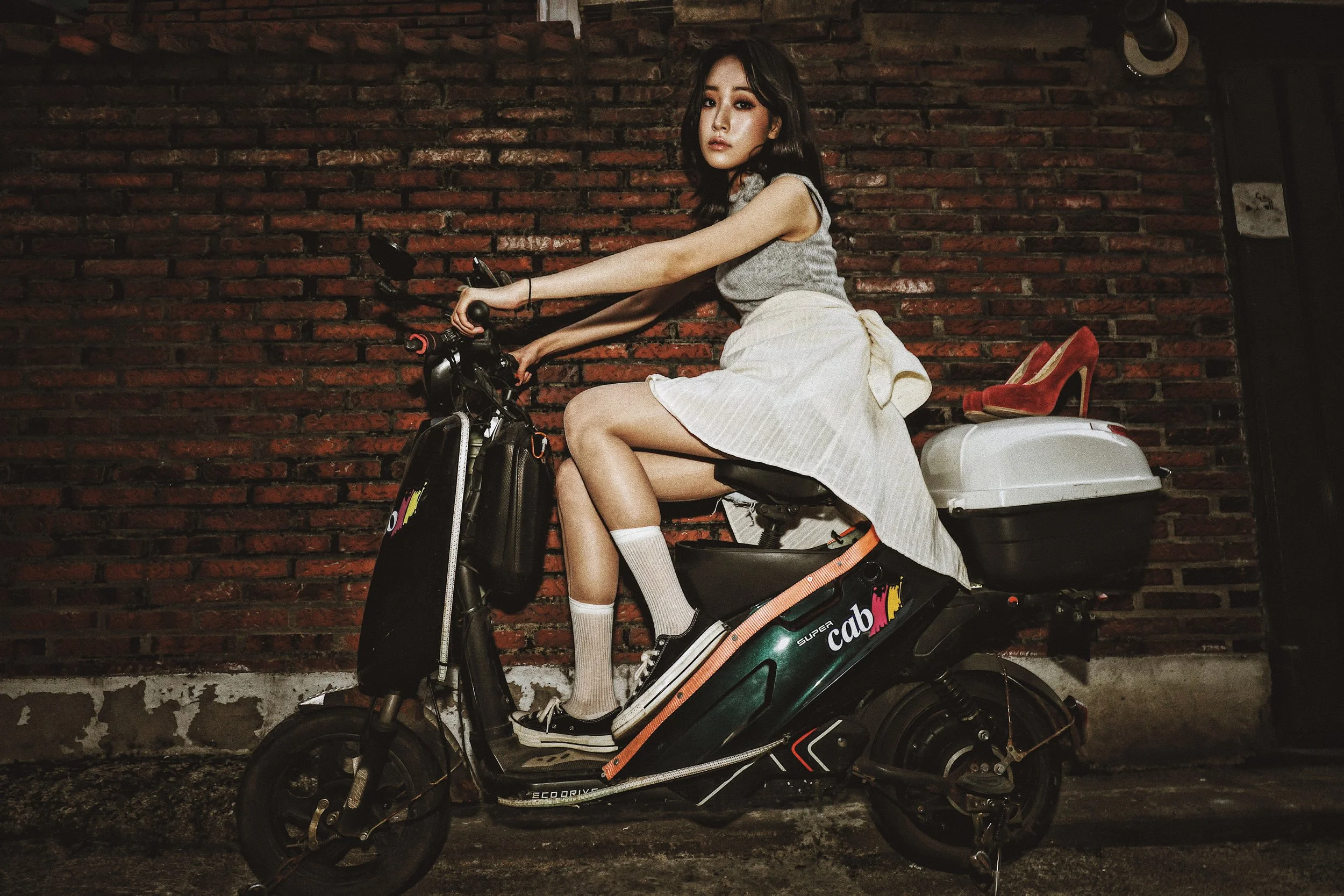
Pretty Maknae (@solsolyou) — the heels got the seat. She took the handlebars.
The heels are riding home on the back of the scooter. She put them there. She made a specific decision to give the heels the seat and take the handlebars herself. This is not an accident of framing. This is someone who has spent an entire evening being conveyed by an institution and has now chosen her mode of transport and her posture within it. The brick wall behind her is the same brick that appears in every night photograph of this neighborhood — old, unmoved, indifferent to what gets named and what doesn't.
RULE 07: You Will Be at Your Desk in the Morning.
This is what all the rules are protecting. The dinner, the drinking, the calibrated laughing, the managed hand, the taxi home — it's infrastructure. It exists so that the work can happen, so that the team cohesion that 정 is supposed to produce actually produces something measurable. Tomorrow the spreadsheet is due. Tomorrow the presentation gets finalized. The hoesik was the social maintenance that makes tomorrow possible.
Whether this is a bargain worth taking is a question the field guide declines to answer. The field guide describes. It does not evaluate. That's above the field guide's pay grade.
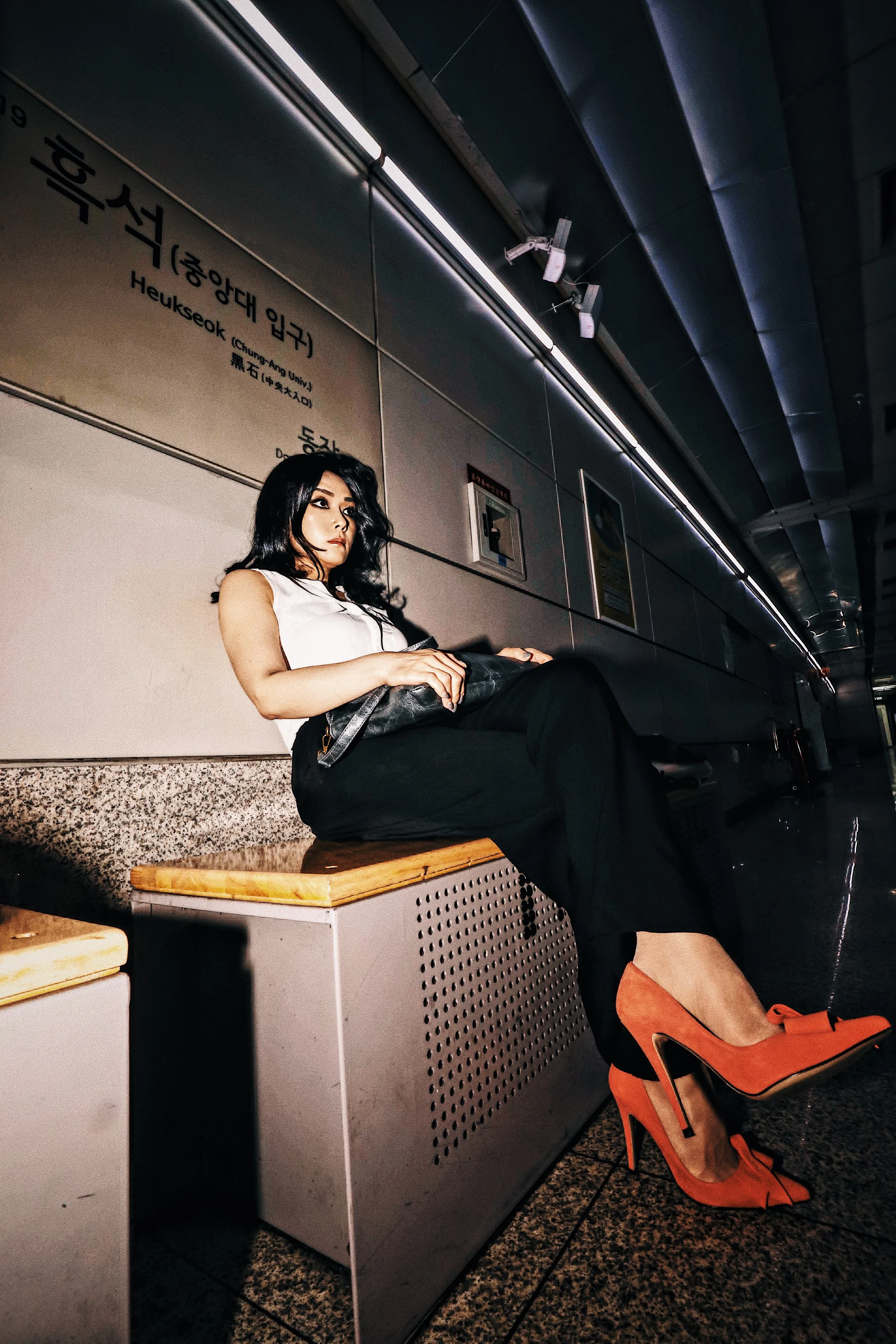
Cool Boss (@shinyjaky) — Heukseok (흑석) station, Line 9. Heels still on.
Heukseok (흑석). Chung-Ang University entrance. The station sign is trilingual — Korean, English, Chinese — because the subway doesn't assume you speak only one language, even if the office does. She is sitting on the platform bench with the posture of someone who has done this before. Many times. The black bag is on her lap. The heels are still on, which means she made it through the entire evening without taking them off — discipline or defiance, in her case probably both.
@shinyjaky is in her mid-40s. She was in the workforce before MeToo. She was at hoesik tables when the hand wasn't deniable and the HR department was the 부장님's college friend. She made 팀장. Possibly higher. She is sitting on that platform in those heels — still on, all night — because she learned early that taking them off was a signal she couldn't afford to send, and by the time she could afford to send it, keeping them on had become its own kind of statement.
The women who survived the old hoesik and stayed — not left for another industry, not quietly managed out, not decided the bargain wasn't worth it — carry a specific kind of institutional knowledge that no sensitivity training session has ever tried to document. She knows exactly which train to take. She has always known.
This image exists in a different register from all the others. The gap between rule six and rule seven, where the performance is fully suspended and what remains is a woman, a drink, a phone with notifications still coming in, and the private accounting of what the night cost and whether the morning is worth it.
It always is. That's the terrible part.
Goodbye, and Good Morning!
Our field guide ends in the alley, with the woman who was never going to follow all the rules anyway.
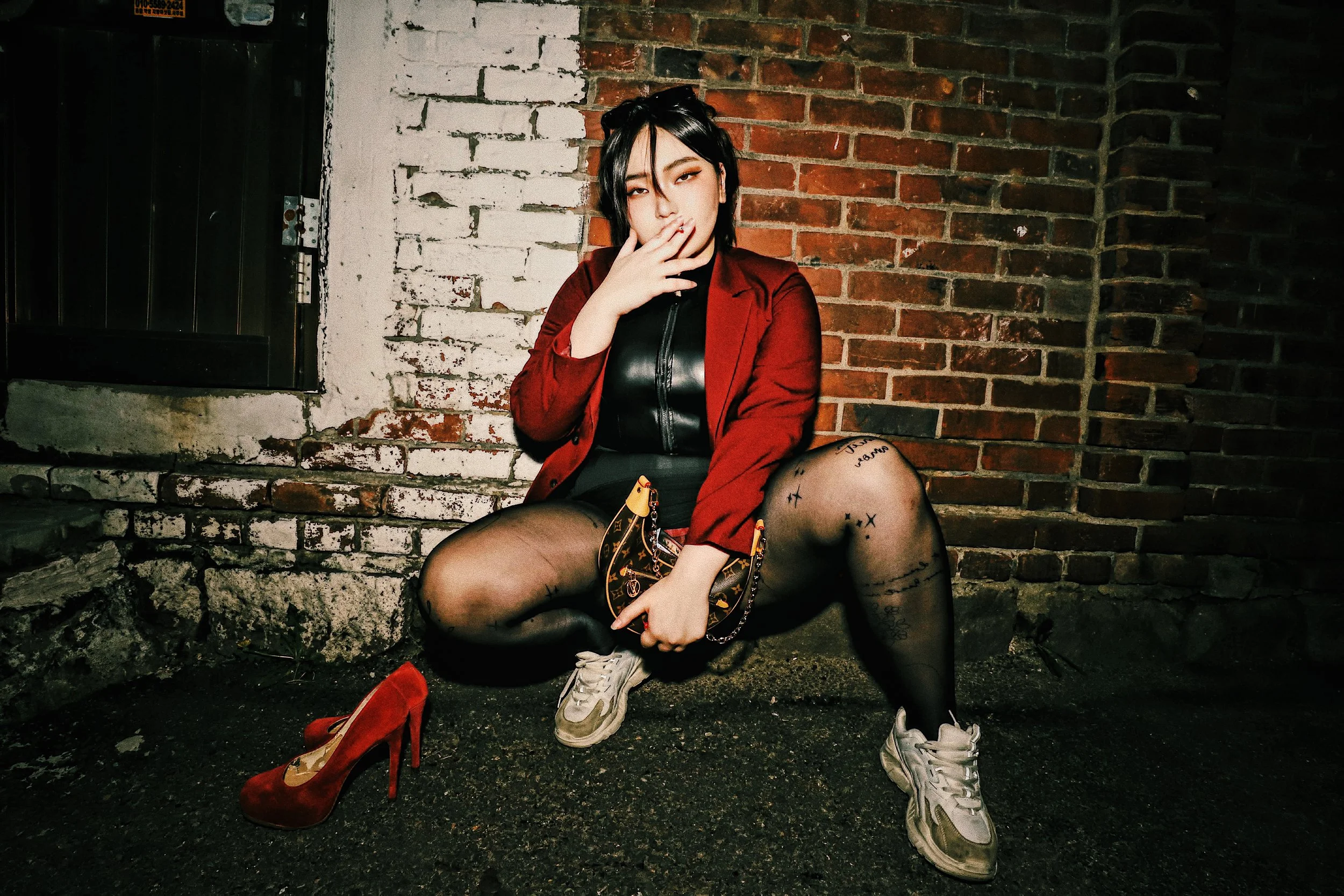
Last Round (@artblockeddd) — Heuknidan-gil, late yester-night. The field guide was not written for her.
The heels are off. The sneakers are on. The LV bag is still clutched — that doesn't go anywhere, that was never about the evening, that was about the years of desk-sitting that preceded it. The cigarette is lit. She is crouching against the brick of Heuknidan-gil (흑리단길) — the ridan-gil that Seoul's tastemakers keep meaning to properly validate and keep getting distracted before they finish the sentence — and she is not going home yet and she is not performing and the tattoos on her tights are visible and she is not sorry about any of it.
There was a hand at the table tonight. There is always a hand. She did not perform not noticing. What she did instead is between her and the brick wall and the cigarette and this photograph.
That's not in the field guide either.
The field guide was not written for her.
Oh, and by the way, Paepi made a beeline home shortly after dinner finished. Something about a 11pm curfew, so she would have to skip the drinks-n-more portion of the evening. So she had to be in the suway by around 9:30. Gen-Z wasn’t built for the heavy hitting of the hoeshik. She’d never been to one, and had gotten her fill of what it was all about. She bounced as fast as possible.
CREDITS
Cool Boss — @shinyjaky (mid-40s; she has been at more of these tables than this field guide has rules for)
It Girl — @youngseova
Pretty Maknae — @solsolyou
Last Round — @artblockeddd
Paepi — @0.8.730
Location — Heuknidan-gil (흑리단길), Heukseok-dong (흑석동), Dongjak-gu (동작구), Seoul
Heukseok Station (흑석역) — Line 9, Exit 3
Photography — @seoulstreetstudios
Production — A SEOUL STREET STUDIOS | KARSI | SEOULACIOUS production