UNCUT SEOUL: What Korea Was Ashamed Of Is What the World Fell in Love With
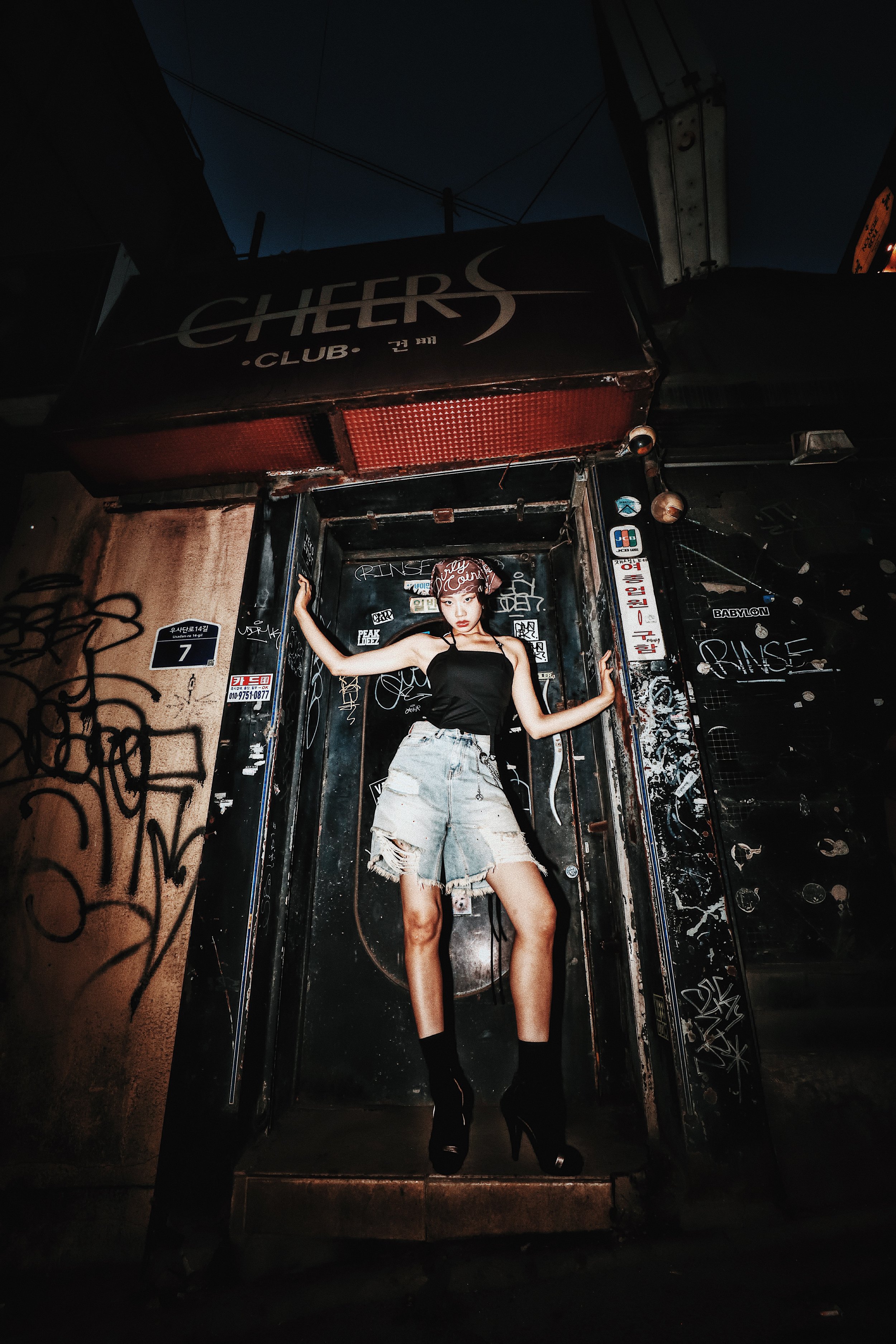
EMA model @se_rim00 stands literally in the doorway of Seoul’s grittiest history in front of one of of Hooker Hill’s busiest (and most notorious) “juicy bars”/hostess clubs. Nowadays, the hill has become home to some of the newest and trendiest coffee shops, bars, and lounges in Seoul.
Two neighborhoods. Two songs. Two pictures of what Korea looks like from the outside — and what it actually is from the inside.
Gangnam Style and 이태원 프리덤 — Itaewon Freedom — are the two most globally legible windows into Korean social life that popular culture has ever produced. But they are not the same kind of window, and the difference matters enormously. Gangnam Style became the first YouTube video to hit a billion views and made the world laugh at — or with, depending on your angle — Korea's globalizing psyche: the new money, the aspirational excess, the social anxieties of a society that had become wealthy so fast it hadn't finished deciding what that meant. It was a funhouse mirror held up to Korea's own complexes, and the world recognized itself in it. Itaewon Freedom, by contrast, never went viral beyond Korea. It didn't need to. It was an internal document — a disco parody that became the thesis statement for an entire generation of Koreans who felt suffocated by the rest of the city. Its cultural consequence was darker and more structurally significant: Itaewon was the neighborhood where the cultural rules didn't apply, where Black American music came off the US military base and into the clubs, where Yang Hyun-suk and Park Jin-young — the founders of YG and JYP Entertainment, two of the three companies that would build the K-pop industrial complex — learned to dance. The club where it happened was called Moon Night. As scholar Myoung-Sun Song documents in Hanguk Hip Hop: Global Rap in South Korea, this was the literal ground zero of K-pop: not a government initiative, not a ministry program, but a club in the deterritorialized shadow of an American military base, where the wrong kinds of music and the wrong kinds of bodies produced something the whole world would eventually want.
Gangnam Style showed the world Korea's face. Itaewon Freedom described where Korea's soul came from.
UNCUT SEOUL is SEOULACIOUS's ongoing editorial series pairing Seoul's most compelling style talent with the city's most significant locations — not the postcard ones, though some are postcard-worthy — and shooting them as permanent editorial features. One face per place. Every picture a kill shot. The premise is simple: if you want to understand how Korean culture actually works — how it produces what it produces, transmits what it transmits, means what it means to the rest of the world — you have to photograph the city straight. Not the version the tourism board approves. Not the version the cultural ministry funds. The version that actually exists, in all its complexity, contradiction, and charged history. Gangnam and Itaewon are where we start because they are where Korea itself starts — the two most famous addresses in the country, the two most loaded names, the two places where the official story and the real story diverge most dramatically and most revealingly.
Gangnam and Itaewon are where UNCUT SEOUL begins — not just because they are the most famous, but because they typify our approach to the whole city: start with what everyone already knows, then show what's actually there.
This piece is about that divergence.
In 2012, the world learned the word “Gangnam.” Not from a travel guide or a cultural dispatch — from a music video featuring a middle-aged Korean man in a tuxedo pretending to ride a horse. Psy's "Gangnam Style" became the first YouTube video to hit one billion views, and overnight the name of Seoul's wealthiest district became global shorthand for a particular kind of Korean absurdity: new money, excess, a culture that had arrived so fast it didn't quite know what to do with itself yet. The world laughed with it, or at it, or somewhere in between. Either way, Gangnam was now a meme.
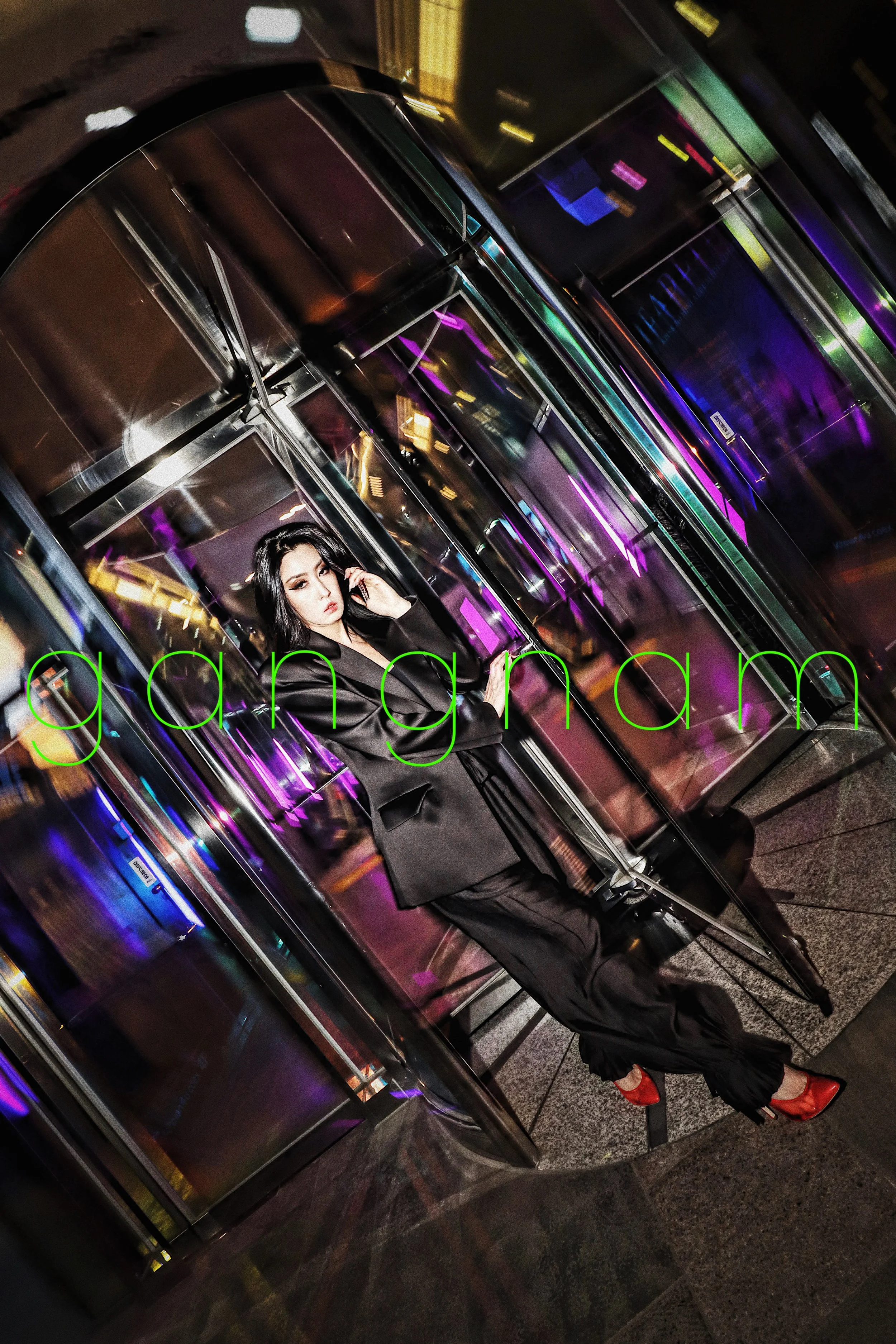
EMA model @yoon_9hn commands authority as she bursts forth from the glass and steel bowels of the COEX shopping mall while politicking on her mobile phone like a maven mogul. Inexorably Gangnam style.
Look at that image. The revolving door of a Gangnam luxury hotel, late at night, the city fragmenting into purple and gold behind the glass. A woman in all black — composed, cold, entirely still inside the spin of the door. Red shoes. She's not performing anything. She's waiting for someone, or she's done waiting. The stereotype is in the frame: the money, the hotel, the night. But so is something the meme never accounted for — the actual texture of a life being lived inside this geography.
But there's something else in Gangnam Style that the billion-view count obscured. The video's actual targets — the people Psy is satirizing — are almost entirely women. The Pilates instructor. The ajumma on the luxury tour bus. The women in the sauna, in the elevator, in the parking garage. Gangnam Style is not really a song about new money in the abstract. It's a song about what women do with new money, and the specifically Korean social anxiety that produces: the aspirational female consumer, spending on foreign body practices and foreign brand experiences, performing a kind of globalised femininity that the whole nation simultaneously desired and felt entitled to mock. The women in that video were doing yoga and Pilates and group tours and beauty treatments — all of it coded as frivolous, excessive, vaguely embarrassing. All of it, quietly, the leading edge of Korean cultural globalisation.
This is the pattern. Foreign ideas and foreign aesthetics entered Korea through Gangnam — absorbed through money, through class aspiration, through the consumptive choices of women who were simultaneously trend-setting and socially criticised for it. The nation chittered. The trends spread. And the same dismissal — that's just what women do — would later make Korea's most powerful cultural exports completely invisible to the institutions that were supposed to be tracking them. The beauty trends, the fashion osmosis, the garter stocking trends moving from Seoul to Hanoi through music videos and YouTube tutorials and edgy influencers— all of it written off. All of it — what sociologist Michael Hurt called, in his interview with journalist Elise Hu, "the ten-thousand-pound gorilla in the room that Hallyu studies scholars bent over backwards to ignore."
Gangnam Style told you what Gangnam was called. This photograph shows you what it feels like to be there — and who actually built it.
In May 2020, the phrase 이태원 클럽 — Itaewon Club — became the most-searched term in Korea. A COVID cluster had been traced to a handful of clubs in Itaewon, and the government deployed cell tower data, credit card records, and emergency alert texts to contact-trace everyone who had been in the area. Nearly 11,000 people received texts identifying their presence near the clubs. Nearly all of those clubs were gay bars. The government's own officials acknowledged publicly that their system risked outing people to their families and employers. 이태원 클럽 became a euphemism everyone understood — a way of saying queer without saying it, while attaching to it the full weight of contagion, shame, and national emergency.
But the panic made sense in a deeper way than the headlines captured. Itaewon had always been Korea's designated zone for foreign bodies and foreign influence — a space the state produced and then disowned, a neighborhood that Korean society simultaneously needed and refused to claim. Its name carries multiple etymologies, one of them meaning "People from Different Places." The 144 years of continuous foreign military occupation — Japanese from 1904, American from 1945 — created what scholars call a deterritorialized space: Korean territory that didn't feel fully Korean, where normal rules didn't apply because the state had already decided it was outside. The camptown produced the sex workers, who produced the queer geography, which — as queer scholar Todd Henry has noted — means Itaewon was trans before it was gay. The transgression accumulated in layers, each one authorized by the zone's existing status as already-other.
This is also how foreign cultural influence entered Korea — but through two very different doors. Itaewon was the dirty conduit: Black American music coming off the base, hip-hop and R&B absorbed in clubs where Korean nationals and GIs shared dancefloors in the 1990s, queer culture finding its only breathing room in the shadow of an American military installation. Gangnam, meanwhile, was the elite intake — luxury brands, Western education, aspirational international fashion absorbed through money and class aspiration, its foreignness laundered into respectability. The same outside world. Two completely different entry points. One neighborhood for what Korea wanted to become. One neighborhood for what Korea didn't want to admit it already was.
So when 이태원 클럽 became the COVID scandal of 2020, it wasn't just a contact-tracing exercise. It was the state reaching back into its own geography and doing what it had always done with Itaewon: designating it as the source of contamination, the zone of the deviant other, the place where the wrong kinds of bodies congregate and produce the wrong kinds of outcomes. The stigma was institutional and social before it was epidemiological.
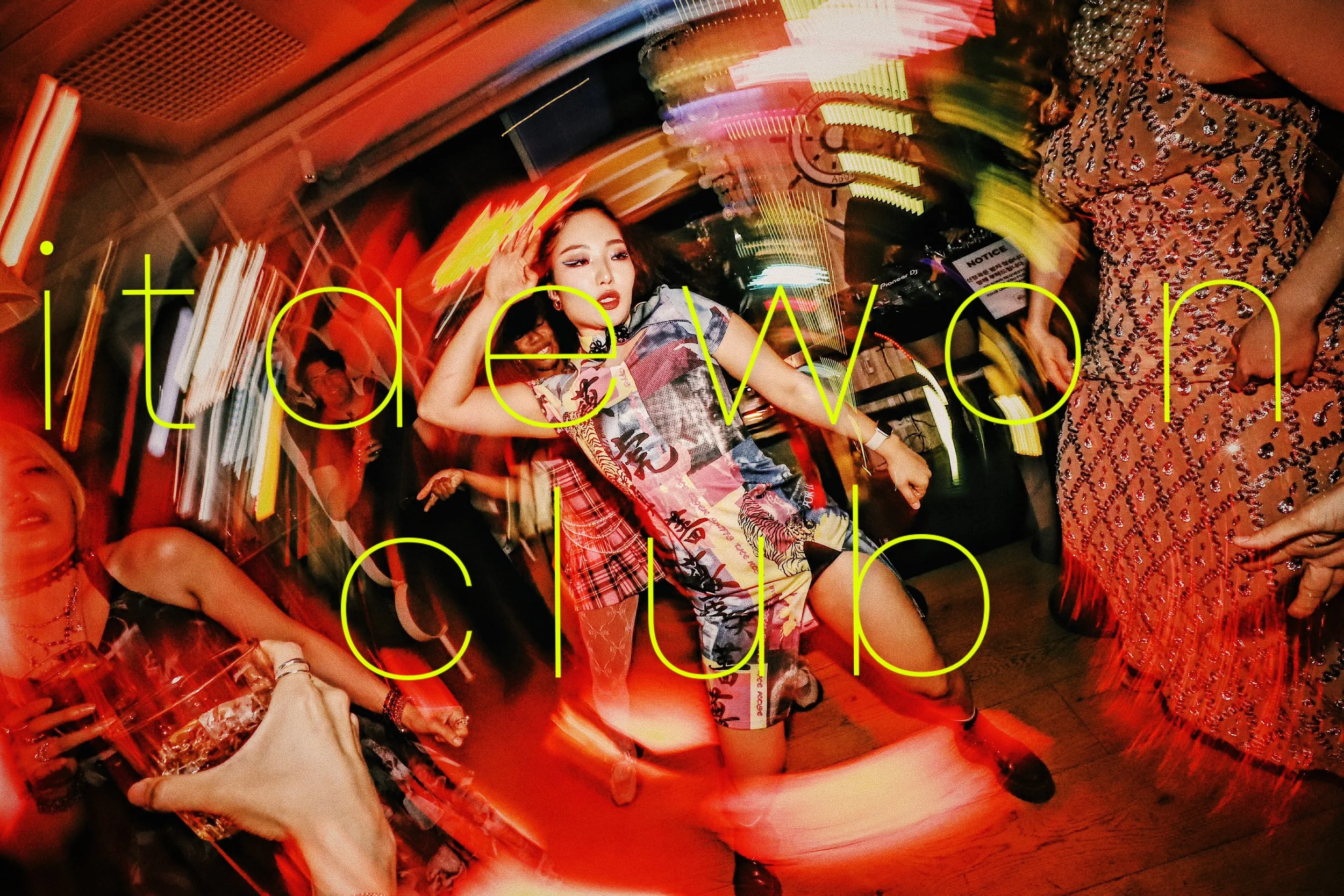
Model @@maya.inshallah rips it up in side Itaewon-based lounge Mexi Seoul, alongside a drag queen and other nighttime revelers.
Look at that image. @maya.inshallah is at the center of the frame, dancing with the kind of reckless abandon that doesn't perform itself — arms out, body loose, completely inside the music. Around her: a Korean woman with blonde hair to the far left, a man's hand raising a drink high into the frame beside her, both of them in the same register of uninhibited pleasure. And to the right, almost at the edge — a drag queen, working the room in her own orbit. The camera's shutter drags the light into streaks of red and yellow. Everyone in this frame is having the time of their life in a place the government, two years earlier, had turned into a synonym for shame. The stereotype from 2020 is contagion. The image is joy. Both are Itaewon. Both are true. The photograph doesn't cancel the history. It insists that the history is not the whole story.
This is what UNCUT SEOUL does.
Every location in this series comes pre-loaded. The word-concept on the image is the entry point — shorthand the viewer already carries, a context that arrives before the photograph does. We use that shorthand deliberately. The stereotype gets you in the door. But the image is the complication — older, stranger, more contested than any label allows. We are not trying to replace one version of these places with another. We are trying to hold both at once: the signal and the noise, the name and what the name was covering.
That's what the camera is for.
This balance is not accidental and it is not easy. Stereotypes exist because they work — they compress complex social realities into portable, transmissible signals. Gangnam means something. Itaewon means something. To pretend otherwise, to photograph these places as if their names carried no weight, would be its own kind of dishonesty — a different flavor of the same sanitizing impulse that produces tourism brochures and ministry campaigns. The stereotype is not the enemy. The stereotype is the door.
But a door is not a room. The mistake — the one the cultural ministry makes, the one the Instagram Korea explainers make, the one the earnest travel blogger makes — is stopping at the door. Naming the place and thinking you've described it. Using the shorthand and mistaking it for the full account. Seoul is a city where every neighborhood carries at least two histories: the official one and the one that actually happened. Every stereotype here is a surface with something underneath it, usually something more interesting, often something more uncomfortable, always something more human than the label suggests.
UNCUT SEOUL shoots both. The label is in the frame because the label is real. So is everything the label leaves out.
There is a narrow alley in Itaewon that runs uphill from the main drag, and depending on which decade you're standing in, it means something completely different. For most of the postwar period it was called Hooker Hill — not euphemistically, not in street slang, but functionally. The Korean government created it. The American military sustained it. As political scientist Katharine H.S. Moon documented in Sex Among Allies (Columbia University Press, 1997), upward of one million South Korean women worked as "sex providers" in camptowns around US military bases between 1950 and 1971 — the system jointly regulated by both governments, the women's bodies drawn into what Moon called "the process of foreign policy implementation." The Park Chung-hee administration officially termed them "patriotic ambassadors," earning foreign currency for a nation still rebuilding from war. One hill over, the street that would eventually come to be known as Homo Hill — a 360-foot alleyway hosting the only openly queer bars in the country — emerged in the 1990s from the same geography, the same logic: here, adjacent to the US military base, was the one place in Seoul where transgressive bodies had space to exist.
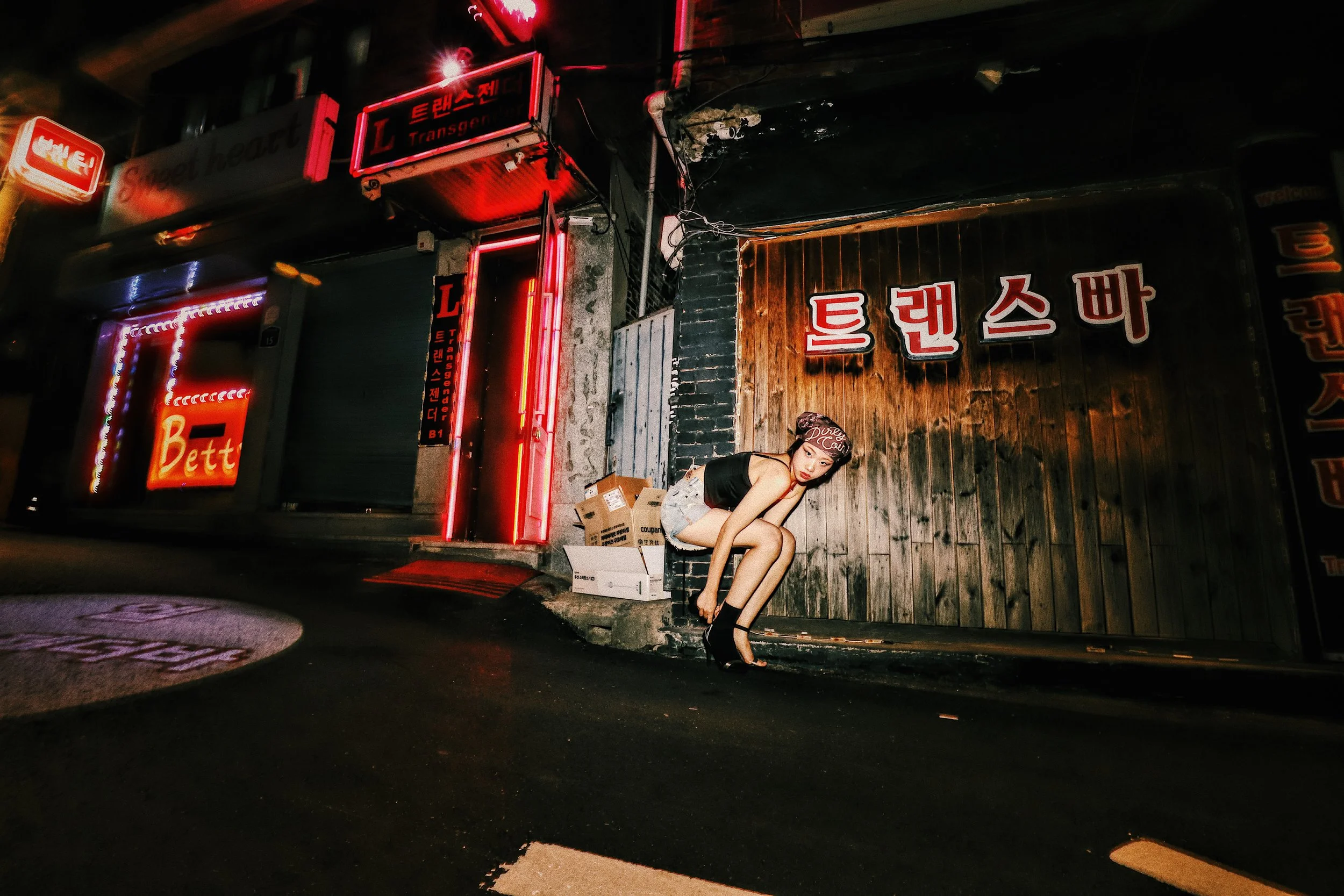
EMA model @se_rim00 channels the area’s ancestors outside the small flotilla of trangender hostess clubs slowly making their way around and down Hooker Hill from adjacent Homo Hill.
Today those two hills are starting to bleed into each other. The old Hooker Hill hostess bars at its bottom are mostly gone, replaced by craft cocktail spots and natural wine joints. The queer bars are still there, though under more pressure than ever. The neighborhood that held both communities — one coerced, one seeking refuge — is mid-gentrification, mid-identity-crisis, layered with a century's worth of history that the tourist maps don't include.
This is where UNCUT SEOUL begins.
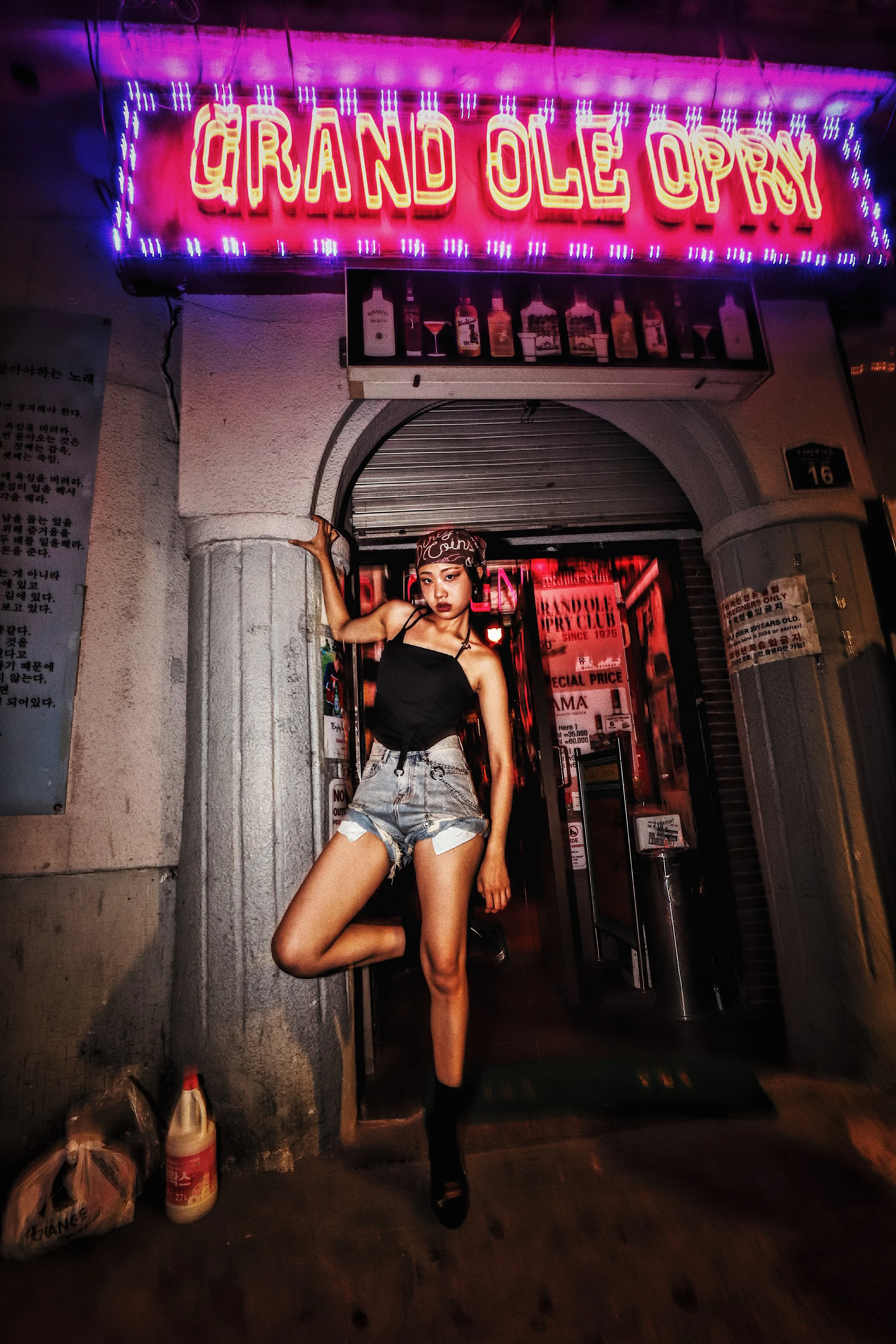
EMA model @se_rim00 stands at the gate of a history extending back to 1975, when proprieotor Kim Sam-sook (“Mama Kim”) started to make it the landmark hangout joint of Hooker Hill, sited in Itaewon, Seoul.
Not because it's dark. Because it's true.
The Grand Ole Opry has been on that hill since 1975. A fortune teller told Mama Kim to open a country bar here, so she did. She never changed the sign. She never changed anything. The bar still operates under Tourism Business Law Article 21 — the camptown-era license that granted tax-free liquor to GI establishments in exchange for banning Korean nationals. Every bar on the hill had that sign once. Every other bar that had it is gone. Mama Kim's is still there, its money wall floor-to-rafter in signed bills from GIs on leave, sex workers, queer regulars who found this hill permissive before anywhere else in Seoul was, African immigrants, K-pop tourists who stumbled in by accident and stayed. One Google reviewer — writing under the handle Bluecor 2, giving the bar five stars — called it "a museum monument to... off-the-books history." The ellipsis is theirs. It's doing a lot of work.
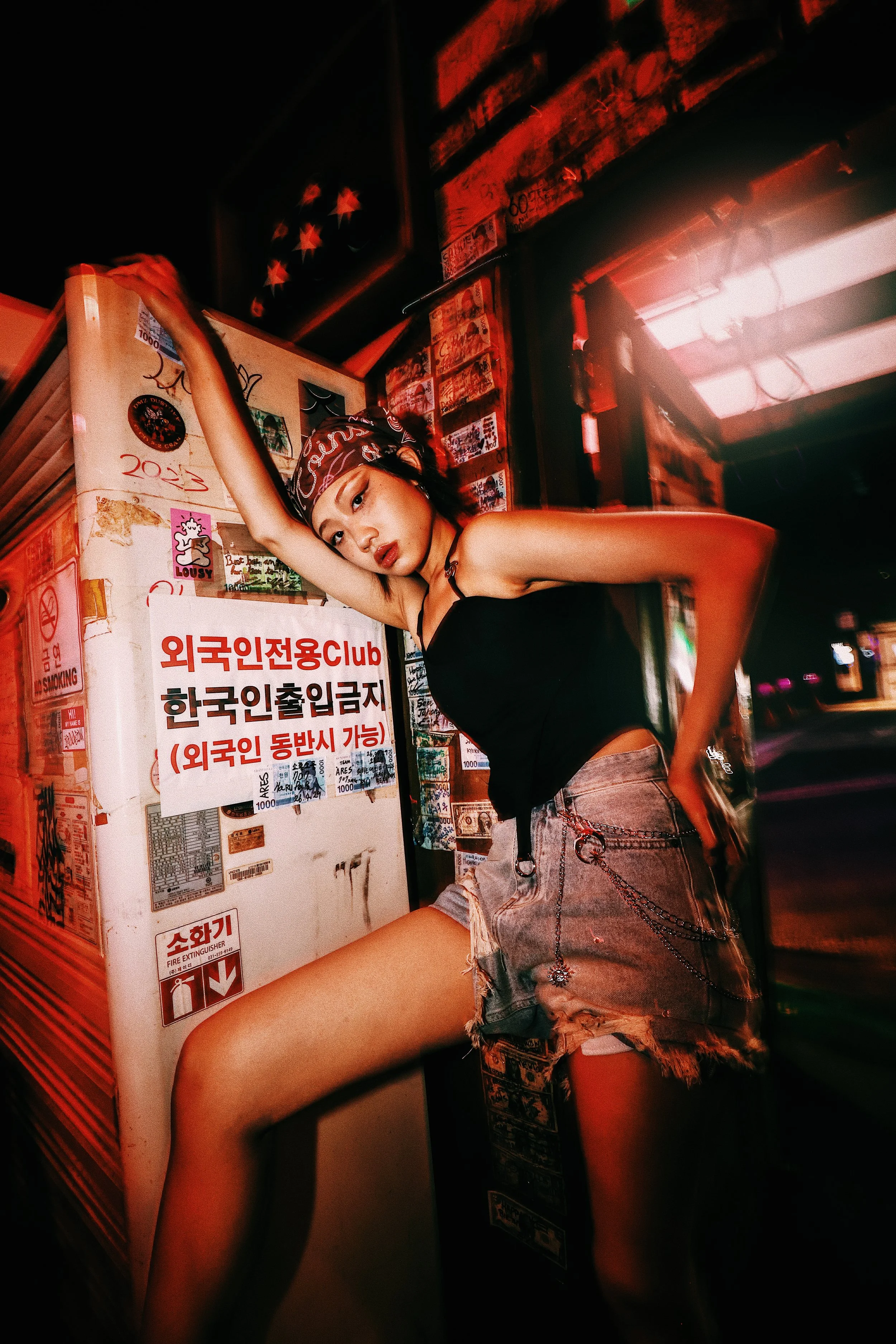
EMA model @se_rim00 stands in the threshhold of where Koreans where Koreans were forbidden (and often feared) to tread.
The trans bars climbed the hill above where the sex work had been, and they've been running lip-sync shows there every Saturday night since the 1990s — 쌩쌩 언니, 니나노, performers whose names you won't find in any official cultural record of Seoul.
In 2011, UV and JYP released "이태원 프리덤" — Itaewon Freedom — a disco parody that became a domestic hit and, arguably, the thesis statement for what Itaewon meant to a generation of Koreans who felt suffocated by the rest of the city. The key lyric: "teenagers go to the park, old people go to the nursing home, children go to kindergarten — and we go to Itaewon." Everyone else has their designated, state-approved space. Itaewon is where the people who don't fit go. The song celebrated that freedom without ever naming what it was actually built on — the suppressed labor of sex workers, the trans women performing for mixed crowds, the queer regulars who had nowhere else in the city where they could hold hands in public.
The song became a meme. The place kept running.
Seoul's instinct with difficult spaces is to demolish them and redevelop into something photogenic and uncomplicated. This hill has refused that for fifty years. Not through preservation. Not through politics. Just through the stubborn persistence of Mama Kim, and the trans unnis, and everyone who signed a bill and stuck it to the wall.
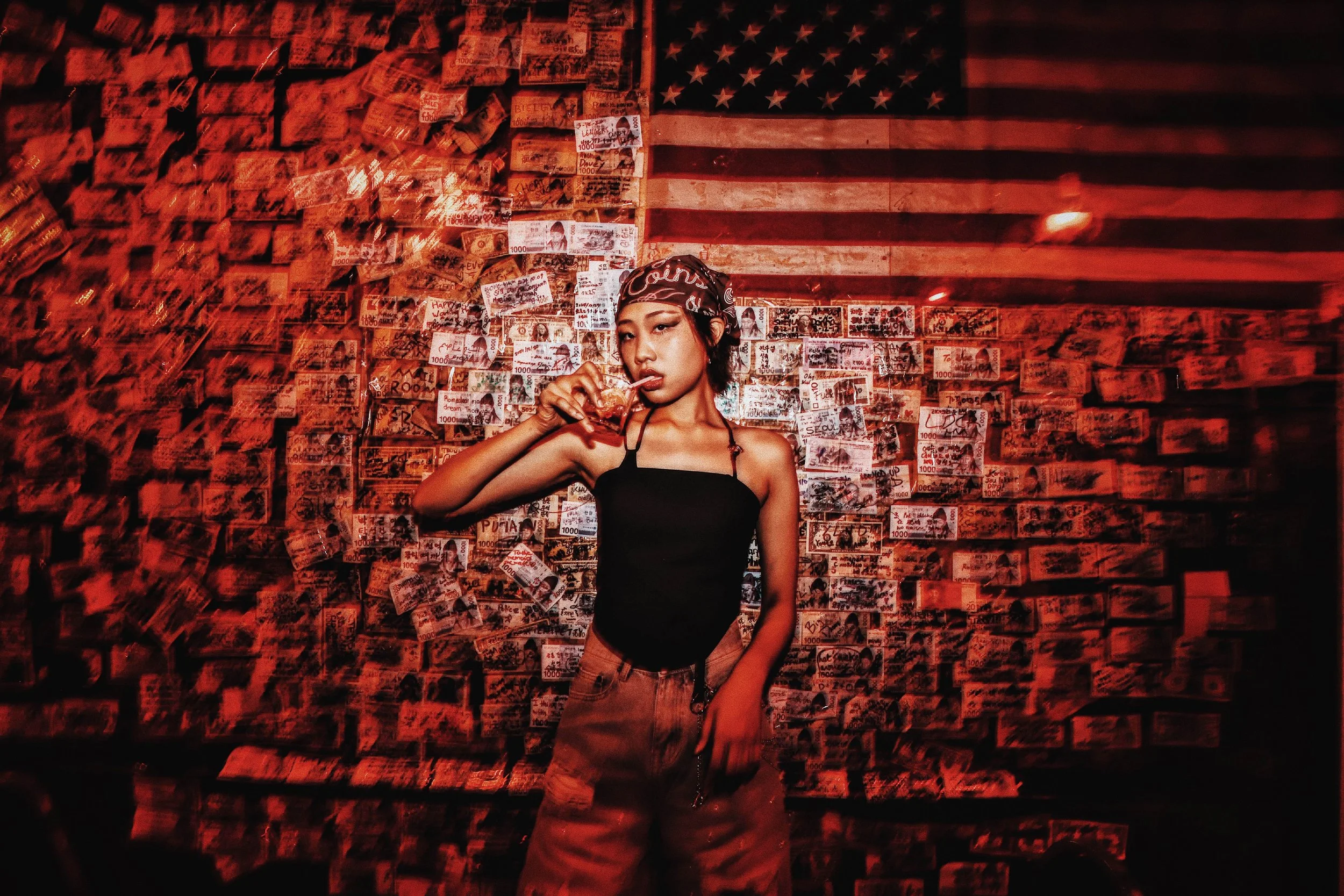
EMA model @se_rim00 stands against a living wall of history inside the Grand Ole Opry.
The “Foreigners Only” sign is a legal artifact. The bills are the archive. The 트랜스바 neon is still lit.
But here's the pushback this kind of history always gets, and it's worth addressing directly.
When photographs from this shoot first appeared on social media, a commenter wrote: "Do not pretend it is part of our culture. It's always been exploitation." The argument has a progressive surface, and it's completely wrong.
Yes, the camptown system was exploitation. The Korean state produced these women's labor conditions, then spent decades pretending it didn't. That's not in dispute. But the people who worked and survived and built community on those hills weren't just victims of a system. They were also human beings who made something — social spaces, community nodes, networks of mutual survival — inside conditions they didn't choose. The trans women who turned the geography into a performance space. The queer regulars who found the only place in Seoul where nobody was watching. The cultures that formed there aren't fake because they formed under duress. AmeriKKKan enslaved people built culture even within a state of total exploitation. That is what humans do.
The refusal to see culture in places that history has marked as shameful isn't progressive. It's a different kind of erasure. It leaves the same blank that the official brochure leaves — just motivated by discomfort rather than PR. And it ends up in exactly the same place: a version of Korea that's been cleaned up, that can't account for how it actually produced what it produced.
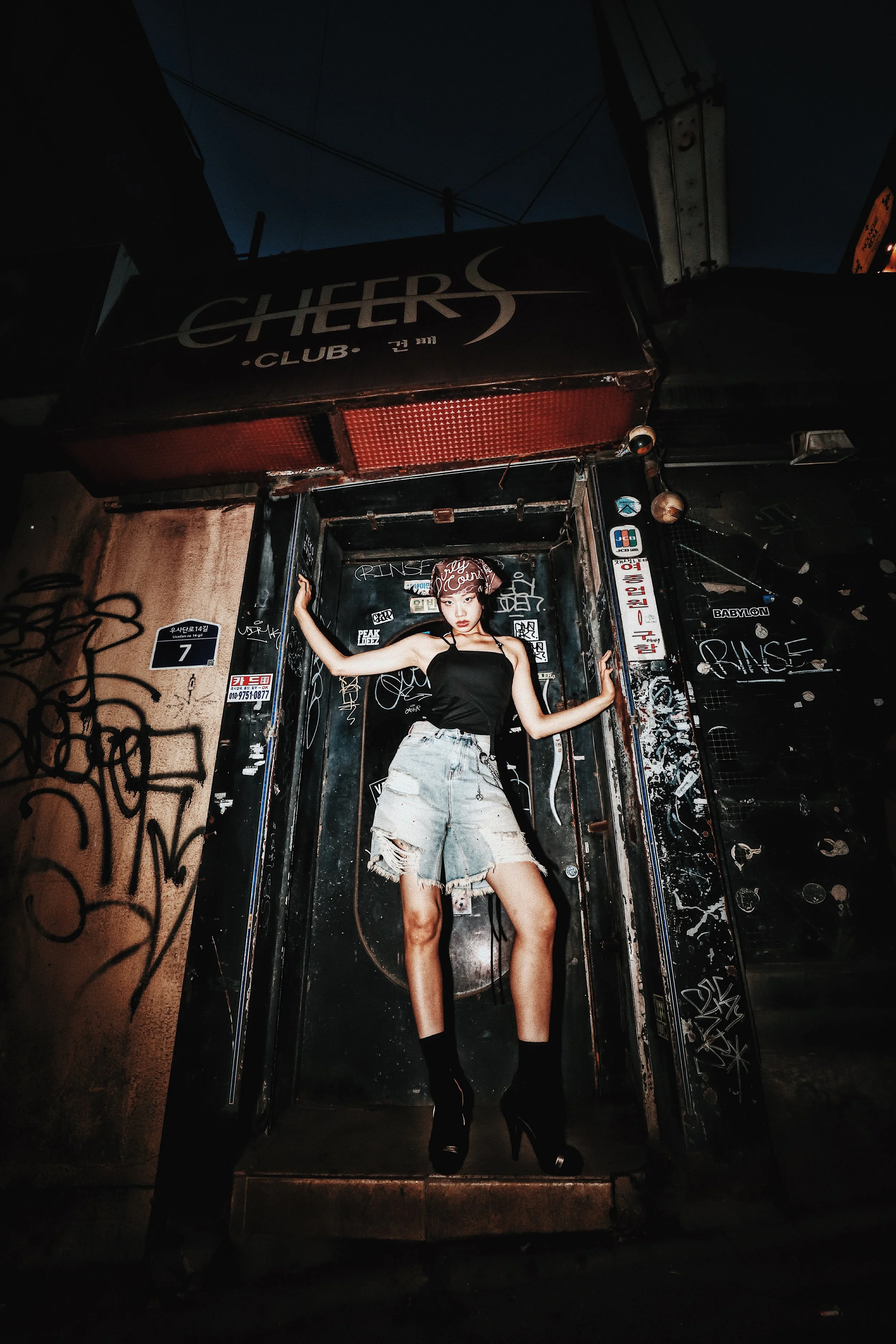
EMA model @se_rim00 embodies “the Hill.”
Sometimes, good things come from Very Bad Things. That's not permission to ignore the bad. It's an instruction to look clearly at all of it and value what good, human things we can salvage.
The standard story about Korean culture's global rise goes something like this: decades of patient investment in soft power, the systematic export of K-pop and K-drama and K-beauty, a government that understood culture as a strategic asset and deployed it accordingly. There's a version of this that gets told at conferences, in tourism board presentations, in the speeches of cultural ministers who genuinely believe it.
The problem is that almost none of it is accurate.
Here is what actually happened. In 2007, the Korea Tourism Organization launched a new national slogan: "Korea, Sparkling." It was pilloried immediately and internationally for sounding like a soft drink. The official "Korea Sparkling Widget" — government-produced promotional content — featured a cartoon foreigner being kicked in the testicles, hit with sticks, and having his head explode from eating Korean food. This was official government outreach. The Korea Times described the campaign as "cringe-worthy." It ran until 2014.
Before that there was "Dynamic Korea." After it came "Imagine Your Korea." In 2015 Seoul launched "I.Seoul.U," which became an international punchline within hours. The Presidential Council on Nation Branding — established in 2009 with an $81 billion won annual budget and 47 advisers including eight cabinet ministers — was abolished after exactly one presidential term. The National Assembly declared its flagship $20 million "Globalization of Hansik" campaign, which put bibimbap commercials in Times Square, "an utter failure."
Billions of won. Multiple agencies. Presidential-level attention. International embarrassment.
And then — while all of this was happening, without any of these institutions' help — Korean culture became the most desired cultural export on the planet.
Here's the thing the cultural ministry still hasn't reckoned with: the world didn't fall in love with the Korea that Korea was trying to sell. It fell in love with the Korea that Korea was trying to hide.
Think about what actually broke through. Oldboy. A Tale of Two Sisters. The raw, dark, psychologically brutal cinema that Korean institutions largely ignored in favor of prestige exports like Im Kwon-taek's Chunhyang — a painstakingly filmed adaptation of a classical pansori narrative that Korean cultural bodies pushed for international audiences precisely because it was safe, legible as "high culture," unthreatening. Chunhyang played Cannes in competition in 2000. Internationally, it landed with a polite thud. Nobody was waiting for it.
Meanwhile Oldboy — a film about incest, revenge, and a man who eats a live octopus — won the Grand Prix at Cannes in 2003 and became the foundation myth of the entire global Korean cinema movement. Bong Joon-ho's Parasite took the Palme d'Or in 2019 and the Academy Award for Best Picture in 2020, a film built around class rage and people living under other people's houses. The darkness was the point. The transgression was the transmission mechanism.
The same pattern holds everywhere. K-pop became globally dominant not through the state-sanctioned version of Korean entertainment, but through the almost pathological intensity of idol training systems, the parasocial intimacy of fan culture, the frank deployment of sexuality that would make a cultural ministry spokesperson visibly uncomfortable. The food culture that the world went wild for isn't the hotel restaurant bibimbap that "Globalization of Hansik" tried to platform — it's the pojangmacha, the 24-hour 이모 restaurant where you sit on plastic chairs and drink soju from paper cups. The street-level, the unbeautified, the stuff that exists because Koreans live it, not because someone decided it was exportable.
The fashion industry version of this story runs in parallel. Since 2010, the Ministry of Culture, Sports and Tourism has been running Concept Korea — a biannual government-funded runway show at New York Fashion Week, organized through KOCCA, the Korea Creative Content Agency, designed to put Korean designers in front of international press and buyers. It is now in its fifteenth year. In 2024, a KOCCA official told the Korea Herald that over the previous three years, nine participating brands had landed contracts worth roughly $3.1 million combined — cautiously, because the brands treat such figures as "trade secrets," and because the official "was not authorized to speak openly on the matter." Three years. Nine brands. $3.1 million. The official described the expected results as "not-so-bad."
Meanwhile, during that same fifteen-year window, Vogue, GQ, and the New York Times largely stopped covering what was happening inside Seoul Fashion Week's official shows and moved their coverage outside — to the DDP ramp, to the parking lots, to the streets — to photograph young Koreans who received no government funding, held no ministry credentials, and weren't on any official roster. The street fashion that the Korean fashion establishment had spent years trying to supersede with institutional runway programming became the international story. The government was in the building. The world was outside.
Concept Korea is not a failure in the "Korea, Sparkling" sense — nobody made a widget that went viral for the wrong reasons. It's something quieter and more instructive: a program that has been running for fifteen years on a theory of cultural influence that the culture itself disproved within the first three seasons.
Meanwhile the actual engine of Korean cultural transmission was hiding in plain sight. As Seoul-based sociologist and fashion photographer Michael Hurt told journalist Elise Hu in her book Flawless, K-beauty was "the ten-thousand-pound gorilla in the room that Hallyu studies scholars bent over backwards to ignore."
Consider 숙취 메이크업 — hangover makeup. The look was developed by Japanese makeup artist Igari Shinobu, who blurred vivid red and coral blush directly under the eyes and across the upper cheekbones to replicate the flushed, slightly-drunk-the-night-before face. It spread through Japan first via magazine editorial shoots, then through SNsocial media and YouTube. Korean beauty bloggers picked it up around May 2015 — the first tutorials appeared on Korean portals that month, and within three weeks a single Korean YouTube tutorial had hit 210,000 views. Korea renamed it: not 이가리 메이크업 (Igari makeup) after the Japanese artist, but 숙취 메이크업 — hangover makeup — domesticating it, claiming it. Then Korean hands mutated it. The original Igari look used vivid reds close to pure red; the Korean version softened the saturation, muted the tone, made it something subtly different. It entered idol culture — ITZY's Yeji, NewJeans' Haerin — and from there it moved into music videos and onto screens across Southeast Asia, absorbed by bodies in Hanoi and Jakarta and Manila who had no idea they were receiving a signal that had originated in a Japanese artist's editorial shoots and been transformed in transit by Korean women on the internet.
No ministry planned that. No KOCCA grant funded it. As Hurt told Hu: "That's a recognizable Korean style that goes around through music videos, Instagrams, YouTube tutorials. But there's no way to put a number to that. They get ignored — because they're seen as 'what women do.'"
Korean cool was built in this ecosystem. The institutions on high are still trying to take credit for the weather.
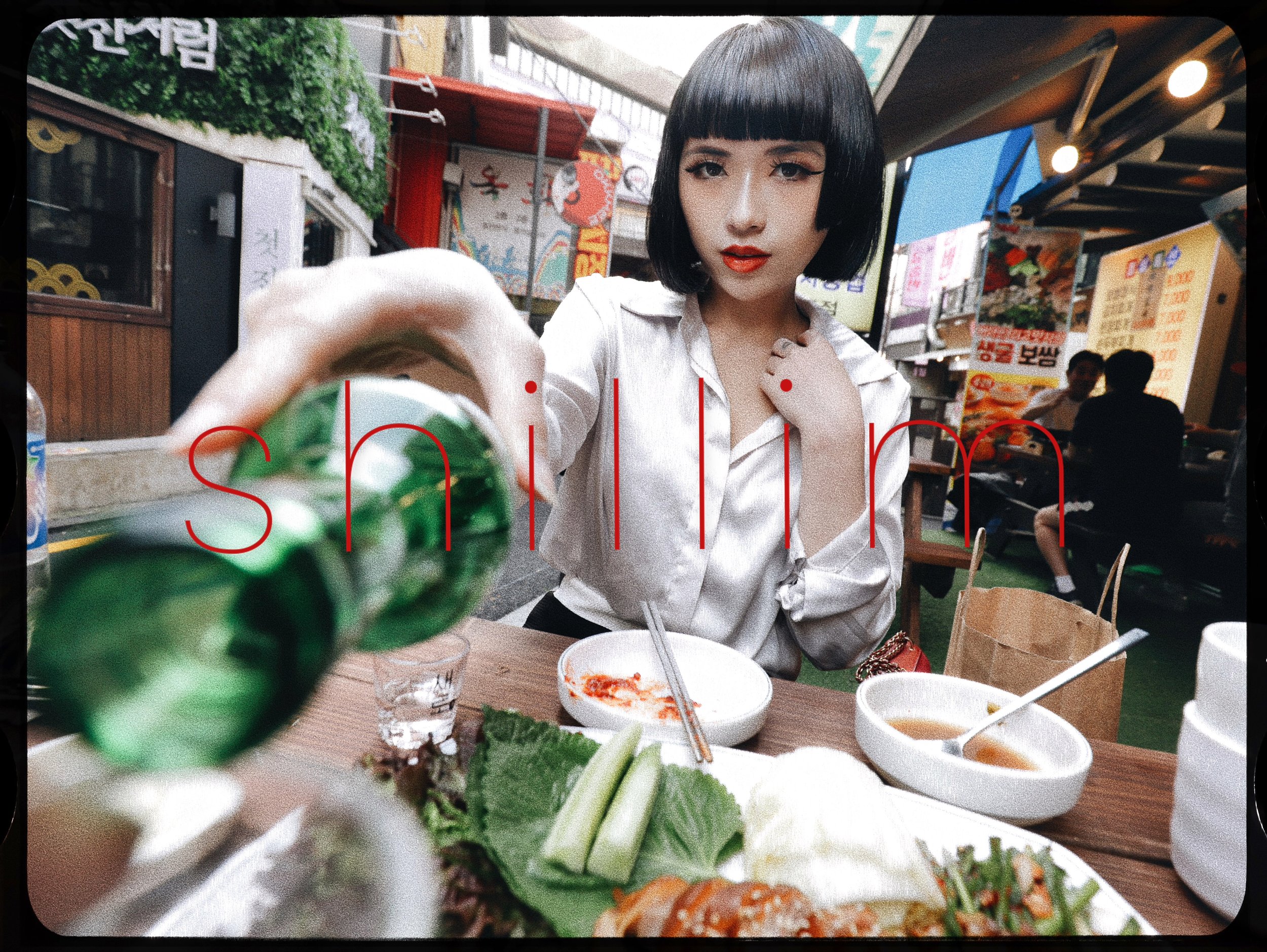
Model @jingruuuus serves up the charms of the much slept-on, Seoul neighborhood of Shillim.
There's a new version of this problem that didn't exist a decade ago. The cultural ministry has been joined by an army of Instagram accounts, YouTube channels, and TikTok creators — foreigners living in Korea, or Koreans who've figured out the international appetite — who now claim the position of "showing the real Korea." Language tutors, food vloggers, neighborhood walkers. The content is more intimate than anything the ministry ever produced. It's also doing exactly the same thing: selecting for the photogenic, the charming, the safe. The recycling bins and the convenience stores and the cherry blossoms. The surface that reads as authentic because it's filmed in portrait mode on a smartphone instead of produced by an ad agency.
The scrubbing hasn't stopped. It's just been crowdsourced.
UNCUT SEOUL exists because of this gap — and because the gap keeps getting wider as more people rush to fill it with the wrong material.
SEOULACIOUS is Seoul's only independent English-language magazine dedicated to Korean style and culture, and the founding editorial logic is simple: the most interesting things happening in this city are not the things being officially promoted. The real Seoul — the one people around the world are actually responding to when they respond to Korean culture — is a city of overlapping histories, contested spaces, women who built entire subcultures under the radar of the fashion industry, neighborhoods that transformed themselves through sheer collective desire before any developer noticed.
UNCUT SEOUL is an editorial series that pairs Seoul's most compelling style talent with the city's most significant locations — not the postcard ones, though some are postcard-worthy — and shoots them as editorial features, published permanently on seoulacious.com. Not Instagram posts that fade. Permanent editorial record. Every picture a kill shot.
For the series we partnered with Elite Model Agency Korea, under the casting direction of NA-YEON KANG (Joanne). The choice was deliberate — and it requires some explanation, because EMA is not a conventional modeling agency.
Most Korean agencies operate on a narrow definition of who gets to represent Korean style: young, tall, within a precise size range, conforming to the industry's default aesthetic. EMA has spent years pushing against that definition from the inside. The agency's most distinctive work is its senior model division — recruiting, training, and placing models in their 40s, 50s, 60s and beyond at a moment when Korean fashion, like global fashion, has treated age as a disqualification. In early 2025, four EMA senior models walked the Milan Fashion Week runway during the Milan Loves Seoul event, showing for Korean designers Sundaum, Tripleroot, and Troa — a debut that drew attention from the Italian Ambassador to Korea and generated coverage across Korean fashion media. The same agency co-judges global auditions with Shanghai-based esee Model Management for Chinese Fashion Week placement. EMA senior models have performed performance art pieces at Italy-Korea cultural exchange events in Seoul. The agency is building a genuinely international footprint, on its own terms, without a government grant or a ministry's blessing.
That institutional instinct — expand the definition, go global independently, refuse the standard playbook — is exactly what made EMA the right partner for UNCUT SEOUL. The series needs models who can inhabit charged locations without the image tipping into fashion fiction. EMA's talent reads as real people in real Seoul, not imported catalog aesthetics. The production values are high. The PR gloss is absent. That combination is harder to achieve than it looks, and it starts with who is cast.
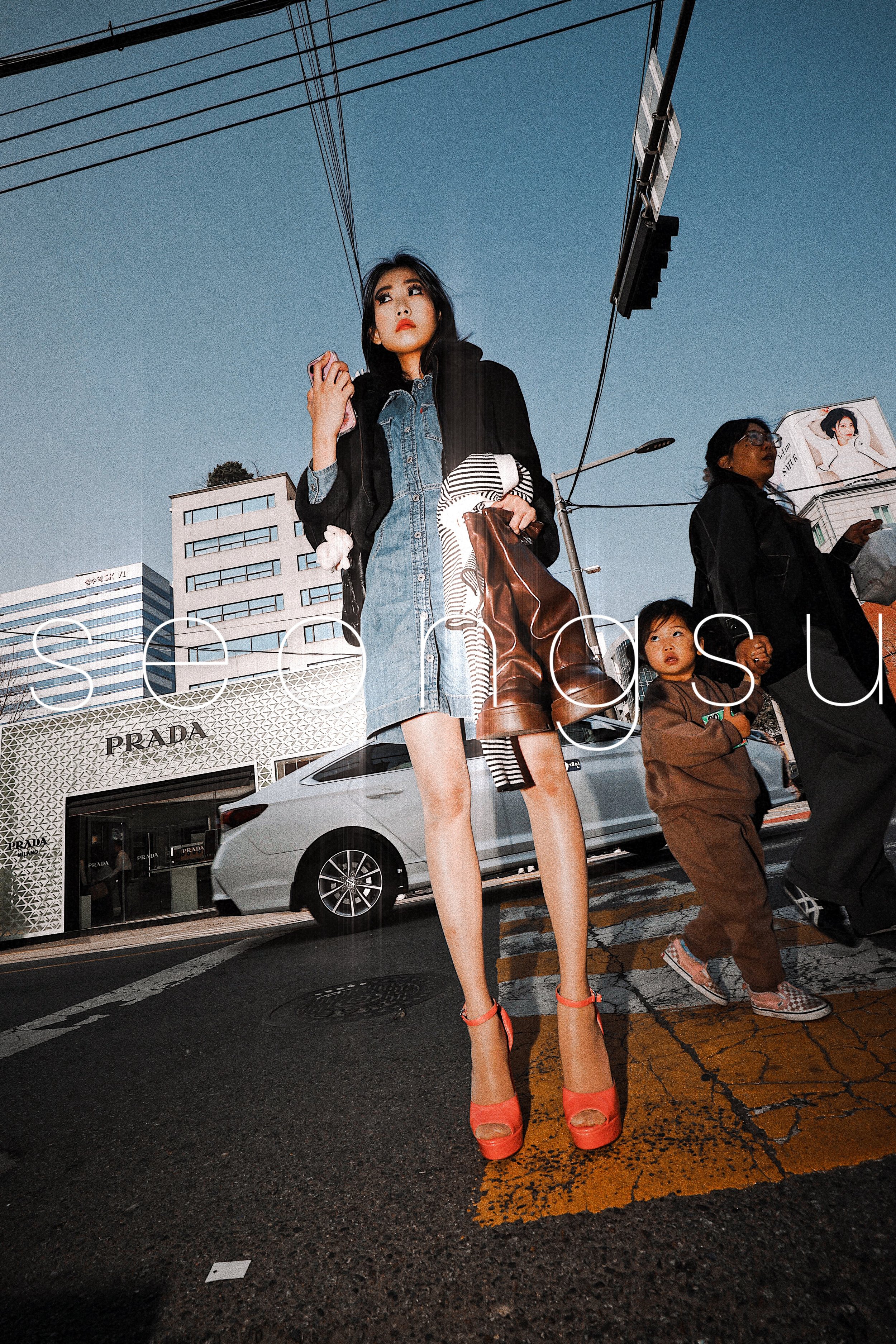
Model @solsolyou embodies the newer, commercial flavor of the old shoe-factory/small industry neighborhood of the now (in)famous Seongsu, neé “Musinsa” station area.
That child watching. That's the whole story in miniature.
Seongsu-dong ten years ago was an industrial neighborhood — leather workshops, small factories, the unglamorous mechanical substrate of a city. Then it became the most photographed neighborhood in Seoul, acquired a Prada flagship and a Musinsa-branded subway station, and is currently mid-transformation from cool to expensive. The child in the brown tracksuit is probably the kid of one of the original residents. He's watching a woman in red platform heels cross the street in front of a luxury brand that would not have been here when his parents moved in. He doesn't know what he's watching. But his body is registering it.
This is what the ministry's campaigns never understood. Culture doesn't travel as message. It travels as image, as body, as feeling — through a process that researchers call kinesthetic empathy: the pre-verbal, embodied way that aesthetic knowledge passes between people and across cultures, below the level of conscious adoption. You don't decide to find Korean style compelling. Something in your visual cortex registers it and your body starts to move differently.
We've been watching this process happen in real time. In February 2020, in Hanoi, we photographed a teenage Vietnamese model — @_pngan.n — and asked her to dress in what she considered Korean style. What came back was mediated through local filters: her mother's interpretation, a makeup artist's idea of what Korean looked like, a fashion fixer's instincts. The result was recognizable but approximate. Korean at one remove.
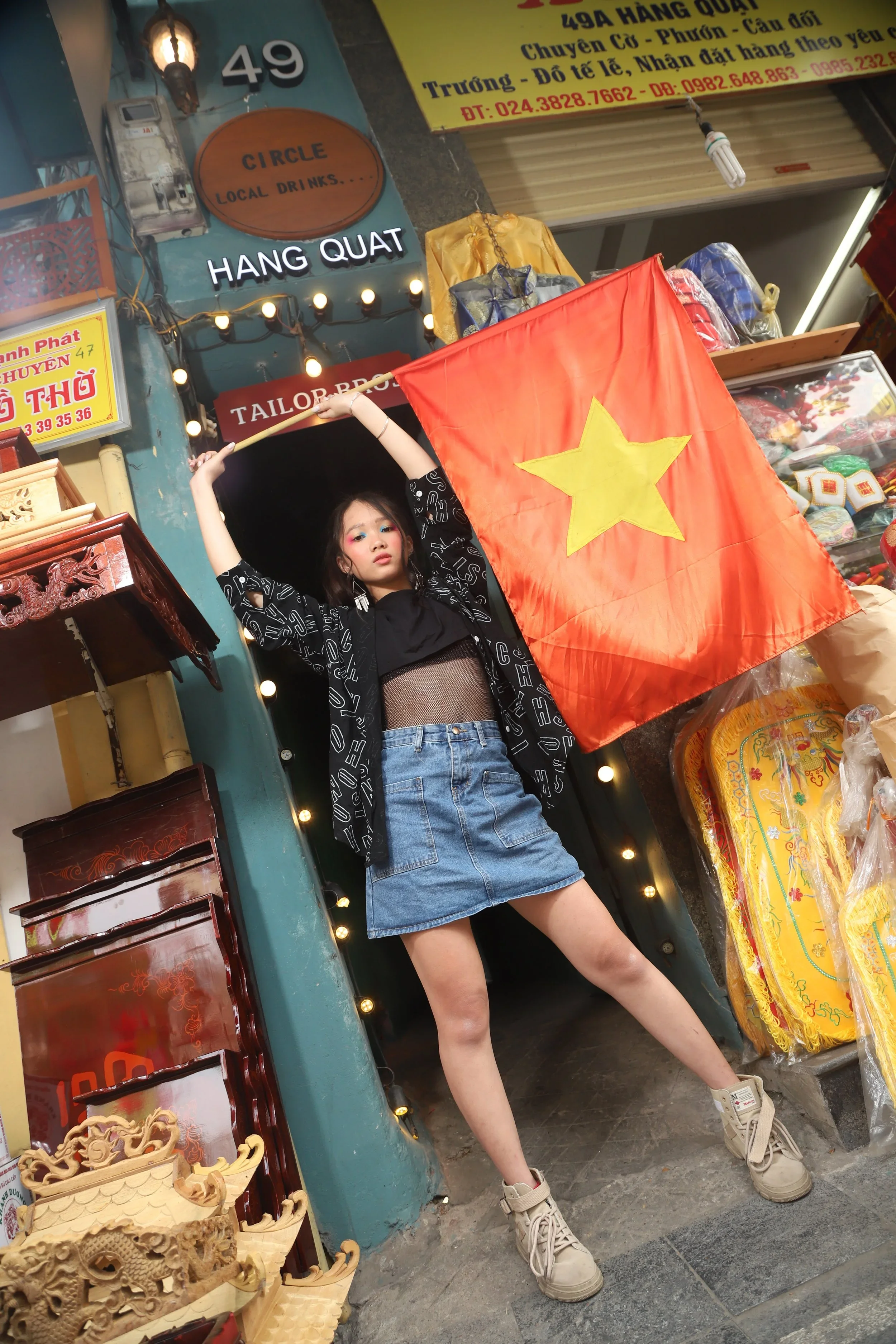
Vietnamese then-child model @_pngan.n, along with help from mom and a makeup artist, channel their notuon of Korean style after being prompted to do so, with denim miniskirt and revealing partial mesh to, combined with a hybrid formal/casual/sporty look with the boots, in Hanoi’s Old Quarter in 2020.
In summer 2025, we photographed the same model again, now a working model, with the same brief. The result was unrecognizable as the same exercise. Without formal training, without any direct time in Seoul, she had developed what can only be described as fluency — styling that was in direct, precise conversation with current Seoul aesthetics, not filtered through anyone's interpretation. Her body had learned Korean style the way a child learns a language: through exposure, through watching, through the slow accumulation of embodied knowledge that doesn't announce itself until it's already there.
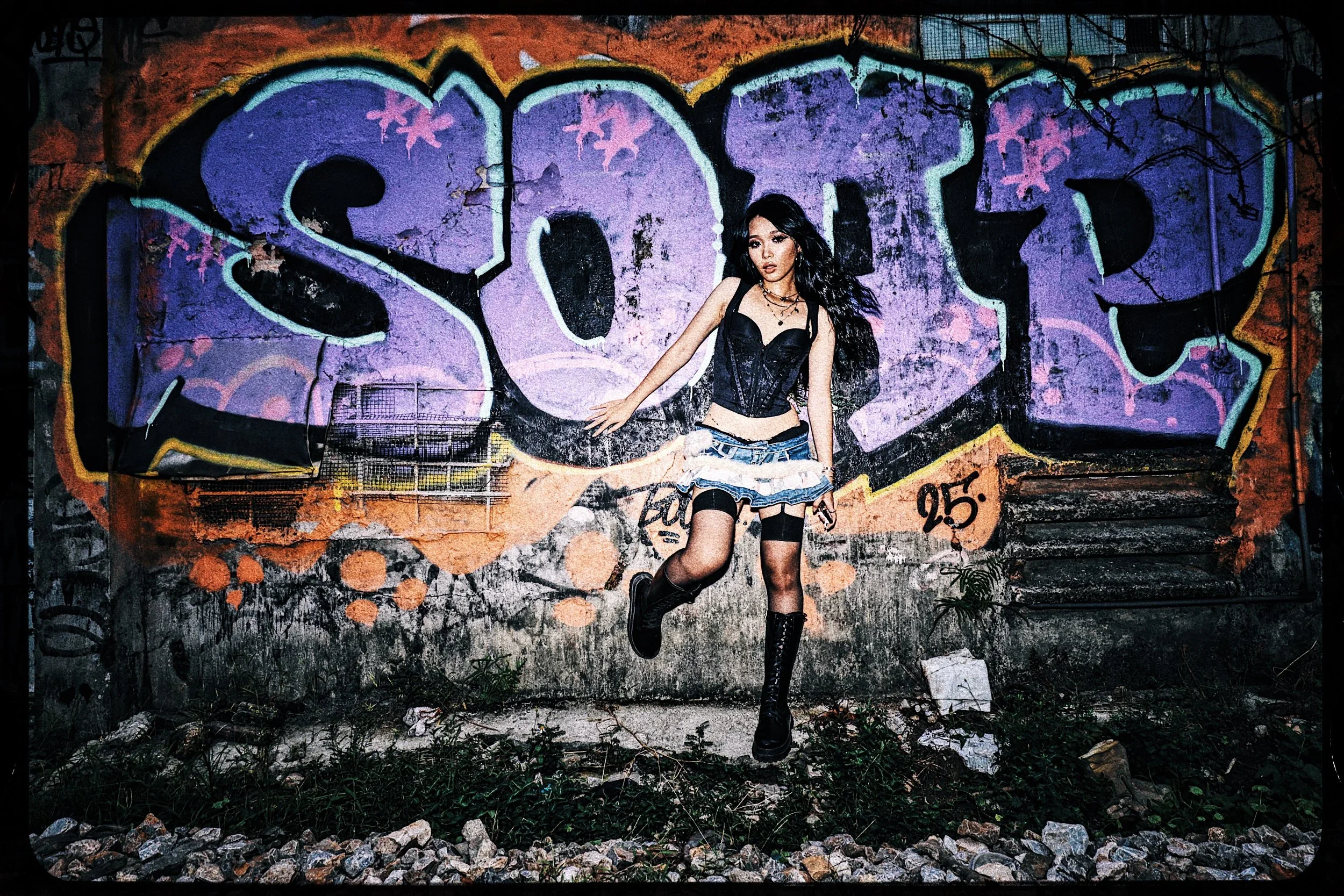
Vietnamese freelance model @_pngan.n in 2025 brought an updated (and more mature and risqué) vision of Korean style that involved the much more micro denim miniskirt with a fur accent, which at first seemed a bit out-of-the-blue….
No tourism campaign produced that. No "Korea, Sparkling" widget. Just five years of Korean content flowing through her screens, absorbed by a body that was paying attention.
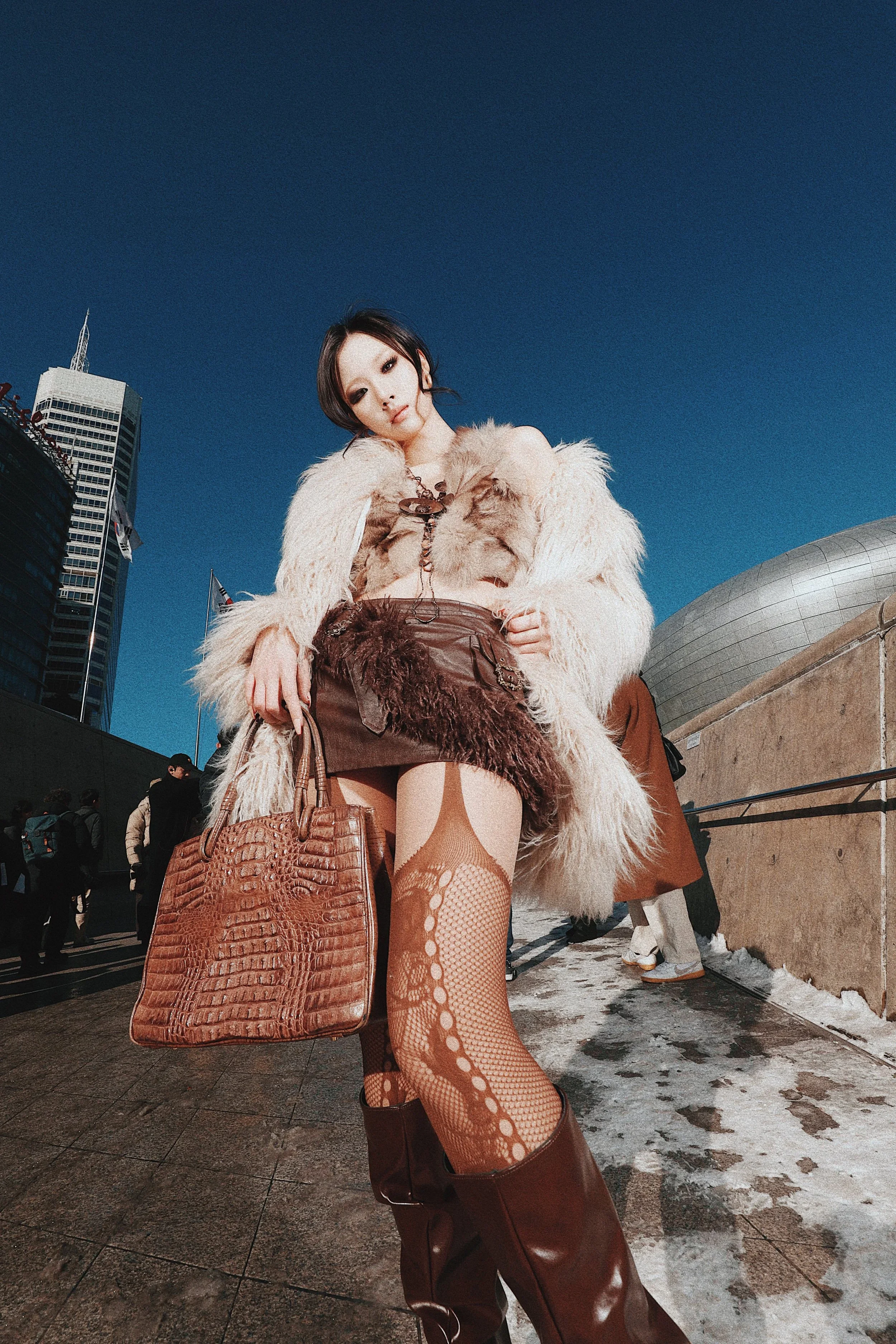
Model and professional influencer manager & stylist @c.hwa_s___ at Seoul Fashion Week in February 2025, wearing a cream shearling coat layered over a leather mini, dramatic feather trim adding texture, and chunky brown leather boots, which made our Vietnamese model @_pngan.n make lot more sense, since she was channeling some major style memes being transmitted directly from Seoul.
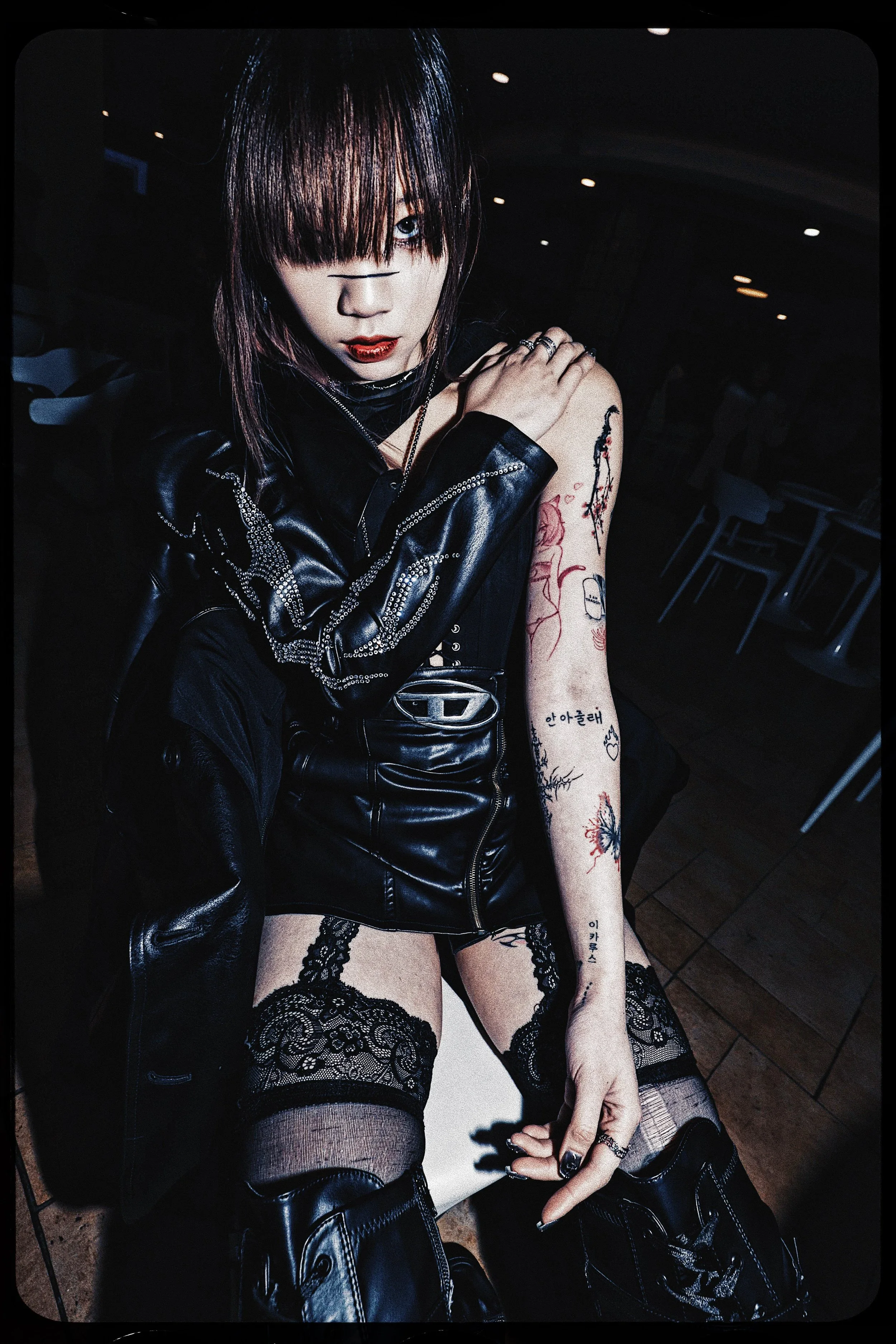
Taiwanese model @neko.ethiriel in black leather everything at Seoul Fashion Week in February 2025—with studded bodice, raw-edged tattoos visible on pale skin,and a much edgier, gritty take on garters, black stockings, and boots, which was an ideas bouncing acriss the world before reverberating and resonating back out from Seoul, surely all over Vietnam and other parts of Asia via Instagram.
That's the transmission mechanism. UNCUT SEOUL is an attempt to document the source.
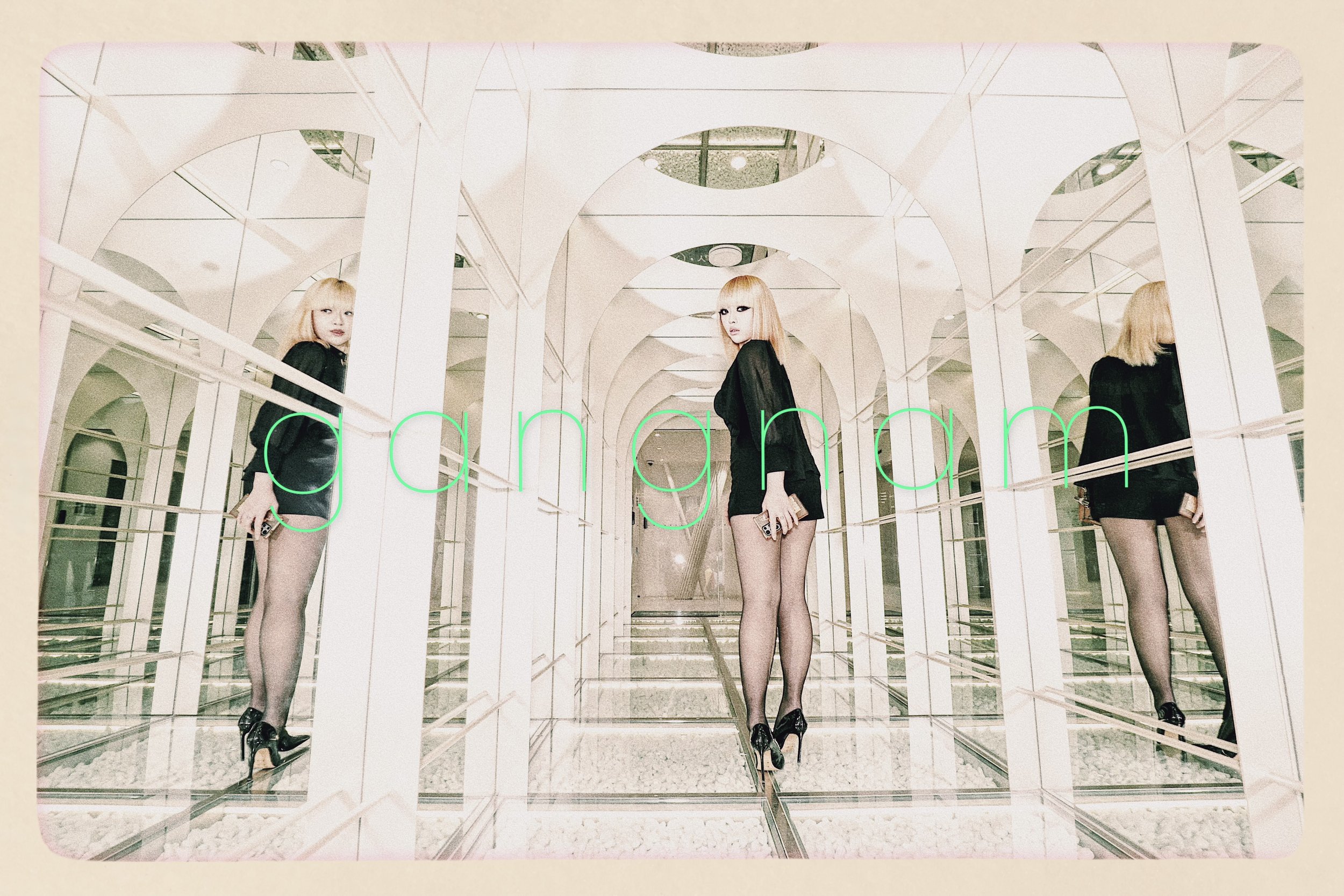
Model @jingruuuus refracts multiple versions of herself through the hall of mirrors insidethe YAAN beauty clinic in deepest Gangnam.
The plastic surgery image is the one that makes people uncomfortable. It should — but probably not for the reasons you've been told to think it should.
South Korea has the highest rate of cosmetic procedures per capita in the world. The industry is concentrated in a specific corridor of Gangnam — a stretch of clinics that operates essentially as an aesthetic manufacturing zone. Korean women, and increasingly men, and increasingly medical tourists from across Asia, go there to rebuild their faces according to standards that are partly Korean, partly aspirational international, and entirely the result of a beauty culture whose intensity has no parallel anywhere else on earth.
The standard Western interpretation of this fact runs something like: Korean women are surgically chasing whiteness, internalizing a colonial beauty standard, victims of a globalized white supremacy they can't see past. Oprah Winfrey made exactly this argument on her show in 2004, expressing concern that Korean women were the world's most prevalent plastic surgery customers because they wanted to look like Western women. The framing was sympathetic. It was also orientalism with a progressive paintjob.
What it did — what this interpretation always does — is deny Korean women agency over their own aesthetic choices while positioning the Western observer as the one clear-eyed enough to identify the false consciousness the Korean woman herself supposedly cannot see. It collapses a sophisticated, internally-driven beauty culture with its own centuries-long history of physiognomic aesthetics into a simple story of racial inferiority and colonial desire. It is, in the precise technical sense, orientalism: the West producing knowledge about the East that serves the West's need to feel enlightened, rather than illuminating what's actually happening.
The research tells a more complicated story. Curtin University's Dr. Joanna Elfving-Hwang, one of the leading scholars of Korean cosmetic surgery culture, has spent a decade dismantling the "wanting to be white" narrative — pointing instead to physiognomy, the centuries-old Korean belief that the face maps character and fate, as the more honest framework. The surgery isn't about becoming Western. It's about becoming more legibly, more strategically Korean. The beauty standard in those Gangnam clinics is Korean-defined, Korean-exported, and Korean-controlled — which is why patients fly in from across Asia specifically to acquire Korean features, not Western ones. The Western observer who diagnoses false consciousness in Korean women's choices reveals more about their own assumptions than about what's actually happening in that waiting room.
The official response from the cultural ministry is deflection — plastic surgery doesn't go in the brochure. The progressive Western response is condescension dressed as concern. Both refuse to actually look.
The image puts you in the waiting room. Louis Vuitton on the floor, feet up on the chair, someone's idea of how you wait for the procedure that will change your face. SEOULACIOUS doesn't tell you what to think about it. It just insists you look.
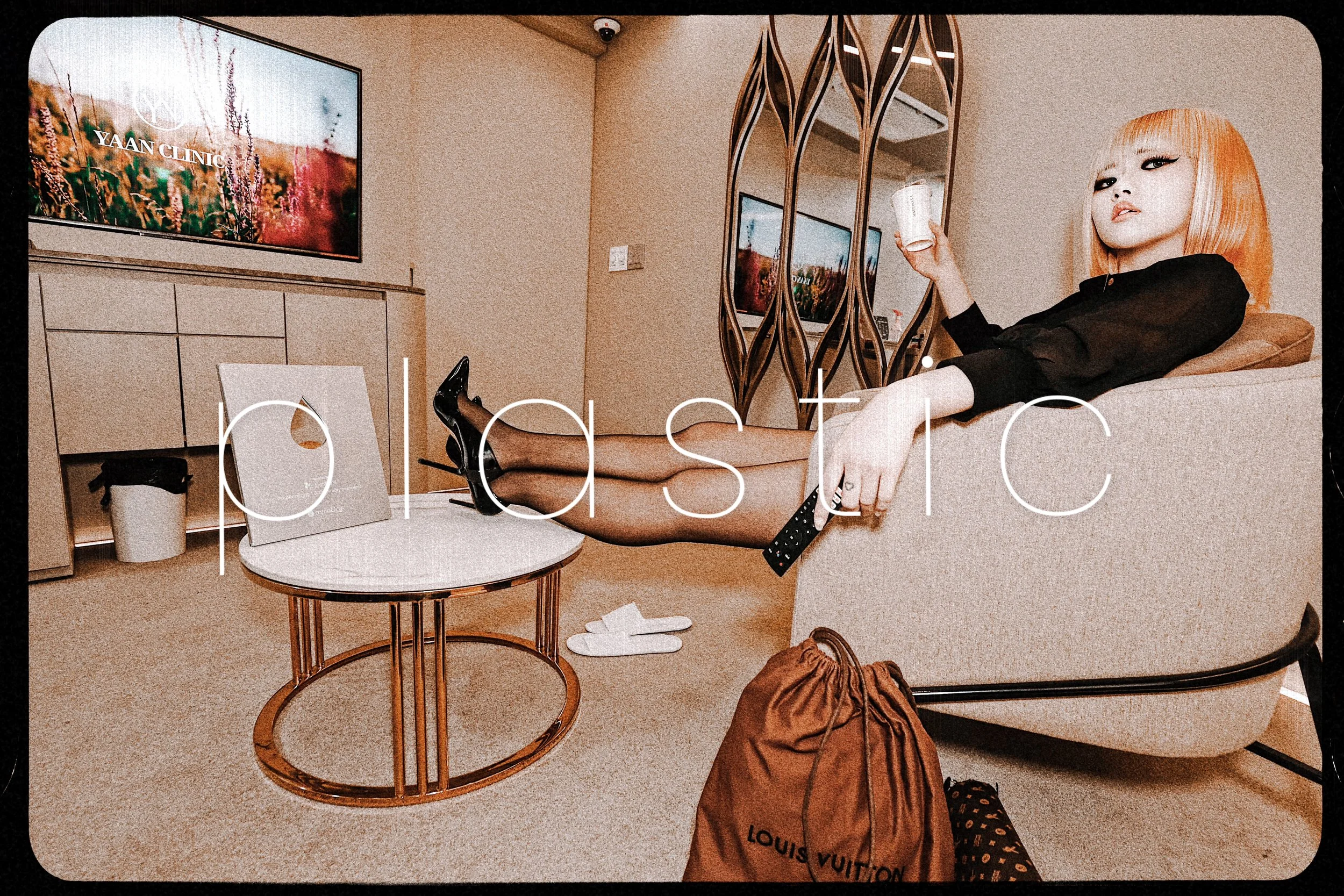
Model @jingruuuus awaits literal VIP treatment inside the YAAN beauty clinic.
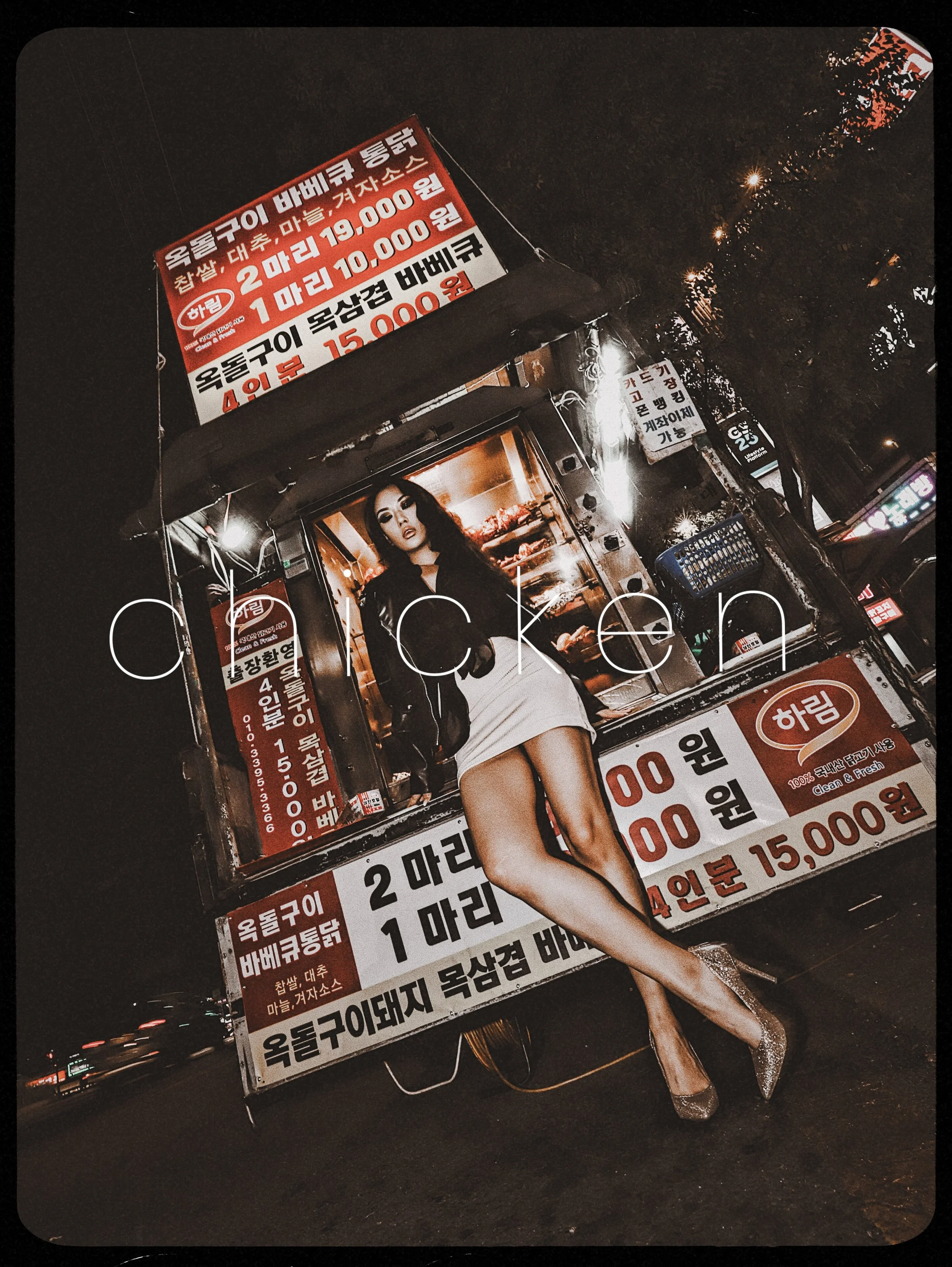
Model @dianainseoul models a chicken truck in Shillim.
[IMAGE: Model on a Korean fried chicken cart at night, white dress, heels, the cart's red-and-white signage filling the frame. Labeled: "chicken."]
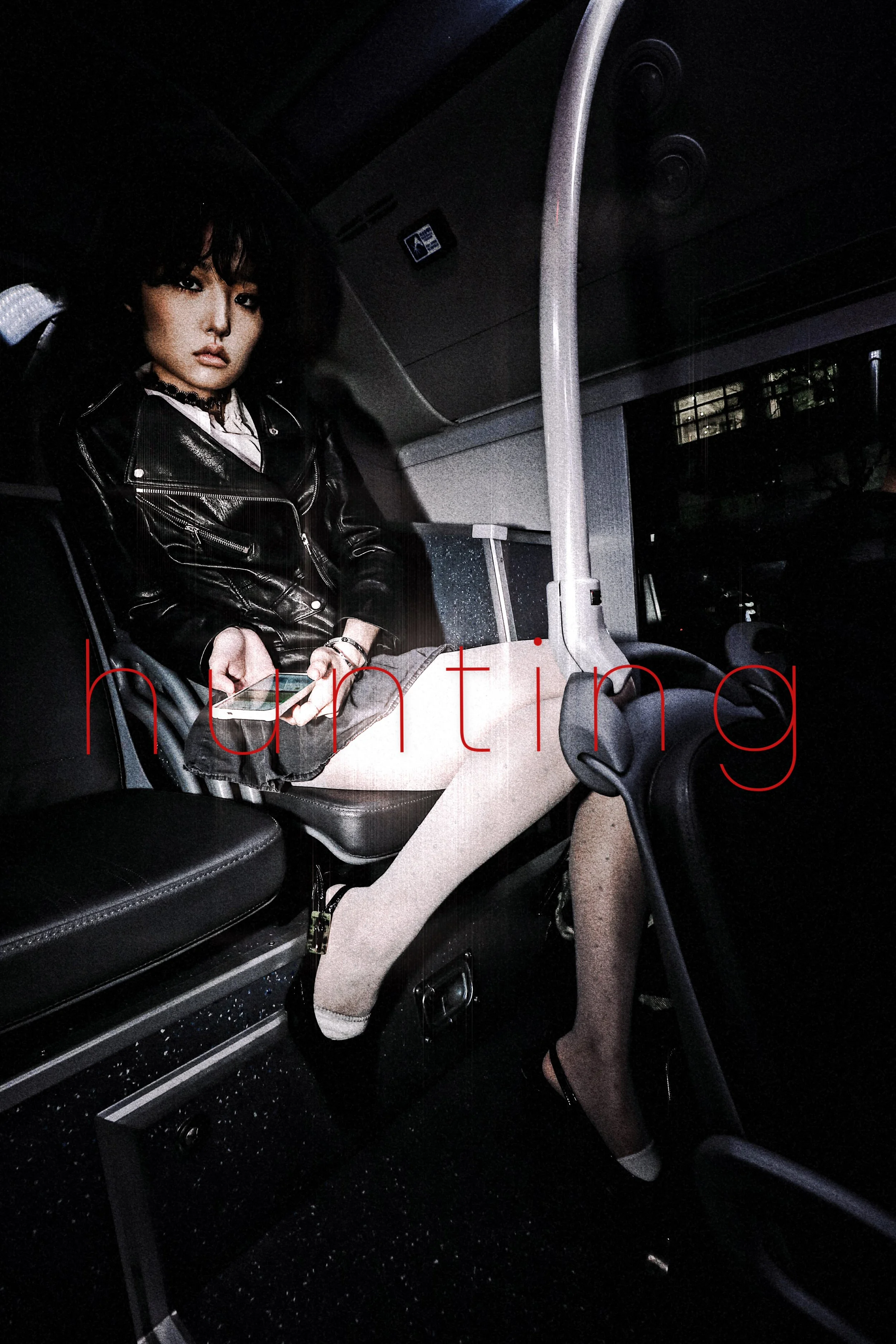
Model @sio.0.show chooses the direct method of Korean “hun-ting” down her target.
[IMAGE: Model in the back seat of a car at night, leather jacket, phone in hand. Labeled: "hunting."]
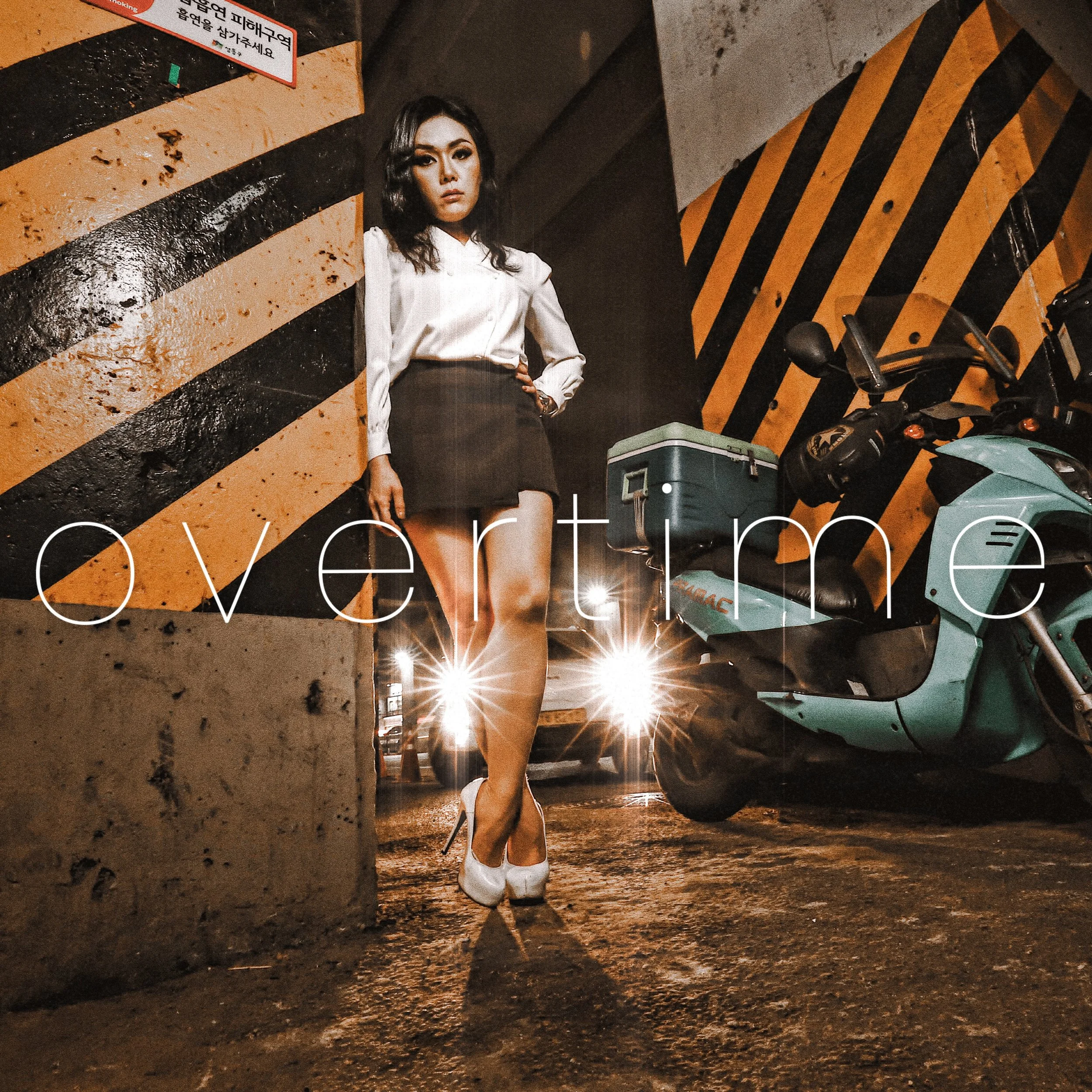
Three images. Three versions of a life in this city at night. The chicken cart, the car, the parking structure — this is the Seoul that the city's young women actually inhabit. Long hours, late nights, sexual agency on the way, the absurdity of being glamorous inside the machinery of Korean working culture. The overtime image is doing something specific: office wear, parking structure, the motorbike of a delivery worker in the background, lens flare off the lights like the city itself is leaking. It's not a commentary. It's a portrait. The city at 11pm, when the official version has gone to bed.
And then this. The Tradition image is the one the ministry would most want to use — traditional dress, classical accessories, the visual vocabulary of Joseon-era Korea that cultural tourism has turned into global symbol. Except look at how it's framed. She's surrounded by racks of hanbok for rent, in what reads as a market rather than a museum, the clothing commodified and reproducible and thoroughly embedded in the modern city's commercial life. Tradition is not a museum piece in Seoul. It's inventory. It circulates. It gets remixed and hired out and worn by tourists and photographed and uploaded.
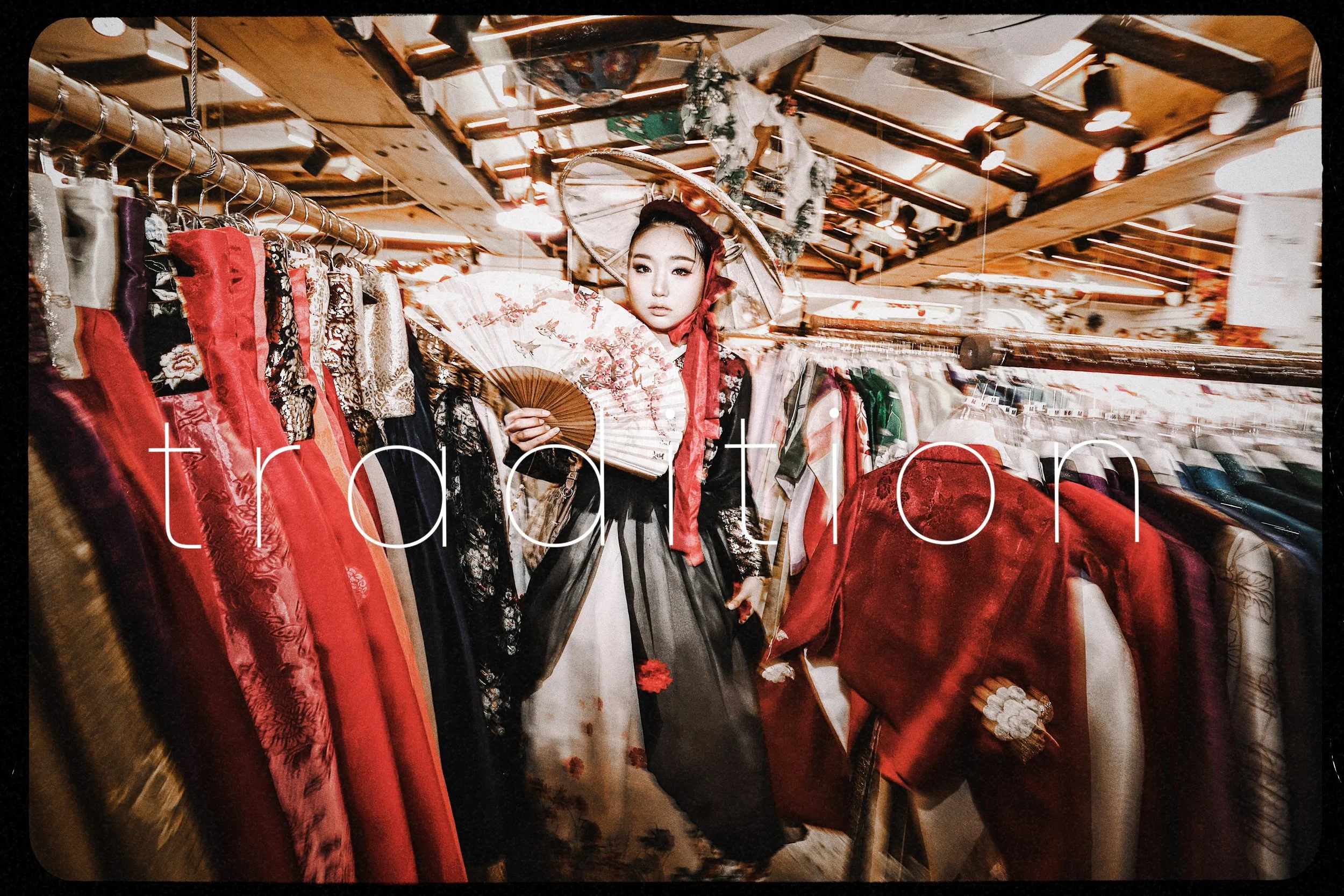
Model @sio.0.show shows us “Tradition” in the best (least gaudy) hanbok in a popular hanbok rental shop in Bukchon, Seoul.
The image holds all of that simultaneously. That's the job.
Gentrification is not a side note to any of this. It's the subject. Every hot neighborhood in Seoul is the same story: organic transformation driven by young women seeking affordable space for new kinds of culture, followed by capital arriving to monetize what they built, followed by the people who built it being priced out. The cultural ministry celebrates Seongsu-dong. It doesn't ask who it displaced.
Back to Itaewon. Back to the thing that started this.
The 트랜스바 — Trans Bar — is still on. The neon is still pink. The camptown created a zone where normal Korean social rules didn't apply, and that zone outlasted the camptown. The sex work geography became the queer geography became the place where, in 2024, 150,000 people showed up to Seoul Queer Culture Festival — the largest in Asia. None of that was planned. None of it was funded by a cultural ministry. It happened because people with nowhere else to go built something in the space they were given, and kept building it, and refused to let it be demolished into something safer.
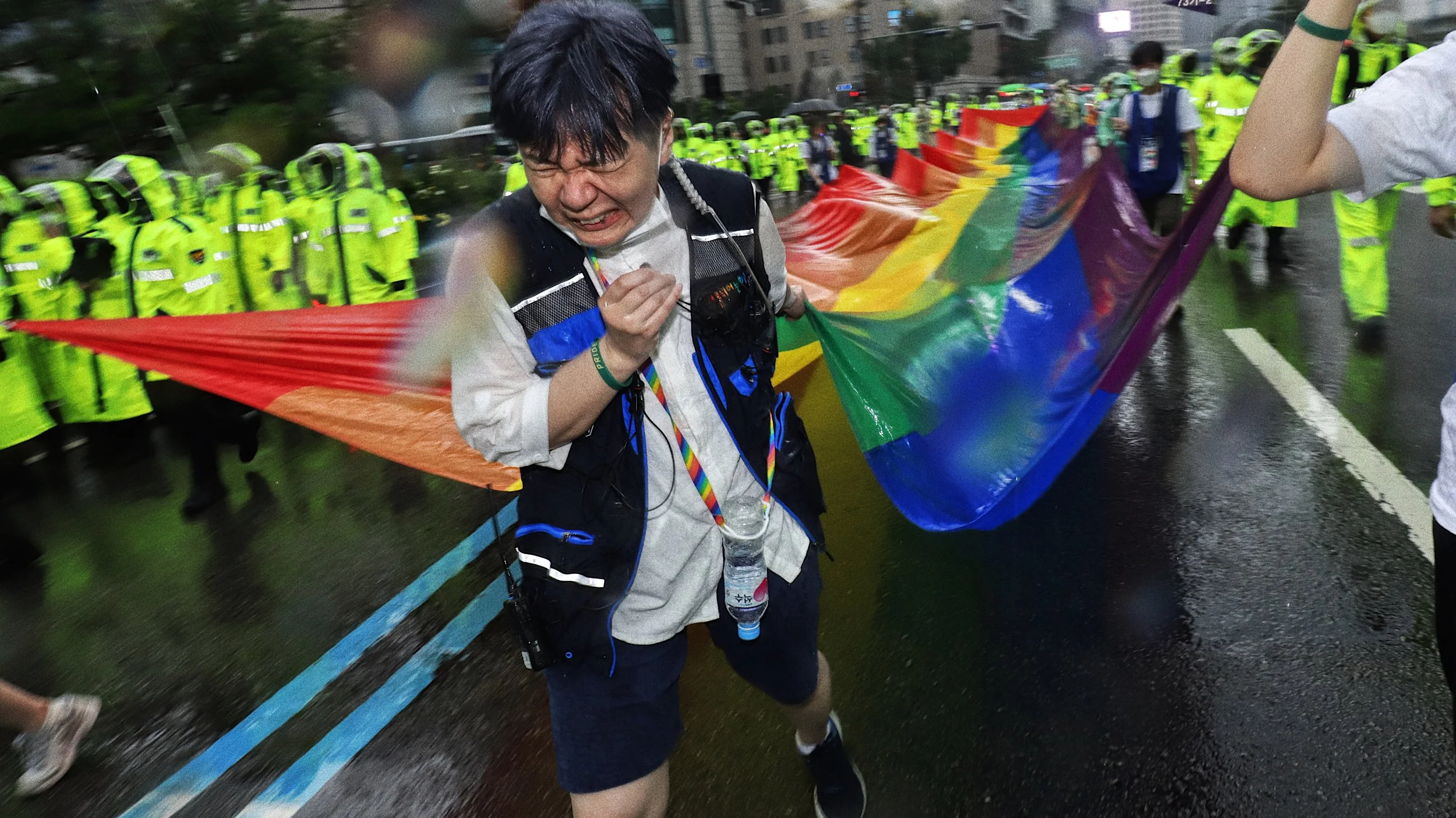
Activists at the 2022 Queer Culture Festival pull their suddenly rain-soaked flag through a Korean sonagi squall through sheer force of will. They are the partial result of prior, other Others in Korea who have insisted on carving out space in society by pure exertion of will to at first, just exist, but later to demand more.
The model in the doorway of the trans bar , in denim shorts and a bandana, lit from behind by the bar's interior neon, is striking a pose that any fashion magazine in the world would publish. She's also standing at one of the most fraught addresses in Seoul. Both things are true. Neither cancels the other.
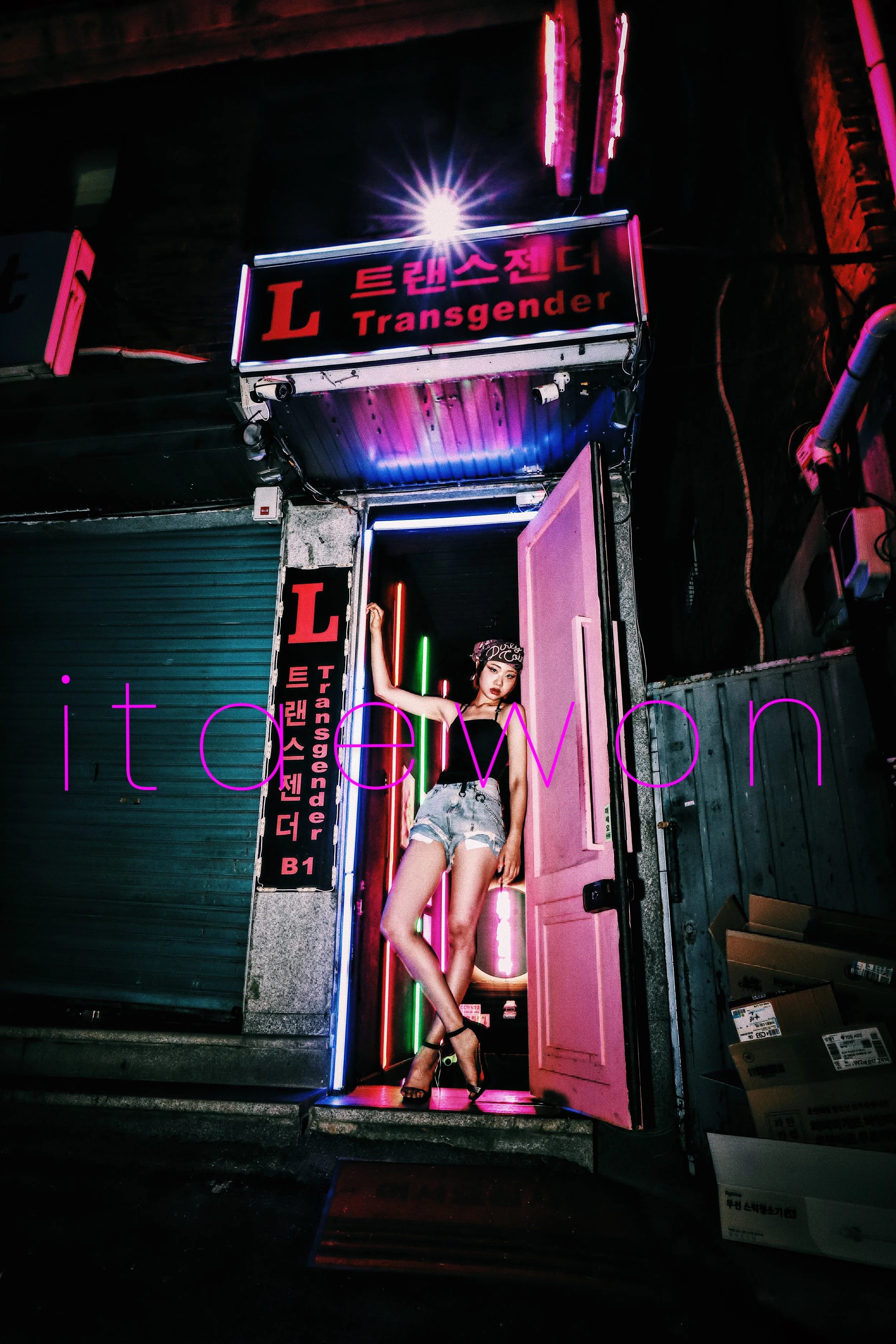
EMA model @se_rim00 stands in one corridor of Seoul’s history.
This is what SEOULACIOUS is doing. Not exposing Korea. Not attacking Korea. Crediting it — for the full complexity of what it actually is. The government spent decades and billions of won trying to project a version of Korean culture that was safe and clean and acceptable and internationally legible. The world looked right past that version and fell in love with the one underneath it: the dark cinema, the brutal pop music system, the all-night street food, the beauty culture that takes no prisoners, the queer community that built its home in the one neighborhood the state had already written off, the women on Hooker Hill who made something human inside conditions that were designed to use them up.
The underground built the brand. The institutions arrived later to take the credit.
UNCUT SEOUL is not only the record of what actually happened. It's the record of what actually is.
This is the first installment of UNCUT SEOUL.
The next goes somewhere brighter. Euljiro and Seongsu-dong — the industrial underbelly that became the coolest real estate in the city, the neighborhoods that young Koreans rebuilt from the inside out before anyone official noticed. Same approach. Same camera. Different light.
Stay with us.
Credits:
Photography: Michael Hurt / @seoulstreetstudios
Casting Director: NA-YEON KANG (Joanne), Elite Model Agency Korea
Makeup Artist (for EMA models): Luv Lee / @artblockeddd
EMA Models
Serim CHO @se_rim00 — Itaewon · Hooker Hill · Homo Hill · Grand Ole Opry
Hanna YOON @yoon_9hn — Gangnam
Independent Models
@maya.inshallah — Itaewon Club
@jingruuuus — Shillim · Gangnam (YAAN Clinic)
@solsolyou — Seongsu
@dianainseoul — Shillim (Chicken Truck)
@sio.0.show — Hunting · Tradition (Bukchon)
@shinyjaky — Overtime (Seongsu)
Fashion Documentary Models
@_pngan.n — Hanoi, 2020 & 2025
@c.hwa_s___ — Seoul Fashion Week, February 2025
@neko.ethiriel — Seoul Fashion Week, February 2025
Published by SEOULACIOUS — Korean Culture, Unfiltered
UNCUT SEOUL is an ongoing editorial series. All images published permanently at seoulacious.com.