She's Not the Object. She’s the Verb.
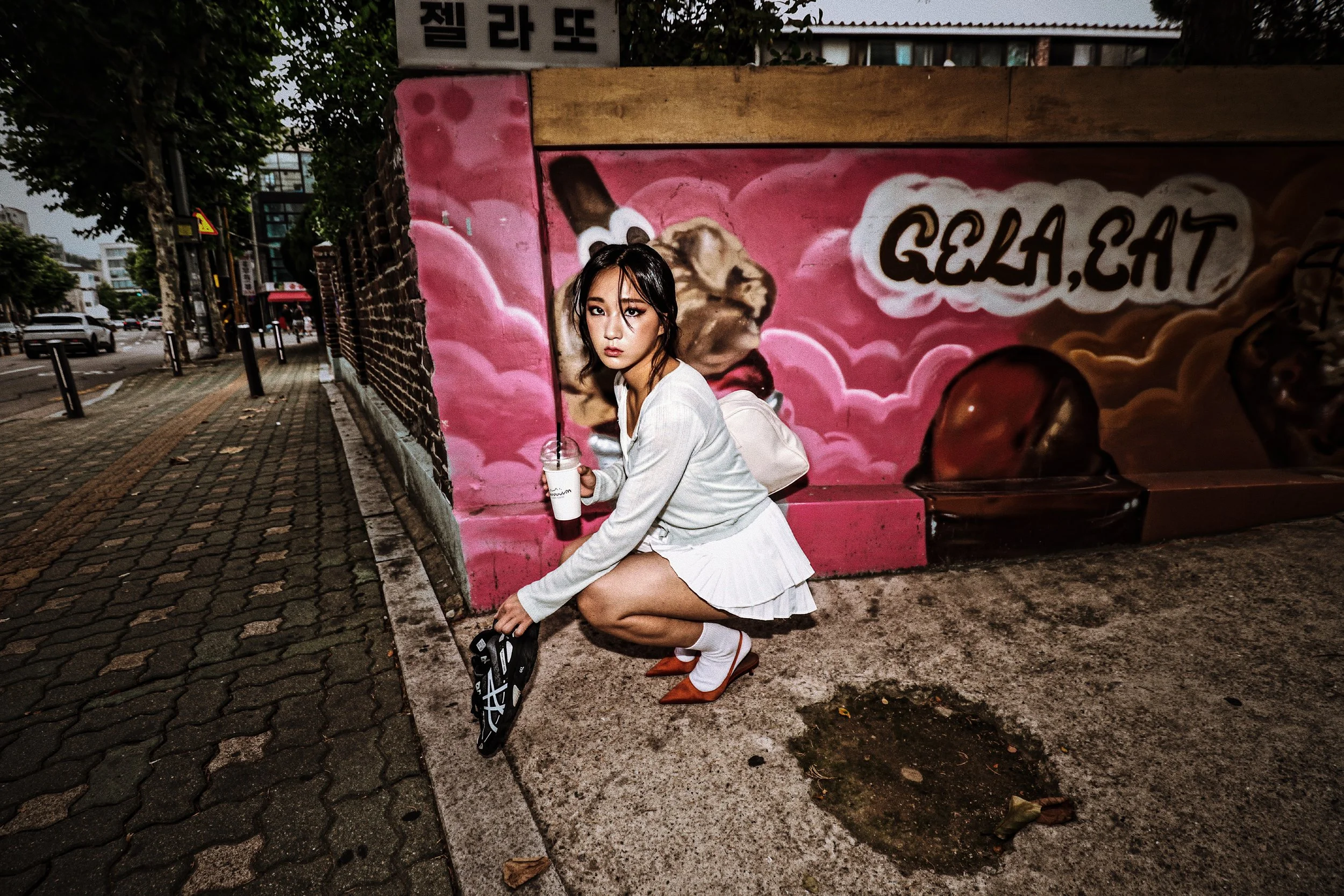
Model @bettercall_betty readies herself for her aesthetic mission in Yeonnam-dong.
A Quick Grammar Lesson
Korean is what linguists call an SOV language — subject, object, verb, in that order, with the verb always last. English front-loads the action: she chose the café. Korean holds it back: she the café chose. You don't find out what actually happened until the very last word.
That's not just a syntax quirk. Korean communication as a whole tends to work the same way — meaning gets layered and withheld, deference and context come first, and the real point often doesn't land until the end of the sentence, sometimes the end of the conversation. Linguists and cultural writers have made this observation for years: in a culture built around reading a room before speaking your mind, saving the decisive word for last isn't an accident of grammar. It's a habit of meaning.
Keep that in mind, because it turns out to be the exact structure of what's happening to this city. You can watch a woman choose a café, a street, a neighborhood, and think you understand the scene — subject, object, nothing left to say. But you don't know what any of it actually means until you see the verb: what she does with that choice, repeated by thousands of other women, until it rearranges the rent, the storefronts, the entire aesthetic identity of a place nobody planned. Seoul, like a Korean sentence, doesn't resolve until the end.
She's the verb.
There's a woman in Yeonnam-dong right now choosing a café.
Not a random café. A specific one, on a specific stretch near what everyone just calls "Yeontral Park" now — the old Gyeongui Line rail bed turned linear park, the nickname itself already doing some of the work this piece is about — for reasons she could probably explain to you in one sentence if you asked: the light, the coffee, the way it feels to be seen sitting there. She'll post about it. Maybe a hundred other women will see the post and make the same choice this week. None of them are coordinating. None of them work for a developer. None of them think they're doing anything except having a nice afternoon.
The park itself has a short, telling history. What's now called “Yeontral Park” — a pun grafted straight onto “Central Park” — used to be an elevated freight rail line, decommissioned and converted into a roughly six-kilometer green corridor starting in 2015, running from Hongik University Station out to Gajwa. It had competition for its name. A rival nickname, “Yeonnidan-gil,” tried to borrow prestige by analogy from Itaewon's Gyeongnidan-gil — pure branding, attached to nothing real. “Yeontral Park” won because it was actually true: there was an actual park to point at. A decade later, “Yeonnidan-gil” is essentially dead — no signage, no delivery app still uses it — while “Yeontral Park” keeps absorbing new cafés every year. Even the naming contest, in other words, was decided by the same mechanism as everything else in this piece: not marketing, but whether real women actually showed up and made it real.
Give any spot in Seoul growing in popularity eighteen months. That alley becomes a destination. The rents move. A magazine — maybe this one — is writing about it as one of Seoul's "hot places." Nobody planned this. Nobody designed it. A few thousand women decided, individually and repeatedly, that this was where they wanted to be — and the city rearranges itself around the decision(s).
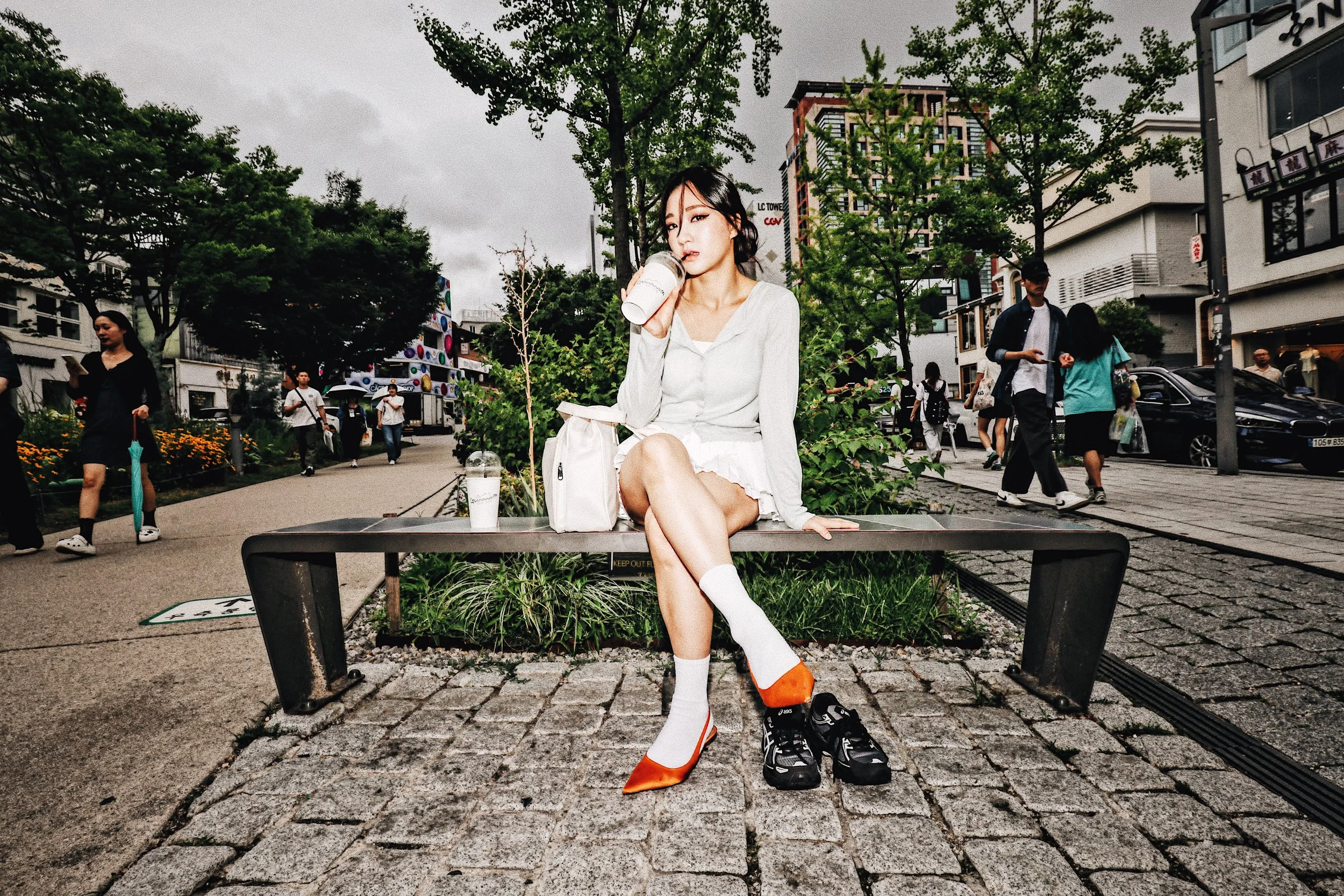
Model @bettercall_betty is metonymic of all young Korean women in Seoul city in that she is master of all she surveys, armed with an 아아/iced americano and elevated aesthetic tastes.
We have a word for this. We'll get to it. But first, the part everyone gets wrong.
The Object of the Sentence
Western film theory has a famous idea, and it's mostly right: the camera looks, and women get looked at. Laura Mulvey named this decades ago — the "male gaze" — and it's held up as an analytical tool ever since. Object of the gaze. Something to be seen, not someone doing the seeing.
Korea offers one of the clearest real-world case studies of exactly this mechanism — proof, if the theory needed it, that the male gaze isn't just a Western cinematic abstraction but something that plays out with brutal specificity in daily life. The evidence has a name: 된장녀, or doenjangnyeo (pronounced roughly dwen-jahng-nyuh) — literally "soybean paste girl," a slur that emerged in the summer of 2006 aimed at young women who supposedly ate cheap food so they could afford expensive coffee.
The Starbucks part isn't incidental — it's the whole joke. Doenjang is fermented soybean paste, the base of one of the cheapest, most humble dishes in Korean cooking. The slur's entire logic was: this woman eats ₩3,000 stew for lunch so she can carry a Starbucks cup in the afternoon. Scholar Jee-Eun Regina Song, who studied the controversy directly, found the cup wasn't just a prop in the mockery — it was the mockery's central image, repeated so often it became shorthand for the whole stereotype.
But look at what was actually being punished. It wasn't the spending. Plenty of men spent plenty of money on plenty of things — drinks after work, golf, whatever — without a slur following them home. What made the Starbucks cup dangerous wasn't its price tag. It was what it announced: that the woman holding it knew exactly what Starbucks signified in the global cultural conversation, and she was carrying that knowledge in public, unapologetically, as her own. She wasn't hiding good taste. She was performing it.
Worth pausing on what Starbucks specifically meant in the Korean conversation, because the choice of target wasn't random. When the chain opened its first Korean store in July 1999, it planted itself directly in front of Ewha Womans University — Korea's most prestigious all-female university — a decision that was not incidental but a deliberate bet on young women as the nation's actual culture-makers and trend-setters. The bet paid off instantly: lines out the door, a sensation from week one. And almost as fast, carrying a Starbucks cup became shorthand for a very specific, very public kind of status — the coffee equivalent of a designer handbag, legible to anyone who saw it. That's precisely why it became the flashpoint. A brand deliberately launched to be read as a woman's public declaration of taste was always going to become the exact object a backlash aimed at that taste would seize on.
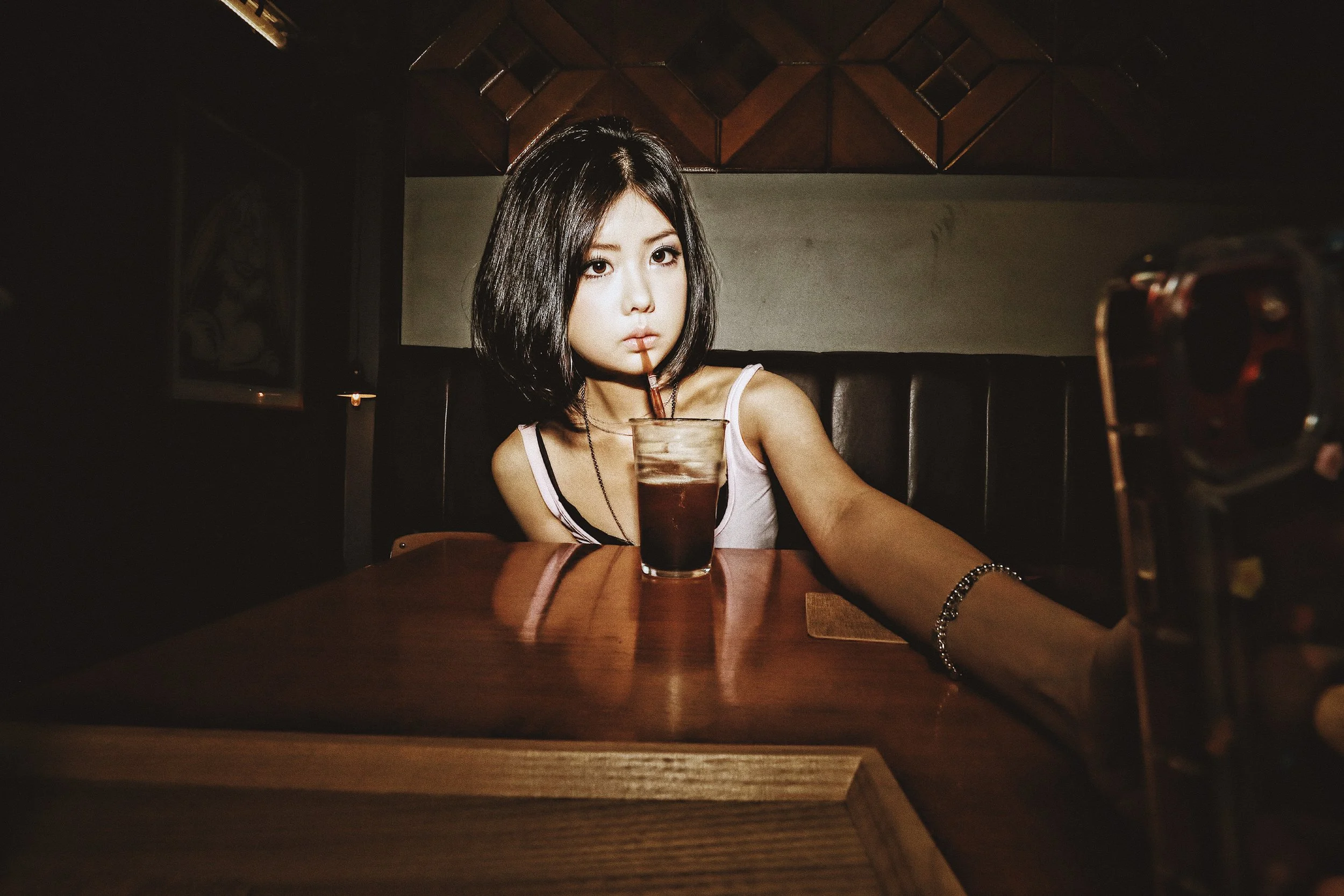
Model @sang_eun0506 nurses her obligatory iced Americano inside the by Nakrang Para coffee shop (“A Local Oasis in Seoul”) @nrparlour_official in the center of Yeonnam-dong’s "“Yeontral Park.”
Here's the thing everyone missed: doenjangnyeo wasn't punishing spending. It was punishing visibility. A woman sitting in a coffee shop, making a public, legible statement about her own taste — that was the crime. The insult didn't just mock her. It stripped the cultural meaning out of what she was doing and left only "vain" and "wasteful" in its place. She wasn't allowed to be a person exercising judgment. She had to be reduced to an object with bad priorities.
There's actually a whole genre of Western horror movie built on exactly this move. Feminist film scholar Linda Williams wrote about it — the moment when the frightened woman on screen finally looks back at the monster, and for a second there's real recognition between them. And then, almost without fail, the movie punishes her for looking. She gets blinded, restrained, turned away. The look itself is dangerous, so the story disciplines it.
Doenjangnyeo is that same discipline, minus the movie theater. A woman's gaze — her visible judgment, her public taste — her agency — gets punished the instant it becomes legible.
This isn't even a 2006 invention. Push back a century, and you find her predecessor: the modern girl (모던걸) of 1920s and '30s Gyeongseong, as colonial-era Seoul was then called — bobbed hair, Western dress, dark lipstick, a fox-fur stole, walking the street with a public visibility no Korean woman had claimed before. The press turned on her almost instantly. "Modern girl" curdled into "bad girl" (못된껄/mote-dwaen-geol) — a slur built by mocking the pronunciation of the English word itself. Whether she held a job, went shopping, or simply took her leisure where she could be seen, the media filed all of it under the same charge: moral delinquency. Doenjangnyeo didn't invent the discipline. It just inherited it.
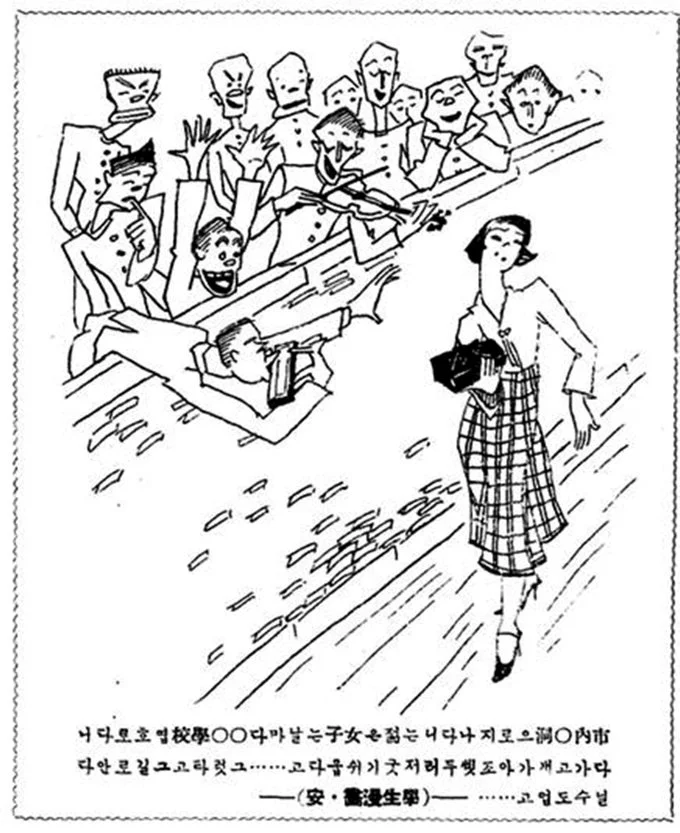
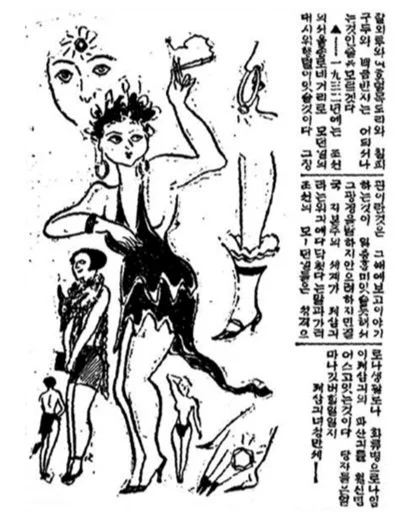
Newspaper cartoons from the Korean magazine 별건곤 (Byeolgeongon), showing a modern girl walking past a boys' school wall while a crowd of male students lean over the fence, gawking and shouting — while she pointedly looks away, unbothered. Women’s consumptive choices have come under fire as a moral temperture test of the nation for more than a century now — it’s nothing new.
Except it didn't work.
“Ladification” Is the Part Nobody Planned For
Here's what the doenjangnyeo backlash couldn't account for: a look is something you can punish. An action, repeated by thousands of people, is not.
This is where things actually got interesting, because while the mockery was happening, women kept doing the thing they were being mocked for. They kept choosing where to sit. What to drink. Which street felt worth being seen on. And because Korea's neighborhoods don't get built top-down the way you might expect — no master plan handed the aesthetic identity of Yeonnam-dong to a committee — those accumulated, uncoordinated choices became the plan. Landlords noticed. Businesses adjusted. Entire neighborhoods reorganized their identities around where women had decided to be.
There's a name for this: ladification — the word itself is doing the argument's work before you even get to the definition. "Gentrification" comes from "gentry," the landed gentlemen whose money and taste were assumed to characterize a neighborhood's transformation. Swap "gentlemen" with "ladies" and you get the actual mechanism at work in Seoul: organic gentrification, powered not by organized, official capital but by the collective, uncoordinated aesthetic judgment of young women. It's not a metaphor. It's the actual mechanism behind Yeonnam-dong's transformation into "Yeontral Park," behind Seongsu-dong's shift from industrial backwater to Instagram landmark, behind Euljiro's rebranding into "Hipjiro" — behind the entire aesthetic logic of what makes a Seoul neighborhood "hot" in the first place.
Here's why the word "gentrification" alone was never going to cut it. The textbook version of that story runs capital-first: a developer or investor spots an undervalued neighborhood, buys in, renovates, and a wealthier population follows the money. Capital moves, then people follow. That's a fine description of plenty of American cities. It is not what happened in Yeonnam-dong.
Nobody with capital woke up one morning and decided a converted rail bed needed a coffee-shop economy built around it. What happened is the opposite order of events: young women started showing up, taking photos, coming back — and only then did rents start climbing, landlords start renovating, cafés start competing on aesthetics instead of coffee. The capital didn't create the value. It arrived afterward to formalize a value that had already been made, for free, by thousands of individual aesthetic choices. You can watch this exact mechanism repeat itself — a neighborhood tips, its original small businesses get priced out by the very appeal they helped generate, and the whole cycle restarts one block over, in whichever nearby street still has cheap rent and enough character left to be worth discovering. Ikseon-dong did this to itself and then handed the baton to the next street over. Yeonnam-dong is doing it right now, in real time, to itself.
Standard gentrification theory has no explanation for why it's specifically this demographic, making these choices, that the whole mechanism runs on — because it was never built to ask that question. Ladification asks it, and answers it: gentrification's actual engine, in Seoul, is running almost entirely on where women in their twenties and thirties decide to sit down.
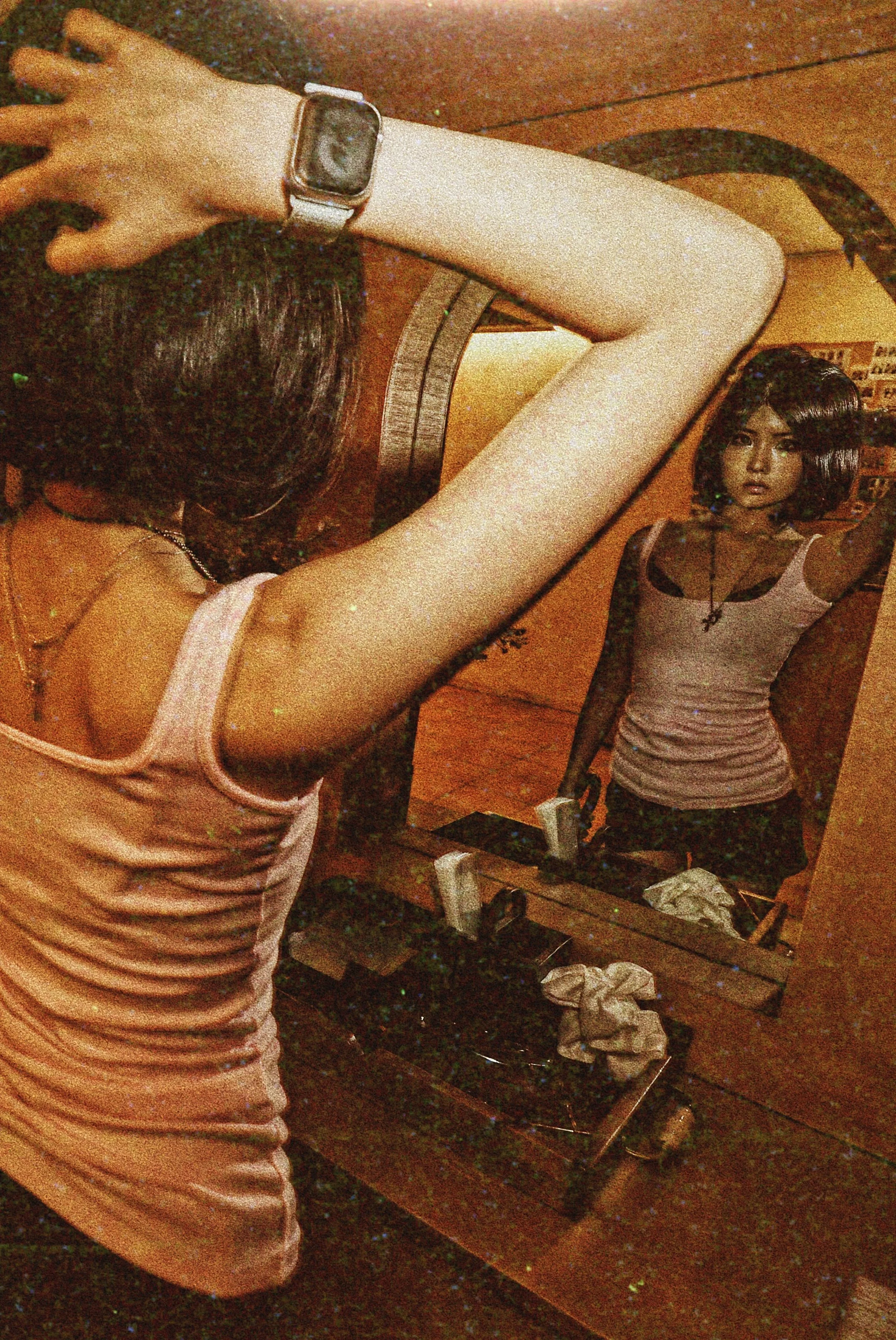
Model @sang_eun0506 doesn't just consume the space inside of one of the many ubiquitous selfie studios that punctuate ladified space in Seoul – she transforms it.
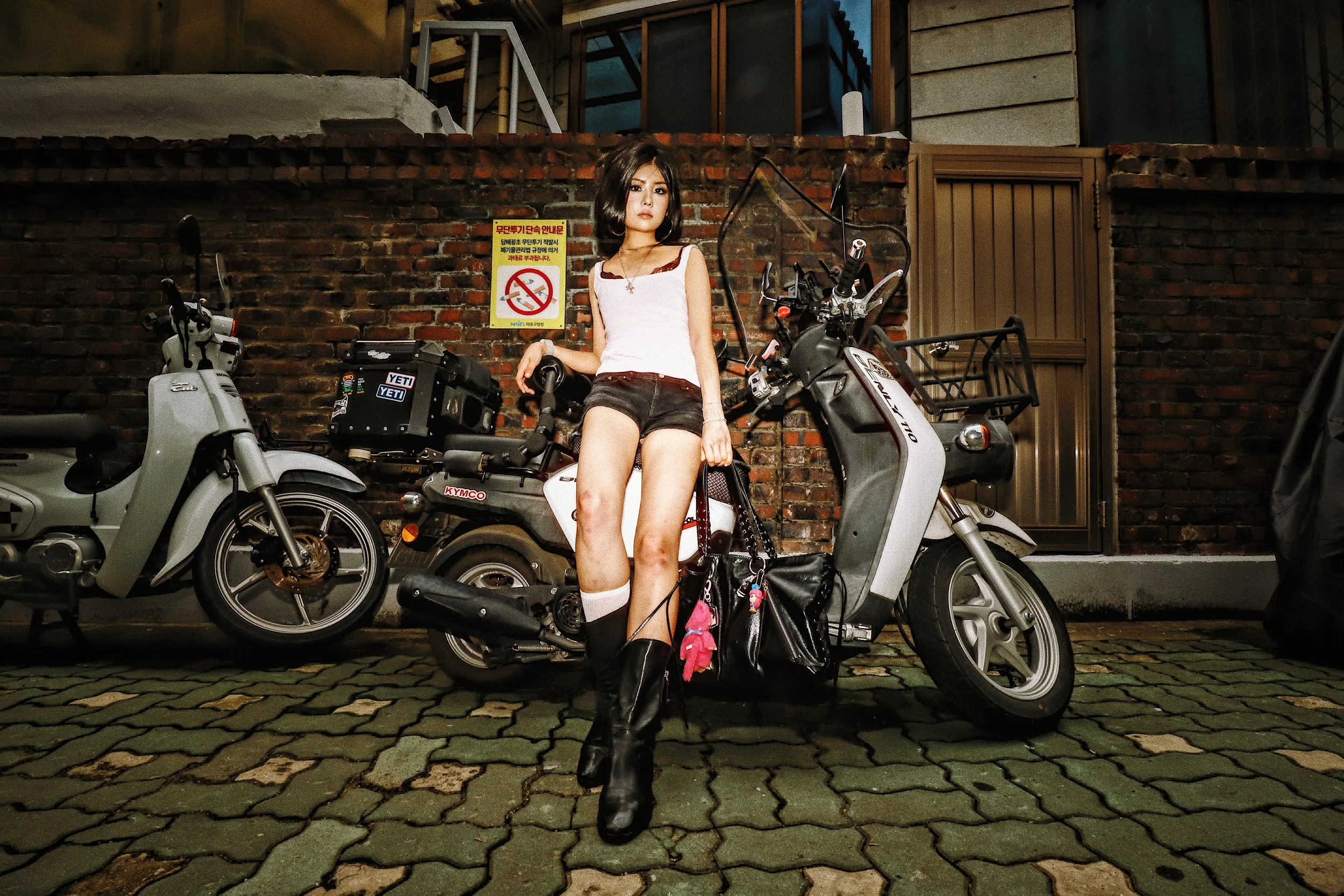
Model @sang_eun0506 other young women like conquer the space wherever she sits.
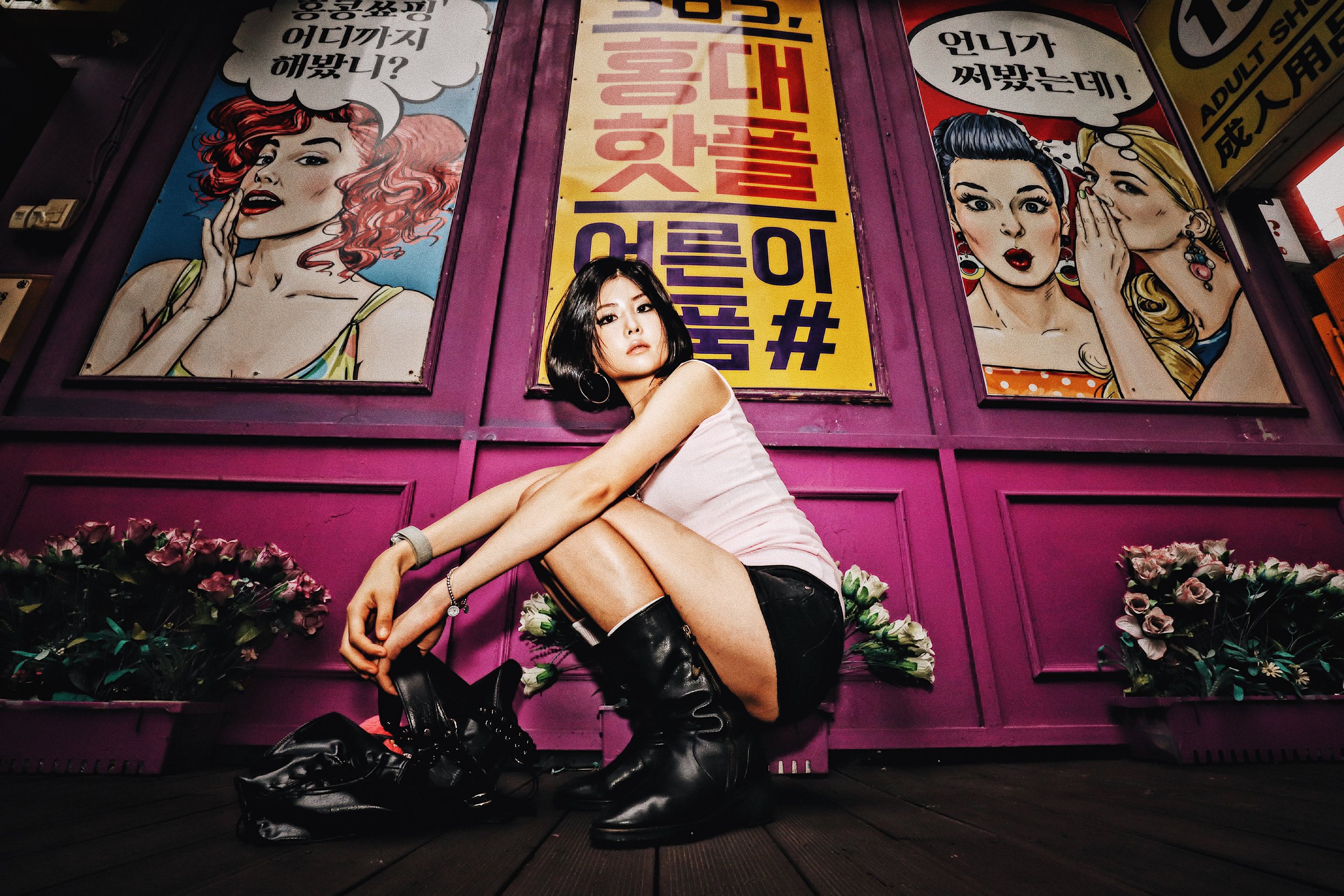
Model @sang_eun0506 take up space outside the art gallery-style storefront that draws in the eye for an adult toys establishment at the front of Yeontral Park. Even 10 to 15 years ago, such stores made newspaper headlines, while now they are just part of the aesthetic backdrop of the area and have just becomegreat visuals for Instagramming.
[IMAGE PLACEHOLDER 4 — The verb, plural]This is the spot for a small grid or sequence — three or four images, if you shot that many distinct consumptive acts today: choosing a table, browsing a shop window, walking a specific street, sitting down somewhere new. The point of this placement is volume and repetition, since the paragraph's whole argument is that no single choice matters but the accumulation does. A single striking image undersells this one; a loose sequence sells it.
Which means the horror-movie logic breaks down completely in the Korean case. You can punish a look. You cannot punish a rent increase that already happened because ten thousand women already decided where they wanted their coffee.
She's the Verb
Korean art critic Ji-Sook Paik made the case decades ago, in a line photographer Hein-kuhn Oh found compelling enough to build an entire body of work around: girls are "both the subject and the object of desire." Oh's 2005 photobook Cosmetic Girls was his answer to it — young women photographed in the full apparatus of their own self-fashioning, makeup as mask and makeup as face at once. It's one of the sharper visual arguments in Korean art for exactly the duality this piece opened with: not simply an object of a gaze the way classical Western film theory assumed, but a subject too — curating her own image, aware of how she's seen, shaping it on purpose.
That's a real and important claim, and it's not mine.
Here's what I'd add to it.
She's not just the subject and the object. She's also the verb.
Paik's formulation doesn't account for what happened after Starbucks opened at Ewha, after the term “doenjangnyeo” tried to shame the look back into silence, after the mockery failed: what these women actually did, at scale, to the physical city around them. That's the part the existing theory stops short of. That's what the rest of this piece is actually about.
You can discipline a look. You cannot discipline a verb once it's already reorganized the city around it.
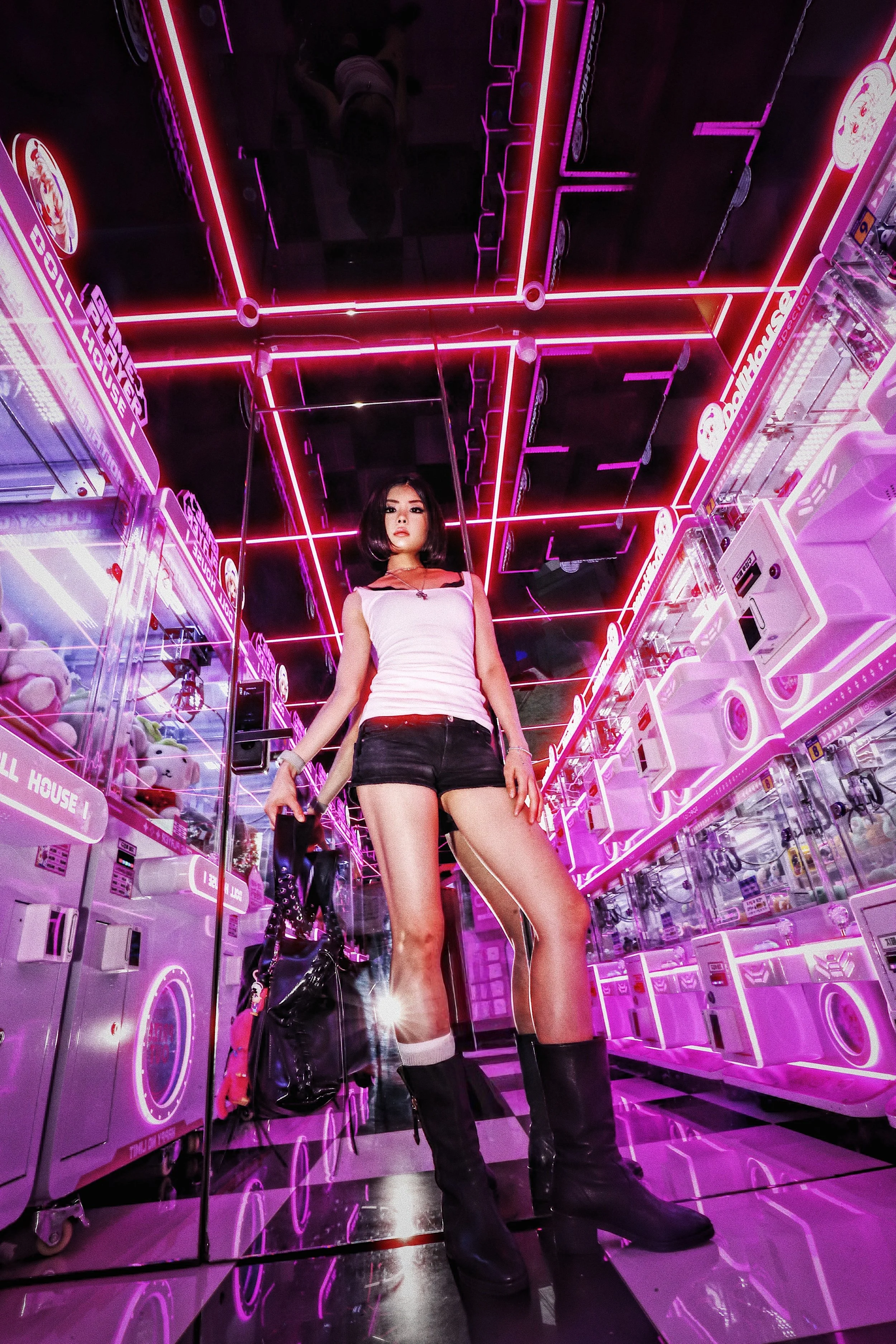
Model @sang_eun0506 conquers and defines everything within the ladified space of not just the gacha shop, but of “Yeontral Park” itself.
Let's be blunt about what this actually is: this is about aesthetics. Not vibes. Not magic. Aesthetics — as in, a specific body of taste, exercised by specific people, with specific, traceable consequences.
Because here's what usually happens when people talk about a Seoul neighborhood being "hot." They talk about it the way you'd talk about weather — it just happened, the vibe just arrived, the place just has something. That's not analysis. That's mystification, and it's the same move people make when they exoticize anything they can't be bothered to actually explain. Yeonnam-dong wasn't always Yeontral Park. It was a quiet, unremarkable residential neighborhood for decades before it was anything else — same with most of the alleys now getting written up as Seoul's coolest streets. So ask the actual question nobody bothers to ask: why this alley, why this decade, why did the transformation start exactly when and where it did? "Good vibes" isn't an answer. It's the absence of one.
Here's the answer, and it's not mysterious once you're willing to look at it directly: a very long history of social discipline aimed specifically at punishing women for wanting things — for consuming, for having taste, for being visible about both — got turned, at some point, into the very mechanism women used to build the city in their own image. Doenjangnyeo was supposed to shame the desire back into hiding. Instead, Korean women took the exact weapon aimed at them and used its own momentum against it — a judo flip on the entire ideological broadside, using the opponent's force to throw them. The mockery didn't stop the consumption. The consumption became the redevelopment plan nobody voted on and everybody now calls a hot place.
Next time someone tries to explain Seoul's "hot places" to you by talking about developers, or trends, or algorithms — stop them, and ask about aesthetics instead. Ask which places actually opened where, which ones survived their first hard year and which quietly closed, which landlord got the windfall rent and which one didn't. Every one of those outcomes was decided by women's aesthetic judgment first, capital second. Aesthetics functions as currency here — the thing that actually decides who gets rewarded and who doesn't, which café makes it and which alley becomes a destination and which one stays forgettable.
This piece started with a woman in Yeonnam-dong, choosing a café for reasons she could barely explain if you asked her. That's not a footnote. In Korean, it's the ending — and the ending is what tells you what the sentence actually meant. This city, block by block, coffee by coffee, is being built to match her own phantasmic desire: not the desire she was assigned as an object of someone else's gaze, but the one she's been quietly building into brick and rent and street life this entire time.
CREDITS:
Models: @bettercall_betty, @sang_eun0506.
Assistants: Colette Lee, Colin Lee.
Photography: Dr. Michael Hurt (@seoulstreetstudios).