The "Korean Waved Hijab" That Isn't Actually Korean
How Indonesian hijabis created a new modest fashion phenomenon—and why they labeled it "Korean"
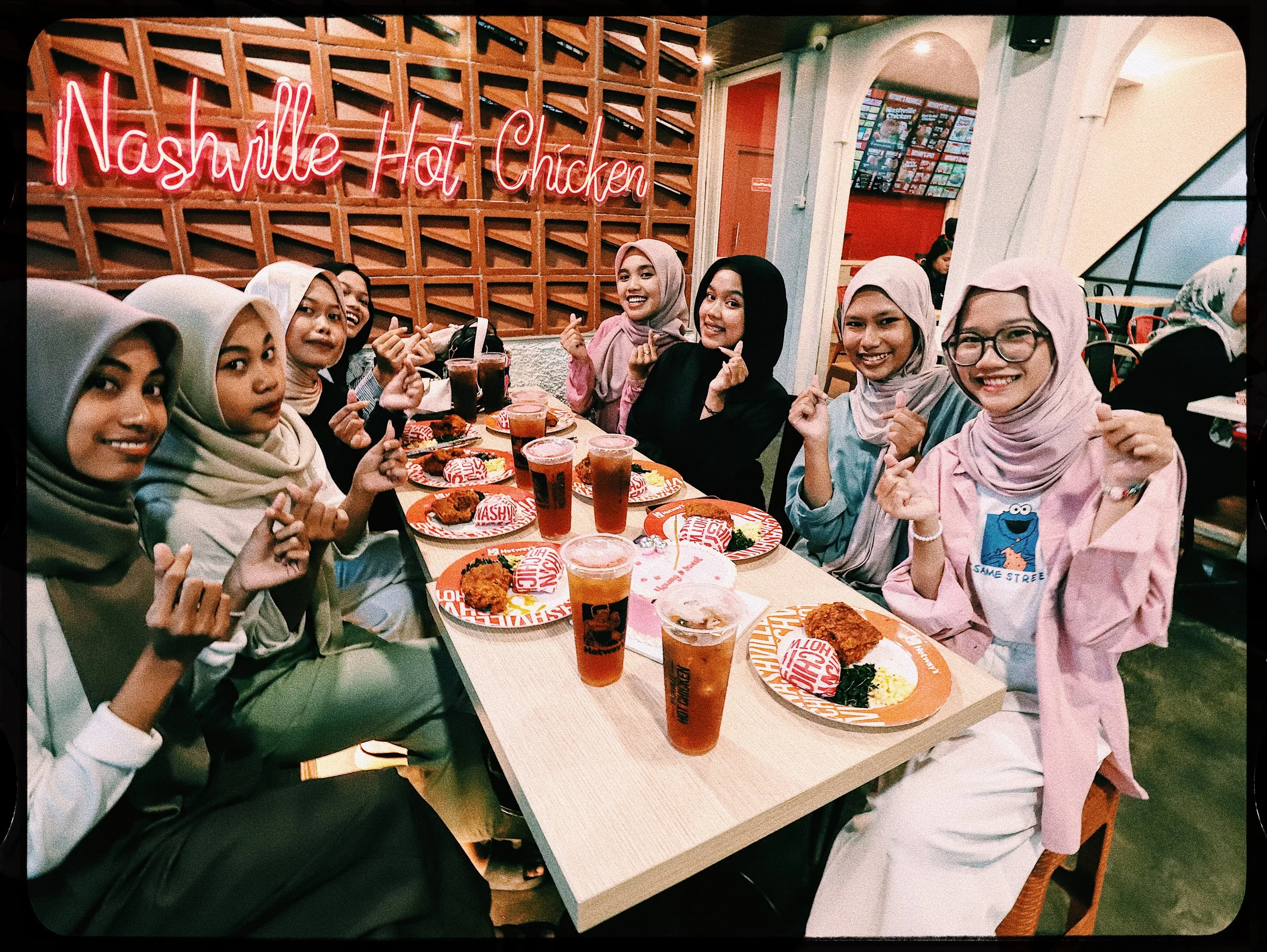
In a Hotways Chicken in the sleepy college town of Yogyakarta, Indonesia, I came across a table of giddy girls apparently celebrating a birthday party (of the young lady at the far right with the Sesame Street t-shirt on). I just had to know, though, why they were throwing up Korean finger hearts, though, and they were more than happy to explain it. Korea has cool authority all across other parts of Asia, and Korean influence has become so ubiquitous that it transcends its owns Korean origins to become a symbol unto itself.
Young Indonesian Muslim women are styling their hijabs in what they call "Korean fashion." The pashmina drapes loosely, effortlessly casual. The colors are sage green, dusty rose, muted cream—that "Korean minimalist" palette. The makeup is full K-beauty: glass skin, gradient lips, flat natural eyebrows. The whole aesthetic screams Korean influence.
Here's the thing: most of it isn't Korean.
The draping technique? That's Turkish şal hijab, sold internationally since the 1990s. The styling preference for loose pashmina? Malaysian, adopted through shared Malay-language media. The muted color palette? A global trend from 2020-2021 that Pinterest and Etsy documented hitting worldwide. Only the makeup is genuinely Korean innovation.
So why does everyone—Indonesian fashion media, boutique chains, beauty brands, the women themselves—call it "Korean style"?
Because this is how Korean soft power actually works in the 21st century. Korea doesn't just export BTS and Blackpink and K-dramas. Korea has become the cultural authority that determines what counts as "modern," "cool," and "fashionable" globally. When Indonesian women assemble aesthetics from Turkish, Malaysian, and global sources, they understand it through a Korean lens—because Korea is the reference point that makes the mix legible as contemporary and desirable.
This isn't Korea losing cultural credit. This is Korea winning at a whole different level.
How I completely missed what I was looking at
I know this phenomenon intimately because I photographed it for over a year without recognizing what I was seeing. Young women at a Nashville Hot Chicken spot in Yogyakarta, wearing hijab in those soft pastels. I'd filed it under "Indonesian modest fashion" and moved on. I'd shown the photos to colleagues, used them in presentations about Indonesian youth culture. Never saw the Korean aesthetic influence.
Prof. Rania Hafez, Associate Professor of Education and Society at the University of Greenwich, had to point it out. She saw immediately what I'd missed: the specific way these hijabs were being worn represented adaptation to Korean aesthetic norms. Not tight, pinned-back traditional jilbab. This was hijab pashmina—loose, effortlessly draped, echoing Korean fashion's signature relaxed elegance. The colors: Korean palette. The makeup: that dewy K-beauty look.
I had completely missed the most significant fashion phenomenon in my own photographs. And I've been documenting Korean cultural transmission through fashion for seventeen years. I've photographed Seoul Fashion Week since 2008. I literally teach visual methodology.
This is the point: Korean aesthetic influence has become so naturalized in Indonesian youth culture that even a researcher like me studying Korean cultural transmission was able to look directly at it and not recognize it.
The phenomenon has a name (sort of)
Once Prof. Hafez pointed out the Korean aesthetic influence, I went searching. The term "Korean Waved Hijab" appears in academic journals—research published in Teosofia: Indonesian Journal of Islamic Mysticism specifically examines "Questioning the 'Korean Waved' Hijab Style in Indonesia," documenting how Hallyu has "cultivated" contemporary hijab style.
Finding this academic terminology made it seem like an established concept. But as I'd discover through deeper research, the term "Korean Waved Hijab" appears in exactly one academic paper. Indonesian women themselves don't actually use it—they say gaya hijab Korea (Korean hijab style) or hijab ala Korea, but there's no single dominant term. More revealing: when describing the actual draping technique, they use terms like pashmina simple, pashmina flowy, or clean look—aesthetic descriptors, not cultural origin labels.
And here's the kicker: Korea has no indigenous hijab fashion tradition to export. Korea's Muslim population is tiny—less than 0.4% of the total population, mostly foreign workers. Korean modest fashion initiatives like Leesle Hanbok's hijab-fusion designs were created specifically to target Muslim tourists. The designer explicitly stated: "Muslim fashion remains unfamiliar in Korea."
So where IS this actually coming from?
Indonesian fashion media uses terms like gaya hijab Korea extensively. TikTok has 1.4 million posts for "Inspirasi Outfit Hijab Rok Korean Style" alone. Maybelline Indonesia creates tutorial series on "Make Up Korean Look Hijab yang Fresh dan Tahan Lama." This isn't a fringe trend—approximately 75% of Indonesian Muslim women now approach hijab as fashion rather than just religious obligation, driven by the Hijabers Community movement that transformed modest dress from religious marker to fashion category.
That 75% figure represents a stunning sociological shift. In 1998, only about 5% of Indonesian Muslim women wore hijab. The explosion from 5% to 75% over roughly 25 years happened because of post-Suharto democratization (the 1998 Reformasi ended 32 years of authoritarian rule that had actually banned hijab as subversive), a global Islamic revival that began in the 1980s-90s, and crucially, 443 sharia-based local regulations (Perda Syariah) issued after 1998 that often prescribed hijab wearing. Politicians courted Islamic groups for electoral support by enacting hijab requirements for female civil servants and students.
But here's where it gets interesting. Young educated urban women saw veiling as a way to be simultaneously modern AND Islamic—participating in global modernity without adopting "consumerist Western lifestyles." For many, wearing hijab was actually an act of self-determination, not submission.
The turn to fashionable hijab wasn't just about consumer choice, though. Watch how Indonesian women actually practice hijab styling: they cultivate competency through repeated practice, bodily discipline, careful attention to draping and color combinations. Anthropologist Saba Mahmood called this "pious agency"—the idea that religious women exercise agency not just by resisting norms, but by cultivating ethical dispositions through embodied practice. Learning to embody pious femininity through how you drape fabric, apply makeup, carry yourself in public.
This matters for understanding how Korean aesthetics enter the picture. Indonesian women cultivated competency in hijab styling the same way they cultivate competency in prayer or modesty—through embodied practice. Korean aesthetic frameworks provided new techniques for this cultivation, enabling women to fashion themselves as both pious AND modern through how they perform femininity with their bodies, not just what they believe intellectually.
Korean aesthetic influence didn't create Indonesian hijab adoption—that was driven by democratization, Islamic revival, and local politics. But Korean style fundamentally shaped HOW that adoption manifests. The Hijabers Community (founded 2010) created the infrastructure—fashion shows, Instagram tutorials, boutique chains—that made hijab a fashion category. Hallyu's acceleration in Indonesia after 2017 provided the aesthetic vocabulary for what fashionable hijab could look like.
The shift centers on hijab pashmina versus traditional jilbab. Pashmina is a long rectangular scarf—typically chiffon or other lightweight fabric—that can be draped loosely around the head and shoulders. Unlike jilbab, which is often sewn into a cap shape and wrapped tightly, pashmina allows what Indonesian fashion discourse calls a meleyot (flowing) effect. The draping is studied casual—effortless-looking but carefully constructed.
That's the exact aesthetic philosophy that makes Korean fashion Korean. The pashmina enabled Korean-style hijab the way high-waisted jeans enabled Korean-style streetwear—it provided the material infrastructure for a Korean aesthetic to be performed.
The colors shifted to match: sage green (hijau sage), dusty rose (pink dusty), milk chocolate brown (cokelat susu), cream (krem). Jakarta boutiques market this explicitly as "Korean minimalist." And the makeup: glass skin (kulit glowing), gradient lips (bibir ombre), flat natural eyebrows (alis rata). The goal is appearing seolah-olah baru bangun tidur—as if you just woke up looking this good.
Korean beauty standards, adapted for women whose hair no one sees.
Why this matters more than you think
If you're reading this because you're interested in Korean pop culture, here's why this Indonesian hijab story is actually about something bigger than modest fashion:
Korean cultural influence has become so powerful that "Korean" is now the default label for "modern and cool"—even when the actual content came from somewhere else. This isn't a weakness. This is cultural power operating at maximum efficiency.
Think about what this means: Korea doesn't need to invent every trend. Korea has become the cultural authority that VALIDATES trends, that makes aesthetic assemblages legible as contemporary and desirable. When Indonesian women take Turkish draping, Malaysian styling, and global color palettes and call the result "Korean," they're recognizing Korea's role as the curator who makes the mix make sense.
This is more impressive—and more durable—than simple content export. BTS and Blackpink spread Korean music. K-dramas spread Korean storytelling. But what's happening in Indonesia shows Korean soft power operating at a different level entirely: Korea has become the reference point that determines what global modernity looks like.
That's not something most countries achieve. Ever.
This Isn't Government “Soft Power”—And That's Why It Works
Here's what the Korean government doesn't understand about what's actually happening:
The Korean government has NO policy targeting Indonesian Muslim fashion. Zero government programs. No state-funded initiatives for hijab aesthetics. No diplomatic strategy for Indonesia's US$20 billion modest fashion market. Korea's 0.4% Muslim population means there's no domestic expertise to export even if they wanted to.
Yet the "Korean Waved Hijab" happened anyway.
This proves something crucial: What's operating here isn't Joseph Nye's "soft power"—which is essentially a government policy tool, cultural imperialism with better PR. What's actually happening is organic cultural authority emerging from Korean creative industries, not government planning.
The difference matters:
Nye-style soft power (what the Korean government thinks they're doing):
Top-down: Government shapes culture to serve foreign policy goals
Instrumental: Culture as tool for national interest
One-directional: "We make content, you consume it"
Coercive (softly): "Our values are better, adopt them"
Examples: Voice of America, Confucius Institutes, Alliance Française
What's actually happening in Indonesia:
Bottom-up: Creative industries respond to markets and audiences
Non-instrumental: Korean companies aren't trying to spread Korean values
Collaborative: Local actors use Korean frameworks creatively for their own purposes
Enabling: "Here are aesthetic tools, use them however serves you"
Nobody directed this - it emerged organically from cultural exchange
This is why it works. Indonesian Muslim women aren't being told to adopt Korean culture. They're choosing to use Korean aesthetic frameworks because those frameworks solve a LOCAL problem: how to be modern AND Islamic without defaulting to Western modernity.
Korean dramas, K-pop, K-beauty aren't government propaganda—they're commercial entertainment and products that happen to provide frameworks for "Asian modernity" that people across Asia find useful. Seoul Fashion Week evolved from street culture and independent designers, not state planning. Korean beauty innovations came from entrepreneurial companies competing in global markets, not cultural policy bureaus.
The Indonesian hijab proves the mechanism:
No Korean government agency planned this
No cultural diplomacy initiative targeted it
Most Korean policymakers probably don't even know it exists
It happened because Indonesian women found Korean aesthetics USEFUL for their own purposes
They assembled Turkish techniques + Malaysian styling + global trends under Korean branding
They exercised sophisticated cultural agency, not passive consumption
This is the opposite of cultural imperialism. Cultural imperialism erases local agency and imposes foreign values. What's happening here ENABLES local agency by providing frameworks Indonesian women use to navigate their own cultural negotiations.
The research proves Korean popular culture has massive global influence—but not in the way the government thinks. The influence isn't top-down cultural policy. It's organic cultural authority that emerged because Korean creative industries produced frameworks that help people across Asia be modern on their own terms, not Western terms.
That's more powerful than any government soft power program could achieve. And it only works BECAUSE it's not government-directed.
The Turkish and Malaysian origin story nobody mentions
The loose pashmina draping that Indonesians call "Korean style"? That's Turkish şal (shawl) hijab, documented in Turkish fashion since the 1990s. Major Turkish brands like Armine (founded 1994), Tuğba (1993), and Secil (40+ years) have been selling exactly this style—long rectangular scarves allowing versatile draping—internationally for decades. Modanisa, the world's largest modest fashion e-retailer (launched 2011), brought Turkish hijab fashion directly to Jakarta Modest Fashion Week in 2018.
Malaysian influence is even more direct. Malaysian women have preferred pashmina-style loose draping since the 1970s-90s, while Indonesian women traditionally favored square hijabs (segi empat). The shift to pashmina in Indonesia represents Malaysian adoption through shared Malay-language media and direct brand presence—Duck Scarves, Naelofar, and other Malaysian brands have official Indonesian distribution.
The muted color palette everyone associates with "Korean minimalism"? That's a global trend from 2020-2021. Pinterest reported a 105% year-over-year increase in UK searches for sage green in 2020. Etsy documented 271% increase in sage green searches in 2021, calling it "the new millennial gray." This wasn't Korean innovation—it was a worldwide reaction to maximalism that hit Indonesian modest fashion at the same moment it hit everywhere else.
Only the makeup is genuinely Korean
K-beauty is the one authentically Korean element in this mix. Glass skin originated in South Korea, going viral globally in 2018. Gradient lips exploded after Girls' Generation used the look in their 2012 "I Got A Boy" video. These are real Korean beauty innovations that spread worldwide—including to Indonesian hijabis who adopted them as part of Indonesia's broader Hallyu enthusiasm.
But K-beauty's adoption in Indonesia isn't hijab-specific. It's a nationwide phenomenon driven by K-pop and K-dramas, with brands like Somethinc partnering with Korean celebrities and the Korean government hosting "Korean Makeup Look Tips for Hijab Women" events. Indonesian hijabis participate in a general K-beauty trend, not a hijab-specific Korean aesthetic.
This is what winning looks like
This is exactly the pattern I've documented elsewhere: Korean cultural authority becomes so dominant that people label things "Korean" even when they're not. Vietnamese consumers systematically identify American hip-hop aesthetics as "Korean." Spaces filled with American vintage Americana get coded as "Korean café culture."
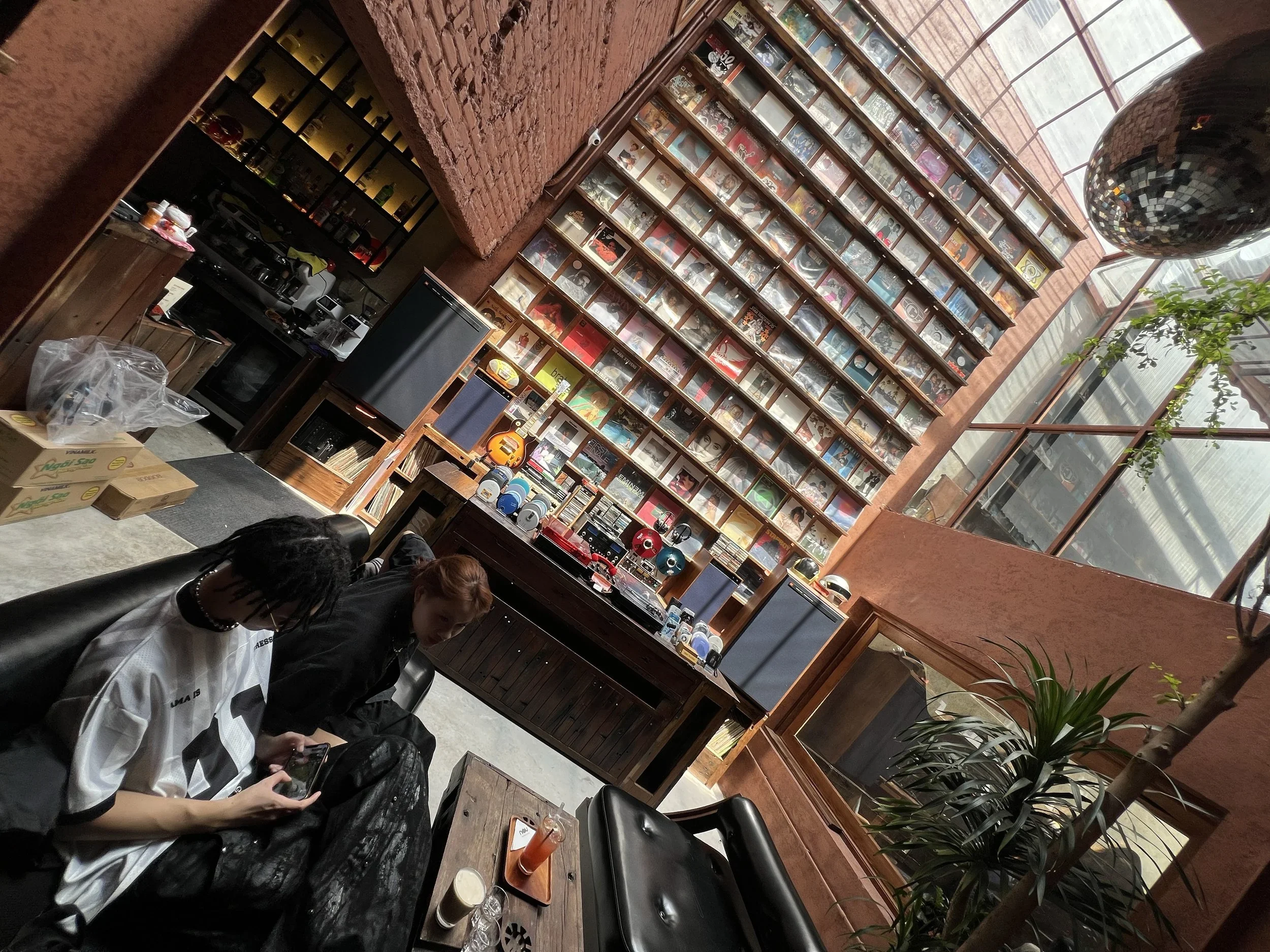
A “Korean” cafe in Hanoi — the Nậu Cafe & Cassette Workshop (@naucassette.cafe), which is filled with vinyl records, retro/old audio equipment, and other pieces of Americana aesthetics — which also maps onto a notion of “Korean” style for many of the customers there.
Korea doesn't export culture—it exports cultural authority. And that's actually MORE powerful than exporting content.
Content is fragile. Trends change. Songs get old. But AUTHORITY is durable. Once you become the reference point for "what's cool," you don't need to create every trend—you just need to be the framework through which people understand trends. The timing proves this: Turkish and Malaysian modest fashion influenced Indonesia since the 1990s, while K-wave penetration accelerated after 2017. The loose, simple draping Indonesian women now call "Korean" predates Korean cultural dominance in Indonesia by decades. What changed wasn't the practice—it was the branding authority.
What Prof. Hafez observed wasn't wrong—there IS a Korean aesthetic sensibility at play. But it operates as branding authority rather than content origin. Indonesian women took Turkish draping techniques, Malaysian styling preferences, global color trends, and genuinely Korean makeup, then assembled it all under Korean branding because Korea represents what's cool, modern, and aspirational.
This is Cultural DJ work, not cultural export, or even “appropriation.” Korea functions as the curator who makes the mix legible as "modern" and "fashionable," not the originator of the content. Like a DJ who doesn't create original music but has the authority to decide what sounds good together, Korea became the reference point that legitimizes this aesthetic assemblage.
And here's why that's more impressive than simple content export: DJs with real authority outlast any single song. Korean dramas will eventually face competition. K-pop groups will evolve. But if Korea remains the cultural authority that determines what "modern Asian fashion" means? That's generational influence.
Here's where it gets interesting. The "Korean Waved Hijab" didn't spread through conscious learning or deliberate cultural export. Nobody taught Indonesian Muslim women how to Koreanize their hijab. They figured it out themselves by watching K-dramas and following Korean influencers.
Scholar Imron Rosidi calls this "symbolic distancing"—selectively appropriating Korean aesthetics while maintaining Islamic values. Accept the color palette, the makeup philosophy, the relaxed draping. Contest the bare shoulders, the short skirts. Transform crop tops into turtlenecks but keep the oversized cardigan layering. Same aesthetic logic, different modesty parameters.
The mechanism is kinesthetic empathy—bodies learning aesthetic competencies through visual exposure. Indonesian women watched Korean actresses in Crash Landing on You and Queen of Tears, absorbed the color palettes and layering techniques, then translated those principles into hijab-compatible forms. The transmission happened below conscious articulation, operating as what Mahmood calls ethical self-cultivation through embodied practice. Just as pious women learn modesty through repeated bodily performance rather than intellectual study, Indonesian hijabis learned Korean aesthetic sensibility through embodied observation, not conscious instruction.
Three channels enabled this: Korean Muslim convert influencers (particularly Ayana Jihye Moon with her 4 million mostly-Indonesian followers), K-drama fashion recreation content on TikTok and Instagram, and K-pop fan communities. Research published in Hyphen magazine documents that K-pop's appeal among Indonesian Muslim fans stems partly from its relative conservatism compared to Western pop culture—Korean idols "aren't drinking or smoking or touching people of the opposite gender." Scholars have analyzed how "Bearded Oppa and Veiled Eonnie" represent this halalized appropriation of Korean pop culture within Indonesian Muslim contexts.
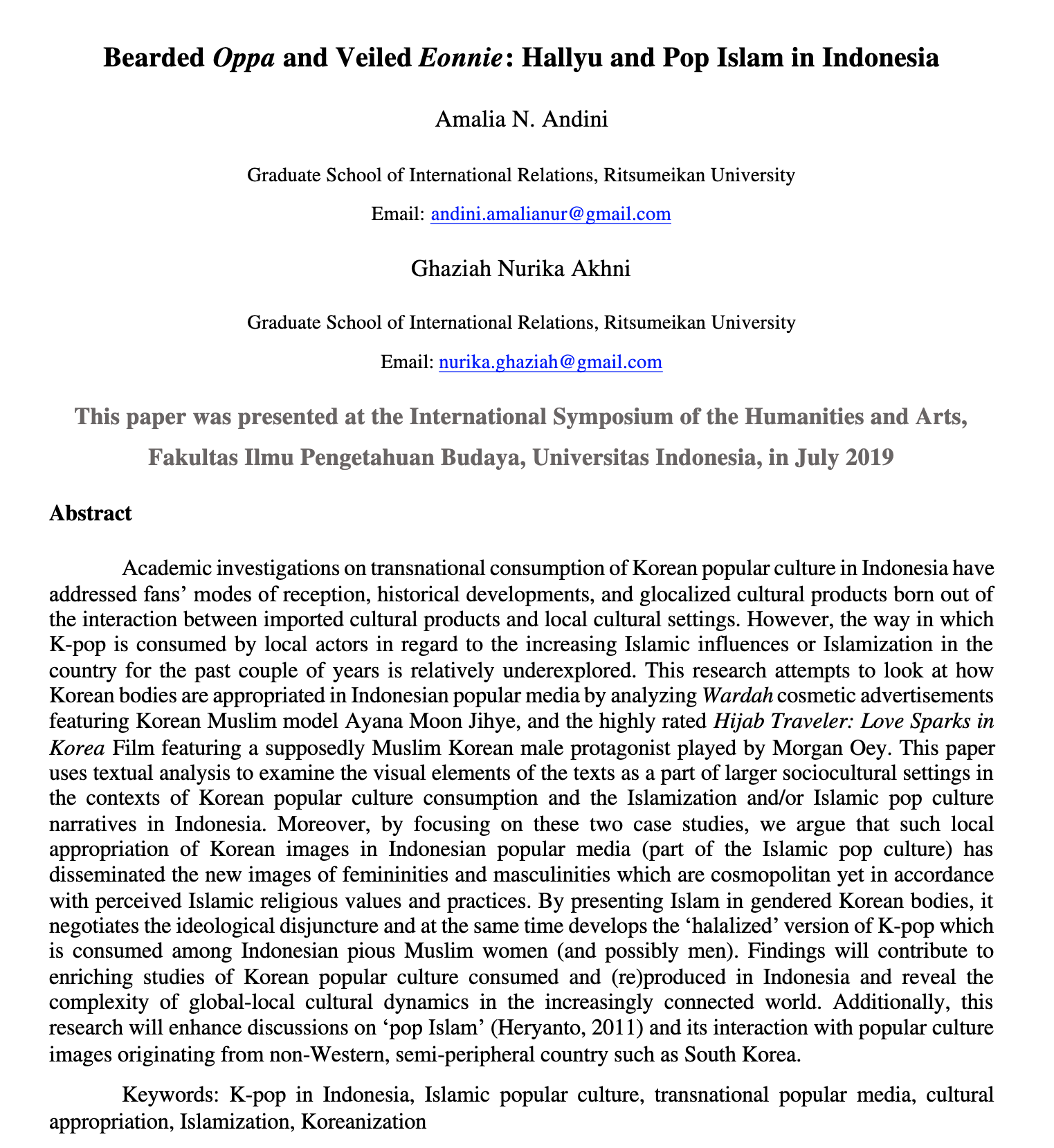
There’s been quite a bit of work on this subject as it’s one of the most fascinating corners of hallyu — how hallyu consumers localize Korean things according to their needs — not the unilateral, uncritical adoption of Korean stuff for its own sake that the “soft power” narrative would have people believe.
What Indonesian Muslim women created is genuinely hybrid—but the hybridity isn't Korean+Islamic. It's Turkish+Malaysian+Global+Korean beauty, all assembled under Korean cultural branding.
The old way to analyze this would be Homi Bhabha's "third space" theory—the idea that when cultures meet, they create hybrid forms that belong to both and neither, existing in some in-between zone. That framework made sense in the 1990s when scholars were trying to show that postcolonial subjects weren't just passive recipients of Western culture.
But "third space" doesn't explain what's happening here. Indonesian women aren't creating something "between" Korean and Islamic culture. They're not mixing two cultures in equal parts. And crucially, they're not creating a third space between the metropole (the West) and the periphery (Indonesia).
This is periphery-to-periphery cultural transmission. Korea isn't the West. Korea isn't the metropole. Korea is another Asian nation, another part of the global periphery that experienced Japanese colonization (1910-1945) and decades of American influence during and after the Korean War. Yet Korea has achieved cultural authority within other peripheral spaces—Indonesia, Vietnam, across Southeast Asia—though how that authority operates varies significantly according to local contexts and needs.
That breaks the entire conceptual framework of postcolonial theory. Bhabha's third space assumed the power dynamic was always metropole/periphery, West/non-West. It didn't account for the possibility that one peripheral nation could become the cultural reference point for other peripheral nations WITHOUT becoming the metropole itself.
This is Cultural DJ work: Korea functions as the curator who makes the mix legible as "modern" and "fashionable," not the originator of the content. The DJ doesn't create the music, but has the authority to decide what sounds good together.
And here's what makes this historically unprecedented: Korea proved you don't need to be the West to have cultural authority. Another peripheral nation can become the reference point for what modernity looks like—not by imitating the West, but by providing an alternative Asian modernity that other Asian nations find more relevant than Western models. That's a different kind of power than either cultural imperialism (metropole imposing on periphery) or hybridity theory (periphery negotiating with metropole) recognized. This is periphery-to-periphery cultural authority—and it fundamentally rewrites how global cultural power works.
This is how Korean soft power operates at maximum efficiency: getting cultural credit for aesthetic influence when most of the transmitted content came from elsewhere. What Indonesian women absorbed from K-dramas wasn't hijab technique (which doesn't appear in K-dramas). They absorbed an aesthetic sensibility and curatorial authority, then applied it to hijab practices they were learning from Turkish and Malaysian sources.
Indonesian women aren't "wrong" when they call this aesthetic "Korean." They're recognizing something real about how cultural authority operates—Korea's success comes from providing the curatorial framework that makes an aesthetic assemblage legible as "modern" and "desirable," even when Korea didn't originate the content. That's not cultural imperialism. That's voluntary adoption of Korean curatorial authority because Korea represents what "cool" looks like in the global cultural moment.
What researchers miss (twice)
This is why Korean cultural authority is so powerful. When it becomes the default lens for "modern fashion" in Southeast Asia, aesthetics from Turkey, Malaysia, and global trends automatically get rebranded as "Korean." The pashmina hijab doesn't announce itself as Turkish draping understood through Korean filters. It just is Korean—even though most of the technical content came from elsewhere.
That's the ultimate proof of cultural authority: when it becomes so naturalized that people no longer think about it. Indonesian women aren't consciously thinking "I'm using Korean frameworks to understand Turkish techniques." They're just styling their hijab in what feels like the modern, fashionable way—and that way happens to be coded as Korean.
The US$20 billion proof of concept
Want to see Korean cultural authority operating in commercial reality? Indonesia's Muslim fashion market is valued at approximately US$20 billion with 18.2% annual growth. Indonesia now ranks #1 globally in modest fashion. And Korean branding is reshaping that entire market—regardless of where the actual fashion techniques originated.
Jakarta boutiques specifically market gaya hijab Korea. Wardah cosmetics hires Korean Muslim converts like Ayana Moon as ambassadors. The terminology has stabilized: Hijab pashmina is a product category. Korean minimalist is a recognized color palette. Glass skin appears on Indonesian skincare packaging.
Here's the commercial reality: "Korean minimalist" sells. "Turkish-Malaysian draping with global color trends" doesn't. The fashion industry reinforces the Korean attribution not despite its inaccuracy, but BECAUSE Korean branding provides commercial leverage that accurately crediting multi-origin sources wouldn't.
This is Cultural DJ Theory operating in commercial space with real money at stake: Korea gets the branding credit (and economic benefit through beauty exports), Indonesian women get access to modern fashion legitimacy, Turkish and Malaysian industries get market share without visibility, and global color trends get locally adopted under Korean labeling. Everyone wins. And Korea's cultural authority is what makes the whole system work.
The market has validated what the phenomenon reveals: Korean cultural influence doesn't need to be about Korean content. It needs to be about Korean authority. And in a US$20 billion market, that authority is worth real money.
Theory doesn't save you from ignorance (but it helps you recognize it faster)
All my theoretical sophistication about embodied cultural transmission and kinesthetic empathy meant nothing when confronted with actual cultural transmission I lacked the competency to recognize. Theory and methodology don't save you from cultural blindness—you need someone with insider knowledge to see what you're missing.
But theory DID help me recognize I needed to verify my assumptions. The "Korean Waved Hijab" seemed too neat, too straightforward. Korea exporting hijab aesthetics to Indonesia? That didn't fit with Korea's tiny Muslim population or lack of indigenous modest fashion tradition. That theoretical discomfort pushed me to do the verification research that revealed the Cultural DJ dynamic.
K-pop is the DJ (and so is everything else Korean)
Here's the meta-example that makes Cultural DJ Theory click: K-pop itself operates the same way.
There's a simplistic argument circulating that K-pop is "just repackaged Black culture" or cultural appropriation of R&B and hip-hop. But that fundamentally misunderstands how K-pop works—and proves why Cultural DJ Theory matters.
K-pop doesn't claim to have invented R&B, hip-hop, or EDM. K-pop groups explicitly credit their musical influences. What K-pop does is CURATE—assemble elements from R&B, hip-hop, pop, EDM, rock, sometimes traditional Korean elements, all executed with distinctly Korean production values, choreography, training systems, and visual aesthetics. The power isn't in originating the constituent parts. The power is in the curatorial authority to assemble them into something that global audiences recognize as distinctly "K-pop."
This is exactly what's happening with the Indonesian hijab. Indonesian women aren't claiming Korea invented hijab. They're using Korean curatorial frameworks to assemble Turkish draping + Malaysian styling + global trends into something they understand as modern modest fashion. Just like K-pop fans aren't confused about where hip-hop came from—they're appreciating Korean curatorial execution of global musical elements.
The cultural appropriation critique of K-pop makes the same error as assuming "Korean Waved Hijab" means Korea invented hijab styling. Both miss that Korea's cultural power operates as curatorial authority, not content origination.
And here's why this matters: Korean creative industries have figured out something that government soft power programs never understand. You don't need to originate content to have cultural authority. You need to be really good at CURATION—assembling, refining, executing global elements in ways that create new value. K-pop does it with music. Korean fashion does it with global streetwear trends. K-beauty does it with skincare ingredients from multiple countries. And Indonesian Muslim women are doing it with hijab styling.
The takeaway: Korean cultural influence is real, massive, and operating across multiple domains—music, fashion, beauty, now modest fashion. But it's not about Korean content export or government soft power. It's about Korean curatorial authority that emerged organically from creative industries operating in global markets.
That's more sophisticated than cultural imperialism. That's more durable than government soft power programs. And that's why Korean influence keeps expanding in spaces (like Indonesia's US$20 billion modest fashion market) that government cultural policy doesn't even know exist.
The photo doesn't change. But once you understand what you're looking at—Korean curatorial authority operating the same way across K-pop, fashion, beauty, and hijab styling—everything in the frame becomes different.
Prof. Rania Hafez is Associate Professor of Education and Society at the University of Greenwich, where she serves as Programme Leader of the MA Education. She founded 'Muslim Women in Education,' a professional network for educationalists and researchers, and is a regular political and cultural commentator whose media credits include the BBC, Channel 4, Levant TV, and the Islam Channel. Her research focuses on professionalism, cultural identity, and Islam and education.
The Indonesia and Vietnam photos discussed in this article are part of ongoing comparative research on Korean cultural transmission across Southeast Asia, documented in the author's field notes from July 2024.